Free original lessons
Whimsical Flowers: Curled Stems and Stylized Petals
Learn to draw playful, non-realistic flowers using curled stems, bell blooms, and fan petals with clear construction steps and a simple rubric.
Free lesson
Four exercises
Worked answers
Object Drawing Lessons
Whimsical flower drawing is about invention, not botanical accuracy. You will build three archetypes from simple construction lines: a spiral curled stem, a bell-shaped stylized bloom, and a fan-petal burst. Each uses a defined convention so your results are checkable while still allowing personal style. Work lightly in pencil first, then darken chosen lines. Use centimeters for stem length, bloom width, and petal length so proportions are easy to compare. The goal is a clear, expressive flower shape that reads instantly as whimsical.
Practice materials: Printable downloads are not available for this lesson yet. Use the instructions and four exercises below.
Reference illustration
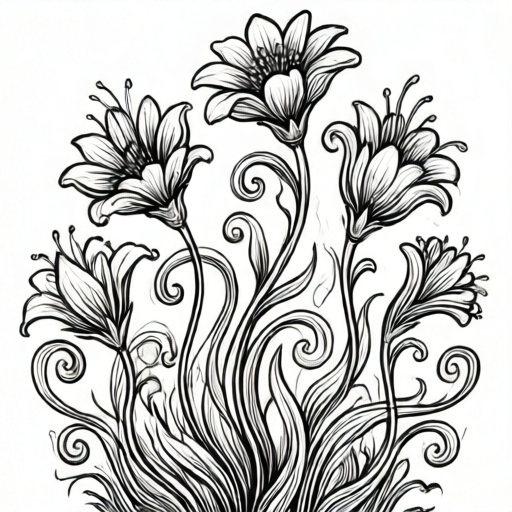
Use the stated measurements and conventions for each exercise.
Construction Convention and Setup
Use a light pencil for construction lines and a darker pencil for final lines. Define a stem as a curved path from soil point to bloom center. A curl is a spiral of at least one full turn with decreasing radius. Petal conventions differ by archetype: for the spiral-stem radial bloom, petals are separate closed shapes whose narrow bases sit at or near the bloom center and whose tips point outward, with small gaps between adjacent petal bases and sides so petals do not touch or overlap; for the fan-petal archetype, each petal is a separate closed fan shape whose narrow base sits at the bloom center and whose tip points outward, with small gaps between adjacent petals; for the bell archetype, the stylized petals are three scallop arcs forming the scalloped bottom edge of the closed bell outline. Stylized petals may be pointed, rounded, or fan-shaped.
Set a working scale: for example, stem length 12 cm, bloom width 5 cm, petal length 3 cm. These are hypothetical examples, not standards. Measure your own paper and adjust so the flower fits your practice box. Keep all measurements in centimeters so proportions are easy to compare.
- Mark a soil point and a bloom center 12 cm apart.
- Draw a light curved stem path between them.
- Add one spiral curl near the middle of the stem.
- Draw the bloom outline around the bloom center.
- Add petals as separate closed shapes.
- Darken final lines and erase construction marks.
Archetype One: Spiral Curled Stem
The spiral curl is the signature whimsical element. Draw the stem as a gentle S-curve, then replace a middle segment with a spiral. The spiral should have at least one full turn and a decreasing radius so it reads as a curl, not a circle. Keep the stem line continuous into the spiral.
Attach a simple five-petal bloom at the top. Petals may be rounded or pointed, but each petal is a closed shape whose narrow base sits at or near the bloom center and whose tip points outward, with small gaps between adjacent petal bases and sides so they do not touch or overlap. For this radial bloom, leave small gaps between petals to keep the stylized look; the bell archetype instead uses a continuous scalloped edge.
- Draw the S-curve stem lightly.
- Mark the curl start and end points on the stem.
- Draw a spiral with one full turn between those points.
- Add five petals around the bloom center.
- Check that the spiral radius decreases by about half from start to end.
Archetype Two: Bell-Shaped Stylized Bloom
A bell bloom hangs from a curled stem. Draw the bell as a rounded triangle with a scalloped bottom edge. The bell width at the mouth should be about twice the width at the top. Add a small loop curl at the stem top so the bell appears to hang.
Stylized bell petals are drawn as three scallops along the bottom edge. Each scallop is a shallow arc. Keep the bell outline closed and attach it to the stem with a short neck line.
- Draw a curled stem ending in a small loop.
- Draw the bell outline: narrow top, wide scalloped bottom.
- Add three scallop arcs along the bottom edge.
- Attach the bell to the loop with a short neck line.
- Check bell mouth width is about twice the top width.
Archetype Three: Fan-Petal Burst
The fan-petal burst uses petals that radiate from a center like a fan. Draw a small circle for the center, then add six to eight petals as elongated fan shapes. Petals should be separate closed shapes with pointed or rounded tips. The fan may be symmetrical or slightly tilted for whimsy.
Keep petal length consistent within one flower. If petal length is 3 cm, all petals should be within about 0.5 cm of that length. This makes the stylized shape read as intentional rather than accidental.
- Draw a small center circle.
- Mark six to eight evenly spaced petal directions.
- Draw each petal as a closed fan shape from the center.
- Check petal lengths are within 0.5 cm of each other.
- Add a curled stem below the center.
Worked example
Draw a whimsical flower with a 12 cm stem, one spiral curl, and five rounded petals. Bloom width 5 cm, petal length 3 cm.
Worked answer
A light S-curve stem from soil point to bloom center 12 cm apart, with a spiral curl of one full turn and decreasing radius near the middle. A five-petal bloom of width 5 cm at the top, each petal a closed rounded shape about 3 cm long with its narrow base at or near the bloom center and its tip pointing outward, small gaps between adjacent petal bases and sides, and a short neck line joining bloom to stem. Final lines darkened, construction marks erased.
Four practice exercises
Exercise 1
Draw a spiral curled stem flower with a 10 cm stem and a four-petal bloom. Petal length 2.5 cm. Describe your construction lines and final shape.
Show answer and check
A 10 cm S-curve stem with one full-turn spiral curl of decreasing radius, topped by a four-petal bloom of petal length 2.5 cm, each petal a closed shape with its narrow base at or near the bloom center and its tip pointing outward, with small gaps between adjacent petal bases and sides.
Why: The stem length and petal length are stated, so proportions are checkable. The spiral convention requires one full turn and decreasing radius. Four petals are separate closed shapes.
Check: Measure stem length 10 cm, confirm spiral has one full turn, count four petals, measure each petal about 2.5 cm, and check petals do not overlap.
Exercise 2
Draw a bell-shaped stylized bloom hanging from a curled stem. Bell mouth width 4 cm, top width 2 cm, three scallops. Describe the neck line and scallops.
Show answer and check
A curled stem ending in a small loop, a bell outline with 4 cm mouth and 2 cm top, three shallow scallop arcs along the bottom, and a short neck line connecting bell to loop.
Why: The bell convention requires mouth width about twice top width, three scallops, and a neck line. The loop makes the bell appear to hang.
Check: Measure mouth 4 cm and top 2 cm, count three scallops, and confirm the neck line connects bell to stem loop.
Exercise 3
Draw a fan-petal burst with six petals radiating from a center. Petal length 3 cm, all within 0.5 cm of 3 cm. Add a curled stem below. Describe petal spacing.
Show answer and check
A small center circle with six closed fan-shaped petals about 3 cm long, spaced evenly around the center, and a curled stem below the center.
Why: Six petals are within the allowed six to eight. Petal lengths must be within 0.5 cm of each other. Even spacing supports the fan look.
Check: Measure each petal length and confirm all are between 2.5 cm and 3.5 cm, count six petals, and check spacing is roughly even.
Exercise 4
Invent a fourth whimsical flower using the same principles: one curled stem, one stylized bloom, separate petals. State stem length, bloom width, and petal length, then describe your construction.
Show answer and check
Example: a 14 cm stem with one spiral curl of decreasing radius, a star-shaped bloom of width 6 cm, and seven pointed petals of length 3 cm, each a separate closed shape with its narrow base at or near the bloom center and its tip pointing outward, with small gaps between adjacent petal bases and sides, and a short neck line connecting the bloom to the stem.
Why: The invention must reuse the construction principles: a continuous curled stem with at least one full turn and decreasing radius, a closed bloom outline attached by a neck line, separate petals with small gaps, and consistent centimeter measurements so the result is checkable.
Check: Measure the stem at 14 cm and confirm it is continuous with one full-turn curl of decreasing radius; confirm the bloom outline is closed and joined by a neck line; count seven petals, measure each near 3 cm (within 0.5 cm), and check petals are separate with small gaps; confirm all measurements are in centimeters.
Common mistakes
- Drawing the spiral curl as a closed circle. Keep the spiral open with decreasing radius and at least one full turn.
- Making petals overlap in this task. Leave small gaps between petals; overlap shading is excluded here.
- Using inconsistent petal lengths in one flower. Measure petal length and keep all petals within 0.5 cm of the chosen length.
- Attaching the bloom without a neck or connection line. Add a short neck line so the bloom clearly connects to the stem.
Self-check rubric
- Stem is a continuous curved path from soil point to bloom center.
- Spiral curl has at least one full turn and decreasing radius.
- Bloom is a closed outline attached to the stem with a neck line.
- Radial/fan petals are separate closed shapes with narrow bases at or near the bloom center and tips pointing outward, with small gaps and no overlap; bell petals are three scallop arcs along the closed bell bottom edge.
- Petal lengths are consistent within 0.5 cm.
- Construction lines are light and final lines are darker.
- Overall shape reads as whimsical and non-realistic.
Questions and answers
Do I need botanical accuracy?
No. This task is stylized and non-realistic. Focus on clear construction and expressive shapes.
Can I use different petal shapes?
Yes. Rounded, pointed, and fan shapes are all valid if each petal is a closed shape attached at the bloom center.
How many curls should a stem have?
At least one spiral curl with one full turn is the convention. More curls are allowed if the stem line stays continuous.
What units should I use?
Use centimeters consistently for stem length, bloom width, and petal length so proportions are checkable.