Free original lessons
Realistic Pitbull Drawing: Head and Body Construction
Learn to draw a realistic pitbull using head-shape guides, body-proportion marks, and fur-stroke practice. Build a convincing breed-specific study.
Free lesson
Four exercises
Worked answers
Object Drawing Lessons
This lesson teaches a realistic pitbull study through head and body construction. You will use simple geometric guides to capture the breed's broad skull, short muzzle, muscular neck, deep chest, and compact body. The focus is on proportion and structure, not cartoon stylization or generic dog anatomy. Work on plain paper with a pencil and eraser. All measurements are relative to your own drawing scale; no special tools are required. By the end, you will have a constructed pitbull drawing and a method to check its build.
Practice materials: Printable downloads are not available for this lesson yet. Use the instructions and four exercises below.
Reference illustration
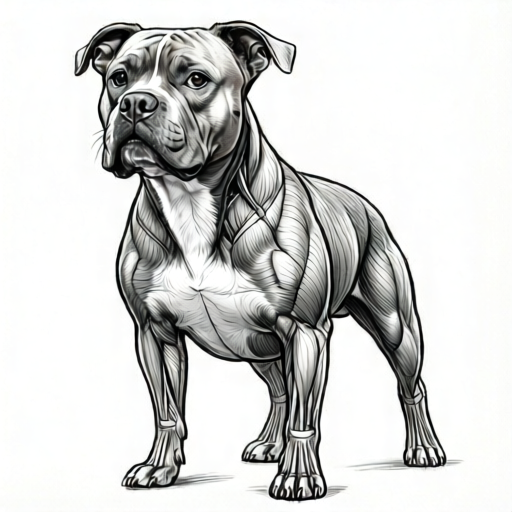
Use the stated measurements and conventions for each exercise.
Head Construction: Broad Skull and Short Muzzle
Begin the head with a horizontal oval for the cranium. Pitbull skulls are broad and slightly flattened on top, so make the oval wider than a typical dog's. Draw a vertical centerline and a horizontal midline. The eyes sit just above the midline, spaced widely apart. The muzzle is short and blocky: draw a rounded rectangle extending forward from the lower half of the oval. Its width should be about two-thirds the width of the cranium. The stop, where the muzzle meets the forehead, is moderate, not steep.
Add the jaw as a slightly narrower rectangle beneath the muzzle. The nose is a broad, rounded triangle at the front of the muzzle. Ears are set high and wide; draw them as small, folded triangles or rose shapes depending on the pose. Keep the cheeks full and rounded, blending into a strong neck. Use light construction lines first, then refine the outline.
- Draw a wide horizontal oval for the cranium; mark the vertical centerline and horizontal midline.
- Place two eye ovals just above the midline, spaced about one eye-width apart.
- Attach a rounded rectangle for the muzzle, width about two-thirds of the cranium.
- Add a narrower jaw rectangle below the muzzle and a broad triangular nose at the front.
- Draw ears high and wide as folded triangles; round the cheeks into the neck.
Body Proportions: Neck, Chest, and Compact Build
The pitbull body is muscular and compact. From the head, draw a thick neck that slopes into a deep chest. The chest should be deep (about one head-length unit) and broad enough that the ribcage oval is wider than the neck; compare chest width to cranium width only as a visual check, not a fixed rule. Use a large oval for the ribcage and a smaller oval for the hindquarters, connected by a relatively short back. The topline is level or slightly sloping toward the rear. Legs are sturdy and straight; front legs align under the shoulders, and hind legs are set slightly wider.
Measure proportions with a simple unit: let the head length from nose to back of skull equal one unit. The body from chest to rump is about two units. The chest depth is about one unit. These are hypothetical examples for practice; adjust to your drawing size. Keep the belly line tucked up slightly behind the ribcage. Draw the tail as a short, tapering extension from the rump, not a long plume.
- Draw a thick neck from the head base, sloping into a deep chest oval.
- Add a large ribcage oval and a smaller hindquarter oval, connected by a short back line.
- Mark the chest depth as about one head-length unit; keep the topline level.
- Place front legs under the shoulders and hind legs slightly wider, using straight sturdy lines.
- Add a short tapering tail and a slight belly tuck behind the ribcage.
Fur Strokes and Surface Finish
Pitbull fur is short and smooth. Use short, overlapping strokes that follow the body's form: downward on the neck and chest, backward along the body, and outward on the legs. Vary stroke direction at joints and curves to suggest volume. Avoid long, uniform lines that flatten the shape. For darker areas, layer strokes closer together; for lighter areas, space them apart. Erase construction lines gently before adding final strokes.
Keep the outline clean but not rigid. Soften transitions at the cheeks, shoulders, and haunches. Add subtle shading under the jaw, behind the front legs, and along the belly to anchor the body. The goal is a believable build, not photorealistic texture. Check that fur strokes do not cross major construction lines at sharp angles, which can break the form.
- Erase construction lines lightly, keeping key proportion marks visible.
- Draw short overlapping strokes downward on the neck and chest.
- Follow the body form with backward strokes along the ribcage and hindquarters.
- Layer strokes closer in shadow areas under the jaw and behind legs.
- Soften transitions at cheeks, shoulders, and haunches with light shading.
Worked example
Construct a side-view pitbull head and body using a head length of 4 cm as one unit and a cranium width of 4 cm. State the body length, chest depth, and muzzle width in centimeters.
Worked answer
Body length is about 8 cm (two units), chest depth is about 4 cm (one unit), and muzzle width is about 2.7 cm (two-thirds of the 4 cm cranium width).
Why: The head length from nose to back of skull is 4 cm. The body from chest to rump is two head-length units, so 2 × 4 = 8 cm. Chest depth is one unit, so 4 cm. Muzzle width is two-thirds of the stated cranium width: (2/3) × 4 ≈ 2.7 cm. These values are hypothetical examples for practice and should be scaled to your drawing.
Check: Measure your drawing with a ruler: body length should be about twice the head length, chest depth about equal to head length, and muzzle width about two-thirds of cranium width. If any measure is off by more than 10 percent, adjust the construction lines before finishing.
Four practice exercises
Exercise 1
Using a head length of 5 cm as one unit, calculate the body length and chest depth for a side-view pitbull. Show your arithmetic.
Show answer and check
Body length = 10 cm; chest depth = 5 cm.
Why: Body length is two head-length units: 2 × 5 = 10 cm. Chest depth is one unit: 1 × 5 = 5 cm. These are hypothetical values for practice.
Check: Verify that body length is twice head length and chest depth equals head length. Measure your drawing to confirm within 10 percent.
Exercise 2
A pitbull cranium is 6 cm wide. What is the recommended muzzle width, and how would you check it on your drawing?
Show answer and check
Muzzle width is about 4 cm (two-thirds of 6 cm).
Why: Muzzle width is two-thirds the cranium width: (2/3) × 6 = 4 cm. This is a hypothetical example.
Check: Measure the muzzle at its widest point and compare to the cranium width. The ratio should be about 2:3.
Exercise 3
Describe how to place the eyes and ears on a front-view pitbull head using a cranium oval with a vertical centerline and horizontal midline.
Show answer and check
Place eyes just above the horizontal midline, spaced about one eye-width apart and roughly one eye-width from the outer edges. Set ears high and wide on the upper sides of the oval.
Why: Wide eye spacing and high, wide ear placement reflect the breed's broad skull. The midline and centerline keep the face symmetrical.
Check: Check that the distance between the eyes is about one eye-width and that each eye is about one eye-width from the outer edge. Ears should sit above the midline.
Exercise 4
Explain how to adjust fur strokes for a pitbull's neck and ribcage, and state one check for form.
Show answer and check
Use short overlapping strokes downward on the neck and backward along the ribcage. Check that strokes follow the curve of the body and do not cross construction lines at sharp angles.
Why: Short strokes that follow form suggest smooth, short fur and preserve volume. Sharp crossings can flatten or break the shape.
Check: Look at the drawing from a short distance: the neck and ribcage should read as rounded volumes, not flat patches. Adjust stroke direction where the form looks broken.
Common mistakes
- Making the muzzle long and narrow like a generic dog. Shorten the muzzle to about two-thirds the cranium width and keep it blocky and rounded.
- Drawing a narrow skull and close-set eyes. Widen the cranium oval and space the eyes about one eye-width apart above the midline.
- Using a long back and shallow chest. Shorten the back so the full body from chest to rump is about two head-length units, and deepen the chest to about one unit.
- Applying long, uniform fur strokes that flatten the body. Use short overlapping strokes that follow the form and vary spacing for light and shadow.
Self-check rubric
- Head shows a broad cranium and short, blocky muzzle with a moderate stop.
- Eyes are spaced widely above the midline; ears are set high and wide.
- Neck is thick and blends into a deep chest wider than the head.
- Body is compact: back about two head-length units, chest depth about one unit.
- Legs are sturdy and straight, front under shoulders, hind slightly wider.
- Fur strokes are short, overlapping, and follow the body form.
- Construction lines are erased or faint; outline is clean but not rigid.
- Valid alternative styles are accepted if proportions and breed features remain recognizable.
Questions and answers
Do I need special art supplies?
No. A pencil, eraser, and plain paper are enough. Any available drawing surface works.
How do I know my proportions are correct?
Use the head-length unit: body about two units, chest depth about one unit. Check that the chest is wider than the head and the back is short.
Can I draw a pitbull in a different pose?
Yes. Keep the head-shape and body-proportion guides consistent, then rotate or tilt the construction to match the pose.
What if my fur strokes look messy?
Keep strokes short and follow the body form. Erase construction lines first and layer strokes gradually rather than covering the whole body at once.