Free original lessons
Rock Band Lineup Drawing: Stage Layout and Instrument Placement
Plan and draw a multi-figure rock band with instruments and a clear stage layout using pose boxes, placement guides, and a simple convention for scale.
Free lesson
Four exercises
Worked answers
Object Drawing Lessons
This lesson teaches a repeatable method for drawing a rock band lineup: decide stage zones, assign instruments, block figures with pose boxes, and place instruments so the composition reads clearly. You will use a simple convention for relative size and spacing, then check your drawing with arithmetic and visual tests. The focus is composition and instrument placement, not drum-set hardware construction or crowd scenes.
Practice materials: Printable downloads are not available for this lesson yet. Use the instructions and four exercises below.
Reference illustration
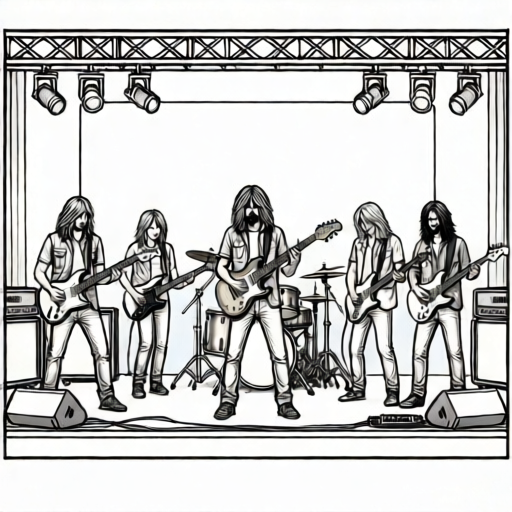
Use the stated measurements and conventions for each exercise.
Stage zones and sightlines
Start by dividing the stage into three depth zones: front (lead singer or guitarist), middle (rhythm section), and back (drummer). Draw a horizontal baseline for the stage edge and a second line for the back wall. Mark left, center, and right positions with small ticks. Keep the tallest standing figures in the middle or back so they do not hide shorter figures in front.
Use a simple scale convention: one head height equals one unit. A standing figure is about seven units tall; a seated drummer is about five units from seat to top of head. Label any numerical values you choose as hypothetical examples, and measure your actual paper or screen to confirm spacing.
- Draw the stage edge and back wall as two horizontal lines.
- Mark three vertical ticks for left, center, and right positions.
- Assign each musician to a zone and write the instrument name above the tick.
- Check that no front figure overlaps more than one-third of a back figure's body.
Pose boxes for multi-figure lineup
A pose box is a rectangle that contains one figure. Draw a box for each musician before adding details. The box width should be about two head heights for a standing player and three head heights for a drummer with a kit. Leave a gap of at least half a head height between boxes so instruments do not collide visually.
Inside each box, sketch a stick figure with shoulders, hips, and a head circle. For guitarists, angle the shoulders slightly and place the instrument across the hips. For the singer, keep the microphone hand near the mouth. For the drummer, show the seated posture and the kit as simple circles and rectangles, not hardware details.
- Draw one pose box per musician using the head-height convention.
- Sketch a stick figure inside each box with head, spine, shoulders, hips, and limbs.
- Add the instrument as a simple shape that fits inside or slightly overlaps the box.
- Erase box edges only after the figure and instrument read clearly.
Instrument placement and visual balance
Place instruments so their long axes follow the figure's body angle. A guitar body sits near the hip and the neck points toward the fretting hand. A bass guitar is longer; allow its neck to extend beyond the pose box by about one head height. Microphone stands should be vertical and placed to the side of the singer's face, not across the mouth.
Balance the composition by alternating tall and short elements. If the drummer is centered at the back, place the guitarist and bassist slightly left and right in the middle zone. The singer can stand front-center or front-left. Check that the total width of all pose boxes plus gaps fits inside the stage width you measured.
- Draw the guitar or bass body at hip height and the neck toward the fretting hand.
- Place the microphone stand beside the singer's face, not in front of it.
- Draw the drummer's kit as a kick drum circle, snare circle, and two cymbal ovals.
- Check that no instrument shape crosses another figure's face.
Checking the lineup with simple arithmetic
Measure your stage width in centimeters or arbitrary units. Add the widths of all pose boxes and the gaps between them. The sum must be less than or equal to the stage width. For example, if the stage is 30 units wide and you have four boxes of 5 units each with three gaps of 2 units, the total is 20 plus 6 equals 26 units, which fits with 4 units to spare.
Use a second check for height: the tallest figure should not exceed the back wall line by more than one head height. If it does, lower the figure or raise the back wall. These checks are simple and repeatable, and they do not require any special equipment.
- Measure stage width and each pose box width.
- Add box widths and gaps; compare with stage width.
- Measure the tallest figure against the back wall line.
- Adjust spacing or figure height until both checks pass.
Worked example
A four-piece band on a stage 30 units wide. Pose boxes: singer 5 units, guitarist 5 units, bassist 5 units, drummer 6 units. Gaps: 2 units each between three pairs. Does the lineup fit?
Worked answer
Yes. Box total is 5+5+5+6=21 units. Gap total is 2+2+2=6 units. Combined total is 27 units, which is less than 30 units, leaving 3 units to spare.
Four practice exercises
Exercise 1
Three-piece band: singer, guitarist, drummer. Stage width 24 units. Boxes: 5, 5, 6 units. Two gaps of 2 units. Does it fit?
Show answer and check
Yes. Box total 16, gap total 4, combined 20, which is less than 24.
Why: Add box widths and gaps, then compare with stage width.
Check: Re-add 5+5+6=16 and 2+2=4; 16+4=20; 20 is less than 24.
Exercise 2
Four-piece band with boxes 5, 5, 5, 6 and three gaps of 3 units on a 30-unit stage. Does it fit?
Show answer and check
Yes. Box total 21, gap total 9, combined 30, which equals the stage width exactly.
Why: The combined total must be less than or equal to stage width.
Check: 21+9=30; 30 equals 30, so it fits with zero spare units.
Exercise 3
A guitarist's pose box is 5 units wide and the bassist's box is 5 units wide. The gap is 1 unit. The guitar neck extends 2 units beyond its box toward the bassist. Does the neck cross into the bassist's box?
Show answer and check
Yes, it crosses 1 unit into the bassist's box because the gap is only 1 unit and the neck extends 2 units.
Why: Compare neck extension with gap width.
Check: 2 units extension minus 1 unit gap equals 1 unit overlap.
Exercise 4
Drummer seated height is 5 head units. Back wall line is 6 head units above the stage edge. The drummer's head top is at 5 units. Is the drummer below the back wall line?
Show answer and check
Yes, the drummer is 1 head unit below the back wall line.
Why: Compare seated height with back wall height.
Check: 6 minus 5 equals 1 unit of clearance.
Common mistakes
- Drawing all figures at the same depth so instruments overlap faces. Assign front, middle, and back zones and keep instrument shapes out of faces.
- Making the drummer the same height as standing players. Use the seated convention: about five head units from seat to top of head.
- Letting guitar necks cross another figure's pose box without a gap. Leave at least half a head height between boxes and angle necks outward.
- Ignoring stage width so the lineup runs off the page. Add box widths and gaps, then compare with measured stage width before inking.
Self-check rubric
- Stage zones are marked and each musician is assigned to a zone.
- Pose boxes are drawn before details and follow the head-height convention.
- Instruments are placed so they do not cover faces and read clearly.
- The arithmetic check for stage width is shown or stated.
- Valid alternatives are accepted: different instrument shapes, left-right ordering, and figure heights are allowed if the checks pass.
Questions and answers
How many musicians should the lineup include?
Three to five is manageable for a single plate. A typical rock band lineup uses singer, guitarist, bassist, and drummer.
Do I need to draw realistic instruments?
No. Simple shapes that read as guitar, bass, microphone, and drum kit are enough for a composition exercise.
What if my figures are different heights?
Use the head-height convention and label your chosen values as hypothetical examples. Measure your actual paper to confirm spacing.
Can I place the singer at the back?
Yes, but check sightlines. A back-zone singer may be hidden by front figures unless you offset positions.