Free original lessons
Drawing a Shrimp: Segmented Body and Curved Tail
Learn to draw a shrimp with clear body segments, a curved abdomen, and a tail fan using a simple construction method and checkable proportions.
Free lesson
Four exercises
Worked answers
Object Drawing Lessons
This lesson teaches a simplified side-view shrimp drawing focused on the cephalothorax, six abdominal segment panels, and tail fan. The panel count follows the six numbered abdominal segments in NOAA's labeled adult white-shrimp side-view diagram; the proportions and curve dimensions below are hypothetical drawing choices, not species standards. Show a central telson and one uropod outline on each side. Use a specimen-specific reference if you need exact anatomy.
Practice materials: Printable downloads are not available for this lesson yet. Use the instructions and four exercises below.
Reference illustration
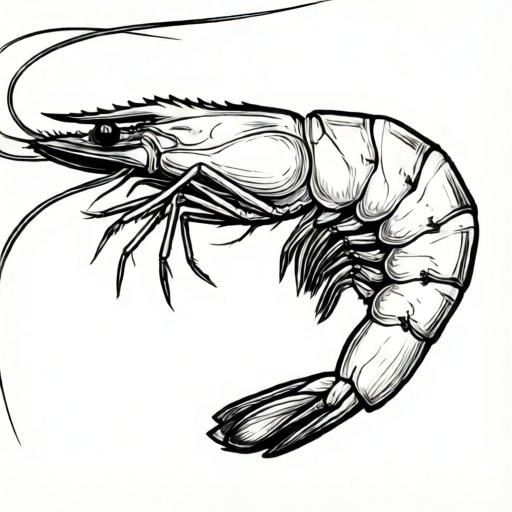
Use the stated measurements and conventions for each exercise.
Body Plan and Segmentation
For this worksheet, draw a simplified shrimp side view with a cephalothorax, six abdominal segment panels, and a tail fan. NOAA's labeled external-anatomy diagram of adult *P. vannamei* numbers the abdominal segments 1 through 6; this page follows that six-panel count. Represent the tail with a central telson and one uropod on each side. All proportions and curve dimensions here are hypothetical drawing choices.
Draw a light curve along the abdomen from the rear edge of the cephalothorax to the tail-fan attachment. Call its measured length L. Mark the start and end of the segment run, then divide the curve length into six equal panels. That requires five internal boundary lines at L/6, 2L/6, 3L/6, 4L/6, and 5L/6; the two endpoint outlines bound the panels and are not extra interior lines. Keep each panel legible. The telson and paired uropods form the tail fan; antenna direction and any overlap are drawing choices.
- Draw a light abdomen curve from the rear of the cephalothorax to the tail-fan attachment and mark both ends of the segment run.
- Draw the cephalothorax as a tapered oval at the front, with a small pointed rostrum at the upper front.
- Add the eye near the rostrum base and two thin antenna curves; keep them clear of the tail.
- Divide the measured segment-run length into six equal panel widths along the curve.
- Add five internal boundary lines at the one-sixth through five-sixths positions; the start and end outlines complete the six panels.
- Draw one central telson and a pair of uropods, one on each side, to form the tail fan.
- Erase construction lines lightly and darken the final contours, keeping the six panels distinct.
Curved Tail Arc and Tail Fan
For this worksheet, draw a smooth abdomen curve and add the six segment panels after the curve is set. Keep the curve shallow or pronounced without doubling back. At its end, draw a central telson and two uropods, one on either side. The last panel may taper as a drawing choice. If checking the curve with a ruler, measure its chord and maximum deviation; an 8 cm chord with a 2 cm deviation is one hypothetical example.
Keep the tail fan compact and aligned with the abdomen curve. The five internal segment-boundary lines can shorten toward the tail if the chosen panels taper; this is a style convention. Use lighter strokes for the internal boundaries and clear outlines for the cephalothorax and tail fan.
- Check the abdomen curve by placing a straight edge along its endpoints; a maximum deviation of one quarter of the chord is one hypothetical drawing choice.
- Draw the final segment panel narrower if desired, then attach a pointed or rounded telson as a drawing choice.
- Add exactly two uropod blades, one on either side of the central telson.
- Keep the antennae clear of the tail fan.
- Add optional light contour accents to the cephalothorax without confusing them with the five internal abdominal boundaries.
- Review the fan for a distinct central telson and paired blades.
Proportions and Checkable Arithmetic
Use simple proportions as a worksheet convention. For a 15 cm side-view drawing, choose a 5 cm cephalothorax and a 10 cm abdomen-plus-fan section; both are hypothetical examples. If 3 cm of that latter length is reserved for the fan attachment, the segment run is 7 cm. Six equal panels then have a pitch of 7÷6≈1.17 cm, with five internal boundaries at about 1.17, 2.33, 3.50, 4.67, and 5.83 cm from the start. The endpoint outlines at 0 and 7 cm bound the six panels. Keep the fan's widest span separate from the abdomen-plus-fan length; a 3 cm fan span on a 15 cm drawing is another hypothetical choice. These proportions are not universal standards.
Check the example with one unit: 5+10=15 cm; 10−3=7 cm of segment run; and 7÷6≈1.17 cm per panel. A separate 9 cm segment run would use a 1.5 cm panel pitch and five internal boundaries at 1.5, 3, 4.5, 6, and 7.5 cm. Measure each length along the chosen curve where applicable, keep the fan span separate, and adjust the drawing to your paper.
- Choose a total body length, such as 15 cm, and mark the cephalothorax as one third and abdomen plus fan as two thirds; label these as hypothetical proportions.
- Choose the length of the six-panel segment run and any remaining fan-attachment portion separately.
- Divide the segment-run length L by 6 to find panel pitch; place five internal boundary lines at the first five multiples of that pitch.
- Measure the tail fan's widest span separately from the body length.
- Record units consistently and adjust the construction before darkening final contours.
Worked example
Draw a side-view shrimp 15 cm long with a 5 cm cephalothorax and a 10 cm abdomen-plus-fan section. Reserve 3 cm for the fan attachment, leaving a 7 cm segment run divided into six equal abdominal panels by five internal boundary lines. Use a 3 cm fan span and state the panel pitch. Treat all measurements as hypothetical.
Worked answer
The cephalothorax is 5 cm and abdomen plus fan is 10 cm. Subtracting the 3 cm fan-attachment portion leaves a 7 cm segment run. Six panels have pitch 7÷6≈1.17 cm; mark five internal boundaries at approximately 1.17, 2.33, 3.50, 4.67, and 5.83 cm from the start, with endpoints at 0 and 7 cm. The fan's widest span is a separate 3 cm example. Draw one central telson and two uropods, one on each side. A 0.75 cm eye and two antennae are optional hypothetical drawing values.
Why: The 7 cm segment run is divided into six panel widths, so the pitch is 7÷6≈1.17 cm. Five interior boundaries separate those six panels; the start and end outlines are the outer boundaries.
Check: Check 5+10=15 cm and 10−3=7 cm. Divide 7 by 6 to confirm a panel pitch of about 1.17 cm, then place five internal lines at the listed multiples. Measure the 3 cm fan span separately and confirm one telson with two uropods.
Four practice exercises
Exercise 1
Draw a shrimp with a 12 cm total body length: cephalothorax 4 cm and abdomen-plus-fan 8 cm. Use a 6 cm segment run and reserve 2 cm for the fan attachment. Divide the segment run into six equal panels with five internal boundary lines. Add a central telson and paired uropods. All measurements are hypothetical. Treat all values as hypothetical drawing dimensions.
Show answer and check
The lengths are 4+8=12 cm, and 8−2=6 cm remains for the segment run. Six panels across 6 cm have a 1 cm pitch. Mark five internal boundaries 1, 2, 3, 4, and 5 cm from the start; the endpoints at 0 and 6 cm bound the six panels. Use a separate hypothetical 2.4 cm fan-span example and a hypothetical 0.6 cm eye if desired. Draw one central telson and two uropods.
Why: Panel count and line count differ: six equal panels require five internal separators, with the start and end contours serving as the outer boundaries. The pitch is 6÷6=1 cm.
Check: Check 4+8=12 and 8−2=6 cm. Divide 6 cm by six panels to get 1 cm each; confirm the five interior marks are at 1, 2, 3, 4, and 5 cm. Measure the fan span separately.
Exercise 2
Draw a shrimp facing left with a pronounced downward abdomen curve. Use a total length of 18 cm, a 6 cm cephalothorax, and a 12 cm abdomen-plus-fan section. Reserve 3.6 cm for the fan attachment; divide the remaining 8.4 cm curve into six equal panels using five internal boundaries. For an 8 cm curve chord, use a 2 cm maximum deviation. Add a telson and two uropods. Treat all values as hypothetical drawing dimensions.
Show answer and check
The body sections total 6+12=18 cm. Subtracting 3.6 cm leaves an 8.4 cm segment run. Six panels have pitch 8.4÷6=1.4 cm; place five internal boundaries at 1.4, 2.8, 4.2, 5.6, and 7.0 cm from the start. The start and end outlines bound the panels. For the curve check, 2÷8=0.25, or one quarter of the chord. Draw one pointed central telson and two uropods; the antennae sweep left, away from the fan.
Why: The 8.4 cm curve length is divided among six panels, giving 1.4 cm per panel; five internal lines create those six panels. The deviation ratio is 2÷8=0.25.
Check: Check 6+12=18 and 12−3.6=8.4 cm. Confirm six 1.4 cm panel widths and five boundaries at the listed positions. Confirm 2÷8=0.25 and the fan has one telson plus two uropods.
Exercise 3
Draw a shrimp with a shallow abdomen curve and compact tail fan. Use a 10 cm total length, with a 3.5 cm cephalothorax and 6.5 cm abdomen-plus-fan section. Use a 4 cm segment run and reserve 2.5 cm for fan attachment. Divide the run into six equal panels with five internal boundaries. Choose a 2 cm fan span, 0.5 cm eye, and 8 cm antennae as hypothetical values. Treat all values as hypothetical drawing dimensions.
Show answer and check
The body sections total 3.5+6.5=10 cm. The segment run is 4 cm, so six panels have pitch 4÷6≈0.67 cm; the five internal boundaries are at approximately 0.67, 1.33, 2.00, 2.67, and 3.33 cm from the start. The fan attachment is 2.5 cm, and the 2 cm fan span is a separate measurement. Draw a 0.5 cm eye and 8 cm antennae as specified, plus one telson and two uropods.
Why: The panel pitch is the 4 cm run divided by six, not by the five interior boundary lines. The 2 cm fan width is not part of the body-length sum.
Check: Check 3.5+6.5=10 cm and 4÷6≈0.67 cm per panel. Confirm five internal boundaries at the listed positions, measure the fan span separately, and count one telson plus two uropods.
Exercise 4
Draw a shrimp with a strong comma-shaped abdomen curve and wide tail fan. Use a 20 cm total length, 7 cm cephalothorax, and 13 cm abdomen-plus-fan section. Set the segment run to 10 cm, leaving 3 cm for the fan attachment. Divide it into six equal panels with five internal boundaries, and use a 4 cm fan span. Add one telson and two uropods. Treat all values as hypothetical drawing dimensions.
Show answer and check
The body sections add to 20 cm, and 13−10=3 cm remains for the fan attachment. Six panels across 10 cm have pitch 10÷6≈1.67 cm. Place five internal boundaries at about 1.67, 3.33, 5.00, 6.67, and 8.33 cm from the start; the endpoints complete the panels. Measure the 4 cm fan span separately. Draw one pointed telson and two uropods. A 1 cm eye and 15 cm antennae are optional hypothetical choices.
Why: Six panels divide the 10 cm segment run into six equal widths; five interior lines separate them. The 4 cm fan span is measured independently from the 3 cm fan-attachment portion.
Check: Check 7+13=20 and 13−10=3 cm. Confirm six panel widths of about 1.67 cm, five internal marks at the listed positions, and a separate 4 cm fan span. Count one telson and two uropods.
Common mistakes
- Drawing the abdomen as a straight line or a series of sharp angles. Draw the smooth central curve first, mark the start and end of the segment run, then add five internal boundaries to form six panels. Check the curve before darkening it.
- Counting six internal boundary lines as six abdominal segments. Draw six segment panels, which require five internal boundaries plus the two end contours; divide the measured run by six to get panel pitch.
- Adding unrelated objects or extra features that hide the segmented shrimp silhouette. Keep the drawing centered on the side-view shrimp, six abdominal panels, and its telson-and-uropod tail fan.
- Letting the antennae cross the tail fan or obscure the segmentation. Sweep the antennae away from the body and keep them thin. Redraw any that cross the fan or hide the panel outlines and internal boundaries.
- Using inconsistent units or unmeasured proportions. Choose one unit, measure your actual paper, and label all numerical values as hypothetical examples. Check the ratios with simple arithmetic.
Self-check rubric
- The shrimp is recognizable in side view with a distinct cephalothorax, curved abdomen, and tail fan.
- The abdomen curve is smooth and continuous, not straight or sharply angled.
- The abdomen has six segment panels separated by five internal boundaries.
- The tail fan is compact and has one central telson with two distinct uropods.
- The antennae are thin, sweep away from the body, and do not obscure the segmentation.
- Proportions are checkable with simple arithmetic and consistent units; numerical values are labeled as hypothetical examples.
- Labels distinguish the six abdominal panels from the five internal boundary lines, central telson, and paired uropods.
- The drawing remains a shrimp side-view construction rather than another crustacean subject or a cooking scene.
Questions and answers
How many abdominal panels should I draw?
This worksheet uses six panels, separated by five internal boundaries, following NOAA's adult *P. vannamei* side-view diagram labeled segments 1 through 6. If you use a different specimen reference, follow its visible segmentation rather than treating this worksheet layout as universal.
Can I draw the shrimp facing the other direction?
Yes. Mirror the side-view construction left to right. Keep the six panels and five internal boundaries in the same order along the abdomen, and keep the telson between the two uropods.
Do I need to draw legs?
Legs are optional in this lesson. If you add them, keep them as short, thin strokes under the thorax so they do not obscure the six panels or five internal boundaries. The focus is segmentation and the curved tail.
How do I check the tail fan without an image?
Measure the fan's widest span separately from the body length. Check that the telson is centered between two distinct uropods and that the abdomen ends in six panels separated by five internal boundary lines.