Free original lessons
Draw an Anchovy: Body Curve and Fin Placement Guide
Learn to draw a small anchovy with a smooth body curve and correctly placed dorsal, pectoral, and anal fins using a simple convention and checkable steps.
Free lesson
Four exercises
Worked answers
Object Drawing Lessons
This guide teaches a repeatable method for drawing a side-view anchovy. You will establish a gentle body curve, mark fin positions relative to that curve, and refine the outline. The convention is explicit: draw a fixed baseline first, then set the midline a chosen distance above it; x-height is that fixed vertical distance from baseline to midline. The body curve is then drawn relative to the fixed midline and must stay within one x-height of it. Letter styles and exact proportions vary, so valid alternatives are accepted when the curve is smooth and fins sit in the marked zones. All measurements are hypothetical examples; measure your own paper and tools.
Practice materials: Printable downloads are not available for this lesson yet. Use the instructions and four exercises below.
Reference illustration
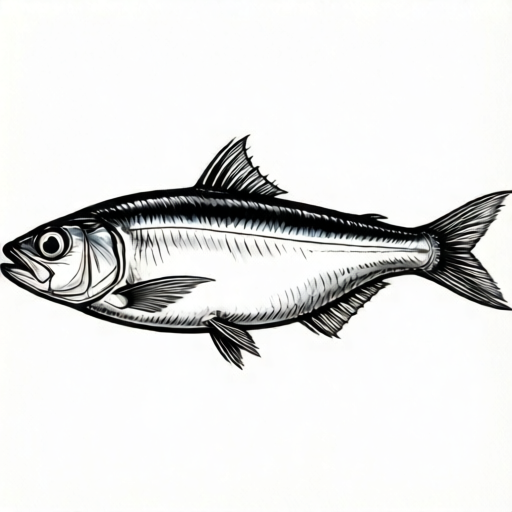
Use the stated measurements and conventions for each exercise.
Set the body curve
Draw a light horizontal baseline first. Set a parallel midline a chosen distance above it; that fixed distance is your x-height. For a small anchovy, choose an x-height of about 2 cm on a 10 cm body length; this is a hypothetical example, not a standard. The baseline and midline are fixed construction references, so the x-height does not change as you draw the body outline.
Mark the nose at the left end of the midline and the tail base at the right. The body curve should bow gently downward from nose to tail base, staying within one fixed x-height of the midline. Avoid sharp kinks; the curve is continuous.
- Draw a 10 cm horizontal baseline and a parallel midline 2 cm above it.
- Mark nose on the midline at 0 cm and tail base at 10 cm.
- Sketch a smooth curve from nose dipping about 1 cm below the midline at the midpoint, then rising to the tail base.
- Check that no point of the curve is more than the fixed x-height (2 cm in this example) from the midline.
Place the dorsal and anal fins
The dorsal fin sits on the back, above the body curve. Place its front edge at about 40 percent of body length from the nose and its rear edge at about 60 percent. The fin height is roughly half the x-height.
The anal fin sits below the body curve, behind the dorsal fin. Place its front edge at about 65 percent of body length and rear edge at about 80 percent. Keep each fin's height to about half the x-height, measured from the body curve outward. The dorsal fin tip is about half an x-height above the body curve; the anal fin tip is about half an x-height below the body curve, so with the curve at most one x-height below the midline the anal fin tip can reach at most 1.5 x-heights below the midline.
- Mark dorsal fin front at 4 cm and rear at 6 cm along the top curve.
- Draw a low triangular dorsal fin rising about 1 cm above the curve.
- Mark anal fin front at 6.5 cm and rear at 8 cm along the bottom curve.
- Draw a similar low triangular anal fin below the curve.
Add pectoral fin and tail
The pectoral fin sits just behind the head, below the midline. Place its base at about 20 percent of body length and about half an x-height below the midline, and angle it backward and downward. Its length is about one x-height.
The tail is forked. Draw two short points from the tail base, each about one x-height long, with a shallow notch between them. Keep the tail symmetrical about the midline.
- Mark pectoral fin base at 2 cm from the nose, 1 cm (half the x-height) below the midline.
- Draw a narrow fin angled back and down, about 2 cm long.
- At the tail base, draw upper and lower tail points each 2 cm long.
- Connect the points with a shallow curve to form the fork.
Refine and check
Erase construction lines lightly. Confirm the body curve is smooth, the dorsal and anal fins are opposite each other in the rear half, and the pectoral fin is behind the head. Use the rubric to accept valid variations in fin shape and curve depth.
If the curve looks too deep, reduce the dip by half. If fins overlap the body outline, shift them outward by 2 mm. These adjustments are hypothetical examples; measure your own drawing.
- Trace the final outline with a darker line.
- Label fin zones lightly and compare to the placement marks.
- Check that the tail fork is symmetrical about the midline.
- Record any changes for a second attempt.
Worked example
Draw an anchovy on a 12 cm body length with an x-height of 2.5 cm. Place the dorsal fin front at 40 percent and rear at 60 percent, the anal fin front at 65 percent and rear at 80 percent, and the pectoral base at 20 percent below the midline. Describe the steps and the final check.
Worked answer
Draw a 12 cm baseline and a midline 2.5 cm above it. Mark nose at 0 cm and tail base at 12 cm. Sketch a smooth curve dipping about 1.2 cm below the midline at the midpoint and rising to the tail base. Mark dorsal fin front at 4.8 cm and rear at 7.2 cm along the top curve; draw a low triangular fin about 1.2 cm high. Mark anal fin front at 7.8 cm and rear at 9.6 cm along the bottom curve; draw a similar fin below. Mark pectoral base at 2.4 cm from the nose, 1.2 cm below the midline; draw a narrow fin angled back and down about 2.5 cm long. Draw a forked tail with two 2.5 cm points and a shallow notch. Check that the curve stays within 2.5 cm of the midline, fins are in their zones, and the tail fork is symmetrical.
Four practice exercises
Exercise 1
On a 10 cm body length with x-height 2 cm, mark the dorsal fin front and rear positions in centimeters from the nose using the 40 and 60 percent rule.
Show answer and check
Front at 4 cm, rear at 6 cm.
Why: 40 percent of 10 cm is 4 cm; 60 percent of 10 cm is 6 cm.
Check: Multiply body length by 0.40 and 0.60; confirm the marks lie on the top curve.
Exercise 2
A drawing has a fixed midline 3 cm above the baseline, so the x-height is 3 cm. The body curve dips 4 cm below the midline at the midpoint. Is the curve within the allowed one x-height? Explain.
Show answer and check
No. The dip is 4 cm, which exceeds the x-height of 3 cm.
Why: X-height is the fixed baseline-to-midline distance, 3 cm. The curve must stay within one x-height of the midline, so the maximum dip is 3 cm.
Check: Compare the dip measurement to the x-height; if dip is greater, reduce it.
Exercise 3
Place the anal fin on a 12 cm body length using 65 and 80 percent marks. Give the positions in centimeters and state where the fin sits relative to the dorsal fin.
Show answer and check
Front at 7.8 cm, rear at 9.6 cm. The anal fin sits below the body curve, behind the dorsal fin.
Why: 65 percent of 12 cm is 7.8 cm; 80 percent is 9.6 cm. The dorsal fin spans 4.8 to 7.2 cm, so the anal fin zone begins after the dorsal fin ends.
Check: Multiply 12 by 0.65 and 0.80; compare the anal fin zone to the dorsal fin zone.
Exercise 4
A pectoral fin base is marked at 3 cm from the nose on a 10 cm body length, on the midline. Describe the correction and the new position using the 20 percent rule and half an x-height below the midline with x-height 2 cm.
Show answer and check
Move the base to 2 cm from the nose and 1 cm below the midline.
Why: 20 percent of 10 cm is 2 cm. Half an x-height is 1 cm below the midline.
Check: Multiply body length by 0.20; measure half the x-height downward from the midline.
Common mistakes
- Making the body curve too deep, more than one x-height from the midline. Reduce the dip at the midpoint by half and redraw the curve smoothly.
- Placing the dorsal fin too far forward, over the head. Move the dorsal fin front edge to about 40 percent of body length from the nose.
- Drawing the pectoral fin on the midline instead of below it. Lower the pectoral fin base to about half an x-height below the midline.
- Making the tail fork asymmetrical. Measure equal lengths above and below the midline from the tail base.
Self-check rubric
- Body curve is smooth and stays within one x-height of the midline.
- Dorsal fin front edge is between 35 and 45 percent of body length from the nose.
- Dorsal fin rear edge is between 55 and 65 percent of body length.
- Anal fin front edge is between 60 and 70 percent of body length.
- Anal fin rear edge is between 75 and 85 percent of body length.
- Pectoral fin base is behind the head and below the midline.
- Tail fork is symmetrical about the midline.
- Valid alternatives in fin shape and curve depth are accepted if placement zones are met.
Questions and answers
What is x-height in this drawing?
X-height is the fixed vertical distance from the baseline to the midline, set before drawing the body curve. It sets a consistent scale for fin heights and curve depth and does not change as the outline is drawn.
Can I change the body curve?
Yes. Any smooth curve that stays within one x-height of the midline is valid. The rubric accepts variations in curve depth and fin shape as long as placement zones are respected.
How do I know the fins are in the right place?
Use the percentage marks along the body length: dorsal fin front at 40 percent, rear at 60 percent; anal fin front at 65 percent, rear at 80 percent; pectoral base at 20 percent. Check that dorsal and anal fins are opposite in the rear half.
Are the measurements standard?
No. All numerical values are hypothetical examples for practice. Measure your own paper and adjust proportions to fit your drawing size.