Free original lessons
Bird Body Drawing: Head, Torso, and Tail Proportion Construction
Learn a repeatable method for building a bird body from three proportional units: head, torso, and tail. Practice with perching, swimming, and soaring body types.
Free lesson
Four exercises
Worked answers
Object Drawing Lessons
Drawing a bird begins with proportion, not plumage. This lesson teaches a construction method that uses the head as a measuring unit to place the torso and tail consistently. You will learn to block in a generic bird body, adapt it to three common body types, and check your work with simple arithmetic. The method works for any species because it focuses on the underlying structure before adding species-specific details.
Practice materials: Printable downloads are not available for this lesson yet. Use the instructions and four exercises below.
Reference illustration
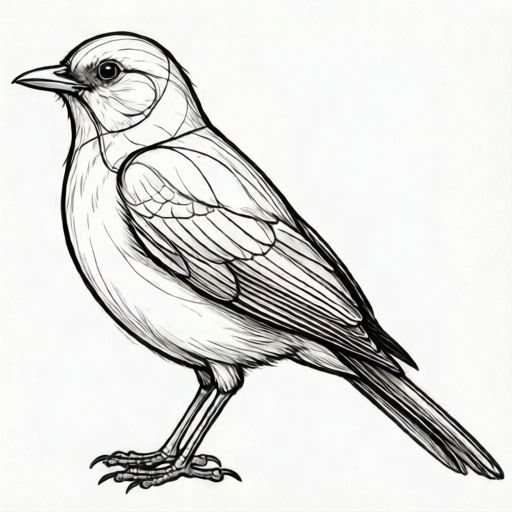
Use the stated measurements and conventions for each exercise.
The Three-Unit Construction Method
Every bird body can be blocked in with three proportional units: head, torso, and tail. The head is the measuring unit. Measure the head's length from the top of the crown to the base of the beak, and its width from the back of the skull to the front of the face. Use these two measurements to size the torso and tail.
The torso is an oval whose length is roughly two to three head-lengths and whose width is roughly one and a half to two head-widths. The tail extends from the rear of the torso and is usually one to two head-lengths long. These ranges are starting points, not rules; adjust them to match your chosen bird.
Draw lightly so you can revise. Begin with a horizontal line for the body axis, then place the head oval at one end. Add the torso oval so it overlaps the head slightly at the neck. Finally, add the tail as a tapered shape from the rear of the torso. Check that the three units connect smoothly before adding any detail.
- Draw a light horizontal axis line for the body.
- Draw the head oval at the front of the axis; record its length and width.
- Draw the torso oval behind the head, using two to three head-lengths for its length.
- Draw the tail from the rear of the torso, using one to two head-lengths for its length.
- Check the proportions with simple arithmetic before adding detail.
Adapting Proportions to Three Body Types
Perching birds typically have a compact torso and a moderate tail. Use a torso length of about two head-lengths and a tail of about one head-length. The head sits high on the torso, and the tail angles slightly downward.
Swimming birds often have a longer, lower torso and a shorter tail. Use a torso length of about three head-lengths and a tail of about half a head-length. The head sits forward and low, and the tail is short and rounded.
Soaring birds usually have a broad torso and a long tail. Use a torso length of about two and a half head-lengths and a tail of about two head-lengths. The head sits forward, and the tail extends straight back. These are hypothetical starting values; measure your own reference bird to set your own numbers.
- Choose a body type: perching, swimming, or soaring.
- Set the torso length as a multiple of the head length.
- Set the tail length as a multiple of the head length.
- Adjust the head position: high for perching, low for swimming, forward for soaring.
- Compare your construction to a reference photo or specimen and revise.
Checking Proportions with Simple Arithmetic
Use consistent units, such as centimeters or grid squares, to check your construction. If the head length is 2 cm, a torso of two head-lengths should be 4 cm, and a tail of one head-length should be 2 cm. Measure your drawing and compare.
A useful check is the total body length: head length plus torso length plus tail length. For a perching bird with a 2 cm head, a 4 cm torso, and a 2 cm tail, the total is 8 cm. If your drawing measures 10 cm, one unit is too long.
Keep a simple table of your measurements. Label any numerical values you choose as hypothetical examples, and measure your actual paper, screen, or reference to set your own scale.
- Measure the head length in your chosen unit.
- Multiply by your chosen torso multiple and tail multiple.
- Measure your drawn torso and tail and compare to the calculated values.
- Adjust the unit that is off, then re-measure.
- Record the final measurements for future drawings.
A Convention for Art and Handwriting Checks
For handwritten labels and notes, use this convention: x-height is the distance from the baseline to the midline of lowercase letters. Letter styles vary, so accept any legible style that keeps x-height consistent within a word. Do not penalize slant, loop shape, or letter width if the x-height is consistent and the text is readable.
For art checks, accept any construction that meets the proportional ranges and connects the three units smoothly. Valid alternatives include different oval shapes, slight overlaps at the neck, and tails that taper or fan. The rubric below lists what to check, not a single correct drawing.
- Write labels on the baseline and keep x-height consistent.
- Check that each label is legible without guessing.
- Check that the head, torso, and tail meet the proportional ranges.
- Accept valid alternatives that meet the rubric.
Worked example
A perching bird has a head length of 2 cm. Use a torso of two head-lengths and a tail of one head-length. Calculate the torso length, tail length, and total body length.
Worked answer
Torso length = 2 × 2 cm = 4 cm. Tail length = 1 × 2 cm = 2 cm. Total body length = 2 cm + 4 cm + 2 cm = 8 cm.
Four practice exercises
Exercise 1
A perching bird has a head length of 3 cm. Use a torso of two head-lengths and a tail of one head-length. Calculate the torso length, tail length, and total body length.
Show answer and check
Torso length = 6 cm. Tail length = 3 cm. Total body length = 12 cm.
Why: Multiply the head length by the torso multiple and the tail multiple, then add the three lengths.
Check: Re-measure each unit in centimeters and confirm the sum equals 12 cm.
Exercise 2
A swimming bird has a head length of 2 cm. Use a torso of three head-lengths and a tail of half a head-length. Calculate the torso length, tail length, and total body length.
Show answer and check
Torso length = 6 cm. Tail length = 1 cm. Total body length = 9 cm.
Why: Three head-lengths is 3 × 2 cm = 6 cm. Half a head-length is 0.5 × 2 cm = 1 cm. The total is 2 + 6 + 1 = 9 cm.
Check: Measure the drawn torso and tail and confirm they match 6 cm and 1 cm.
Exercise 3
A soaring bird has a head length of 4 cm. Use a torso of two and a half head-lengths and a tail of two head-lengths. Calculate the torso length, tail length, and total body length.
Show answer and check
Torso length = 10 cm. Tail length = 8 cm. Total body length = 22 cm.
Why: Two and a half head-lengths is 2.5 × 4 cm = 10 cm. Two head-lengths is 2 × 4 cm = 8 cm. The total is 4 + 10 + 8 = 22 cm.
Check: Measure each unit and confirm the sum equals 22 cm.
Exercise 4
A bird drawing has a head length of 2 cm, a torso of 5 cm, and a tail of 3 cm. The intended multiples were two head-lengths for the torso and one head-length for the tail. Identify which units are off and give the corrected lengths.
Show answer and check
Both the torso and the tail are off. The intended torso length is 4 cm, so the drawn torso is 1 cm too long. The intended tail length is 2 cm, so the drawn tail is 1 cm too long. Corrected torso = 4 cm; corrected tail = 2 cm.
Why: Two head-lengths is 2 × 2 cm = 4 cm. One head-length is 1 × 2 cm = 2 cm. Compare the drawn values to the intended values.
Check: Re-measure the torso and tail after correction and confirm they match 4 cm and 2 cm.
Common mistakes
- Drawing the torso without measuring the head first. Draw and measure the head oval before sizing the torso. Use the head length as your unit.
- Making the tail too long for a swimming bird. For swimming birds, use a tail of about half a head-length and check with arithmetic.
- Leaving a gap between the head and torso. Overlap the head and torso slightly at the neck so the units connect smoothly.
- Using inconsistent units when checking proportions. Choose one unit, such as centimeters or grid squares, and use it for every measurement.
Self-check rubric
- Head oval is drawn and its length and width are recorded.
- Torso length is between two and three head-lengths.
- Torso width is between one and a half and two head-widths.
- Tail length is between half a head-length and two head-lengths.
- Head, torso, and tail connect smoothly with a slight overlap at the neck.
- Measurements use one consistent unit and are checked with arithmetic.
- Handwritten labels keep x-height consistent from baseline to midline and are legible.
- Valid alternatives in oval shape, tail taper, and label style are accepted if the proportional ranges are met.
Questions and answers
Do I need to draw a specific species?
No. The method teaches generic body proportion construction. Choose any bird and adjust the multiples to match your reference.
What if my bird does not fit the three body types?
Use the closest type as a starting point, then measure your reference and set your own multiples. The ranges are starting points, not rules.
How do I know if my proportions are correct?
Measure the head, torso, and tail in one unit and compare to your chosen multiples. Check that the total body length matches the sum of the three units.
Can I use a ruler or grid?
Yes. A ruler or grid helps keep units consistent. Measure your actual paper or screen to set your scale.