Free original lessons
Cartoon Kitty Drawing: Ears, Whiskers, and Tail Shapes
Learn to draw a cartoon kitty by building simple shapes, then vary ears, whiskers, and tail curves. Includes a worked example, practice tasks, and a fair rubric.
Free lesson
Four exercises
Worked answers
Object Drawing Lessons
This lesson teaches a repeatable way to draw a cartoon kitty using basic shapes and clear choices for ears, whiskers, and tail. You will work from a construction sketch to a finished line drawing, then practice variations. The focus is cartoon simplification, not realistic cat anatomy. Use any pencil and paper. Keep your lines light at first so you can adjust proportions. A useful convention for this lesson: x-height means the distance from the baseline to the midline of lowercase letters in your normal handwriting. Use that distance as a rough unit for eye spacing and whisker length so your kitty stays balanced. Letter styles vary, so treat x-height as a personal measuring guide, not a fixed standard. Measure your own paper and tools if you want consistent sizes.
Practice materials: Printable downloads are not available for this lesson yet. Use the instructions and four exercises below.
Reference illustration
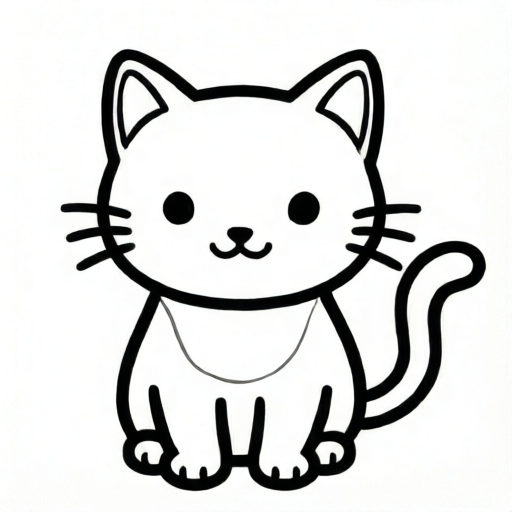
Use the stated measurements and conventions for each exercise.
Build the kitty from simple shapes
Start with a light construction sketch. Draw a circle for the head and a smaller oval for the body. Add a vertical midline and a horizontal midline on the head to place features. Keep these guide lines faint. The midline helps you center the nose and mouth, and the horizontal line helps you place the eyes at the same height.
Next, place the ears on the top half of the head circle. Cartoon ears can be tall triangles, rounded triangles, or short wide triangles. Choose one style and draw both ears with the same basic shape so the kitty looks consistent. Leave a small gap between the ear base and the top of the head circle if you want a softer look.
Then add the face. Put two oval eyes on the horizontal midline, spaced about one x-height apart. Add a small nose below the midline and a simple mouth curve under the nose. Whiskers come next: draw three to five light curves on each side of the muzzle. Keep whisker length similar on both sides, and angle them slightly downward or outward. Finally, sketch the tail as a curved line from the back of the body. A tail can curl up, sweep sideways, or make a gentle S curve.
- Draw a light head circle and a smaller body oval.
- Add faint vertical and horizontal midlines on the head.
- Choose one ear style and draw both ears with matching shapes.
- Place eyes on the horizontal midline, about one x-height apart.
- Add a small nose and a simple mouth curve.
- Draw three to five whiskers on each side of the muzzle.
- Sketch a tail curve from the back of the body.
- Refine the outline and erase construction lines.
Choose ear, whisker, and tail variations
Ear shape changes the kitty's personality. Tall narrow triangles read as alert. Short wide triangles read as calm or sleepy. Rounded ears read as soft and friendly. You can also tilt the ears slightly outward for a curious look. Whatever you choose, keep the left and right ear shapes related so the kitty does not look accidental.
Whisker placement affects the muzzle. Place whiskers on the sides of the nose, not on the eyes. Use short strokes that start near the muzzle and curve outward. Three whiskers per side is a clean cartoon choice; five gives a fuller look. Keep the spacing even and avoid crossing whiskers over the eyes.
Tail curves carry motion. A tail that curls upward suggests happiness. A tail that sweeps low suggests calm. An S curve suggests playfulness. Draw the tail as one smooth curve first, then thicken it slightly at the base. Keep the tail attached to the back of the body, not the side of the head.
- Pick one ear style and draw both ears with the same basic shape.
- Place three to five whiskers per side, starting near the muzzle.
- Choose a tail curve: upward curl, low sweep, or gentle S.
- Attach the tail at the back of the body oval.
- Check that ears, whiskers, and tail do not overlap the eyes.
Refine and check your drawing
Once the construction sketch is in place, darken the final lines. Erase the midlines and any shape guides that are no longer needed. Check that the eyes sit at the same height and that the ears are balanced. Look at the whiskers: they should be similar in length on both sides and should not cover the eyes. Check the tail attachment point and make sure the curve is smooth.
Use a simple measurement check. Measure the distance between the eye centers with your pencil or a small ruler. Compare it to one x-height from your handwriting. If the eyes are much wider apart than one x-height, the kitty may look surprised; if much closer, it may look cross-eyed. Either can be a valid cartoon choice, but make it intentional. Measure whisker length on each side and adjust if one side is much longer.
- Darken the final outline and erase construction lines.
- Check eye height and spacing against your x-height unit.
- Compare whisker lengths on the left and right sides.
- Confirm the tail attaches at the back of the body.
- Make small adjustments before finalizing.
Worked example
Draw a cartoon kitty with rounded ears, three whiskers per side, and a tail that curls upward. Use a head circle and body oval. Place eyes about one x-height apart.
Worked answer
A finished cartoon kitty with a round head, two rounded ears on top, two oval eyes on the horizontal midline about one x-height apart, a small nose, a simple mouth curve, three curved whiskers on each side of the muzzle, and a tail attached at the back of the body that curls upward in one smooth curve. Construction lines are erased and the outline is darkened.
Four practice exercises
Exercise 1
Draw a cartoon kitty with tall triangle ears, four whiskers per side, and a tail that sweeps low to the right. Use a head circle and body oval. Keep eyes about one x-height apart.
Show answer and check
A cartoon kitty with two tall triangle ears on top of the head, four whiskers on each side of the muzzle, and a tail attached at the back of the body sweeping low to the right in a smooth curve. Eyes are on the horizontal midline about one x-height apart.
Why: The prompt fixes ear style, whisker count, and tail direction. The construction uses a head circle and body oval, with eyes placed on the midline for balance.
Check: Check that both ears are tall triangles, each side has four whiskers, and the tail attaches at the back and sweeps low to the right. Measure eye spacing against one x-height.
Exercise 2
Draw a cartoon kitty with short wide ears, three whiskers per side, and a gentle S-curve tail. Place the nose below the horizontal midline and the mouth curve under the nose.
Show answer and check
A cartoon kitty with two short wide ears, three whiskers per side, a small nose below the horizontal midline, a mouth curve under the nose, and a tail attached at the back forming a gentle S curve.
Why: Short wide ears and three whiskers per side are specified. The nose and mouth placement follows the midline guide. The tail is an S curve attached at the back.
Check: Confirm ear shape is short and wide on both sides, whisker count is three per side, nose is below the midline, and the tail forms an S curve from the back of the body.
Exercise 3
Draw a cartoon kitty with one ear tilted outward and the other upright, five whiskers per side, and a tail that curls upward. Keep whisker lengths similar on both sides.
Show answer and check
A cartoon kitty with one ear tilted outward and one upright, five whiskers on each side of the muzzle with similar lengths, and a tail attached at the back curling upward.
Why: The prompt allows asymmetric ear tilt but requires five whiskers per side and similar whisker lengths. The tail curls upward from the back of the body.
Check: Check that one ear tilts outward and the other is upright, each side has five whiskers, whisker lengths are similar, and the tail curls upward from the back.
Exercise 4
Draw a cartoon kitty with rounded ears, three whiskers per side, and a tail that curves to the left. Add a simple mouth curve and check that the eyes are level.
Show answer and check
A cartoon kitty with two rounded ears, three whiskers per side, a simple mouth curve, level eyes on the horizontal midline, and a tail attached at the back curving to the left.
Why: Rounded ears and three whiskers per side are specified. The mouth curve is simple, and the eyes are checked for level placement. The tail curves left from the back of the body.
Check: Confirm rounded ears on both sides, three whiskers per side, level eyes, a simple mouth curve, and a tail curving left from the back of the body.
Common mistakes
- Drawing ears with different shapes on each side. Choose one ear style and repeat its basic shape on both sides, then tilt both ears slightly if desired.
- Placing whiskers on the eyes or too high on the face. Start whiskers near the sides of the nose and curve them outward, keeping them below the eyes.
- Attaching the tail to the side of the head or body. Attach the tail at the back of the body oval, then draw one smooth curve outward.
- Making the eyes uneven in height. Use the horizontal midline as a guide and place both eyes on it before adding details.
Self-check rubric
- Kitty has a clear head and body built from simple shapes.
- Ears are present and use a consistent style on both sides.
- Eyes sit at roughly the same height and are spaced intentionally.
- Whiskers appear on both sides of the muzzle and do not cover the eyes.
- Tail is attached at the back of the body and forms a smooth curve.
- Construction lines are erased or faint, and the final outline is clear.
- Valid alternatives are accepted: ear style, whisker count from three to five, and tail curve direction may vary.
Questions and answers
Do I need to draw a realistic cat?
No. This lesson focuses on cartoon simplification. Use simple shapes and clear choices for ears, whiskers, and tail.
How many whiskers should I draw?
Three to five per side is a good cartoon range. Keep the number and length similar on both sides.
What is x-height and why use it?
X-height is the distance from the baseline to the midline of lowercase letters in your handwriting. It gives you a personal unit for spacing eyes and whiskers. Letter styles vary, so measure your own writing.
Can I change the tail curve?
Yes. Upward curls, low sweeps, and S curves are all valid. Choose one and keep the curve smooth.