Free original lessons
Deer Mount Drawing: Head, Antlers, and Plaque Construction
Plan a mounted deer head drawing with clear proportions, branching antlers, and a sturdy plaque, using a defined convention and checkable measurements.
Free lesson
Four exercises
Worked answers
Object Drawing Lessons
This lesson teaches how to draw a mounted deer head with antlers and a plaque as a single constructed object. You will set a drawing convention, block the head and neck, build antlers by branching, and design a plaque that visually supports the mount. The focus is the mount itself, not a full deer body or habitat scene. All measurements are hypothetical examples; measure your own paper and tools before drawing. Use the same units throughout, and keep your construction lines light until the final check.
Practice materials: Printable downloads are not available for this lesson yet. Use the instructions and four exercises below.
Reference illustration
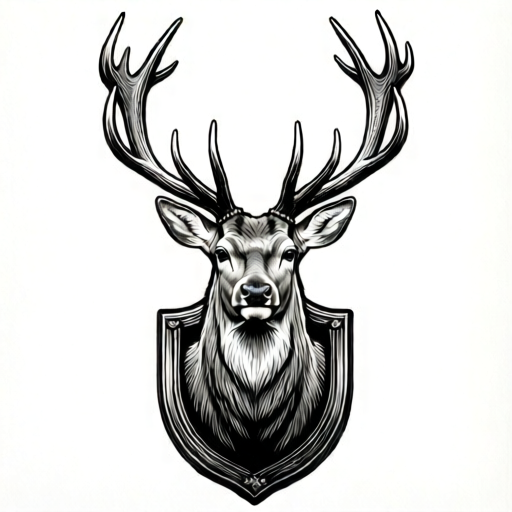
Use the stated measurements and conventions for each exercise.
Set a drawing convention and proportion guide
Choose a convention before drawing: for this lesson, the head height is measured from the chin baseline to the top of the skull midline, and the neck width is measured at the base where it meets the plaque. Write these definitions at the top of your page so your checks are consistent. Letter styles and handwriting vary, so the convention is about measured landmarks, not a single correct look.
Block the head as an oval with a narrower muzzle. Place the eye line about halfway between the chin baseline and the top of the skull. Place the ear bases slightly above the eye line and angle them outward. The neck tapers from the skull to the plaque; its base width should be narrower than the skull width but wide enough to look stable.
- Draw a light vertical midline for the face and a horizontal eye line.
- Block an oval skull and a tapered muzzle; mark the chin baseline.
- Add ear base marks above the eye line and angle the ears outward.
- Taper the neck to a base width that fits the plaque opening.
Build antlers by branching
Antlers grow from the top of the skull, one on each side of the midline. Start with a short main beam that curves outward and slightly back, then add branches as simple forks. Keep branch lengths checkable: for example, a hypothetical main beam of 6 cm and a first branch of 3 cm, measured on your actual paper. Branch angles should be readable, not tangled.
Use a consistent branching rule: each fork splits from a clear point, and no branch crosses another without a visible junction. Vary the number of branches between left and right only if you intend asymmetry; otherwise mirror the branch points. Check that the antler bases sit on the skull, not floating above it.
- Mark two antler bases on the skull top, spaced evenly from the midline.
- Draw the main beams outward and slightly back.
- Add first forks, then secondary forks, keeping junction points visible.
- Check branch lengths and angles against your written convention.
Construct the plaque and attach the mount
The plaque is a flat shape behind the neck base. Choose a simple rectangle or shield shape and measure its width and height on your paper. A hypothetical plaque of 10 cm wide and 14 cm tall is only an example; use your actual measurements. The neck base should overlap the plaque slightly so the mount looks attached, not pasted on.
Add a border line inside the plaque edge to suggest thickness. Center the neck base on the plaque unless you deliberately choose an offset. Check that the plaque is large enough to support the antler span visually and that the mount does not extend beyond the plaque in a way that looks unstable.
- Measure and draw the plaque outline lightly.
- Mark the center and place the neck base over the plaque edge.
- Add an inner border for thickness.
- Check symmetry, overlap, and support before darkening lines.
Refine, label, and self-check
Darken final lines only after the construction check. Label the chin baseline, eye line, antler bases, and plaque center on a separate note or lightly on the page. Compare left and right branch counts and plaque margins. If a branch looks too long, shorten it rather than redrawing the whole antler.
Use the rubric to score proportion, branching clarity, plaque support, and convention consistency. Valid alternatives include different plaque shapes, asymmetric antlers, and varied ear angles, as long as your convention is stated and your checks pass.
- Trace final lines over approved construction lines.
- Label key landmarks and record measurements.
- Score with the rubric and note one improvement.
Worked example
A student draws a deer mount on paper measuring 21 cm by 29 cm. They choose a hypothetical head height of 8 cm from chin baseline to skull top, a neck base width of 5 cm, and a plaque 10 cm wide by 14 cm tall. The antler main beam is 6 cm with one 3 cm first branch on each side. Check whether the plaque supports the neck base and whether the antler bases sit on the skull.
Worked answer
The neck base width is 5 cm and the plaque width is 10 cm, so the base fits with 2.5 cm margin on each side if centered. The antler bases are marked on the skull top, so they sit correctly. The main beam plus first branch is 9 cm per side, which fits within the 10 cm plaque width visually. The drawing passes the support and attachment checks.
Four practice exercises
Exercise 1
On a 15 cm by 20 cm page, draw a deer mount with a hypothetical head height of 6 cm, neck base width of 4 cm, and a rectangular plaque 8 cm wide by 10 cm tall. Add one antler main beam of 5 cm per side with one 2 cm branch. Check the plaque margin.
Show answer and check
The neck base is 4 cm and the plaque is 8 cm wide, so a centered base leaves 2 cm margin on each side. The antler bases sit on the skull top. The drawing passes the support check.
Why: Subtract the neck base width from the plaque width and divide by two for the centered margin. Confirm antler bases touch the skull.
Check: Measure the margin on both sides; they should be equal within your measurement precision.
Exercise 2
Draw a deer mount with an asymmetric antler plan: left main beam 6 cm with two 2 cm branches, right main beam 5 cm with one 3 cm branch. Use a shield plaque 9 cm wide by 12 cm tall and a neck base of 4 cm. State one check that confirms the antlers are attached.
Show answer and check
Both antler bases must touch the skull top. The left total branch length is 6 plus 2 plus 2 equals 10 cm; the right is 5 plus 3 equals 8 cm. The neck base fits the 9 cm plaque with 2.5 cm margin per side if centered.
Why: Asymmetry is allowed if the convention states it. Attachment is checked by the base-to-skull contact, not by equal lengths.
Check: Place a ruler along each antler base and confirm contact with the skull line; measure margins.
Exercise 3
A student uses a plaque 7 cm wide and a neck base 4 cm wide, centered. They claim the margin is 1.5 cm per side. Check the arithmetic and state whether the plaque supports the base.
Show answer and check
The margin is 7 minus 4 equals 3 cm total, so 1.5 cm per side. The claim is correct, and the plaque supports the base with a positive margin.
Why: Subtract the base width from the plaque width, then divide by two for a centered mount.
Check: Re-measure the plaque and base widths and repeat the subtraction.
Exercise 4
Draw a deer mount with a head height of 7 cm, eye line at 3.5 cm above the chin baseline, and ear bases 1 cm above the eye line. Add antlers with main beams of 5 cm and one 2 cm branch per side. Use a plaque 9 cm wide by 11 cm tall and a neck base of 5 cm. Check the eye line placement and plaque margin.
Show answer and check
The eye line is halfway between chin baseline and skull top, which matches the convention. The neck base margin is 9 minus 5 equals 4 cm total, or 2 cm per side if centered. The drawing passes both checks.
Why: Half of 7 cm is 3.5 cm, so the eye line is correctly placed. The margin calculation uses the same subtraction rule.
Check: Measure the chin-to-eye and eye-to-skull distances; they should be equal. Measure both plaque margins.
Common mistakes
- Antler bases float above the skull. Re-mark the bases on the skull top and redraw the first segment to touch the skull.
- Plaque is too small to support the neck base. Measure the neck base width and enlarge the plaque so the base overlaps with a visible margin.
- Branch junctions are hidden or tangled. Redraw forks from clear points and keep each junction visible.
- Measurements mix units or are not written down. Write the unit and convention at the top of the page and re-measure key landmarks.
Self-check rubric
- Head proportion follows the stated chin-to-skull convention.
- Eye line and ear bases are placed consistently.
- Antler bases touch the skull and branch junctions are visible.
- Plaque supports the neck base with a measurable margin.
- Measurements use one unit and are recorded.
- Valid alternatives are allowed if the convention is stated and checks pass.
Questions and answers
Do I need to draw a full deer body?
No. This lesson covers only the mounted head, antlers, and plaque.
Can the antlers be asymmetric?
Yes, if you state that choice in your convention and check branch junctions and lengths.
What if my plaque shape is not rectangular?
A shield or rounded plaque is valid if it supports the neck base and passes the margin check.
Are the numerical examples required?
No. They are hypothetical examples; measure your own paper and tools.