Free original lessons
Draw a Rhododendron: Clustered Trumpet Blooms Step by Step
Learn to draw a rhododendron branch with clustered trumpet blooms and leathery leaves using simple shapes, clear structure, and a checkable rubric.
Free lesson
Four exercises
Worked answers
Object Drawing Lessons
Rhododendron flowers grow in rounded clusters of trumpet-shaped blooms, each with five lobes and a slight flare at the mouth. The leaves are leathery, elongated, and often curve downward. This lesson breaks the plant into basic shapes, then refines them into a believable cluster. You will use a simple convention: x-height runs from baseline to midline, and letter styles vary, so treat all written labels as optional guides. Measure your own paper and tools; any numbers here are hypothetical examples. The goal is structural accuracy and expressive line, not a single universal answer.
Practice materials: Printable downloads are not available for this lesson yet. Use the instructions and four exercises below.
Reference illustration
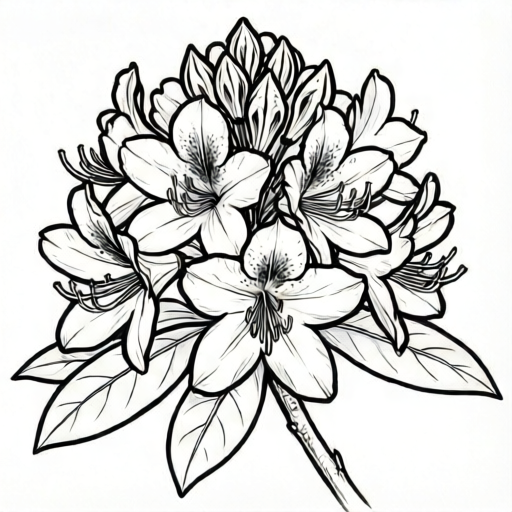
Use the stated measurements and conventions for each exercise.
Start with the cluster envelope and branch line
Begin by drawing a light oval or rounded polygon that encloses the whole bloom cluster. This envelope should be wider than tall for most rhododendron clusters. Add a gently curving branch line entering from one side. The branch should feel woody but not thick; a double line with slight taper works well.
Inside the envelope, mark three to five bloom centers as small circles. These are not the final flower positions but anchors for the trumpet shapes. Keep them unevenly spaced so the cluster looks natural. A hypothetical example: on a 15 cm wide practice area, place centers about 3 cm apart, but adjust to your paper.
- Draw a light oval envelope for the cluster.
- Add a curved branch line entering the envelope.
- Mark three to five small circles as bloom centers.
- Check that centers are unevenly spaced and inside the envelope.
Build each trumpet flower from a cone and a flared mouth
Each rhododendron bloom is a trumpet: a narrow tube that flares into five rounded lobes. From each center circle, draw a short cone or funnel pointing outward from the cluster. The mouth should be wider than the tube. Add five lobes around the mouth as soft arcs, not sharp points.
Vary the angle of each trumpet so some face the viewer and some turn away. Overlap is normal in a cluster. Keep the tube length roughly equal to the mouth width for a balanced look, but treat this as a guide, not a rule. Erase the envelope only after the trumpets are placed.
- Draw a short funnel from each center circle.
- Flare the mouth wider than the tube.
- Add five soft lobes around each mouth.
- Vary trumpet angles and allow overlaps.
- Erase the envelope when placement is clear.
Add leathery leaves and refine the cluster outline
Rhododendron leaves are elongated, slightly glossy, and leathery. Draw them as long ovals with a gentle downward curve. Attach leaves to the branch below the cluster, not inside the blooms. Add a central vein and a few side veins lightly.
Refine the cluster outline by connecting the trumpet mouths with small gaps and overlaps. Do not outline the whole cluster as one blob; let individual flowers read. Darken the branch and leaf edges, then add subtle shading under the cluster to suggest depth.
- Draw elongated, downward-curving leaves on the branch.
- Add a central vein and light side veins.
- Connect trumpet mouths with small overlaps, not one blob.
- Darken branch and leaf edges.
- Add light shading under the cluster.
Worked example
Draw a rhododendron branch with a cluster of three trumpet blooms and two leathery leaves. Use a light oval envelope, three bloom centers, five lobes per mouth, and leaves attached below the cluster.
Worked answer
A completed line drawing shows a curved branch entering a rounded cluster envelope. Three funnel-shaped trumpets flare into five soft lobes each, angled differently. Two elongated leaves curve downward from the branch below the cluster, each with a central vein. The envelope is erased, and light shading sits under the cluster.
Four practice exercises
Exercise 1
Draw one rhododendron trumpet bloom facing the viewer. Use a narrow tube, a flared mouth, and five soft lobes. Add a short stem.
Show answer and check
A single trumpet with a tube about as long as the mouth is wide, five rounded lobes around the mouth, and a short stem at the base.
Why: The exercise isolates the trumpet structure so the five-lobed mouth and flared cone are clear before clustering.
Check: Confirm the mouth is wider than the tube, five lobes are visible, and the stem attaches at the narrow end.
Exercise 2
Draw a cluster envelope with four bloom centers. Place four trumpets at different angles, allowing one overlap. Do not erase the envelope yet.
Show answer and check
A rounded envelope containing four funnel shapes with varied angles and one clear overlap, each with five lobes.
Why: This practices placement and angle variation inside the cluster before refinement.
Check: Check that all four centers are inside the envelope, angles differ, and the overlap does not hide a mouth completely.
Exercise 3
Add three leathery leaves to a branch below a bloom cluster. Make each leaf elongated and curved downward, with a central vein.
Show answer and check
Three long oval leaves attached to the branch below the cluster, each curving down and showing a central vein.
Why: Leaves establish the rhododendron's leathery character and must sit below the blooms.
Check: Verify leaves attach below the cluster, curve downward, and have a visible central vein.
Exercise 4
Refine a cluster of three trumpets by connecting mouths with small overlaps and adding light shading under the cluster. Keep individual flowers readable.
Show answer and check
Three distinct trumpet mouths linked by small overlaps, with shading beneath the cluster and no single blob outline.
Why: Refinement tests whether the cluster reads as separate blooms while gaining depth.
Check: Check that each mouth remains visible, overlaps are small, and shading sits under rather than inside the flowers.
Common mistakes
- Drawing the cluster as one solid blob without individual trumpet mouths. Keep each bloom center visible and draw five lobes per mouth before connecting outlines.
- Making all trumpets face the same direction. Rotate each funnel slightly and vary the mouth angle to show natural clustering.
- Using thin, flat leaves that look like generic foliage. Elongate the leaves, curve them downward, and add a central vein for a leathery look.
- Placing leaves inside the bloom cluster. Attach leaves to the branch below the cluster and keep the flower area clear.
Self-check rubric
- Cluster envelope is rounded and wider than tall, with uneven bloom centers.
- Each bloom reads as a trumpet with a narrow tube and flared five-lobed mouth.
- Trumpet angles vary and overlaps are intentional, not merged into one blob.
- Leaves are elongated, downward-curving, and attached below the cluster.
- Line quality is controlled, with darker edges and light shading for depth.
- Valid alternatives in leaf curve, lobe softness, and bloom count are accepted if structure remains readable.
Questions and answers
How many blooms should a cluster have?
Three to five blooms is a practical starting range. More can work if spacing stays uneven and each trumpet remains readable.
Do I need to draw every lobe perfectly?
No. Five soft lobes per mouth is the convention, but slight variation is expected. The rubric rewards readable trumpet structure, not identical lobes.
What does x-height mean here?
X-height is the distance from baseline to midline in written labels. Letter styles vary, so use it only as a consistent guide for optional annotations.
Can I use a different leaf shape?
Yes, as long as leaves are elongated, leathery-looking, and attached below the cluster. Valid alternatives are allowed by the rubric.