Free original lessons
Draw a Siamese Cat: Point Coloration and Slender Body
Learn to draw a Siamese cat with dark points, blue eyes, and a slender frame using a clear construction method and a flexible style rubric.
Free lesson
Four exercises
Worked answers
Object Drawing Lessons
This lesson teaches a repeatable way to draw a Siamese cat that reads clearly as the breed: a long, slender body, a wedge-shaped head, large blue eyes, and dark point coloration on the ears, face, paws, and tail. You will build the cat from simple measured shapes, place the points deliberately, and shade the cream body so the dark areas stay distinct. The method works for standing and seated poses. Because drawing is not a single-answer task, the rubric rewards correct breed features and clean construction while allowing personal line style, fur texture, and pose choices. All measurements below are hypothetical examples you can scale to your paper; measure your own tools and surface before committing to sizes.
Practice materials: Printable downloads are not available for this lesson yet. Use the instructions and four exercises below.
Reference illustration
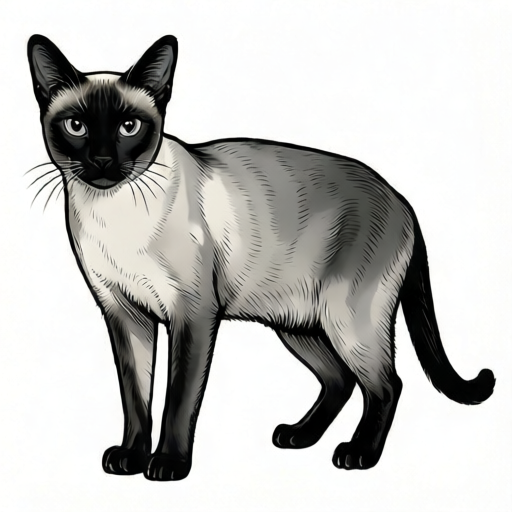
Use the stated measurements and conventions for each exercise.
Build the slender frame from measured shapes
Start with a light construction drawing. For a standing Siamese, draw a horizontal oval for the ribcage and a smaller oval for the hips, then connect them with two gentle curves to suggest a long, lean torso. The body should look longer than it is tall. A useful hypothetical proportion is a torso length about 1.6 times the shoulder height; adjust to your pose and paper.
Add a narrow neck and a wedge-shaped head. The head is longer than wide, with a blunt muzzle and large, almond-shaped eyes set wide apart. Ears are large and pointed, set fairly high. Legs are long and slim, with small oval paws. The tail is long and tapers, often carried low or curved. Keep all construction lines light so they can be refined or erased.
- Draw a light horizontal line for the ground and mark the standing height.
- Place a ribcage oval and a hip oval, then connect them with lean torso curves.
- Add a narrow neck and a wedge-shaped head with a blunt muzzle.
- Set large almond eyes wide apart and add tall pointed ears.
- Draw long slim legs with small oval paws and a long tapering tail.
- Check that the torso reads longer than tall before adding detail.
Place point coloration deliberately
Point coloration means the body is pale cream and the ears, face mask, paws, and tail are dark. On your construction, mark the point areas before shading. The face mask should cover the muzzle, cheeks, and area around the eyes but leave the forehead and neck pale. Ears are fully dark. Paws are dark from the wrist or ankle down. The tail is dark along its length, often darkest at the tip.
Keep the boundary between cream and dark soft but readable. Use a light pencil to outline each point area, then shade with short strokes that follow the fur direction. Leave the eyes blue and bright: draw a dark pupil, a blue iris, and a small white highlight. Avoid making the whole body dark; the contrast between cream and points is the breed signal.
- Lightly outline the face mask, ears, paws, and tail as point areas.
- Shade the ears fully dark, keeping edges soft.
- Shade the face mask around the muzzle and eyes, leaving the forehead pale.
- Shade each paw from the wrist or ankle down.
- Shade the tail along its length, darkest at the tip.
- Add blue iris, dark pupil, and a small white highlight to each eye.
Refine pose, proportion, and shading
For a seated pose, stack the shapes vertically: a rounded hip base, a lean upright torso, and the wedge head above. The front legs stay long and straight, and the tail curves around the body. Check that the seated cat still looks slender, not bulky. The neck should be visible and narrow.
Shade the cream body with light, even strokes, leaving the paper white in highlight areas. Use a slightly darker cream under the chin, belly, and behind the legs to suggest form without turning the body dark. Keep the point areas clearly darker than the body. If your pencil pressure makes the body too dark, lift some graphite with a clean eraser and re-shade more lightly.
- Choose standing or seated pose and redraw construction shapes to fit.
- Confirm the torso is longer than tall and the neck is narrow.
- Shade the cream body lightly, leaving white highlights.
- Deepen the point areas so they stay clearly darker than the body.
- Soften boundaries with short strokes rather than hard outlines.
- Erase construction lines and check the breed features against the rubric.
Worked example
A standing Siamese cat is drawn with a torso length of 8 cm and a shoulder height of 5 cm. The face mask is shaded over a 3 cm wide area, each paw point is 1.5 cm tall, and the tail point is 6 cm long. What total length of dark point boundary is outlined if the mask boundary is 7 cm, each paw boundary is 4 cm, and the tail boundary is 10 cm?
Worked answer
The total outlined boundary is 7 + 4 + 4 + 10 = 25 cm.
Why: Add the mask boundary, two paw boundaries, and the tail boundary. The 3 cm mask width and 1.5 cm paw height describe shaded areas, not boundary lengths, so they are not added. The torso and shoulder measurements confirm the slender proportion but do not affect the boundary total.
Four practice exercises
Exercise 1
A seated Siamese cat is drawn with a torso height of 6 cm and a hip width of 4 cm. The face mask boundary is 8 cm, each front paw boundary is 3 cm, and the tail boundary is 9 cm. What is the total outlined point boundary?
Show answer and check
8 + 3 + 3 + 9 = 23 cm.
Why: Add the mask boundary, two front paw boundaries, and the tail boundary. The torso height and hip width describe the slender seated frame but are not boundary lengths.
Check: Recount the four boundary values and confirm the sum is 23 cm; verify that torso and hip measurements were not added.
Exercise 2
A standing Siamese cat has a torso length of 10 cm and a shoulder height of 6 cm. Is the torso longer than tall, and by how much?
Show answer and check
Yes, the torso is longer than tall by 4 cm.
Why: Compare 10 cm torso length with 6 cm shoulder height. Since 10 is greater than 6, the torso is longer; subtract 6 from 10 to get 4 cm.
Check: Confirm the subtraction 10 - 6 = 4 and that the longer measurement is the torso, not the height.
Exercise 3
A Siamese cat drawing has point areas on the ears (5 cm boundary), face mask (7 cm boundary), four paws (2 cm boundary each), and tail (8 cm boundary). What total point boundary is outlined?
Show answer and check
5 + 7 + 2 + 2 + 2 + 2 + 8 = 28 cm.
Why: Add the ear boundary, mask boundary, four paw boundaries, and tail boundary. Four paws at 2 cm each contribute 8 cm total.
Check: Add the paw boundaries separately (2 + 2 + 2 + 2 = 8), then add 5 + 7 + 8 + 8 = 28 cm.
Exercise 4
A seated Siamese cat is drawn with a torso height of 7 cm and a hip width of 5 cm. The face mask is shaded over a 4 cm wide area, and the tail point is 6 cm long. If the mask boundary is 9 cm and the tail boundary is 11 cm, what total boundary is outlined, and does the seated frame read slender?
Show answer and check
Total boundary is 9 + 11 = 20 cm. The seated frame reads slender because the torso height (7 cm) is greater than the hip width (5 cm).
Why: Only the mask and tail boundaries are outlined in this example, so add 9 and 11. The 4 cm mask width and 6 cm tail length are shaded-area measurements, not boundaries. A taller-than-wide seated frame supports the slender look.
Check: Verify 9 + 11 = 20 cm and confirm that 7 cm is greater than 5 cm; check that width and length values were not added to the boundary total.
Common mistakes
- Making the body round and bulky like a generic cat. Lengthen the torso ovals and narrow the connection curves so the body reads lean and long.
- Shading the whole body dark instead of keeping cream and points separate. Leave the body pale cream and reserve dark shading for ears, face mask, paws, and tail.
- Drawing small round eyes instead of large almond blue eyes. Widen the eye shapes, set them farther apart, and add a blue iris with a white highlight.
- Hard outlines around the point areas that look like painted patches. Soften boundaries with short fur-direction strokes and blend the edge slightly.
Self-check rubric
- Slender body: torso clearly longer than tall, narrow neck, long slim legs.
- Wedge-shaped head with blunt muzzle and large almond eyes set wide.
- Blue eyes with dark pupil and a visible white highlight.
- Point coloration present on ears, face mask, paws, and tail, clearly darker than the cream body.
- Cream body shaded lightly with white highlights, not darkened overall.
- Construction lines light and mostly erased; point boundaries soft and readable.
- Valid alternative styles accepted if breed features remain clear and proportions stay slender.
Questions and answers
Do I have to use the exact proportions given?
No. The numbers are hypothetical examples. Measure your paper and adjust so the cat fits and still looks slender.
Can I draw the cat in a different pose?
Yes. The construction method works for standing, seated, walking, or curled poses as long as the slender frame and point areas remain clear.
How dark should the points be?
Dark enough to contrast clearly with the cream body, but you can vary the darkness for style. The key is a readable separation, not one fixed shade.
What if my lines are messy?
Keep construction lines light and erase them at the end. Cleanup is part of the process, and the rubric rewards clear breed features over perfect line quality.