Free original lessons
Draw and Compare Taproot, Fibrous, and Tuberous Root Systems
Learn to sketch three root types with labeled parts, a comparison table, and self-checking practice tasks using a clear drawing convention.
Free lesson
Four exercises
Worked answers
Object Drawing Lessons
This lesson teaches you to draw three root-system constructions: taproot, fibrous, and tuberous. You will use a simple convention so your drawing is checkable even though root shapes vary. The convention is: the soil line is a horizontal baseline; the root crown sits on that baseline; x-height means the distance from baseline to midline, used only to scale labels and spacing. Draw roots as smooth tapering lines, show branching by forking lines, and show swelling by widening a root section without changing its centerline. Label only the parts listed for each type. A comparison table then helps you check differences in structure, branching, and storage. All practice tasks are self-contained; where an example diagram is needed, it is described in words. Numerical values in examples are hypothetical and should be replaced by measurements of your actual paper and pencil.
Practice materials: Printable downloads are not available for this lesson yet. Use the instructions and four exercises below.
Reference illustration
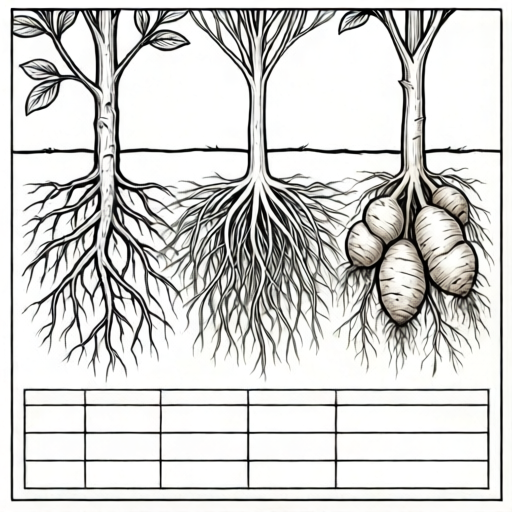
Use the stated measurements and conventions for each exercise.
Set up the drawing convention
Place a horizontal baseline across the page to represent the soil surface. Mark a root crown point on the baseline. Decide a scale: for example, let one x-height equal 10 mm on your paper; this is a hypothetical value, so measure your own paper and pencil and choose a workable scale. Keep all three panels the same scale so the comparison table is fair.
Use a pencil for construction lines and a darker pencil for final lines. Draw roots as tapering lines that start wider at the crown and narrow toward the tip. Branching is shown by a fork: a line splits into two thinner lines. Swelling is shown by widening a section of a root while keeping its centerline smooth. Labels sit outside the root area, connected by a short straight leader line.
- Draw the baseline and mark three crown points, one per panel.
- Choose and record your scale in the margin.
- Sketch each root system lightly before adding labels.
- Check that every label leader touches the part it names.
Draw the taproot panel
A taproot has one main root that continues downward from the crown and gives off smaller branch roots. Draw the main root as a single tapering line from the crown to the deepest point. Add three to five branch roots on each side, forking outward and downward. Branch roots should be thinner than the main root at the point where they join it.
Label the crown, main root, branch roots, and root tip. Keep labels short. The main root should be visibly longer than the branch roots in your drawing, and the branch roots should not cross the main root.
- Draw the main root from crown to tip.
- Add branch roots in pairs, thinner than the main root.
- Label crown, main root, branch roots, and root tip.
- Check that branch roots join the main root without crossing it.
Draw the fibrous panel
A fibrous root system has many similar-sized roots spreading from the crown, with no single dominant root. Draw six to ten roots fanning out from the crown. Keep their thickness similar near the crown, and let each taper to a tip. Add small forks near the ends to show fine branching.
Label the crown, fibrous roots, fine branches, and root tips. In your drawing, no root should be more than about twice as long as the shortest root, which keeps the spread even. This is a drawing convention, not a botanical rule.
- Draw six to ten roots fanning from the crown.
- Keep root thickness similar near the crown.
- Add small forks near the tips.
- Label crown, fibrous roots, fine branches, and root tips.
Draw the tuberous panel and build the comparison table
A tuberous root system includes swollen storage sections. Draw a short main root from the crown, then widen one or two sections into rounded swellings. Keep the centerline smooth through each swelling. Add a few thin branch roots from the swollen sections. Label crown, swollen root, branch roots, and root tip.
Build a three-row comparison table with columns for root type, main structure, branching, and storage. Fill it from your drawings: taproot has one main root and branch roots, no storage swelling; fibrous has many similar roots and fine branching, no storage swelling; tuberous has swollen sections and branch roots, with storage. Check that each table entry matches a labeled part in the corresponding panel.
- Draw a short main root and widen one or two sections.
- Add thin branch roots from the swollen sections.
- Label crown, swollen root, branch roots, and root tip.
- Complete the comparison table and match entries to labels.
Worked example
On a page with a 120 mm baseline, draw a taproot panel using a scale where one x-height equals 10 mm. The main root is 50 mm long. Add four branch roots, each 20 mm long, two on each side. Label crown, main root, branch roots, and root tip.
Worked answer
Baseline drawn 120 mm wide; crown marked at the center. Main root drawn 50 mm down from the crown, tapering to a tip. Four branch roots drawn 20 mm long, two per side, joining the main root without crossing it. Labels placed outside the root area with leader lines touching crown, main root, branch roots, and root tip. Scale note written in the margin: 1 x-height = 10 mm (hypothetical example).
Four practice exercises
Exercise 1
Draw a fibrous panel on a 100 mm baseline. Use a scale where one x-height equals 8 mm (hypothetical). Draw eight roots fanning from the crown, each between 15 mm and 25 mm long. Label crown, fibrous roots, fine branches, and root tips.
Show answer and check
A fibrous panel with eight roots of similar thickness near the crown, lengths between 15 mm and 25 mm, small forks near tips, and four labels with leader lines touching the named parts.
Why: Eight roots satisfy the six-to-ten convention; the length range keeps no root more than about twice the shortest; labels match the listed parts.
Check: Measure each root length and confirm it lies between 15 mm and 25 mm; count eight roots; point to each label and confirm its leader touches the named part.
Exercise 2
Draw a tuberous panel on a 90 mm baseline. Draw a short main root 20 mm long, widen one section into a swelling 12 mm wide, and add three thin branch roots 10 mm long from the swelling. Label crown, swollen root, branch roots, and root tip.
Show answer and check
A tuberous panel with a smooth centerline through the swelling, one widened section 12 mm wide, three thin branch roots from the swelling, and four labels with leader lines.
Why: The swelling is shown by widening, not bending; branch roots start at the swollen section; labels match the listed parts.
Check: Confirm the centerline is smooth through the swelling; measure the swelling width as 12 mm; count three branch roots; check each label leader.
Exercise 3
Draw a taproot panel on a 110 mm baseline. Draw a main root 40 mm long and six branch roots, three per side, each 15 mm long. Then write one comparison-table row stating the main structure and whether storage swelling is shown.
Show answer and check
A taproot panel with one main root 40 mm long, six branch roots 15 mm long that do not cross the main root, and a table row: main structure is one main root with branch roots; storage swelling is not shown.
Why: The main root is longer than branch roots; branch roots join without crossing; the table row matches the drawing.
Check: Measure main root and branch roots; check no branch crosses the main root; read the table row and point to the matching labeled parts.
Exercise 4
Draw all three panels on one page using a single scale where one x-height equals 10 mm (hypothetical). Use baselines of 100 mm each. For each panel, write one sentence explaining how its branching differs from the other two.
Show answer and check
Three panels at the same scale with 100 mm baselines. Taproot sentence: one main root with branch roots. Fibrous sentence: many similar roots with fine branching. Tuberous sentence: swollen sections with branch roots from the swellings.
Why: A single scale makes the comparison fair; each sentence names the branching pattern that distinguishes that panel.
Check: Confirm all baselines are 100 mm and the scale note is the same; read each sentence and point to the labeled parts that support it.
Common mistakes
- Drawing branch roots that cross the main root. Start each branch root at the main root edge and angle it away; erase any crossing line.
- Making one fibrous root much longer than the others. Redraw the long root shorter so no root exceeds about twice the shortest root.
- Showing swelling by bending the root centerline sharply. Keep the centerline smooth and widen the root section instead.
- Using different scales in the three panels. Record one scale in the margin and apply it to all panels.
Self-check rubric
- Baseline and crown are present in all three panels.
- Taproot panel shows one main root and branch roots that do not cross it.
- Fibrous panel shows six to ten similar-sized roots with fine branching.
- Tuberous panel shows smooth swelling and branch roots from swollen sections.
- Labels match the listed parts and leader lines touch the named parts.
- Comparison table entries match labeled parts in each panel.
- One scale is recorded and applied to all panels.
- Valid alternatives are accepted when the convention and table remain consistent.
Questions and answers
Do my roots have to look exactly like the examples?
No. The convention allows valid alternatives: root count, slight curves, and branch angles may vary as long as labels match parts and the comparison table stays consistent.
What does x-height mean here?
It is the distance from the baseline to the midline, used only to scale labels and spacing. It is not a botanical measurement.
Can I use a ruler for the baseline?
Yes. Measure your actual paper and pencil, and label any chosen numerical value as a hypothetical example.
How do I check my comparison table?
Point to each table entry and then to the labeled part in the matching panel. Every entry should have a visible labeled part.