Free original lessons
Draw a Cute Gnome: Hat, Beard, Body and Boots
Learn a repeatable construction for cute gnomes: pointed hat cone, beard mass, body block and boots, with checks and practice tasks.
Free lesson
Four exercises
Worked answers
Object Drawing Lessons
This guide teaches a simple, repeatable way to draw a cute gnome from construction shapes rather than copying a finished picture. You will build the figure in layers: a pointed hat cone, a beard mass that overlaps the body, a rounded body block, and short boot forms. The method uses light guide lines that you refine or erase later. Because drawing is not a single-answer task, the rubric rewards clear construction, proportion control and deliberate style choices rather than exact replication. All measurements below are hypothetical examples for practice; measure your own paper and tools if you adapt them.
Practice materials: Printable downloads are not available for this lesson yet. Use the instructions and four exercises below.
Reference illustration
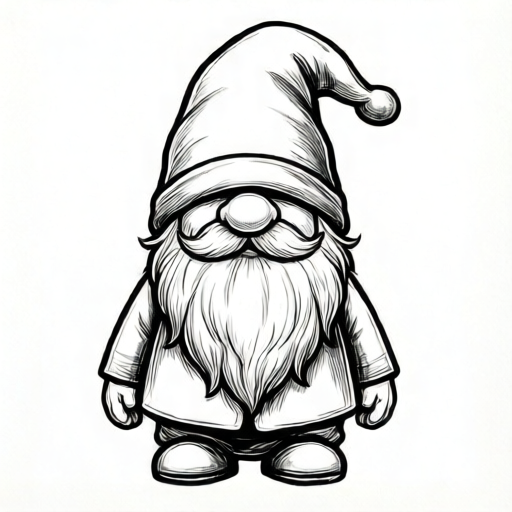
Use the stated measurements and conventions for each exercise.
Set up the construction plate
Work on plain paper with a pencil and eraser. Draw a faint vertical centre line and a horizontal baseline. Mark a total figure height of about 12 cm as a hypothetical example, then divide it into four bands: hat about 4 cm, head and beard about 3 cm, body about 3 cm, boots about 2 cm. These bands are guides, not rules.
Keep guide lines light so they can be removed. Use a consistent unit, such as centimetres, for every measurement you record.
- Draw the vertical centre line and baseline.
- Mark the four height bands with faint horizontal ticks.
- Label the bands hat, head/beard, body and boots.
- Check that the bands add up to your chosen total height.
Build the hat cone and beard mass
The hat is a cone whose base sits on the head band and whose tip leans slightly to one side for cuteness. The beard is a soft mass that starts under the hat brim and overlaps the top of the body block. Draw the beard as a rounded triangle or teardrop, wider at the top and tapering downward.
Overlap matters: the beard should cover part of the body so the figure reads as one connected character. Keep the hat tip inside the top band so proportions stay controlled.
- Draw an oval for the head inside the head band.
- Add a cone from the head top to the hat tip, leaning slightly.
- Draw the beard mass from under the brim to the lower head band.
- Check that the beard overlaps the body band by about 1 cm.
Add body block and boot forms
The body is a rounded rectangle or egg shape inside the body band. Boots are two short, wide forms at the baseline, each about 2 cm tall and 2 cm wide as hypothetical examples. Leave a small gap between boots so the stance is readable.
Refine outlines after the construction reads clearly. You may erase guides or keep them faint. Style choices such as a floppy hat tip or a rounder beard are valid alternatives if the construction remains clear.
- Draw the body block inside the body band.
- Place two boot forms on the baseline, spaced apart.
- Connect beard, body and boots with clean outlines.
- Check that the figure fits the four bands and stands on the baseline.
Check proportions and style
Use simple arithmetic checks: hat 4 cm plus head/beard 3 cm plus body 3 cm plus boots 2 cm equals 12 cm. If your total differs, adjust one band and re-add. X-height is baseline to midline; letter styles vary, so do not force a single handwriting look on labels.
Valid alternatives include a taller hat, a wider beard or angled boots, provided the overlaps and baseline contact remain clear.
- Re-add your band heights and compare with the total.
- Confirm beard overlaps body and boots touch the baseline.
- Choose one style variation and note why it still reads as a gnome.
- Erase or lighten guides before final outlining.
Worked example
A learner chooses a 12 cm total height with bands of 4 cm hat, 3 cm head/beard, 3 cm body and 2 cm boots. They draw a leaning hat tip, a beard overlapping the body by 1 cm, and two boots on the baseline. Check the construction.
Worked answer
The bands sum to 12 cm, the beard overlaps the body, and both boots touch the baseline, so the construction is clear and valid. The leaning hat is an acceptable style choice.
Four practice exercises
Exercise 1
Using bands of 5 cm hat, 3 cm head/beard, 3 cm body and 2 cm boots, state the total height and check the sum.
Show answer and check
Total height is 13 cm because 5 + 3 + 3 + 2 = 13.
Why: Add the four band heights in the same unit to confirm the total.
Check: Re-add the bands and compare with the stated total.
Exercise 2
A beard is drawn from 3 cm to 6 cm on a vertical scale, and the body band starts at 6 cm. Does the beard overlap the body? Explain.
Show answer and check
No overlap occurs because the beard ends exactly where the body begins; extend the beard below 6 cm to create overlap.
Why: Overlap requires the beard to pass the body band start.
Check: Compare the beard end value with the body start value.
Exercise 3
Two boots are each 2 cm wide with a 1 cm gap. What total width do they span?
Show answer and check
5 cm because 2 + 1 + 2 = 5.
Why: Add both boot widths and the gap.
Check: Re-add widths and gap in the same unit.
Exercise 4
A learner draws a hat tip 1 cm above the hat band and a beard 1 cm short of the body band. Name two fixes.
Show answer and check
Lower the hat tip into the hat band and extend the beard 1 cm into the body band.
Why: Both fixes restore the planned band limits and overlap.
Check: Measure the tip against the band top and the beard against the body start.
Common mistakes
- Drawing the hat tip outside the top band, making the figure too tall. Keep the tip within the hat band or adjust the band total and re-check the sum.
- Letting the beard float above the body without overlap. Extend the beard mass about 1 cm into the body band so the parts connect.
- Placing boots above the baseline so the gnome appears to float. Move both boot forms down until their lowest edges touch the baseline.
- Using heavy guide lines that cannot be erased cleanly. Draw guides faintly and outline only after the construction reads clearly.
Self-check rubric
- Hat cone is present and its tip stays within the chosen hat band.
- Beard mass overlaps the body band by a stated amount.
- Body block sits inside the body band.
- Two boot forms touch the baseline with a readable gap.
- Band heights add up to the chosen total using consistent units.
- Guide lines are light and refined or erased before final outline.
- At least one valid style alternative is used or explained.
Questions and answers
Do I need to copy an exact gnome?
No. The method rewards clear construction and deliberate style choices; valid alternatives are accepted.
What units should I use?
Use one consistent unit such as centimetres and label any chosen values as hypothetical examples.
How do I know the proportions are correct?
Add your band heights and compare with your chosen total; adjust one band if needed.
Can the hat lean?
Yes, a slight lean is a valid style choice if the tip stays within the hat band.