Free original lessons
Draw a Donkey Side Profile: Muzzle, Ear and Leg Placement
Learn a repeatable side-profile donkey construction: body mass, long ear angle, muzzle contour, and leg joint placement, with checks and practice tasks.
Free lesson
Four exercises
Worked answers
Object Drawing Lessons
This lesson teaches a side-profile donkey drawing using simple shapes and measured placement. You will build the body mass first, then place the long ear angle, shape the muzzle contour, and set leg joints so the animal stands convincingly. The method uses a defined convention: x-height is measured from baseline to midline of the body mass, and letter styles vary, so treat proportions as ranges rather than fixed rules. All measurements are hypothetical examples unless you measure your own paper and tools. Work lightly, check each stage, and adjust before adding detail.
Practice materials: Printable downloads are not available for this lesson yet. Use the instructions and four exercises below.
Reference illustration
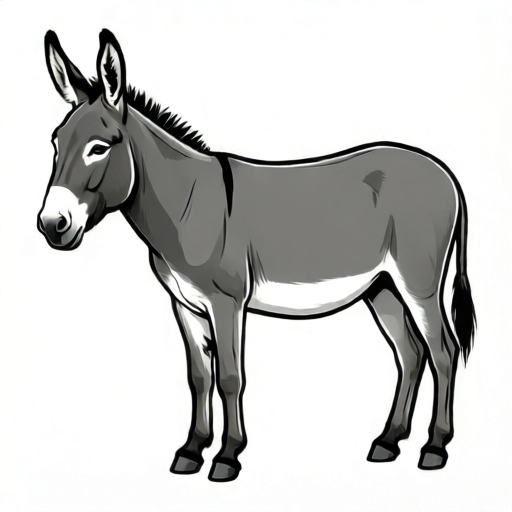
Use the stated measurements and conventions for each exercise.
Build the body mass and set the x-height
Start with a soft oval for the barrel, tilted slightly so the chest is lower than the rump. Mark a baseline under the hooves and a midline through the oval. The distance from baseline to midline is your x-height for this drawing; use it to compare ear length, muzzle depth, and leg length. Because letter styles vary, choose a comfortable x-height for your paper and keep it consistent.
Add a smaller oval for the hindquarter and a rounded wedge for the chest. Keep the back line gently dipped behind the withers and slightly hollow before the rump. These masses are guides, not final contours.
- Draw a light baseline and a midline through the body oval.
- Measure baseline-to-midline and label it x-height.
- Add hindquarter and chest masses, checking they sit on the same baseline.
- Compare the body length to x-height; a common hypothetical range is 2.5 to 3 x-heights.
Place the long ear angle and muzzle contour
Donkeys have long ears that often angle outward and slightly back from the head. Draw the head as a tapered wedge from the neck, then add the ear as a long leaf shape. Measure the ear length against x-height; a hypothetical example is 0.8 to 1.1 x-heights, but adjust to your chosen style. The muzzle is blunt and slightly squared, not pointed like a horse. Shape the contour with a gentle curve down from the forehead, a soft stop, and a rounded nose.
Check the ear angle by drawing a line from ear base to tip and comparing it with the neck line. Valid alternatives include ears more upright or more relaxed, as long as the long-ear proportion and outward angle read clearly.
- Draw the head wedge from neck to nose.
- Add the ear leaf shape and measure its length against x-height.
- Shape the muzzle with a blunt, rounded contour.
- Check that the ear tip does not overlap the back line unless your pose intends it.
Set leg joint placement and ground contact
Place front and hind legs using joint landmarks: shoulder, elbow, knee, hock, and hoof. In side profile, the front leg should drop from the shoulder with a slight bend at the knee; the hind leg angles from the hip to the hock, then down to the hoof. Use the baseline to keep hooves level unless the pose is walking. Measure leg length from body underside to baseline and compare with x-height; a hypothetical range is 1.2 to 1.6 x-heights.
Keep the cannon bones short and the hooves small and neat. Check that the elbow sits behind the chest and the hock sits below the rump. Adjust joint positions before darkening lines.
- Mark shoulder, elbow, knee, hock, and hoof points lightly.
- Draw front leg with a slight knee bend and hind leg with a clear hock angle.
- Check hooves meet the baseline evenly for a standing pose.
- Compare leg length to x-height and adjust if needed.
Refine contours and check the whole profile
Once masses and joints are placed, refine the neck, back, belly, and tail. The neck should be thick and short compared with a horse, and the tail tuft sits at the end of a thin tail. Check the silhouette: long ears, blunt muzzle, level hooves, and a body that reads as a donkey rather than a horse or mule. Use the rubric to score proportion, placement, and clarity, and allow valid alternatives in ear angle and leg stance.
- Refine neck and back lines without changing the main masses.
- Add tail and small details after placement is checked.
- Score the drawing with the rubric and note one adjustment.
- Redraw one section if a check fails.
Worked example
A donkey stands in side profile on a baseline. The body oval has a midline 4 cm above the baseline, so x-height is 4 cm. The ear measures 4 cm, the muzzle depth is 2 cm, and the leg length from body underside to baseline is 6 cm. Check the proportions and state one adjustment.
Worked answer
Ear length is 1.0 x-height, within the hypothetical 0.8 to 1.1 range. Muzzle depth is 0.5 x-height, acceptable for a blunt muzzle. Leg length is 1.5 x-heights, within the hypothetical 1.2 to 1.6 range. No adjustment is required, but if the ear looked short, lengthen it slightly while keeping the outward angle.
Four practice exercises
Exercise 1
A side-profile donkey has x-height 5 cm. The ear is 6 cm, the muzzle depth is 3 cm, and the leg length is 7 cm. Using the hypothetical ranges in the lesson, check each proportion and state whether any adjustment is needed.
Show answer and check
Ear is 1.2 x-heights, above the hypothetical 0.8 to 1.1 range, so shorten slightly or accept as a stylistic choice. Muzzle is 0.6 x-height, acceptable. Leg is 1.4 x-heights, within 1.2 to 1.6. Adjust the ear if strict range is required.
Why: Divide each measurement by x-height: 6/5=1.2, 3/5=0.6, 7/5=1.4. Compare with the stated ranges.
Check: Re-measure x-height and each part with the same ruler, then recalculate the ratios.
Exercise 2
A drawing shows a donkey with a pointed muzzle, ears 0.5 x-height long, and hooves 1 cm above the baseline. Identify two mistakes and give a fix for each.
Show answer and check
Mistake one: pointed muzzle; fix by blunting the contour and rounding the nose. Mistake two: short ears; fix by lengthening to about 0.8 to 1.1 x-height with an outward angle. Also lower hooves to the baseline.
Why: Compare the described features with the lesson checks for muzzle shape, ear length, and ground contact.
Check: Redraw the head and legs lightly, then measure ear length and hoof contact against the baseline.
Exercise 3
You are drawing a walking donkey in side profile. The front hooves are 2 cm apart along the baseline and the hind hooves are 3 cm apart. X-height is 4 cm. Describe how to place the leg joints so the pose reads as walking, and give one check.
Show answer and check
Place the front leg forward with shoulder, elbow, and knee aligned toward the forward hoof; place the hind leg back with a clear hock angle toward the rear hoof. Keep joint spacing consistent with the hoof spacing. Check that the body mass stays centered over the supporting legs and that no hoof floats above the baseline.
Why: Walking poses shift hoof positions along the baseline; joints must follow the hoof targets while keeping the body balanced.
Check: Draw vertical guide lines from each hoof to its joint chain and confirm the lines meet the intended joint points.
Exercise 4
A donkey side profile has body length 12 cm and x-height 4 cm. The ear is 4 cm and the leg length is 5 cm. Check body length, ear, and leg against the hypothetical ranges, and state one valid alternative for ear angle.
Show answer and check
Body length is 3.0 x-heights, within the hypothetical 2.5 to 3 range. Ear is 1.0 x-height, within 0.8 to 1.1. Leg is 1.25 x-heights, within 1.2 to 1.6. A valid alternative is a more upright ear angle, as long as the ear remains long and clearly outward.
Why: Divide each measurement by x-height: 12/4=3.0, 4/4=1.0, 5/4=1.25. Compare with the lesson ranges.
Check: Re-measure with the same ruler and confirm the ratios; check the ear angle against the neck line.
Common mistakes
- Drawing horse-like pointed muzzle and short ears. Lengthen the ear to about 0.8 to 1.1 x-heights and blunt the muzzle with a rounded nose.
- Placing hooves above or below the baseline unevenly. Re-measure from body underside to baseline and adjust joint points so standing hooves meet the line.
- Making legs too long or too thin for the body mass. Compare leg length to x-height and thicken the upper leg to match the barrel.
- Ear angle pointing straight up like a rabbit. Angle the ear outward and slightly back, checking the base-to-tip line against the neck.
Self-check rubric
- Body mass sits on the baseline with a clear midline and consistent x-height.
- Ear length and outward angle read as a long donkey ear, with valid alternatives allowed.
- Muzzle contour is blunt and rounded, not pointed.
- Leg joints are placed at shoulder, elbow, knee, hock, and hoof with hooves meeting the baseline for a standing pose.
- Overall silhouette reads as a donkey side profile, not a horse or mule.
Questions and answers
How long should the ears be?
Use x-height as your unit. A hypothetical range is 0.8 to 1.1 x-heights, but adjust for your chosen style and pose.
What makes the muzzle read as a donkey?
A blunt, slightly squared contour with a rounded nose and a soft stop, rather than a pointed horse muzzle.
Where should the hock sit?
Below the rump, with a clear angle from hip to hock and then down to the hoof. Check it against the hindquarter mass.
Can I change the ear angle?
Yes. Valid alternatives include more upright or more relaxed ears, as long as the long-ear proportion and outward angle are clear.