Free original lessons
Draw a Flowering Tree: Blossom Clusters and Branch Spread
Plan branch spread and place blossom clusters on a flowering tree drawing using a scaffold, petal reference, and clear placement rules.
Free lesson
Four exercises
Worked answers
Object Drawing Lessons
This lesson teaches a repeatable method for drawing a flowering tree with believable blossom clusters and a balanced branch spread. You will build a simple branch-spread scaffold, decide where clusters sit along each branch, and use a petal-shape reference to keep blossoms consistent without making them identical. All numerical values here are hypothetical examples you can adjust after measuring your own paper and tools. The goal is a clear, checkable drawing process rather than a single universal answer.
Practice materials: Printable downloads are not available for this lesson yet. Use the instructions and four exercises below.
Reference illustration
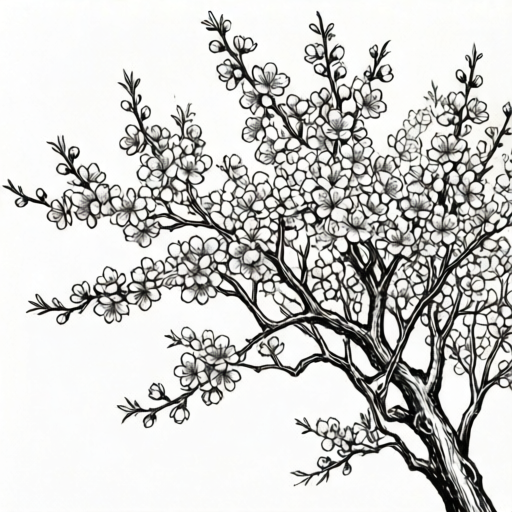
Use the stated measurements and conventions for each exercise.
Build the branch-spread scaffold
Start with a light trunk line and three to five main branches that spread outward and upward. Keep the crown width wider than the total trunk height so the tree reads as open rather than columnar. Mark a crown boundary with a faint oval or irregular loop; this is your placement guide, not a final outline.
Divide the crown into three zones: inner, middle, and outer. Inner zones hold fewer clusters because branches overlap; outer zones hold more because they face the viewer. Use a simple ratio such as 1 cluster inner, 2 middle, 3 outer as a hypothetical starting point, then adjust after measuring your actual paper size.
- Draw the trunk and main branches with light pressure.
- Add secondary branches that fork at roughly one-third and two-thirds along each main branch.
- Sketch a faint crown boundary and divide it into inner, middle, and outer zones.
- Mark cluster anchor points along branches, spacing them farther apart near the trunk and closer near the tips.
Place blossom clusters along branches
A blossom cluster is a small group of five to nine blossoms sharing one anchor point. Place clusters so they sit on or just above a branch line, never floating in empty space. Vary cluster size: larger clusters near the middle of a branch, smaller clusters at tips, to suggest depth.
Use the petal-shape reference to draw three or four petal outlines per blossom. Keep petal length consistent within one cluster. Petal width may vary between blossoms and between clusters, but keep each individual blossom symmetrical. Allow slight rotation of individual blossoms within a cluster.
- Choose an anchor point on a branch and draw a faint circle for the cluster boundary.
- Draw three to five blossoms inside the circle, each with three or four petals.
- Rotate each blossom slightly within the cluster, and let petal width vary between blossoms and clusters while keeping petal length consistent within the cluster.
- Repeat along the branch, leaving gaps so branch lines remain visible.
Refine spread and cluster balance
Check that no branch crosses another at a sharp angle without a visible fork. Trim or redraw crossing lines so the spread reads clearly. Compare cluster counts across zones; if one zone is crowded, remove a cluster rather than shrinking all blossoms.
Add a few loose petals near outer clusters to suggest movement, but keep them within the crown boundary. Finish by darkening trunk and main branches, then blossom outlines, so the structure stays readable.
- Review branch crossings and redraw any ambiguous forks.
- Count clusters per zone and adjust to your chosen ratio.
- Add loose petals only near outer clusters.
- Darken trunk, then branches, then blossoms in that order.
Worked example
A student draws a trunk 10 cm tall and a crown boundary 8 cm wide with 12 clusters: 6 inner, 3 middle, 3 outer. Identify two problems and state a fix for each.
Worked answer
Problem one: crown width (8 cm) is less than trunk height (10 cm), so the spread is too narrow. Fix: widen the boundary to about 12 cm. Problem two: inner zone has 6 clusters while outer has 3, reversing the intended depth ratio. Fix: move 3 clusters from inner to outer, giving 3 inner, 3 middle, 6 outer.
Four practice exercises
Exercise 1
A drawing has a trunk 12 cm tall and a crown boundary 9 cm wide. State whether the spread is too narrow and give a corrected width using the rule that crown width should exceed trunk height.
Show answer and check
Yes, 9 cm is less than 12 cm, so the spread is too narrow. A corrected width is 14 cm, which exceeds 12 cm.
Why: The rule compares crown width to trunk height directly. Since 9 is less than 12, the boundary must widen. Any value greater than 12 works; 14 cm is a simple choice.
Check: Compare the two numbers with the same unit: 14 cm > 12 cm, so the corrected width satisfies the rule.
Exercise 2
A student places 8 clusters in the inner zone, 4 in the middle, and 2 in the outer zone, for 14 clusters total. The intended pattern is that inner has the fewest clusters and outer has the most, with middle between them. State how many clusters to move and to which zones so that inner < middle < outer, keeping all zones nonempty.
Show answer and check
Move 5 clusters from inner to outer and 1 cluster from inner to middle. This gives 2 inner, 5 middle, 7 outer, and 2 + 5 + 7 = 14, so inner < middle < outer holds.
Why: The current counts (8, 4, 2) put the most clusters in the inner zone, which reverses the intended depth pattern. Removing 6 clusters from inner leaves 2 there. Adding 1 to middle makes 5, and adding 5 to outer makes 7. The order becomes 2 < 5 < 7, and the total stays 14.
Check: Add the final counts: 2 + 5 + 7 = 14, matching the original total. Then compare: 2 < 5 < 7, so inner has the fewest and outer the most.
Exercise 3
A cluster contains 6 blossoms. Each blossom has 4 petals. State the total petal count and explain how to check it without counting every petal individually.
Show answer and check
Total petals = 6 × 4 = 24. Check by grouping: count petals in two blossoms (8), then multiply by 3 groups to get 24.
Why: Multiplication gives the total directly. The check uses a smaller group and scaling, which is faster and less error-prone than counting all petals.
Check: Recount one blossom to confirm 4 petals, then multiply by the number of blossoms: 4 × 6 = 24.
Exercise 4
A branch line runs from the trunk to a tip 15 cm away. A student places clusters at 2 cm, 5 cm, 9 cm, and 14 cm from the trunk. State whether spacing is even and suggest one adjustment using the rule that spacing should increase toward the tip.
Show answer and check
Spacing is 3 cm, 4 cm, and 5 cm, which already increases toward the tip, so it is acceptable. No adjustment is required; if a change is desired, move the 14 cm cluster to 15 cm to place it at the tip.
Why: The gaps are 3, 4, and 5 cm, which increase toward the tip, matching the rule. The answer notes the rule is satisfied rather than forcing a change.
Check: Subtract consecutive positions: 5−2=3, 9−5=4, 14−9=5. Confirm the sequence 3, 4, 5 increases.
Common mistakes
- Clusters float between branches with no anchor point. Move each cluster so at least one blossom touches a branch line or sits just above it, close enough that the cluster clearly belongs to that branch.
- All blossoms are identical in size and rotation. Rotate each blossom slightly within its cluster, and vary petal width between blossoms and clusters while keeping petal length consistent within each cluster.
- Branch spread is narrower than the trunk height, making the tree look columnar. Widen the crown boundary until its width exceeds the trunk height, then redistribute clusters.
- Inner zone is as crowded as the outer zone. Remove clusters from the inner zone and add them near branch tips to restore depth.
Self-check rubric
- Branch spread: crown width clearly exceeds trunk height, with visible forks and no ambiguous crossings.
- Cluster placement: every cluster has an anchor point on or just above a branch line, with no clusters floating in empty space.
- Cluster balance: inner zone has fewer clusters than outer zone, matching the chosen ratio.
- Petal consistency: petal length is consistent within each cluster, with rotation and width variation allowed between blossoms and clusters.
- Readability: trunk, branches, and blossoms remain distinguishable after darkening.
Questions and answers
How many blossoms should one cluster contain?
Use five to nine blossoms per cluster as a hypothetical range. Fewer reads as sparse; more becomes a solid mass and hides branch lines.
Can I use a different petal shape?
Yes. The petal reference is a guide, not a rule. Any shape with three or four petals per blossom works if petal length stays consistent within a cluster.
What if my paper is small?
Measure your actual paper first, then scale the crown boundary and cluster count down. Keep the zone ratio the same so balance is preserved.
How do I check branch spread without a ruler?
Compare crown width to trunk height by eye using a pencil as a makeshift gauge, then adjust the boundary until width clearly exceeds height.