Free original lessons
Sauropod Drawing: Neck, Legs, and Tail Construction
Learn to draw a sauropod with a proportion guide, curved neck and tail steps, and a blank outline for independent practice.
Free lesson
Four exercises
Worked answers
Object Drawing Lessons
This lesson teaches a repeatable method for drawing a sauropod dinosaur with a long neck, columnar legs, and a tapering tail. You will use a simple skeletal proportion guide, construct the neck and tail as smooth curves, and place legs as vertical columns under the body. The approach favors clear structure over cartoon styling, so the result reads as a believable sauropod rather than a predatory dinosaur. All measurements are hypothetical examples; measure your own paper and tools before drawing. Work lightly in pencil so you can adjust proportions before committing to darker lines.
Practice materials: Printable downloads are not available for this lesson yet. Use the instructions and four exercises below.
Reference illustration
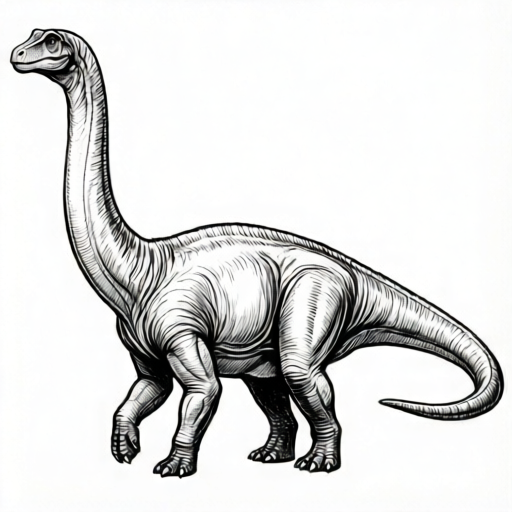
Use the stated measurements and conventions for each exercise.
Build a skeletal proportion guide
Start by drawing a faint horizontal baseline across the middle of your paper. Mark a body oval that is roughly twice as long as it is tall; this represents the torso. Place a small head circle at the far left, about one body-height above the baseline, and connect it to the torso with a gentle S-curve for the neck. Add a tapering tail curve from the right side of the torso, ending in a point about one body-length away. These are guides, not final lines.
Use a consistent unit for all measurements. For example, let one unit equal the width of your thumb. A hypothetical guide might use a torso 6 units long and 3 units tall, a neck 5 units long, and a tail 7 units long. Label these values on your guide so you can check them later. The exact numbers are yours to choose; the important part is that the neck and tail lengths are proportional to the torso and that the legs sit under the body's center of mass.
- Draw a faint baseline and mark the torso oval.
- Place the head circle and sketch the neck S-curve.
- Sketch the tail taper from the torso to a point.
- Label your unit measurements on the guide.
Construct the neck and tail curves
The neck should rise from the shoulders in a smooth arc, not a straight line. Draw it as two parallel curves that narrow toward the head. Keep the curve gentle: a sauropod neck is long but not kinked. The tail mirrors this idea, starting thick at the hips and tapering to a thin tip. Use a single continuous curve for the top of the tail and a second curve for the underside, meeting at the tip.
Check the curves by tracing them with your finger. If you feel a sharp corner, redraw that section with a lighter line. The neck and tail should feel balanced: if the neck curves left, the tail can counter-curve slightly right to keep the body visually stable. This is a drawing convention, not a rule about real anatomy, and valid alternatives include a straighter neck or a more drooping tail as long as the taper remains clear.
- Draw the neck as two narrowing parallel curves.
- Draw the tail as a thick-to-thin taper.
- Smooth any sharp corners with a lighter line.
- Balance the neck and tail curves visually.
Place columnar legs and finalize the body
Sauropod legs are columnar: roughly vertical, thick, and evenly spaced under the torso. Draw four legs as rounded rectangles or tapered cylinders. The front legs attach near the shoulders, the back legs near the hips. Keep the feet flat on a common ground line so the animal looks grounded. A hypothetical spacing might put the front legs 2 units apart and the back legs 3 units apart, but measure your own drawing to keep the stance stable.
Once the legs are placed, refine the body outline by connecting the neck, torso, and tail with smooth transitions. Add a simple eye and a small nostril on the head circle, but avoid cartoon features like large eyes or smiles. The goal is a clear, structured sauropod silhouette. Erase the guide lines gently and darken the final outline. Check that the legs support the body's weight visually: the torso should not appear to float above the ground line.
- Draw four columnar legs under the torso.
- Align the feet on a common ground line.
- Connect neck, torso, and tail smoothly.
- Erase guides and darken the final outline.
Worked example
Using a hypothetical unit where the torso is 6 units long and 3 units tall, place a head 5 units above the baseline, draw a neck 5 units long, and a tail 7 units long. Describe the steps to construct the body outline.
Worked answer
Draw the baseline and torso oval (6 by 3 units). Mark the head circle 5 units above the baseline at the left. Sketch the neck as two narrowing curves from the shoulders to the head, keeping the length about 5 units. Sketch the tail from the hips to a point 7 units to the right, tapering gradually. Place four columnar legs under the torso, with feet on a common ground line. Connect the neck, torso, and tail with smooth transitions, then erase guides and darken the outline.
Four practice exercises
Exercise 1
A student draws a torso 8 units long and 4 units tall, a neck 6 units long, and a tail 9 units long. They place the head 6 units above the baseline. Check whether the neck length is proportional to the torso and describe one adjustment if needed.
Show answer and check
The neck is 6 units and the torso is 8 units, so the neck is 0.75 of the torso length. This is a reasonable proportion. No adjustment is needed unless the neck looks too short; if so, extend it to 7 units.
Why: Compare neck length to torso length using the same unit. A ratio between 0.6 and 1.0 is visually balanced for a sauropod guide.
Check: Measure the neck and torso on the drawing with the same unit and divide neck by torso. Confirm the result is between 0.6 and 1.0.
Exercise 2
A drawing shows a tail that starts 3 units thick at the hips and ends 2 units thick at the tip after 7 units of length. Identify the problem and state a fix using the taper convention.
Show answer and check
The tail does not taper enough; it should narrow gradually to a point. Fix by redrawing the tail so the thickness decreases steadily from 3 units at the hips to about 0.5 units near the tip.
Why: A sauropod tail tapers from thick to thin. A tip that is 2 units thick is too blunt for the convention used in this lesson.
Check: Measure the tail thickness at the hips and near the tip. The tip should be noticeably thinner, ideally less than one-quarter of the hip thickness.
Exercise 3
A student places the front legs 4 units apart and the back legs 6 units apart under a torso 8 units long. The feet are on different ground lines. Describe two fixes to make the stance stable.
Show answer and check
First, move the legs inward so the front legs are about 2 units apart and the back legs about 3 units apart, keeping them under the torso. Second, align all feet on a single ground line.
Why: Columnar legs should sit under the body's center of mass and share a ground line so the animal looks grounded.
Check: Check that each leg's top is under the torso oval and that the bottom of each foot touches the same horizontal line.
Exercise 4
A neck is drawn as a straight line 5 units long with a sharp corner at the shoulders. Using the curve convention, describe how to redraw it and how to check the result.
Show answer and check
Redraw the neck as two narrowing parallel curves that rise smoothly from the shoulders to the head, keeping the length about 5 units. Check by tracing the curve with your finger; there should be no sharp corner.
Why: The lesson convention uses smooth S-curves for the neck to avoid kinks and to show the neck narrowing toward the head.
Check: Trace the neck outline slowly; if you feel a corner, redraw that section with a lighter line and smooth the transition.
Common mistakes
- Drawing the neck as a straight line or with sharp kinks. Redraw the neck as a gentle S-curve using two narrowing parallel lines.
- Making the tail too short or too thick at the tip. Extend the tail to about one body-length and taper it gradually to a point.
- Placing legs too far apart or not under the body. Move the legs inward so they sit under the torso's center of mass and share a ground line.
- Adding cartoon features like oversized eyes or a smile. Keep the head simple with a small eye and nostril, focusing on structure over styling.
Self-check rubric
- Neck is drawn as a smooth curve that narrows toward the head.
- Tail tapers gradually from thick at the hips to a thin tip.
- Four columnar legs are placed under the torso and share a ground line.
- Body outline connects neck, torso, and tail without sharp corners.
- Head is simple, without cartoon styling.
- Proportions are consistent with the chosen unit measurements.
Questions and answers
Do I need to measure exactly?
No. The unit measurements are hypothetical examples. Choose your own consistent unit and check that the neck and tail are proportional to the torso.
Can I draw the neck straighter?
Yes. A straighter neck is a valid alternative as long as it narrows toward the head and connects smoothly to the shoulders.
How many legs should I show?
Draw four legs. If the animal is side-on, you may show two legs clearly and hint at the others behind, but keep the columnar shape.
What if my tail curves upward?
An upward tail curve is acceptable if the taper is clear and the tail balances the neck visually. There is no single universal answer.