Free original lessons
Draw a Sitting Dragon: Folded Legs and Curled Tail
Learn to draw a seated dragon with folded legs and a curled tail using clear pose construction, sequencing, and a simple proportion check.
Free lesson
Four exercises
Worked answers
Object Drawing Lessons
This guide teaches a reliable way to draw a dragon in a seated pose. The dragon rests on its haunches, front legs folded close to the chest, hind legs tucked under the body, and the tail curling around one side. You will build the pose from simple shapes, place the folded legs and tail in a clear order, and check proportions with a basic unit system. The method is flexible: you can change head shape, wing size, and tail curl direction while keeping the seated pose readable. All measurements are hypothetical examples; measure your own paper and tools before drawing.
Practice materials: Printable downloads are not available for this lesson yet. Use the instructions and four exercises below.
Reference illustration
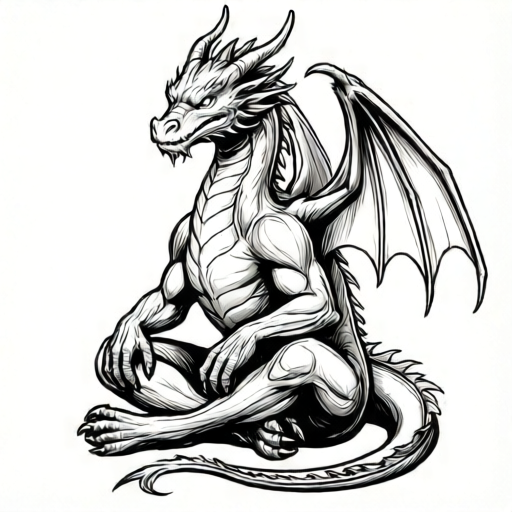
Use the stated measurements and conventions for each exercise.
Build the seated pose from simple shapes
Start with a vertical oval for the torso, tilted slightly back so the chest lifts. Add a smaller circle for the head above the torso, leaving a short neck gap. Draw a wide, low oval at the base for the hips and folded hind legs. This base oval should be about one and a half head widths wide and sit directly under the torso.
Place the front legs as two narrow rectangles or tapered shapes that fold inward toward the chest. The elbows sit near the lower torso, and the forepaws rest close together in front. Keep the front legs shorter than the torso so the dragon reads as sitting rather than standing.
Add the tail as a curved line starting from the lower back, sweeping around the base oval, and curling inward near the forepaws. The tail should not cross the front legs. Use a light pencil line first, then thicken it once the curl looks balanced.
- Draw a vertical torso oval about 8 cm tall on A4 paper (hypothetical example).
- Add a head circle about 4 cm wide above the torso, leaving a 1 cm neck gap.
- Draw a base oval about 6 cm wide (1.5 head widths) and about 4 cm tall under the torso for the hips.
- Sketch two folded front legs as tapered shapes from the lower torso to the chest.
- Draw the tail curve from the lower back around the base oval and curl it near the forepaws.
- Check that the tail does not overlap the front legs, then darken the final lines.
Sequence the leg folds and tail curl
Draw the hind legs first because they support the seated pose. Each hind leg folds under the body: the thigh is a rounded shape at the side of the base oval, the knee points forward, and the lower leg tucks back under the hip. Keep both hind legs roughly symmetrical unless the tail curl or a slight lean calls for asymmetry.
Next, draw the front legs. Fold them so the elbows point down and slightly outward, and the forepaws rest near the center of the chest. The fold should look compact, not stretched. A common error is making the front legs too long, which makes the dragon look like it is standing.
Finally, draw the tail curl. Begin at the lower back, curve around the outside of the base oval, and bring the tip inward toward the forepaws. The curl should form a loose spiral or hook. Leave a small gap between the tail and the body so the tail reads as separate.
- Sketch the hind thigh as a rounded shape at each side of the base oval.
- Add the hind knee pointing forward and the lower leg tucked under the hip.
- Draw the front elbows near the lower torso and the forepaws near the chest center.
- Start the tail at the lower back and curve it around the base oval.
- Curl the tail tip inward toward the forepaws, leaving a small gap from the body.
- Compare the tail curl on both sides and adjust for balance.
Check proportions with a simple unit system
Use the head width as one unit. In a typical seated dragon, the torso is about two head widths tall, the base oval is about one and a half head widths wide, and the tail curl spans about two head widths. These are hypothetical proportions; adjust them to your design.
Measure your drawing with a ruler or by marking the head width on a strip of paper. Check that the torso is not taller than three head widths, which would make the dragon look stretched. Check that the base oval is wide enough to support the hips.
The folded legs should fit inside the base oval and torso area. If a leg extends beyond the base oval, shorten it or widen the base. The tail curl should stay outside the front legs and not cross them.
- Mark the head width on a strip of paper as one unit.
- Measure the torso height and compare it to two head widths.
- Measure the base oval width and compare it to one and a half head widths.
- Check that the folded legs stay within the base oval and torso area.
- Check that the tail curl stays outside the front legs.
Refine the silhouette and line quality
Once the pose is clear, refine the silhouette. The back should curve gently from the head to the tail base. The chest should lift slightly. The folded legs should create a compact, grounded shape.
Use a consistent line weight for the body and a slightly thicker line for the tail curl to separate it from the body. Avoid full-body scale texture; this task focuses on pose, not surface detail. A few simple lines for the belly or wing edge are enough.
Check the drawing from a distance. The seated pose should be readable: hips low, front legs folded, tail curled. If the pose looks like a standing or flying dragon, adjust the base oval and leg folds.
- Smooth the back curve from head to tail base.
- Lift the chest slightly to show the seated posture.
- Thicken the tail curl line to separate it from the body.
- Add only minimal detail lines for the belly or wing edge.
- View the drawing from a distance and confirm the seated pose reads clearly.
Worked example
A dragon sits with its torso upright, front legs folded near the chest, hind legs tucked under the hips, and tail curling around the right side. The head is about 4 cm wide. The torso is about 8 cm tall, the base oval is about 6 cm wide, and the tail curl spans about 8 cm. Check the proportions using the head width as one unit.
Worked answer
Head width = 1 unit (4 cm). Torso height = 2 units (8 cm), which fits the suggested two head widths. Base oval width = 1.5 units (6 cm), which fits the suggested one and a half head widths. Tail curl span = 2 units (8 cm), which fits the suggested two head widths. The pose is consistent: hips low, front legs folded, tail curling around the right side without crossing the front legs.
Four practice exercises
Exercise 1
A dragon sits with a head width of 5 cm. The torso is 10 cm tall, the base oval is 7.5 cm wide, and the tail curl spans 10 cm. Using the head width as one unit, state the torso height, base oval width, and tail curl span in units, and say whether they match the suggested proportions of two, one and a half, and two units.
Show answer and check
Torso height = 2 units (10 cm). Base oval width = 1.5 units (7.5 cm). Tail curl span = 2 units (10 cm). All three match the suggested proportions.
Why: Divide each measurement by the head width: 10 ÷ 5 = 2, 7.5 ÷ 5 = 1.5, and 10 ÷ 5 = 2. Compare each result to the suggested values.
Check: Re-measure the head width and each part with a ruler. Confirm the divisions are correct and the units are consistent.
Exercise 2
A seated dragon has a torso 12 cm tall and a head width of 4 cm. The base oval is 5 cm wide. Using the head width as one unit, state the torso height and base oval width in units. Identify which of these two measurements deviates from the suggested target values (torso about two units, base oval about one and a half units) and suggest one adjustment.
Show answer and check
Torso height = 3 units (12 ÷ 4 = 3), which is above the suggested target of 2 units but at the stated maximum of three head widths. Base oval width = 1.25 units (5 ÷ 4 = 1.25), below the suggested target of 1.5 units. Both deviate from the suggested targets; one adjustment is to shorten the torso to about 8 cm (2 units) or widen the base oval to about 6 cm (1.5 units).
Why: Divide each measurement by the head width: 12 ÷ 4 = 3 and 5 ÷ 4 = 1.25. Compare each result to the suggested targets of 2 units for the torso and 1.5 units for the base oval. The torso is at the maximum acceptable limit but above the target, and the base oval is below the target, so either part can be adjusted to bring the pose closer to the suggested proportions.
Check: Measure the torso and base oval again after adjustment. Confirm the torso is about two head widths (and no more than three) and the base oval is about one and a half head widths, using the same head-width unit throughout.
Exercise 3
A dragon sits with its tail curling around the left side. The tail curve starts at the lower back, sweeps around the base oval, and the tip points toward the forepaws. The front legs are folded near the chest. Describe one mistake that would make the pose unclear and how to fix it.
Show answer and check
A common mistake is drawing the tail across the front legs. This hides the folded pose. Fix it by routing the tail around the outside of the base oval and curling the tip near the forepaws without crossing them.
Why: The tail should stay outside the front legs so the folded pose remains visible. Crossing the legs obscures the key feature of the task.
Check: Trace the tail line with your finger. Confirm it does not overlap the front legs and that the curl stays outside the base oval.
Exercise 4
A dragon sits with a head width of 3 cm. The torso is 6 cm tall, the base oval is 4.5 cm wide, and the tail curl spans 6 cm. The front legs are folded, but one forepaw extends 2 cm beyond the base oval. State whether the leg fold is consistent with the pose and suggest a fix.
Show answer and check
The proportions match the suggested values: torso = 2 units, base oval = 1.5 units, tail curl = 2 units. However, the forepaw extending 2 cm beyond the base oval makes the fold look stretched. Shorten the front leg by about 2 cm or widen the base oval by about 2 cm so the forepaw stays within the horizontal footprint of the torso and base oval.
Why: The folded legs should fit within the horizontal footprint of the base oval and torso area. A forepaw extending 2 cm beyond the base oval breaks the compact seated shape, so the overhang should be reduced by shortening the leg or widening the base.
Check: Measure the forepaw position relative to the base oval. After adjustment, confirm the forepaw rests near the chest center and stays within the horizontal footprint of the torso and base oval, with no more than a small overhang.
Common mistakes
- Making the front legs too long, so the dragon looks like it is standing. Shorten the front legs and fold the elbows closer to the torso. Keep the forepaws near the chest center.
- Drawing the tail across the front legs, which hides the folded pose. Route the tail around the outside of the base oval and curl it near the forepaws without crossing them.
- Making the base oval too small, so the hips and hind legs look unstable. Widen the base oval to about one and a half head widths and tuck the hind legs inside it.
- Adding full-body scale texture before the pose is clear. Finish the pose and silhouette first. Add only minimal detail lines until the seated shape reads correctly.
Self-check rubric
- Seated pose is clear: hips low, torso upright, dragon not standing or flying.
- Front legs are folded close to the chest and forepaws rest near the center.
- Hind legs are tucked under the hips and fit within the base oval.
- Tail curls around one side and does not cross the front legs.
- Proportions are checked with a consistent unit system and adjusted as needed.
- Silhouette is readable from a distance and line quality is consistent.
- Minimal detail is used; full-body scale texture is avoided.
Questions and answers
Can the tail curl to either side?
Yes. The tail can curl left or right as long as it stays outside the front legs and does not cross them. Choose one side and keep the curl consistent.
How do I know if the dragon looks seated?
Check that the hips are low, the front legs are folded close to the chest, and the tail curls around the base. If the legs look stretched, shorten them.
Do I need to draw wings?
Wings are optional. If you add them, keep them folded or partially folded so they do not change the seated pose. The focus is folded legs and tail curl.
What if my proportions look wrong?
Use the head width as one unit. Compare the torso, base oval, and tail curl to the suggested proportions, then adjust one part at a time.