Free original lessons
Draw a Faceted Stone with Clear Planes and Shading
Learn to construct a single faceted stone using plane breaks, a fixed light direction, and graded tonal shading. Includes a worked example, four practice tasks, and a validation plan.
Free lesson
Four exercises
Worked answers
Object Drawing Lessons
This lesson teaches a reliable method for drawing one faceted stone as a solid form. You will define a light direction, build the stone from a few flat planes, and shade each plane according to its angle to the light. The goal is clarity of form, not realistic rock texture or landscape context. All measurements are hypothetical examples; measure your own paper and tools before drawing. The convention for any lettering or labels is simple: use clear uppercase print with x-height measured from baseline to midline, and accept any legible style that meets the rubric.
Practice materials: Printable downloads are not available for this lesson yet. Use the instructions and four exercises below.
Reference illustration
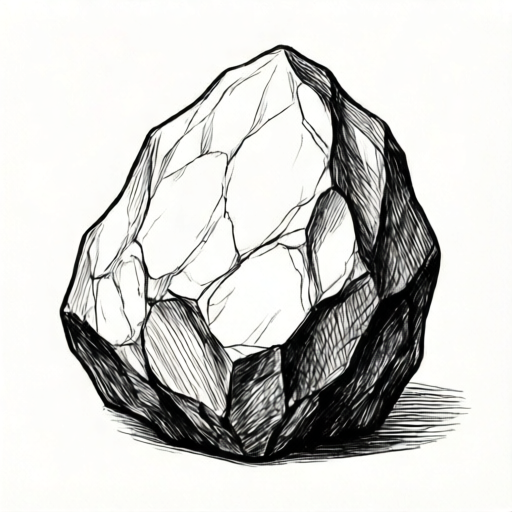
Use the stated measurements and conventions for each exercise.
Set the light direction and the stone outline
Choose one light direction and state it in words before drawing, for example 'light from upper left, about 45 degrees above the paper'. Keep this direction fixed for the whole drawing so every facet can be checked against it.
Draw a single closed outline that fits inside a rectangle you measure on your paper. A hypothetical example is a 10 cm by 7 cm bounding rectangle, but use your actual paper size. The outline should suggest a chunky stone with a few straight-ish edges rather than a perfect circle.
- Measure and lightly mark a bounding rectangle for the stone.
- Draw one closed outline inside the rectangle, keeping the stone as a single form.
- Write the light direction in the margin using clear uppercase print.
- Check that the outline has at least four distinct edge changes where facets can meet.
Break the form into facet planes
Facets are flat planes. Draw three to six internal lines that connect outline points or meet at a shared vertex. Each enclosed region is one facet. Avoid curves inside the stone; keep the plane breaks straight or gently angular.
Label each facet with a letter or number using the same clear print convention. This lets you compare tones and fix mistakes without redrawing the whole stone.
- Draw internal plane lines from outline points toward a central area.
- Keep each facet region large enough to shade with a pencil.
- Label facets A, B, C and so on in clear uppercase print.
- Check that no facet line floats without touching another line or the outline.
Assign tones by angle to the light
Decide a simple three-level tone scale: light, middle, dark. A facet facing the light gets the light tone; a facet angled away gets middle; a facet facing away gets dark. Use only these three levels at first so the form reads clearly.
Shade each facet evenly with pencil strokes in one direction. Keep edges crisp where facets meet. If two adjacent facets get the same tone, adjust one slightly so the plane break remains visible.
- List each facet label and write L, M or D beside it based on the light direction.
- Shade each facet evenly, keeping the tone inside its boundary.
- Leave the lightest facet mostly paper-white with only light strokes.
- Check the drawing from a distance: the stone should look solid, not flat.
Refine edges and check the whole form
Strengthen the outline slightly and keep internal facet lines thinner so the stone reads as one object. Do not add rock texture, cracks, or background scenery; the brief excludes those.
Use a simple check: cover the labels and ask whether the light direction is still obvious. If not, adjust one or two tones rather than redrawing everything.
- Darken the outer outline a little more than internal lines.
- Erase labels only after the tone check is complete.
- Compare the final drawing to the stated light direction.
- Record any tone changes you made so the drawing can be repeated.
Worked example
A stone is drawn inside a 10 cm by 7 cm bounding rectangle with light from upper left. It has four facets: A faces upper left, B faces upper right, C faces lower left, D faces lower right. Assign tones and explain the shading.
Worked answer
Facet A gets light tone because it faces the light. Facet B gets middle tone because it angles away to the right. Facet C gets middle tone because it angles down but still catches some light. Facet D gets dark tone because it faces away from the upper-left light. Shade each facet evenly, keep edges crisp, and check that A is lightest and D is darkest.
Four practice exercises
Exercise 1
Draw a stone with exactly three facets inside a 9 cm by 6 cm bounding rectangle. State light from upper right. Label facets A, B, C and assign light, middle, or dark tone.
Show answer and check
A sample valid answer: facet A faces upper right and is light; facet B faces lower right and is middle; facet C faces left and is dark. The outline is one closed form and the three facets meet at a shared internal point.
Why: With light from upper right, the facet most facing that direction receives the light tone, the side facet receives middle, and the away-facing facet receives dark. Three facets keep the form simple and checkable.
Check: Confirm the bounding rectangle is measured, the outline is closed, exactly three facets are labeled, and the lightest facet faces upper right while the darkest faces away.
Exercise 2
A stone has four facets: A faces upper left, B faces upper right, C faces lower left, D faces lower right. Light comes from upper left. Assign tones and describe one adjustment if B and C look too similar.
Show answer and check
A is light, B is middle, C is middle, D is dark. If B and C look too similar, darken C slightly or lighten B slightly so the plane break remains visible.
Why: A faces the light directly, D faces away, and B and C are side-facing. Adjacent facets need a visible tone difference, so one middle tone can be adjusted.
Check: Check that A is lightest, D is darkest, and B and C differ by at least a slight tone change. Confirm the light direction is written in the margin.
Exercise 3
Draw a stone with five facets and use only two tone levels plus paper white. State light from directly above. Explain how you keep the form readable with limited tones.
Show answer and check
A sample valid answer: top-facing facets stay paper white, side-facing facets get middle tone, and one lower facet gets dark tone. The form reads because the top is lightest and the lower side is darkest, with middle tones separating them.
Why: Limited tones force clear grouping: top faces light, sides middle, lower away-facing dark. The plane breaks and outline carry the form when tones are few.
Check: Confirm five labeled facets, a stated overhead light direction, and that the topmost facet is lightest while the lowest away-facing facet is darkest.
Exercise 4
Draw a stone with four facets inside a 12 cm by 8 cm rectangle. Light from lower left. Label facets and write a one-sentence check that proves the shading matches the light direction.
Show answer and check
A sample valid answer: the facet facing lower left is light, the two side facets are middle, and the upper-right-facing facet is dark. Check sentence: 'The lightest facet faces lower left and the darkest faces upper right, matching the stated light direction.'
Why: The light direction determines which facet is lightest and which is darkest. A written check makes the reasoning visible and easy to verify.
Check: Measure the rectangle, confirm four labeled facets, and read the check sentence against the drawing to see that lightest and darkest facets match lower-left light.
Common mistakes
- Drawing many small curved facets that look like texture rather than planes. Reduce to three to six straight-ish facet regions and shade each one evenly.
- Changing the light direction partway through shading. Write the light direction in the margin first and check every facet against it.
- Making all facets the same tone so the stone looks flat. Use the three-level scale and ensure adjacent facets differ by at least one level.
- Adding background landscape or boulder clusters that break the brief. Keep the page to one stone form and its facet labels only.
Self-check rubric
- One single stone form is drawn with a closed outline and no background context.
- Three to six facet planes are clearly separated by internal lines that connect to the outline or to each other.
- A single light direction is stated and consistently applied to all facets.
- At least three distinct tone levels are used, and adjacent facets differ enough to show the plane break.
- Labels or notes use clear uppercase print with x-height from baseline to midline; any legible style is accepted.
- No rock texture, cracks, boulder clusters, or landscape elements are added.
Questions and answers
How many facets should the stone have?
Three to six is a practical range for a clear single stone. More facets can work if each remains large enough to shade evenly.
Do I need a ruler?
A ruler helps measure the bounding rectangle, but freehand straight-ish lines are acceptable if the facet planes remain clear.
What if my stone outline is not symmetrical?
Asymmetry is fine. The method depends on plane breaks and consistent light direction, not on a perfect shape.
Can I use cross-hatching instead of single-direction strokes?
Yes, if each facet still reads as one even tone. The rubric checks tone separation, not stroke style.