Free original lessons
American Bully Drawing Guide: Head, Build, and Stance
Learn to draw an American Bully with breed-specific head proportions, muscular build, and a stable stance using a simple measurement convention.
Free lesson
Four exercises
Worked answers
Object Drawing Lessons
This guide teaches a repeatable method for drawing an American Bully that reads as breed-specific rather than a generic dog. You will use a defined measurement convention: the dog's standing height at the withers is divided into eight equal units called head-units (HU). All proportions below are expressed in HU so you can scale the drawing to any paper size. All HU values in this guide are hypothetical examples chosen for practice, not breed standards; measure your own reference if you have one. The American Bully is characterized by a broad, blocky head with a pronounced cheek muscle, a short muzzle, a thick neck, a wide and muscular chest, and a compact, powerful stance with forelegs set fairly wide. Work lightly in pencil, check each stage against the stated ratios, and adjust before adding detail. The method separates head construction, build construction, and stance construction so you can diagnose problems stage by stage. Letter styles and line quality vary between artists; the rubric rewards correct proportion and clear breed signals, not a single universal rendering.
Practice materials: Printable downloads are not available for this lesson yet. Use the instructions and four exercises below.
Reference illustration
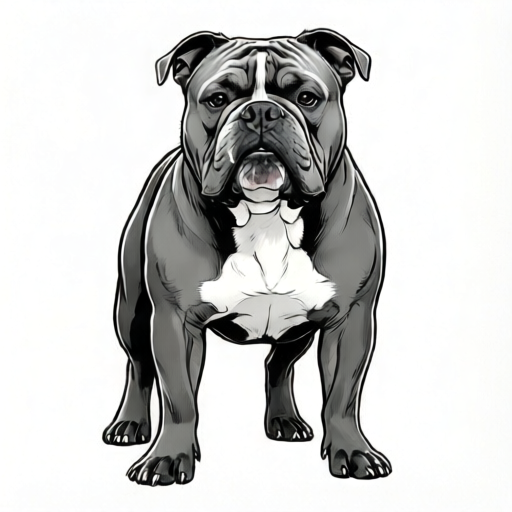
Use the stated measurements and conventions for each exercise.
Head construction: blocky skull and short muzzle
Begin with the head as a rounded rectangle rather than a circle. In HU, the skull width at the widest point (across the cheek muscles) is about 1.1 HU, and the skull length from the back of the head to the stop (the dip between forehead and muzzle) is about 0.7 HU. The muzzle is short: from stop to nose tip is about 0.35 HU, and muzzle width is about 0.45 HU. These values are hypothetical examples chosen for practice; measure your own reference if you have one.
Place the eyes on a line about one-third down the skull from the top. Eyes are set wide, roughly 0.45 HU apart, and are small relative to the skull. Ears are set high and wide; cropped or natural ears are both valid, so choose one and keep it consistent. The jawline should be strong with a broad lower jaw; the bite should be a scissor bite, not undershot.
- Draw a rounded rectangle 1.1 HU wide and 0.7 HU long for the skull.
- Mark the stop at the front center, then add a short muzzle 0.35 HU long and 0.45 HU wide.
- Place the eye line one-third down the skull and set eyes 0.45 HU apart.
- Add high, wide ear bases and a broad lower jaw, then check that muzzle length is less than half the skull length.
Build construction: thick neck, wide chest, compact body
The neck is thick and short, about 0.5 HU long and 0.6 HU wide at the base. The chest is the widest part of the body: about 1.4 HU across at the ribs, with a deep brisket that reaches roughly 0.45 HU below the elbow line. The body length from chest front to rump is about 2.2 HU, making the dog compact rather than long. The back line is fairly straight with a slight rise over the loin.
Muscle is shown by contour, not by shading alone. Use broad, smooth curves for the shoulder and thigh, and keep the belly line tucked but not thin. The overall silhouette should read as heavy and powerful while remaining balanced.
- Draw the neck as a short thick column 0.5 HU long and 0.6 HU wide.
- Block the chest 1.4 HU wide and set the brisket 0.45 HU below the elbow line.
- Mark body length at 2.2 HU from chest front to rump and keep the back line nearly straight.
- Refine shoulder and thigh contours with broad curves, then compare chest width to head width (chest should be wider).
Stance construction: wide, stable, and powerful
A correct American Bully stance is stable and square. Forelegs are set wide, roughly 0.7 HU apart at the paws, and are vertical from elbow to paw. Hind legs are also set wide, about 0.8 HU apart, with a moderate bend at the hock. Paws are compact and point forward. The topline from withers to tail base stays level, and the tail is set moderately high.
Check the stance by drawing vertical guide lines from each elbow and each hock to the ground. If a paw falls far outside its guide, adjust the leg. The dog should look planted, not stretched or crouched.
- Draw a ground line and mark forepaw positions 0.7 HU apart and hind paw positions 0.8 HU apart.
- Draw vertical guides from elbows and hocks to the ground line.
- Set the topline level from withers to tail base and place the tail moderately high.
- Check that all four paws sit on the ground line and that leg guides are close to vertical.
Checking and refining the drawing
Before adding detail, verify the three key ratios: skull width is about 1.1 HU, chest width is about 1.4 HU, and body length is about 2.2 HU. If chest width is less than skull width, the dog will read as a different breed. If body length exceeds 2.5 HU, the dog will look too long. Use a light pencil to mark HU on the page edge so you can compare quickly.
Refine line quality last. Keep contour lines smooth and confident, and avoid over-shading. The rubric rewards correct proportion, clear breed signals, and a stable stance; stylistic choices such as ear type or line weight are acceptable alternatives.
- Mark HU on the page edge and measure skull, chest, and body length.
- Compare chest width to skull width and adjust if chest is narrower.
- Check body length against 2.2 HU and shorten or lengthen as needed.
- Refine contours and erase construction guides, then self-score with the rubric.
Worked example
A drawing uses HU = 2 cm. The skull is drawn 2.0 cm wide, the chest 2.6 cm wide, and body length 4.6 cm. Check these against the guide values (skull 1.1 HU, chest 1.4 HU, body 2.2 HU) and state adjustments.
Worked answer
Skull: 2.0 cm ÷ 2 cm = 1.0 HU, slightly narrow; widen to about 2.2 cm (1.1 HU). Chest: 2.6 cm ÷ 2 cm = 1.3 HU, slightly narrow; widen to about 2.8 cm (1.4 HU). Body length: 4.6 cm ÷ 2 cm = 2.3 HU, slightly long; shorten to about 4.4 cm (2.2 HU). After adjustment, chest (2.8 cm) is wider than skull (2.2 cm), and body length is 2.2 HU.
Four practice exercises
Exercise 1
A sketch has HU = 3 cm. The skull is 3.6 cm wide, the chest is 3.9 cm wide, and body length is 6.9 cm. Convert each to HU and state whether each matches the guide values (skull 1.1 HU, chest 1.4 HU, body 2.2 HU).
Show answer and check
Skull: 3.6 ÷ 3 = 1.2 HU (slightly wide; target 1.1 HU). Chest: 3.9 ÷ 3 = 1.3 HU (slightly narrow; target 1.4 HU). Body: 6.9 ÷ 3 = 2.3 HU (slightly long; target 2.2 HU).
Why: Divide each measurement by HU to express it in head-units, then compare with the guide values. The chest is 1.3 HU and the skull is 1.2 HU; the chest is wider than the skull but still below the 1.4 HU target, so widen the chest slightly.
Check: Recompute each division and confirm chest HU is greater than skull HU after adjustment.
Exercise 2
A drawing has forepaws 1.4 cm apart and hind paws 1.6 cm apart, with HU = 2 cm. Convert to HU and compare with the stance guide (forepaws 0.7 HU, hind paws 0.8 HU).
Show answer and check
Forepaws: 1.4 ÷ 2 = 0.7 HU (matches). Hind paws: 1.6 ÷ 2 = 0.8 HU (matches).
Why: Divide each paw spacing by HU. Both results equal the guide values, so the stance width is correct.
Check: Multiply each HU value by 2 cm to recover the original spacing and confirm the arithmetic.
Exercise 3
A sketch has a muzzle 1.2 cm long and a skull 2.4 cm long, with HU = 2 cm. Convert both to HU and check whether the muzzle is shorter than half the skull length, as required.
Show answer and check
Muzzle: 1.2 ÷ 2 = 0.6 HU. Skull: 2.4 ÷ 2 = 1.2 HU. Half the skull is 0.6 HU, so the muzzle is equal to half, not shorter; shorten the muzzle to about 0.35 HU (0.7 cm).
Why: The guide requires muzzle length about 0.35 HU and less than half skull length. Here the muzzle equals half the skull, so it is too long for the breed-specific head.
Check: After shortening, divide the new muzzle length by HU and confirm it is less than half the skull HU.
Exercise 4
A drawing has body length 5.0 cm and HU = 2.5 cm. Convert to HU and state whether it matches the guide value of 2.2 HU; if not, give a corrected length in cm.
Show answer and check
5.0 ÷ 2.5 = 2.0 HU, which is shorter than the guide 2.2 HU. Corrected length: 2.2 × 2.5 = 5.5 cm.
Why: Divide body length by HU to compare with the guide. The result is 2.0 HU, so lengthen the body to 2.2 HU, which is 5.5 cm at this scale.
Check: Multiply 2.2 HU by 2.5 cm to confirm 5.5 cm, then re-divide to recover 2.2 HU.
Common mistakes
- Drawing a long muzzle and narrow skull, which reads as a generic dog. Keep muzzle length at about 0.35 HU and skull width at about 1.1 HU; check that muzzle length is less than half skull length.
- Making the chest narrower than the head. Set chest width to about 1.4 HU, wider than the 1.1 HU skull, and recheck the silhouette.
- Stretching the body too long, losing the compact build. Limit body length to about 2.2 HU from chest front to rump and keep the back line nearly straight.
- Placing paws too close together, making the stance unstable. Set forepaws about 0.7 HU apart and hind paws about 0.8 HU apart, then check vertical guides from elbows and hocks.
Self-check rubric
- Skull width is about 1.1 HU and muzzle length is about 0.35 HU, with muzzle shorter than half the skull length.
- Chest width is about 1.4 HU and is visibly wider than the skull.
- Body length is about 2.2 HU and the back line is nearly straight.
- Forepaws are about 0.7 HU apart and hind paws about 0.8 HU apart, with vertical guides from elbows and hocks close to the paws.
- All four paws sit on the ground line and the topline is level.
- Breed signals (blocky head, thick neck, wide chest, compact build, stable stance) are clear; ear type and line style may vary.
Questions and answers
What is a head-unit (HU) and why use it?
HU is the dog's standing height at the withers divided into eight equal parts. Using HU lets you scale all proportions to any paper size and check ratios with simple arithmetic.
Are the numerical values exact breed standards?
No. They are hypothetical examples chosen for practice. Measure your own reference if you have one, and label any chosen values as examples.
Can I draw natural ears instead of cropped ears?
Yes. Ear type is a stylistic choice; the rubric rewards correct head proportions and clear breed signals, not a single ear style.
How do I know if the stance is correct?
Draw vertical guides from each elbow and hock to the ground line. Paws should sit near their guides, all four paws on the ground line, and the topline should be level.