Free original lessons
Toilet Isometric Drawing: Bowl, Tank, Seat and Base
Learn to draw a toilet in isometric projection using axes, a tank box, an isometric bowl ellipse, seat ring and base, with checks and practice tasks.
Free lesson
Four exercises
Worked answers
Object Drawing Lessons
This lesson teaches a reliable construction for a toilet in isometric projection. You will set isometric axes, build the tank as a box, place the bowl as an ellipse on the isometric plane, add the seat ring and base, and verify proportions with simple measurements. The convention is explicit: vertical edges stay vertical, the two receding directions follow 30-degree isometric axes, and ellipses are drawn on the plane they occupy. Letter styles and line weights vary, so the rubric rewards correct construction and clear labeling rather than a single universal appearance.
Practice materials: Printable downloads are not available for this lesson yet. Use the instructions and four exercises below.
Reference illustration
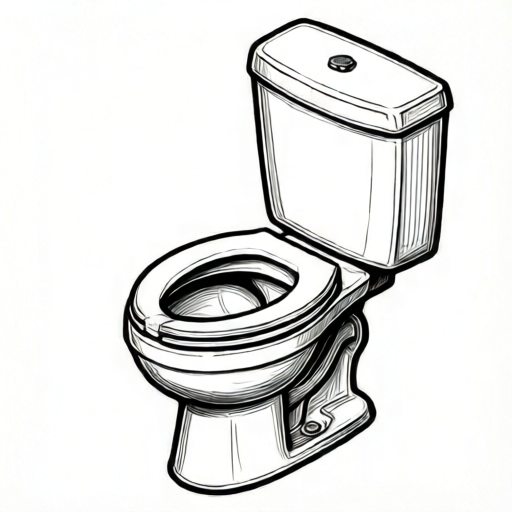
Use the stated measurements and conventions for each exercise.
Set the isometric axes and scale
Begin with a light construction cross. Draw one vertical axis for height. From the same origin, draw two receding axes at 30 degrees above the horizontal, one to the left and one to the right. These are the only three directions used for box edges. Choose a working scale in millimetres, for example 1 unit equals 10 mm, and state it on the sheet. All numerical values in this lesson are hypothetical examples for practice, not equipment specifications.
Measure your actual paper and pencil before committing to a size. If the sheet is 200 mm wide, keep the overall drawing within about 150 mm so labels fit. Mark the tank height, bowl length and base width on the axes before drawing any solid lines.
- Draw a vertical axis and two 30-degree receding axes from one origin.
- Label the scale, for example 1 unit = 10 mm.
- Mark overall height, length and width on the axes with light ticks.
- Check that every planned box edge is parallel to one of the three axes.
Build the tank as an isometric box
The tank is a rectangular box. On the vertical axis mark the tank height. On the two receding axes mark the tank depth and width. Connect the marks with lines parallel to the axes to form the top face, then drop vertical edges to the base of the tank. Only three faces are visible in isometric: top, front-left and front-right.
Keep hidden edges light or omit them. Add a lid line slightly below the top face and a simple flush button as a small ellipse on the top face. The button ellipse must follow the top plane, not the vertical plane.
- Mark tank height on the vertical axis.
- Mark tank depth and width on the two receding axes.
- Draw the top face as a parallelogram with edges parallel to the axes.
- Drop vertical edges and close the visible side faces.
- Add a lid line and a small top-plane ellipse for the button.
Draw the bowl ellipse on the isometric plane
The bowl opening lies on a horizontal plane, so its ellipse must be drawn on the isometric plane. A common error is drawing a true circle or a vertically oriented ellipse. Construct the ellipse inside a parallelogram whose sides follow the two receding axes. Draw both diagonals of the parallelogram and mark where they cross; this crossing is the ellipse centre. The ellipse is tangent to all four sides, and it is symmetric about the parallelogram centre. Its conjugate diameters are parallel to the parallelogram sides (the two isometric axes). Sketch a smooth curve that stays tangent to all four sides and check tangency on each side before darkening. Tangency points fall at the side midpoints only when the parallelogram is a rhombus (equal adjacent sides); for a general parallelogram, find the tangency points by construction rather than assuming midpoints.
The bowl extends forward from the tank. Place the parallelogram so its rear edge meets the tank front. The ellipse is symmetric about the parallelogram centre; its conjugate diameters are parallel to the parallelogram sides (the two isometric axes), and it is tangent to all four sides. Keep the curve smooth and symmetrical about the parallelogram centre.
- Draw a parallelogram on the isometric plane for the bowl opening.
- Draw both diagonals and mark their crossing as the ellipse centre.
- Sketch a smooth ellipse tangent to all four sides and symmetric about the parallelogram centre.
- Check tangency at each side and symmetry about the centre.
- Erase construction lines only after the ellipse is confirmed.
Add seat ring, base and final checks
The seat ring is a second ellipse slightly larger than the bowl opening, drawn on the same plane. Offset it outward by a consistent small amount, for example 3 mm on the drawing. The base is a shorter box below the bowl, centred under the bowl ellipse. Its top face is another isometric parallelogram.
Final checks: all vertical edges are vertical; all receding edges are at 30 degrees; ellipses sit on the correct plane; the tank, bowl and base share a consistent centre line. Measure two opposite sides of each parallelogram to confirm they are equal within your pencil width.
- Draw the seat ring as a larger concentric ellipse on the same plane.
- Draw the base box centred under the bowl.
- Confirm the centre line passes through tank, bowl and base.
- Measure opposite parallelogram sides for equality.
- Darken final lines and label tank, bowl, seat and base.
Worked example
Using a scale of 1 unit = 10 mm, construct a toilet with tank height 4 units, tank depth 2 units, tank width 3 units, bowl opening 4 units long and 3 units wide, seat offset 0.3 units, and base height 1 unit. Describe the construction and give two checks.
Worked answer
Draw vertical and two 30-degree axes. Mark tank height 40 mm on the vertical axis, tank depth 20 mm and width 30 mm on the receding axes. Complete the tank box with edges parallel to the axes. Draw a 40 mm by 30 mm parallelogram on the isometric plane in front of the tank for the bowl opening, draw both diagonals, mark their crossing as the centre, and sketch a smooth ellipse tangent to all four sides. Draw a second ellipse offset outward by 3 mm for the seat ring on the same plane. Draw a base box 10 mm high centred under the bowl. Check one: opposite sides of each parallelogram measure equal within pencil width. Check two: the centre line passes through tank, bowl and base.
Why: The tank is a box because its faces are flat. The bowl opening is horizontal, so it must be an ellipse on the isometric plane, constructed tangent to the parallelogram sides with its centre at the diagonal crossing. The seat ring shares that plane and is offset outward. The base is a shorter box centred under the bowl. Checks confirm projection consistency and alignment.
Check: Measure opposite parallelogram sides for equality and verify the common centre line. Confirm all receding edges are at 30 degrees and all vertical edges are vertical.
Four practice exercises
Exercise 1
Construct a toilet with tank height 3 units, tank depth 2 units, tank width 2 units, bowl opening 3 units long and 2 units wide, seat offset 0.2 units, and base height 1 unit. Use 1 unit = 10 mm. Describe each construction step and state two checks.
Show answer and check
Axes: vertical plus two 30-degree receding axes. Tank: 30 mm height, 20 mm depth, 20 mm width box. Bowl: 30 mm by 20 mm parallelogram on the isometric plane; draw both diagonals, mark the crossing as centre, and sketch an ellipse tangent to all four sides. Seat: second ellipse offset 2 mm outward on the same plane. Base: 10 mm high box centred under the bowl. Checks: opposite parallelogram sides equal; centre line through all parts.
Why: Each part follows the isometric convention. The tank is a box, the bowl opening is a horizontal ellipse constructed tangent to its parallelogram, the seat shares that plane, and the base is a centred box. The checks test projection consistency and alignment.
Check: Measure opposite sides of each parallelogram and confirm equality within pencil width. Verify all receding edges are at 30 degrees and the centre line is continuous.
Exercise 2
A student draws the bowl as a true circle inside a square. Explain the error and describe how to correct it using an isometric parallelogram. Include one measurement check.
Show answer and check
The error is using a square and circle instead of an isometric parallelogram and ellipse. Correct by drawing a parallelogram whose sides follow the two receding axes, drawing both diagonals and marking their crossing as the centre, then sketching a smooth ellipse tangent to all four sides and symmetric about the parallelogram centre. Find the tangency points by construction; they lie at the side midpoints only if the parallelogram is a rhombus. Check symmetry by confirming tangency on each side and that the ellipse is symmetric about the centre.
Why: A horizontal circle appears as an ellipse in isometric projection. The parallelogram defines the correct plane, the diagonal crossing gives the centre, and tangency to the four sides guides a symmetrical ellipse.
Check: Confirm tangency on all four sides at the constructed tangency points and symmetry about the centre. Confirm parallelogram sides are parallel to the isometric axes. If the parallelogram is a rhombus, the tangency points should also fall at the side midpoints.
Exercise 3
Given tank height 5 units, tank depth 2 units, tank width 3 units, bowl opening 4 units long and 3 units wide, seat offset 0.3 units, and base height 1 unit, list the millimetre marks on each axis at 1 unit = 10 mm and describe where the seat ellipse is placed.
Show answer and check
Vertical axis: 50 mm for tank height, plus 10 mm for base height below the bowl. Receding axes: 20 mm tank depth and 30 mm tank width; bowl parallelogram 40 mm by 30 mm. Seat ellipse: same isometric plane as the bowl opening, centred on the same point, offset outward by 3 mm. Base box: 10 mm high, centred under the bowl.
Why: Marks are converted by the stated scale. The seat must share the bowl plane to remain a horizontal ring in projection. The base is a separate shorter box centred under the bowl.
Check: Confirm each mark equals the unit value times 10 mm. Measure the seat offset at two opposite points; both should be about 3 mm.
Exercise 4
Describe how to check a finished toilet isometric drawing for three common errors: non-vertical height edges, bowl drawn as a circle, and misaligned centre line. Give one simple measurement for each check.
Show answer and check
Height edges: place a straightedge vertically beside each height edge; any tilt indicates an error. Bowl: check that the ellipse is tangent to all four sides of its isometric parallelogram and symmetric about the parallelogram centre; a true circle cannot remain tangent to a non-rhombic parallelogram. Centre line: measure from the centre line to the left and right edges of the tank and bowl; corresponding distances should match.
Why: Each check targets a specific projection rule. Vertical edges must stay vertical, horizontal circles become ellipses tangent to their isometric parallelogram, and all parts share a centre line.
Check: Use a straightedge for verticality, confirm ellipse tangency to all four parallelogram sides, and compare left and right distances from the centre line at tank and bowl.
Common mistakes
- Drawing the bowl as a true circle or a vertical ellipse. Construct the ellipse inside an isometric parallelogram, using the diagonal crossing as centre and keeping the curve tangent to all four sides.
- Using horizontal and vertical lines for receding box edges. Redraw receding edges at 30 degrees to the horizontal and keep only height vertical.
- Making the seat ring a different plane from the bowl opening. Draw both ellipses inside parallelograms that share the same isometric plane and centre.
- Letting the tank, bowl and base drift off a common centre line. Mark a centre line first and measure each part from it before darkening lines.
Self-check rubric
- Isometric axes: vertical edges vertical; receding edges at 30 degrees; scale labeled.
- Tank: box constructed with parallel edges; visible faces correct; lid and button on top plane.
- Bowl: ellipse constructed inside an isometric parallelogram; smooth and symmetrical; correct plane.
- Seat ring: larger concentric ellipse on the same plane with consistent offset.
- Base: centred box under the bowl; common centre line maintained.
- Labels and readability: parts labeled clearly; line weights consistent; valid alternative styles accepted.
Questions and answers
Why is the bowl drawn as an ellipse rather than a circle?
In isometric projection, a horizontal circle appears as an ellipse on the isometric plane. Drawing a true circle would break the projection convention.
Can I use different line weights or lettering styles?
Yes. The rubric rewards correct construction, clear labels and consistent scale. Line weight and handwriting style may vary as long as the drawing remains readable.
How do I check the 30-degree axes without a protractor?
Use an isometric grid or measure a 30-degree slope: for every 10 mm horizontal, rise about 5.8 mm (tan 30° ≈ 0.577). Label your chosen method on the sheet.
Are the millimetre values in this lesson real toilet dimensions?
No. They are hypothetical practice values. Measure your own paper and equipment, and label any chosen numbers as examples.