Free original lessons
Draw Realistic Snake Scales: Overlapping Rows and Tattoo Layout
Learn to draw realistic snake scales with overlapping rows, dorsal-to-belly size change, and a clean tattoo-style layout using a simple convention and checkable steps.
Free lesson
Four exercises
Worked answers
Object Drawing Lessons
Snake scales are not a flat texture; they are overlapping plates arranged in rows that change size and shape from the dorsal midline to the belly. This lesson teaches a repeatable drawing convention: each scale is a rounded diamond or shield shape, drawn from tail toward head so the front edge overlaps the one ahead. You will practice three row bands (dorsal, flank, belly), then arrange the pattern into a small tattoo-style layout. The convention is explicit so your work can be checked, but valid alternatives are allowed: scale outlines may be sharper or rounder, and row spacing may vary as long as overlap direction and size progression stay consistent. All measurements are hypothetical examples; measure your own paper and tools.
Practice materials: Printable downloads are not available for this lesson yet. Use the instructions and four exercises below.
Reference illustration
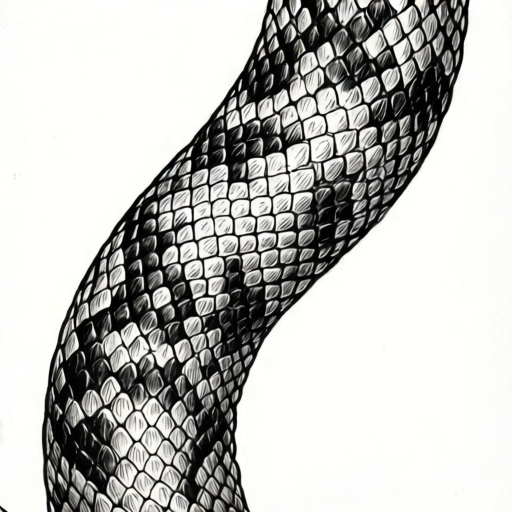
Use the stated measurements and conventions for each exercise.
The overlap convention and row bands
Define a scale as a closed shape with a front edge (toward the head) and a rear edge (toward the tail). Draw rows from tail to head so each new scale's rear edge sits under the previous scale's front edge. This creates the overlapping look. Use a light pencil for row guides and a darker line for final outlines.
Divide the snake body into three bands: dorsal (along the spine, usually smallest and most rounded), flank (sides, medium and slightly elongated), and belly (wide, flat, and larger). The size change is gradual: dorsal scales might be 4 mm wide in a hypothetical example, flank 6 mm, belly 9 mm. Keep units consistent and measure your actual drawing space.
- Draw a smooth body curve with a centerline for the spine.
- Mark three parallel guide lines: dorsal band edges and belly band edges.
- Starting at the tail, draw one row of dorsal scales using rounded diamonds about 4 mm wide (hypothetical).
- Add the next row toward the head, overlapping the rear edges under the previous row's front edges.
- Repeat for flank and belly bands, increasing scale width gradually (for example 6 mm and 9 mm).
- Check overlap direction: every scale's front edge should sit above the scale ahead.
Tattoo-style layout: arranging the pattern
A tattoo-style layout means the scale pattern is composed as a small, balanced design rather than a full anatomical study. Choose a simple body curve that fits inside a rectangular layout box. Keep the three bands visible but simplify the number of rows so the design reads clearly at small size.
Use a layout box with a light border. Place the body curve so the dorsal band runs along the curve's center, flank bands on either side, and a narrow belly band at the lower edge. Leave a small margin so the design does not touch the border. The pattern should flow with the curve, not against it.
- Draw a rectangular layout box and a single body curve inside it.
- Mark the dorsal centerline and two flank guide lines.
- Draw dorsal rows first, then flank rows, then a simplified belly band.
- Keep scale sizes consistent within each band; do not mix band sizes randomly.
- Erase guide lines and darken final outlines, leaving a clean margin.
Checking realism and consistency
Realism comes from consistent overlap, gradual size change, and row alignment. Check that no scale floats without overlapping a neighbor, that dorsal scales are not larger than belly scales, and that rows follow the body curve. A simple arithmetic check: count scales in one dorsal row and one belly row over the same body length; the belly row should have fewer, wider scales.
Valid alternatives include sharper scale tips, rounder shields, or slightly uneven row spacing, as long as the overlap direction and size progression remain clear. Do not claim a single universal answer; the rubric rewards consistency and readability.
- Trace one row with your finger: each front edge should cover the rear edge of the scale ahead.
- Compare dorsal and belly scale widths; belly should be wider.
- Check that rows curve with the body, not straight across.
- Confirm the tattoo layout has a clean margin and readable bands.
Worked example
A body curve is 120 mm long. Dorsal scales are 4 mm wide, flank 6 mm, belly 9 mm (hypothetical). How many scales fit in one row of each band along the curve, and which band has the fewest?
Worked answer
Dorsal: 120 ÷ 4 = 30 scales. Flank: 120 ÷ 6 = 20 scales. Belly: 120 ÷ 9 ≈ 13 scales (round down to 13 full scales). The belly band has the fewest scales because its scales are widest.
Four practice exercises
Exercise 1
A straight body section is 80 mm long. Dorsal scales are 5 mm wide and belly scales are 10 mm wide (hypothetical). How many scales fit in one dorsal row and one belly row, and which row has fewer?
Show answer and check
Dorsal: 80 ÷ 5 = 16 scales. Belly: 80 ÷ 10 = 8 scales. The belly row has fewer scales.
Why: Divide the section length by each scale width using the same unit. Wider scales produce fewer scales over the same length.
Check: Multiply the number of scales by the scale width: 16 × 5 = 80 mm and 8 × 10 = 80 mm. Both match the section length.
Exercise 2
You draw a row of 12 flank scales, each 7 mm wide (hypothetical), along a curve. What total length does the row cover? If the curve is 90 mm long, how much length remains uncovered?
Show answer and check
Row length: 12 × 7 = 84 mm. Remaining length: 90 − 84 = 6 mm.
Why: Multiply the number of scales by the width of one scale, then subtract from the curve length.
Check: Add the remaining length to the row length: 84 + 6 = 90 mm, matching the curve length.
Exercise 3
A tattoo layout box is 60 mm wide. You plan three bands: dorsal 20 mm, flank 25 mm, belly 15 mm. Do the bands fit inside the box, and how much margin remains if you center them?
Show answer and check
Total band width: 20 + 25 + 15 = 60 mm. The bands exactly fill the box, leaving 0 mm margin. To keep a margin, reduce one band or enlarge the box.
Why: Add the band widths and compare with the box width. A positive difference is the available margin.
Check: Re-add the bands: 20 + 25 + 15 = 60 mm, equal to the box width, confirming no margin.
Exercise 4
In a dorsal row you count 18 scales over 72 mm. In a belly row you count 9 scales over the same 72 mm. What are the average scale widths, and does the size progression follow the convention?
Show answer and check
Dorsal average width: 72 ÷ 18 = 4 mm. Belly average width: 72 ÷ 9 = 8 mm. The belly scales are wider, so the progression follows the convention.
Why: Divide the same length by each count to find average width. Compare the two averages to check the dorsal-to-belly size increase.
Check: Multiply back: 18 × 4 = 72 mm and 9 × 8 = 72 mm. Both match the row length.
Common mistakes
- Drawing rows from head to tail, so scales point the wrong way. Reverse the order: start at the tail and draw toward the head so each front edge overlaps the scale ahead.
- Making dorsal scales larger than belly scales. Use a gradual size increase from dorsal to belly; measure widths with a ruler and label hypothetical values.
- Letting scales float without overlapping neighbors. Draw each new scale so its rear edge sits under the previous scale's front edge; check row by row.
- Packing the tattoo layout against the border. Leave a small margin inside the layout box and simplify rows so the design reads clearly.
Self-check rubric
- Overlap direction is consistent: front edges overlap the scale ahead in every row.
- Three bands are present and distinguishable: dorsal, flank, belly.
- Scale size increases gradually from dorsal to belly; no random mixing.
- Rows follow the body curve rather than running straight across.
- Tattoo layout has a clean margin and readable band structure.
- Valid alternatives (sharper or rounder shapes, uneven spacing) are accepted if consistency and readability remain.
Questions and answers
Do I need to draw every scale perfectly?
No. Consistency matters more than perfection. Keep overlap direction and size progression clear; small variations are valid alternatives.
How many rows should the tattoo layout have?
Simplify to a few readable rows per band. The exact number is your choice; check that bands remain distinguishable at small size.
Can I use different scale shapes?
Yes. Rounded diamonds, shields, or slightly sharper tips are valid if the overlap convention and size change stay consistent.
What units should I use?
Use one unit consistently, such as millimeters. Any numerical widths are hypothetical examples; measure your own paper.