Free original lessons
Cross-Contour Banana Drawing: Wrap Lines Around the Peel
Learn to draw a banana using cross-contour lines that follow the curved peel surface, with guided steps, a worked example, and four practice tasks.
Free lesson
Four exercises
Worked answers
Object Drawing Lessons
Cross-contour lines are lines that travel across a form, wrapping around its curved surface like stripes on a balloon. Unlike outline, which traces the edge, cross-contours describe volume by following the peel's curvature from one side to the other. This lesson teaches a repeatable method for drawing a banana with cross-contour lines only, excluding shading and other fruit. You will use a simple convention: each cross-contour is a smooth curve that starts at one side contour, arcs across the banana's width, and ends at the opposite side contour, bending in the direction the peel surface would bend. Because letter styles and line spacing vary, the rubric rewards consistent wrapping and clear volume cues rather than one exact line pattern.
Practice materials: Printable downloads are not available for this lesson yet. Use the instructions and four exercises below.
Reference illustration
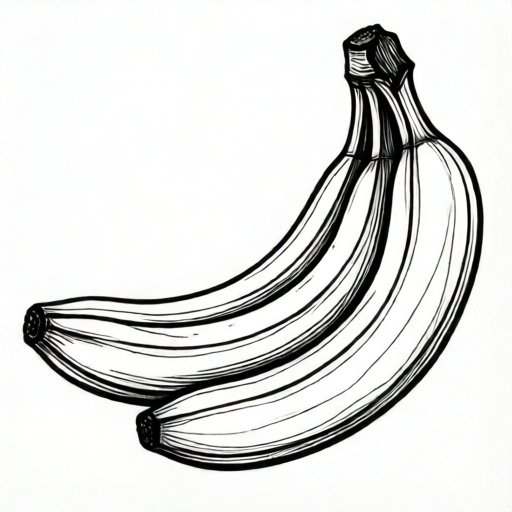
Use the stated measurements and conventions for each exercise.
Set Up the Banana's Side Contours
Begin by drawing the banana's side contours: the two long edges that define its silhouette. A banana typically has a gentle S-curve, a rounded stem end, and a tapered tip. Draw these edges lightly so you can adjust them. The side contours are not cross-contours; they are the boundaries that every cross-contour will touch.
Keep the banana's length roughly three to four times its width. This proportion helps the cross-contours read as wrapping around a long form rather than a short blob. If your banana curves strongly, make sure both side contours curve together; a common error is one edge curving while the other stays straight.
- Draw a light S-curve for the upper side contour.
- Draw a matching lower side contour, keeping the width fairly even.
- Close the stem end with a small rounded cap and the tip with a tapered point.
- Check that the two side contours do not cross and that the banana's width stays consistent.
Draw Cross-Contours That Wrap the Peel
A cross-contour on a banana is a curved line that crosses the peel from one side contour to the other. Imagine the banana as a cylinder bent into a curve. Each cross-contour should bow slightly toward the stem end or the tip end depending on where it sits on the curve. Near the middle of a strong bend, the lines bow more; near the ends, they flatten.
Space the cross-contours unevenly to suggest the peel's changing surface. Closer spacing near a ridge or bend makes that area feel more curved. Do not draw straight horizontal lines across the banana; straight lines flatten the form. Instead, let each line curve gently and consistently with its neighbors.
- Mark four to six guide points along each side contour at uneven intervals.
- Connect a point on one side to the matching point on the other side with a smooth arc.
- Make the arc bow in the same direction as the peel's surface would bend at that location.
- Repeat across the banana, keeping the curvature direction consistent.
- Lightly erase any guide points that distract from the final lines.
Use Line Spacing and Curvature to Show Volume
Cross-contour drawings show volume through two cues: curvature and spacing. A line that bows strongly suggests a more curved surface, while a flatter line suggests a flatter area. Spacing works similarly: tight spacing suggests a steep curve or a ridge, and wide spacing suggests a broad, gentle surface.
Apply this by placing tighter cross-contours near the banana's edges where the peel turns away from you, and wider spacing across the broad front. This is a convention, not a universal rule, but it reliably reads as volume. Keep your line weight consistent; cross-contour drawing does not require shading or thick-thin variation.
- Identify the banana's broad front area and place wider-spaced cross-contours there.
- Identify the edges where the peel curves away and place tighter cross-contours there.
- Check that each line's curvature matches its neighbors so the surface reads as one continuous peel.
- Step back and confirm the banana looks rounded rather than flat.
Refine and Self-Check the Drawing
Refinement is about consistency, not perfection. Trace each cross-contour mentally from one side contour to the other. If a line stops short, crosses another line, or changes curvature abruptly, adjust it. The goal is a set of lines that all describe the same curved peel surface.
Use a simple check: cover the side contours with your hand. The remaining cross-contours should still suggest a long, curved form. If they look like random stripes, revisit the curvature direction and spacing. Because valid alternatives exist, your drawing may use different spacing or slightly different curvature than the worked example and still meet the rubric.
- Confirm every cross-contour touches both side contours.
- Confirm no cross-contours cross each other.
- Confirm curvature direction is consistent across neighboring lines.
- Confirm spacing varies to suggest volume.
- Make final light adjustments and erase stray guide marks.
Worked example
Draw a banana about 12 cm long and 4 cm wide with a gentle S-curve. Add five cross-contour lines that wrap the peel, using tighter spacing near the edges and wider spacing across the front.
Worked answer
First draw two side contours forming a gentle S-curve, 12 cm long and about 4 cm wide, with a rounded stem cap and a tapered tip. Mark five uneven guide points along each side. Connect each pair with a smooth arc that bows slightly toward the stem end near the middle of the bend and flattens near the ends. Place the first two arcs closer together near the upper edge, the middle arc across the broad front with wider spacing, and the last two closer together near the lower edge. Check that every arc touches both side contours, no arcs cross, and the curvature direction is consistent. The result reads as a rounded banana described only by wrapping lines.
Four practice exercises
Exercise 1
A banana is drawn 10 cm long and 3 cm wide with a mild curve. You plan six cross-contours. Describe where you would place them and how you would space them to show volume.
Show answer and check
Place six arcs from stem to tip at uneven intervals. Put two arcs closer together near the upper edge, two across the broad front with wider spacing, and two closer together near the lower edge. Each arc should bow gently in the same direction as the peel's curve.
Why: Tighter spacing near the edges suggests the peel turning away, while wider spacing across the front suggests a broad surface. Consistent bowing keeps the surface continuous.
Check: Verify that all six arcs touch both side contours, no arcs cross, and spacing is tighter near the edges than across the front.
Exercise 2
You draw a banana with a strong bend near the middle. Explain how the curvature of the cross-contours should change from the stem end to the tip end.
Show answer and check
Near the stem and tip ends, the cross-contours should be flatter. Near the middle of the strong bend, they should bow more strongly. The direction of bowing should stay consistent with the peel's surface.
Why: A stronger bend means the surface curves more sharply, so the wrapping lines bow more. Flatter ends need flatter arcs to match the gentler surface.
Check: Compare the middle arcs to the end arcs: the middle arcs should show visibly more curvature, and all arcs should bow in the same general direction.
Exercise 3
A student draws eight cross-contours on a banana but uses equal spacing everywhere and makes every line perfectly straight. Identify the two main problems and state one fix for each.
Show answer and check
Problem one: straight lines flatten the form; fix by curving each line to follow the peel. Problem two: equal spacing gives no volume cue; fix by tightening spacing near curved edges and widening it across the broad front.
Why: Cross-contours communicate volume through curvature and spacing. Straight, evenly spaced lines remove both cues.
Check: Check that each line is curved and that spacing differs between the edges and the front area.
Exercise 4
You have drawn a banana 14 cm long and 4 cm wide. One cross-contour stops 1 cm short of the lower side contour. Describe how to correct it and how to confirm the fix.
Show answer and check
Extend that cross-contour smoothly until it touches the lower side contour, keeping its curvature consistent with neighboring lines. Then confirm that every cross-contour touches both side contours and that no line crosses another.
Why: A cross-contour must wrap from one side contour to the other to describe the full surface. A short line leaves part of the peel undescribed.
Check: Trace each line from upper side contour to lower side contour; all should connect, and the corrected line should match its neighbors' curvature.
Common mistakes
- Drawing straight horizontal lines across the banana. Curve each line gently so it bows with the peel surface; straight lines flatten the form.
- Letting cross-contours stop before reaching the side contours. Extend each line until it touches both side contours so the wrapping is complete.
- Using even spacing everywhere. Vary spacing: tighter near curved edges, wider across the broad front, to suggest volume.
- Changing curvature direction from line to line. Keep neighboring cross-contours bowing in the same direction so the surface reads as continuous.
Self-check rubric
- Side contours form a closed banana shape with consistent width and no crossing edges.
- At least four cross-contour lines are present and each touches both side contours.
- Cross-contour lines curve to follow the peel surface rather than running straight.
- Curvature direction is consistent among neighboring lines.
- Spacing varies to suggest volume, with tighter spacing near curved edges and wider spacing across the broad front.
- No shading or unrelated fruit is included; the drawing uses cross-contour lines as the primary volume cue.
- Valid alternatives in line count, exact spacing, and slight curvature differences are accepted if the wrapping and volume cues remain clear.
Questions and answers
What exactly is a cross-contour line on a banana?
It is a line that crosses the peel from one side contour to the other, curving to follow the peel's surface. It is not an outline and not a shading mark.
How many cross-contours should I draw?
There is no fixed number. Four to eight well-spaced lines usually read clearly. Choose a number that lets you show curvature and spacing without clutter.
Can I use a ruler for the cross-contours?
A ruler tends to produce straight lines, which flatten the form. Draw freehand arcs instead, even if they are slightly uneven.
Does the banana have to be a specific variety or shape?
No. Any banana-like form with two side contours and a curved peel works. The method applies to gentle or strong curves as long as the cross-contours wrap consistently.