Free original lessons
Map Drawing Practice: Compass Rose, Legend, and Boundary Lines
Learn to draw a clear map with a compass rose, legend, and boundary lines using a simple convention and a checklist for self-checking.
Free lesson
Four exercises
Worked answers
Object Drawing Lessons
This lesson teaches the fundamentals of drawing a map: placing a compass rose, building a legend, and drawing boundary lines that clearly separate regions. You will use a simple, explicit convention so that your map can be checked fairly, even though letter styles and handwriting vary. All practice uses a blank map frame, a compass-rose template, a legend box, and a boundary-line grid. No real-world geography or scale calculations are required. The goal is clarity and consistency: every symbol explained, every boundary traceable, and orientation unambiguous.
Practice materials: Printable downloads are not available for this lesson yet. Use the instructions and four exercises below.
Reference illustration
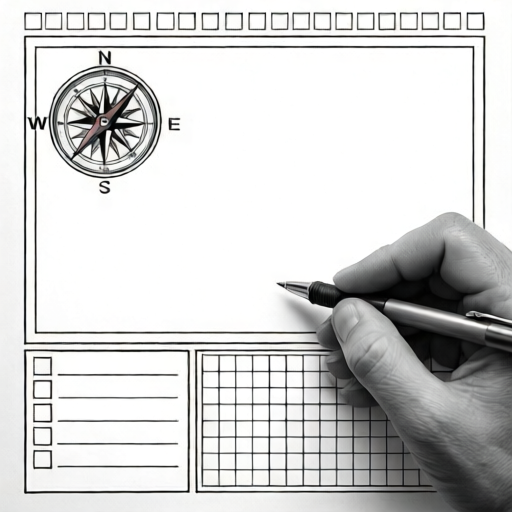
Use the stated measurements and conventions for each exercise.
Compass Rose: Orientation Convention
A compass rose shows direction. Use a four-point rose with North at the top of the page unless your teacher states otherwise. Draw a small circle at the center, then draw four arms: North up, East right, South down, West left. Label each arm with a capital letter. The convention for this lesson is that the North arm is the longest, and the label N sits at its tip. Letter styles vary, so the rubric checks that the label is readable and correctly placed, not that it matches a single handwriting style.
Place the compass rose in a corner of the map frame where it does not cover boundary lines or legend entries. A common choice is the top-right corner. Keep the rose small enough that it does not dominate the map. If you use a template, trace the circle and arms lightly, then darken the final lines.
- Draw a small circle at the chosen corner of the map frame.
- Draw four arms from the circle: up, right, down, left.
- Make the North arm slightly longer than the others.
- Label each arm N, E, S, W at the tip.
- Check that N is at the top of the page and the labels are readable.
Legend: Symbols and Meanings
A legend explains every symbol on the map. Draw a rectangular legend box in a corner opposite the compass rose, for example the bottom-left. Inside, list each symbol once with a short plain-language meaning. Use simple shapes: a solid line for a boundary, a dashed line for a path, a small circle for a marker, and a triangle for a peak. The convention is that each symbol appears in the legend before it appears on the map.
Keep legend entries short. Write the symbol on the left and the meaning on the right. If you use a boundary line, the legend entry should say boundary. If you use a dashed line, say path. Do not use the same shape for two different meanings. Letter styles vary, so the rubric checks that each entry is readable and matches its symbol, not that the handwriting is identical to a model.
- Draw a rectangular legend box in a corner opposite the compass rose.
- Choose no more than four symbols for your map.
- Draw each symbol once on the left side of the legend box.
- Write a short meaning next to each symbol.
- Check that every symbol used on the map appears in the legend.
Boundary Lines: Drawing and Checking
Boundary lines separate regions on the map. Use a solid line for a boundary and keep the line continuous from one edge of the map frame to another, or close it into a loop. The convention is that a boundary line does not cross itself and does not stop in the middle of a region. If you need to show a path, use a dashed line and label it in the legend. Boundary lines should be drawn with a ruler or straight edge when possible so they are easy to trace.
Use the boundary-line practice grid to draw three short boundary segments before drawing them on the map. Each segment should start and end on grid intersections. This makes the line checkable: you can count grid squares to confirm the line is straight and continuous. Numerical values such as grid square size are hypothetical examples for practice; measure your actual paper and ruler if you need exact dimensions.
- Draw three practice boundary segments on the grid, each starting and ending on intersections.
- Check each segment is straight and does not cross itself.
- Transfer one boundary line to the map frame, running edge to edge or as a closed loop.
- Add the boundary symbol to the legend if it is not already there.
- Trace the boundary with your finger to confirm it is continuous.
Map Checklist: Putting It Together
Before finishing, use a checklist to confirm the map has all required elements. The checklist has five items: compass rose with N at top, legend box with at least three entries, at least one boundary line, every symbol explained, and labels readable. Check each item by pointing to it on your map. If an item is missing, add it in the correct corner without covering existing lines.
The checklist is also the basis for the rubric. A map that meets all five items is complete. A map that meets four is nearly complete. A map that meets three or fewer needs revision. Because letter styles vary, readability is judged by whether a classmate can read the label without asking, not by matching a single handwriting model.
- Point to the compass rose and confirm N is at the top.
- Point to the legend box and count at least three entries.
- Point to at least one boundary line and confirm it is continuous.
- Check that every symbol on the map appears in the legend.
- Ask a classmate to read each label; revise any label that is unclear.
Worked example
Draw a small map on a blank frame with a compass rose, a legend with three entries, and one boundary line that separates the frame into two regions. Use the convention from this lesson.
Worked answer
Place a four-point compass rose in the top-right corner with N at the top, E right, S down, W left, and the North arm slightly longer. Place a rectangular legend box in the bottom-left corner with three entries: solid line = boundary, dashed line = path, small circle = marker. Draw one solid boundary line from the left edge of the frame to the right edge, slightly above the middle, so it separates the frame into a top region and a bottom region. Add a small circle marker in the top region and a dashed path in the bottom region. Check that every symbol appears in the legend and that the boundary line is continuous.
Four practice exercises
Exercise 1
On a blank map frame, draw a compass rose in the top-left corner using the lesson convention. Label all four arms. Then state where North points.
Show answer and check
A four-point rose with N at the top, E right, S down, W left, and the North arm slightly longer. North points to the top of the page.
Why: The convention fixes North at the top and requires four labeled arms. The top-left corner is a valid placement because it does not cover other elements.
Check: Point to the N label and confirm it is at the top of the page. Confirm all four labels are present and readable.
Exercise 2
Draw a legend box with exactly three entries: solid line = boundary, dashed line = path, triangle = peak. Then draw one boundary line and one path on the map frame, and one triangle marker. Check that every symbol is in the legend.
Show answer and check
Legend box with three entries as listed. One solid boundary line from edge to edge, one dashed path, and one triangle marker. All three symbols appear in the legend.
Why: Each symbol used on the map must be explained in the legend. The boundary line is continuous, and the path uses the dashed symbol.
Check: Count the symbols on the map and match each to a legend entry. Confirm the boundary line is continuous.
Exercise 3
A map has a compass rose with N pointing to the right side of the page and a boundary line that stops in the middle of the frame. Identify two mistakes and state how to fix each.
Show answer and check
Mistake 1: North points to the side. Fix: redraw the rose with N at the top. Mistake 2: the boundary line stops in the middle. Fix: extend it to the frame edge or close it into a loop.
Why: The convention requires N at the top, and a boundary line must separate regions completely rather than stopping mid-region.
Check: Check the N label is at the top and trace the boundary line to confirm it reaches an edge or closes.
Exercise 4
Using the boundary-line practice grid, draw two straight boundary segments that each start and end on grid intersections. Then describe how you would check each segment is straight and continuous.
Show answer and check
Two segments drawn between grid intersections. Check by counting grid squares along the line and confirming the line does not cross itself or stop before the end intersection.
Why: Starting and ending on intersections makes the line checkable by counting squares. A straight, continuous line has no gaps or self-crossings.
Check: Place a ruler along each segment and confirm it touches both end intersections. Trace with a finger to confirm no gaps.
Common mistakes
- Placing the compass rose so that North points to the side of the page. Redraw the rose with the North arm pointing to the top of the page, and move the rose to a corner where it fits.
- Using a symbol on the map that is not listed in the legend. Add the missing symbol and its meaning to the legend, or remove the symbol from the map.
- Drawing a boundary line that stops in the middle of a region. Extend the line to the map frame edge or close it into a loop so it separates two areas completely.
- Making legend entries too long to fit in the box. Shorten each meaning to one or two words, such as boundary or path.
Self-check rubric
- Compass rose present with N at the top of the page and all four labels readable.
- Legend box present with at least three entries, each symbol matching its meaning.
- At least one boundary line drawn continuously from edge to edge or as a closed loop.
- Every symbol used on the map appears in the legend, and every legend entry appears on the map.
- Labels are readable to a classmate without asking for clarification.
- Map checklist completed with all five items marked.
Questions and answers
Do I need to use a ruler for boundary lines?
A ruler helps make lines straight and checkable, but freehand lines are acceptable if they are continuous and do not cross themselves. The rubric checks continuity and clarity, not perfect straightness.
How many symbols should the legend have?
Use at least three and no more than four symbols. Every symbol on the map must appear in the legend, and every legend entry must appear on the map.
Can I put the compass rose anywhere on the map?
Yes, as long as North points to the top of the page and the rose does not cover boundary lines or legend entries. A corner is usually clearest.
What if my handwriting is messy?
Letter styles vary. The check is whether a classmate can read each label without asking. If not, rewrite the label more slowly or use capital letters.