HomeScenery Drawing Practice: Foreground, Horizon, and Background Layers Free original lessons
Scenery Drawing Practice: Foreground, Horizon, and Background Layers
Learn to build depth in scenery sketches using three clear layers: foreground, horizon, and background. Includes guided practice, common fixes, and a self-check rubric.
Free lesson
Four exercises
Worked answers
Object Drawing Lessons
Scenery drawing becomes easier when you separate the view into three layers. The foreground holds the largest, most detailed shapes nearest you. The horizon is the line where land or water meets the sky, and it anchors the whole scene. The background contains the smallest, simplest shapes farthest away. This lesson uses a simple convention: draw a horizon line across the page, place a few large foreground shapes below it, and add small background shapes above or near it. You will practice judging size, overlap, and spacing so the scene reads as having depth. All measurements here are hypothetical examples; measure your own paper and tools before drawing.
Practice materials: Printable downloads are not available for this lesson yet. Use the instructions and four exercises below.
Reference illustration
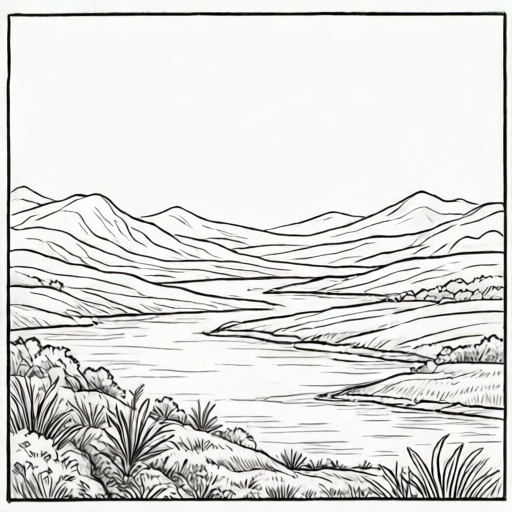
Use the stated measurements and conventions for each exercise.
Set up the three layers
Start by drawing a light horizontal horizon line across the middle of your page. This line is the farthest visible edge of the ground or water. Everything below it is closer to you; everything above it is sky or distant land. Keep the line light so you can adjust it.
Next, choose two or three large shapes for the foreground, such as a bush, a rock, or a tree trunk. Place them near the bottom edge and make them noticeably bigger than anything else. Overlap at least one foreground shape with another to show that they sit at different distances.
Finally, add background shapes near the horizon: small hills, distant trees, or simple clouds. Keep these shapes small and low in detail. The contrast between large foreground shapes and small background shapes is what creates the feeling of depth.
- Draw a light horizon line across the middle of the page.
- Sketch two or three large foreground shapes near the bottom edge.
- Overlap one foreground shape with another to show depth.
- Add small background shapes close to the horizon line.
- Check that foreground shapes are clearly larger than background shapes.
Use size and overlap to show distance
Size is the strongest depth cue in a sketch. A tree drawn near the bottom of the page should be several times taller than a tree drawn near the horizon. If two shapes are meant to be the same kind of object, the one closer to you should be larger.
Overlap reinforces size. When a foreground bush covers part of a background hill, the viewer reads the bush as closer. Draw the closer shape first, then draw the farther shape so it stops at the closer shape's edge.
Spacing also matters. Foreground shapes can sit far apart or close together, but background shapes usually cluster near the horizon. Leave more empty space between foreground shapes and fewer gaps in the background to suggest that distant objects are packed together.
- Compare the height of each foreground shape with each background shape.
- Draw closer shapes first, then let farther shapes stop at their edges.
- Cluster background shapes near the horizon and spread foreground shapes wider.
- Adjust any shape that looks the same size as a shape in a different layer.
Keep detail in the foreground and simplify the background
Detail is another depth cue. Foreground shapes can show texture, edges, and small features. Background shapes should be simple silhouettes or broad shapes with little internal detail. If you add too much detail to the background, it competes with the foreground and flattens the scene.
Use line weight to support the layers. Draw foreground outlines slightly darker or thicker, and keep background outlines light. This is a convention, not a rule; you can reverse it if you state your choice and apply it consistently.
Before finishing, step back and check the three layers. The foreground should be large and detailed, the horizon should be clear, and the background should be small and simple. If any layer is unclear, adjust size, overlap, or detail rather than adding new objects.
- Add texture or small features only to foreground shapes.
- Simplify background shapes to broad outlines or silhouettes.
- Make foreground outlines slightly darker than background outlines.
- Step back and confirm that all three layers are easy to identify.
Worked example
A sketcher draws a horizon line 10 cm from the top of a 20 cm tall page. They draw a foreground bush 6 cm tall at the bottom and a background hill 2 cm tall near the horizon. The bush overlaps the hill by 1 cm. Is the depth reading clear?
Worked answer
Yes. The foreground bush is 6 cm tall and the background hill is 2 cm tall, so the foreground is three times larger. The 1 cm overlap shows the bush is closer. The horizon sits at the middle of the page, leaving room for both layers. The depth reading is clear.
Four practice exercises
Exercise 1
On a 20 cm tall page, draw a horizon line 8 cm from the top. Draw one foreground rock 5 cm tall at the bottom and one background tree 1.5 cm tall near the horizon. Check the size ratio.
Show answer and check
The foreground rock is 5 cm and the background tree is 1.5 cm, so the foreground is more than three times larger. The horizon leaves 12 cm below for foreground and 8 cm above for sky. The depth reading is clear.
Why: A large foreground shape and a small background shape near the horizon create a strong size contrast. The horizon position leaves enough room for both layers.
Check: Measure both shapes with a ruler. Divide the foreground height by the background height. If the result is 3 or more, the size contrast is strong.
Exercise 2
Draw a horizon line across the middle of a page. Draw two foreground bushes that overlap by 2 cm. Draw three background hills that are each half the height of the bushes. Describe how the overlap and size difference affect depth.
Show answer and check
The overlapping bushes read as closer because one covers part of the other. The hills are half the height of the bushes, so they read as farther away. Together, overlap and size contrast make the scene read with depth.
Why: Overlap is a strong depth cue because a closer shape interrupts a farther shape. Size contrast reinforces the effect when background shapes are clearly smaller.
Check: Confirm the overlap is at least 1 cm and that each hill is no taller than half the bush height. Ask a viewer to point to the closest shape without explanation.
Exercise 3
Sketch a scene with a horizon line, one large foreground tree trunk, and two small background clouds. The trunk is 7 cm tall and each cloud is 2 cm tall. The trunk touches the bottom edge. Is the layer separation clear?
Show answer and check
Yes. The trunk is 7 cm and each cloud is 2 cm, so the foreground is more than three times larger. The trunk touches the bottom edge, which anchors it as nearest. The clouds sit near the horizon and are simple shapes. The layers are clear.
Why: Touching the bottom edge strengthens the foreground position. Small, simple clouds near the horizon read as background. The size ratio supports the separation.
Check: Measure the trunk and one cloud. Confirm the trunk reaches the bottom edge and the clouds are no taller than one-third of the trunk. Check that clouds have no internal detail.
Exercise 4
A sketch has a horizon line 5 cm from the top of a 15 cm page. The foreground shapes are 3 cm tall and the background shapes are 2.5 cm tall. Identify the problem and describe one fix using size or position.
Show answer and check
The foreground and background shapes are too similar in size, so the depth reading is weak. One fix is to make the background shapes smaller, for example 1 cm tall, or move them closer to the horizon. Either change increases the size contrast.
Why: Depth depends on clear differences between layers. When foreground and background shapes are nearly the same size, the viewer cannot tell which is closer. Increasing the size difference restores the cue.
Check: Measure both shapes. If the foreground is less than twice the background height, adjust the background size or position and re-measure.
Common mistakes
- Drawing background shapes the same size as foreground shapes. Shrink background shapes to roughly one-third or less of the foreground height, or move them closer to the horizon.
- Placing the horizon line too high or too low so one layer disappears. Move the horizon toward the middle of the page and leave room for both foreground and background shapes.
- Adding heavy detail to background shapes. Erase internal lines in the background and keep only the outer silhouette or broad shape.
- Letting foreground shapes float without touching the bottom edge. Extend at least one foreground shape to the bottom edge of the page so it reads as nearest.
Self-check rubric
- Horizon line is visible and separates ground from sky or distant land.
- At least two foreground shapes are clearly larger than background shapes.
- At least one foreground shape overlaps another shape to show depth.
- Background shapes are small and simple, with little internal detail.
- Foreground shapes reach or approach the bottom edge of the page.
- The three layers can be identified by a viewer without explanation.
Questions and answers
Do I have to use a straight horizon line?
No. A gently curved or broken horizon can work for hills or shorelines. Keep it light and continuous enough that the viewer can still read it as the farthest edge.
How many foreground shapes should I draw?
Two or three is enough for practice. More shapes can work, but keep them large and overlapping so the foreground stays distinct from the background.
Can I use color instead of line weight?
Yes. You can make foreground shapes darker or more saturated and background shapes lighter or duller. State your convention and apply it consistently.
What if my scene looks flat?
Check size first: make foreground shapes larger and background shapes smaller. Then check overlap and detail. Adjusting those three cues usually restores depth.