Free original lessons
Facade Symmetry Drawing: Axis and Paired Features
Learn to draw a building facade with a central axis and mirrored architectural features. Includes a worked example, four practice tasks, and a rubric for valid alternatives.
Free lesson
Four exercises
Worked answers
Object Drawing Lessons
Symmetry in architecture drawing starts with a clear central axis and paired features placed at equal distances from it. This lesson teaches a repeatable method for drawing a facade front-on, without perspective, so that windows, columns, and decorative elements mirror correctly. You will use a simple convention: the axis is a vertical line, and every paired feature is measured horizontally from that axis. The method works for any facade style because it depends on distances, not on a single correct appearance. All measurements in examples are hypothetical; measure your own paper and tools. The goal is a clean, checkable drawing where the left and right sides correspond.
Practice materials: Printable downloads are not available for this lesson yet. Use the instructions and four exercises below.
Reference illustration
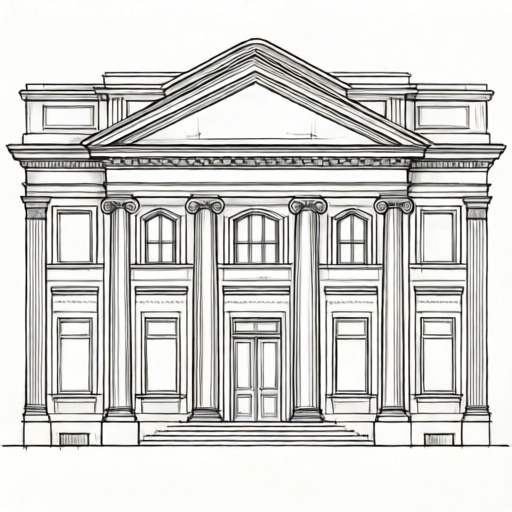
Use the stated measurements and conventions for each exercise.
Set the axis and the facade outline
Begin by drawing a light vertical line down the center of your paper. This is the axis. It is a construction line, not part of the final facade, so keep it faint or dashed. Next, decide the overall width and height of the facade. Measure equal distances left and right from the axis to mark the outer edges. Connect these marks with a rectangle. Because both sides use the same distance from the axis, the outline is symmetric by construction.
Check the outline before adding details. Measure from the axis to the left edge and from the axis to the right edge. The two distances should match within your drawing tolerance. If they do not, adjust the outline now rather than later. A consistent unit, such as centimeters or grid squares, keeps the arithmetic simple.
- Draw a faint vertical axis line.
- Mark the facade width by measuring equal distances left and right from the axis.
- Mark the facade height with a horizontal top and bottom line.
- Connect the marks to form a rectangle.
- Verify that left and right widths from the axis are equal.
Place paired features by distance from the axis
Choose a feature to pair, such as a window. Measure a horizontal distance from the axis to the center of the left window, then mark the same distance on the right. Use the same vertical position for both. Repeat for each pair. Columns work the same way: mark the center of each column at equal distances from the axis, then draw the column width equally on both sides of each center mark.
A useful convention is to record each pair as a distance from the axis and a height from the bottom line. For example, a hypothetical window pair might be 6 cm from the axis and 10 cm above the bottom. These numbers are examples only; use your own measurements. Keeping a small table of distances makes the drawing easy to check and revise.
- List each paired feature and its distance from the axis.
- Mark the left feature center, then mirror the distance to the right.
- Use the same vertical height for both features in a pair.
- Draw each feature around its center mark with equal width on both sides.
- Repeat until all paired features are placed.
Complete the facade and check symmetry
After placing all pairs, add any single central features on the axis, such as a door or a decorative keystone. These features are centered, so their midpoint lies on the axis. Then check the drawing by measuring a few pairs. For each pair, the left distance from the axis and the right distance should match. Also compare the vertical heights of paired features; they should be the same.
Valid alternatives are allowed. A facade may have a different number of window pairs, different column spacing, or decorative details that are not mirrored if the brief allows. The rubric rewards a clear axis, consistent paired distances, and a checkable layout, not a single universal design. If you choose to vary a feature, state the rule you used so the drawing remains checkable.
- Add centered features on the axis.
- Measure two or three pairs to confirm equal distances from the axis.
- Confirm paired features share the same height.
- Erase or lighten construction lines if desired, keeping the axis visible for checking.
- Label your distance table or note any deliberate variations.
Worked example
A facade outline is 20 cm wide and 15 cm tall, centered on a vertical axis. Place one pair of windows with centers 6 cm from the axis and 10 cm above the bottom line. Place one pair of columns with centers 9 cm from the axis and 2 cm above the bottom line. Describe the marks and check the symmetry.
Worked answer
The axis is at the center, so the left and right edges are 10 cm from the axis. The left window center is 6 cm left of the axis at height 10 cm; the right window center is 6 cm right of the axis at the same height. The left column center is 9 cm left of the axis at height 2 cm; the right column center is 9 cm right at the same height. Check: each pair has equal horizontal distances from the axis and equal heights, so the layout is symmetric.
Four practice exercises
Exercise 1
A facade outline is 16 cm wide and 12 cm tall, centered on an axis. Place one pair of windows with centers 4 cm from the axis and 8 cm above the bottom. Place one pair of columns with centers 7 cm from the axis and 1 cm above the bottom. State the left and right positions and check the symmetry.
Show answer and check
Left window center: 4 cm left of axis, height 8 cm. Right window center: 4 cm right of axis, height 8 cm. Left column center: 7 cm left of axis, height 1 cm. Right column center: 7 cm right of axis, height 1 cm. Each pair has equal distances from the axis and equal heights, so the layout is symmetric.
Why: The outline is centered, so each side is 8 cm from the axis. Pairing by equal distance from the axis and equal height produces mirror positions. The check compares horizontal distances and heights for each pair.
Check: Measure from the axis to each feature center. Confirm left and right distances match for each pair and that paired heights are equal.
Exercise 2
A facade outline is 24 cm wide and 18 cm tall, centered on an axis. Place two window pairs: pair A centers 5 cm from the axis at height 12 cm; pair B centers 9 cm from the axis at height 6 cm. Place one centered door whose midpoint is on the axis at height 0 cm. Describe the marks and explain how you would check the result.
Show answer and check
Pair A: left center 5 cm left of axis at height 12 cm; right center 5 cm right at height 12 cm. Pair B: left center 9 cm left of axis at height 6 cm; right center 9 cm right at height 6 cm. The door midpoint lies on the axis at the bottom. Check by measuring each pair's horizontal distance from the axis and comparing heights; the door is centered because its midpoint is on the axis.
Why: Each pair uses the same distance from the axis on both sides and the same height. The centered door is placed by putting its midpoint on the axis. The check uses the same distance and height comparisons plus a midpoint check for the door.
Check: For each window pair, measure left and right distances from the axis and confirm they match; confirm equal heights. For the door, confirm its midpoint lies on the axis.
Exercise 3
A facade outline is 30 cm wide and 20 cm tall, centered on an axis. Place three column pairs with centers 4 cm, 8 cm, and 12 cm from the axis, all at height 2 cm. Place one window pair with centers 6 cm from the axis at height 14 cm. State the positions and identify one possible valid alternative that still follows a clear pairing rule.
Show answer and check
Column pairs: left and right centers at 4 cm, 8 cm, and 12 cm from the axis, all at height 2 cm. Window pair: left and right centers 6 cm from the axis at height 14 cm. A valid alternative is to use two column pairs instead of three, provided each pair is placed at equal distances from the axis and the same height, and the rule is stated.
Why: The positions are generated by mirroring each distance from the axis and keeping heights equal within a pair. The alternative is valid because the rubric checks the pairing rule and distances, not a fixed number of columns.
Check: Measure each column pair's distance from the axis and confirm left equals right; confirm all columns share height 2 cm. Check the window pair the same way. For the alternative, confirm the stated rule is followed for every pair.
Exercise 4
A facade outline is 18 cm wide and 14 cm tall, centered on an axis. Place one window pair with centers 3 cm from the axis at height 9 cm. Place one column pair with centers 6 cm from the axis at height 1 cm. Add a centered decorative circle whose midpoint is on the axis at height 12 cm. Describe the layout and give a check method using a simple distance table.
Show answer and check
Window pair: left center 3 cm left of axis at height 9 cm; right center 3 cm right at height 9 cm. Column pair: left center 6 cm left of axis at height 1 cm; right center 6 cm right at height 1 cm. The circle midpoint is on the axis at height 12 cm. A distance table lists each pair with distance from axis and height; checking means comparing left and right entries and confirming the circle midpoint is on the axis.
Why: The pairs are placed by equal distance from the axis and equal height. The centered circle is placed by its midpoint on the axis. The distance table makes the symmetry check straightforward and repeatable.
Check: Create a table with columns for feature, left distance, right distance, and height. Confirm left and right distances match for each pair and heights match within a pair. Confirm the circle's midpoint lies on the axis.
Common mistakes
- Measuring from the paper edge instead of the axis. Measure every paired feature from the central axis so both sides use the same reference.
- Using different vertical heights for a pair. Mark the height once and transfer it to both sides of the pair before drawing.
- Drawing the axis as a heavy final line. Keep the axis faint or dashed; it is a construction guide, not a facade feature.
- Assuming one facade design is the only correct answer. Follow the stated pairing rule and check distances; valid alternatives are acceptable when the rule is clear.
Self-check rubric
- A faint vertical axis is present and used as the reference for paired features.
- The facade outline is symmetric: left and right widths from the axis match within the stated tolerance.
- Each paired feature has equal horizontal distance from the axis on both sides.
- Paired features share the same vertical height within the stated tolerance.
- Centered features have their midpoint on the axis.
- A distance table or notes make the layout checkable.
- Any deliberate variation is stated as a rule, allowing valid alternatives.
Questions and answers
Do I need perspective for this facade drawing?
No. This lesson uses a front-on view without perspective so that symmetry is easy to measure and check.
What if my paired features are not exactly equal?
Small differences can happen from drawing error. Measure again from the axis and adjust the mark that is off. The rubric allows a stated tolerance.
Can I change the number of windows or columns?
Yes, if you state the pairing rule. The method checks equal distances from the axis, not a fixed count.
Are the numbers in the examples required?
No. All numerical values are hypothetical examples. Measure your own paper and use consistent units.