Free original lessons
Contour Drawing of Road and River Edges
Learn to draw road and river boundary lines as continuous contours, using blind and slow contour exercises to build accurate observation.
Free lesson
Four exercises
Worked answers
Object Drawing Lessons
Contour drawing trains your eye to follow an edge without lifting the pencil or guessing. In a landscape, the road edge and riverbank are ideal subjects because they are long, irregular, and easy to verify. This lesson isolates those boundary lines from perspective, shading, and full composition. You will use a simple convention: x-height is measured from baseline to midline of lowercase letters, and letter styles may vary. All numerical examples are hypothetical and should be replaced by measurements of your actual equipment.
Practice materials: Printable downloads are not available for this lesson yet. Use the instructions and four exercises below.
Reference illustration
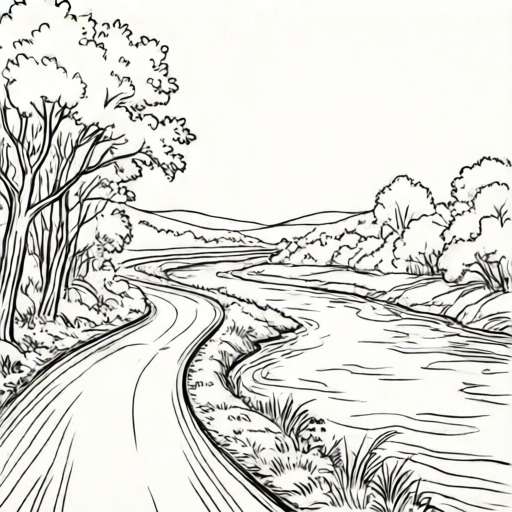
Use the stated measurements and conventions for each exercise.
Why road and river edges suit contour study
A road edge is a boundary between pavement and verge; a riverbank is a boundary between water and land. Both are continuous lines that change direction gradually. Drawing them as single contours forces you to observe small turns rather than inventing smooth curves.
Work on plain paper with a pencil. Choose a view where the road and river run roughly parallel or cross once. Avoid complex intersections at first. The goal is not a finished landscape but a record of how your eye tracked each edge.
- Select a road edge and a riverbank that are both visible in one view.
- Mark a start point on each edge with a light dot.
- Decide which edge you will draw first and keep the other as a reference.
- Draw the first edge as one continuous line, pausing only to look.
- Repeat for the second edge, comparing spacing between the two lines.
Blind contour: following without looking at the paper
Blind contour means you look only at the subject while your pencil moves on the paper. You do not check the drawing until the line is complete. This exercise builds hand-eye coordination and prevents premature correction.
Use a box on your paper about the size of your palm. Start at the road edge and follow it slowly. When you reach a bend, let your pencil turn at the same rate your eye turns. Do not lift the pencil. A blind contour of a riverbank often looks distorted, which is expected.
- Place your pencil at the start dot and fix your eyes on the road edge.
- Move the pencil only as fast as your eye moves along the edge.
- At each change of direction, change the pencil direction without lifting.
- Continue until you reach the end of the visible edge.
- Repeat once for the riverbank in a second box.
Slow contour: checking proportion and spacing
Slow contour allows brief glances at the paper to check spacing. The line remains continuous, but you may pause to compare the distance between the road edge and the riverbank at two or three points.
Use a simple check: at a chosen point, estimate the gap between the two edges in pencil widths. Write that number lightly beside the line. Later, compare the same gap at another point. If the gap changes, your contour should show that change. Keep all units consistent; pencil widths are a convenient unit.
- Draw the road edge as a continuous line, glancing at the paper every few seconds.
- Mark two reference points where the gap to the river is easy to see.
- Estimate each gap in pencil widths and note the numbers.
- Draw the riverbank as a continuous line, keeping the noted gaps.
- Compare the finished contours with the actual view and adjust only if a gap is clearly wrong.
Using a defined convention for letter labels
When you label points on your contour study, use lowercase letters. Measure x-height from baseline to midline; letter styles may vary, so a rounded a and an angular a are both acceptable if their x-height matches your convention. This keeps labels readable without forcing one handwriting style.
For example, label the start of the road edge a and the start of the riverbank b. If you add a midpoint label c, place it where the gap is easiest to measure. The labels are for your own checking, not for decoration.
- Write labels in lowercase using your normal letter style.
- Keep x-height consistent from baseline to midline.
- Place each label near the point it names without crossing the contour.
- Use the labels to compare gaps at different points.
Worked example
A road edge runs from point a to point d. At point a the gap to the riverbank is 3 pencil widths. At point c the gap is 5 pencil widths. Draw a slow contour of both edges, keeping the line continuous and noting the gaps.
Worked answer
Start at a and draw the road edge continuously to d. Mark c where the gap is easiest to see. Note 3 at a and 5 at c. Draw the riverbank continuously, keeping the gap wider at c than at a. The two contours should not be parallel; the riverbank moves farther from the road between a and c.
Four practice exercises
Exercise 1
In a blind-contour box, draw a road edge that curves left, then right, then left. Do not look at the paper until the line is complete. Describe the result in one sentence.
Show answer and check
A single continuous line with three changes of direction, drawn without looking at the paper.
Why: Blind contour requires the eye to lead the pencil. The three turns test whether the hand follows the eye's changes without correction.
Check: Confirm the line is continuous and has three direction changes. The shape need not match the view exactly.
Exercise 2
A riverbank runs from point b to point e. At b the gap to the road is 2 pencil widths; at e it is 4 pencil widths. Draw a slow contour of the riverbank only, noting both gaps. State whether the riverbank moves toward or away from the road.
Show answer and check
The riverbank moves away from the road because the gap increases from 2 to 4 pencil widths.
Why: The gap is measured in one consistent unit. A larger number at e means greater distance from the road.
Check: Check that the noted numbers are 2 and 4 and that the contour shows a wider gap at e.
Exercise 3
Draw a slow contour of a road edge and a riverbank that cross once. Label the crossing point c in lowercase. Keep x-height from baseline to midline. Describe how you kept the lines continuous at the crossing.
Show answer and check
The two contours meet at c and continue without lifting the pencil; the crossing is drawn as one line passing over the other or as a shared point, depending on your convention.
Why: A crossing is a single event in the contour. Continuity is maintained by not lifting the pencil and by deciding how the lines meet before drawing.
Check: Confirm the label c is lowercase with consistent x-height and that neither contour has a break at the crossing.
Exercise 4
Using a hypothetical example, a road edge has gaps of 3, 3, and 6 pencil widths at three points. Draw a slow contour of the road edge and riverbank that reflects these gaps. Explain why the contour is not parallel.
Show answer and check
The contour shows two equal gaps followed by a wider gap, so the riverbank moves away from the road at the third point. The lines are not parallel because the gap changes.
Why: Parallel lines would keep a constant gap. The measured gaps of 3, 3, and 6 require the riverbank to shift outward at the third point.
Check: Verify the noted gaps are 3, 3, and 6 and that the drawn gap is visibly wider at the third point.
Common mistakes
- Lifting the pencil to correct a bend. Keep the line continuous; if a bend is wrong, continue and note the error for the next attempt.
- Drawing the road edge from memory instead of looking. Return your eyes to the actual edge and move the pencil only while looking at it.
- Making the riverbank parallel to the road everywhere. Measure the gap at two points in pencil widths and let the contour show the difference.
- Using inconsistent units for gap estimates. Choose one unit, such as pencil widths, and use it for every measurement in the study.
Self-check rubric
- Both road edge and riverbank are drawn as continuous lines without lifting the pencil.
- The gap between the two contours changes where the measured gap changes.
- Gap estimates use one consistent unit, such as pencil widths.
- Labels are lowercase and x-height is measured from baseline to midline; letter style may vary.
- The study excludes shading, perspective construction, and full landscape composition.
Questions and answers
Do I need to draw the whole landscape?
No. This lesson isolates the road edge and riverbank as contour lines. Leave out buildings, trees, shading, and perspective construction.
How long should each contour take?
A blind contour of one edge may take two to five minutes. A slow contour may take five to ten minutes. These are hypothetical examples; adjust to your pace.
Can I use a pen instead of a pencil?
Yes, if you accept that corrections are impossible. A pencil allows light notes for gap measurements.
What if my blind contour looks nothing like the view?
That is normal. The exercise trains observation, not finished accuracy. Compare the slow contour for proportion.