Free original lessons
Chow Chow Contour Drawing: Single-Line Outline Study
Learn to draw a Chow Chow in contour line only: continuous edges, mane silhouette, muzzle shape, and tail curl, with checks and practice tasks.
Free lesson
Four exercises
Worked answers
Object Drawing Lessons
Contour drawing asks you to trace the visible boundary of a subject without shading or fur texture. For a Chow Chow, the challenge is the dense mane, the broad muzzle, and the curled tail, which can tempt you into scribbling fur. This lesson keeps the line single and continuous, using a simple convention: one unbroken outline per major form, drawn at a steady pace. You will compare your line to a reference by checking edge continuity at three zones: mane, muzzle, and tail. All measurements are hypothetical examples; measure your own paper and pencil before starting.
Practice materials: Printable downloads are not available for this lesson yet. Use the instructions and four exercises below.
Reference illustration
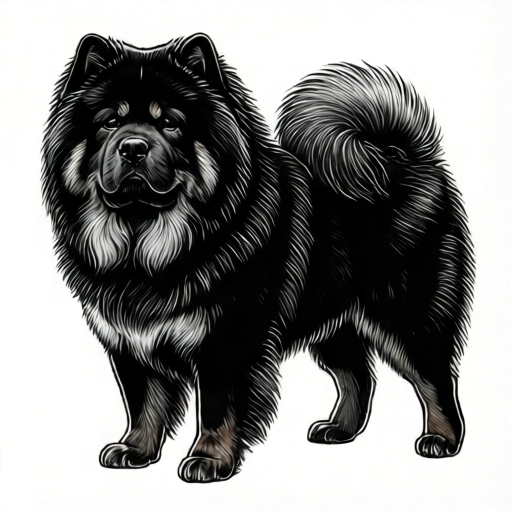
Use the stated measurements and conventions for each exercise.
Set the contour convention
Define contour line as a single visible edge that separates the dog from the background. Do not draw internal fur strands. If two forms overlap, such as the ear over the mane, lift the pencil only at the overlap and resume the same edge. Keep line weight even; a hypothetical 0.5 mm pencil line is a starting example, not a standard.
Work on a sheet at least 15 cm by 20 cm. Mark a light box 12 cm by 16 cm as the drawing area. Place the reference beside the paper so your eye can move without turning the page.
- Measure your paper and draw a 12 cm by 16 cm box with a ruler; label it 'contour only'.
- Choose one pencil and test a 10 cm line on scrap paper to confirm steady pressure.
- Decide the start point: the top of the head, moving left around the mane.
Trace the mane and head edge
The Chow Chow mane reads as a rounded, slightly scalloped silhouette. Draw it as one continuous edge from the top of the head down the left side, pausing only where the ear overlaps. Keep scallops shallow: a hypothetical 3 mm inward dip between outward bumps is enough to suggest fur without rendering it.
At the muzzle, the edge turns forward and down. The muzzle is broad and short; draw a gentle curve rather than a point. Check that the line does not double back on itself.
- Start at the top center of the head and draw left around the mane in one pass.
- At the ear, lift and resume at the same point on the far side of the ear edge.
- Continue around the muzzle, keeping the curve smooth and single.
- Return up the right side of the mane to the start, closing the outline.
Draw the tail curl and check continuity
The tail curls over the back. Draw its outer edge as a spiral-like curve that does not touch the back line except at the base. Leave a hypothetical 2 mm gap between the tail curve and the back to keep the forms separate.
After drawing, check three zones: mane, muzzle, and tail. In each zone, confirm the line is unbroken except at deliberate overlaps. If a gap appears, mark it with a small cross and redraw that segment on a fresh sheet rather than patching.
- Draw the tail base at the rear, then curve outward and over the back.
- Keep the tail edge separate from the back edge by a small gap.
- Check mane, muzzle, and tail for breaks; count breaks and record the number.
- Redraw any zone with more than one unintended break.
Worked example
A learner draws a Chow Chow outline on a 12 cm by 16 cm box. They start at the top of the head, go left around the mane, lift at the ear, continue around the muzzle, and close at the top. They then draw the tail as a separate curve with a 2 mm gap from the back. They count two unintended breaks in the mane and one in the tail. Using the lesson checks, decide whether the drawing passes and what to redraw.
Worked answer
The drawing does not pass because the mane has two unintended breaks, exceeding the limit of one per zone. The tail has one break, which is within the limit. Redraw the mane zone on a fresh sheet, keeping the ear lift as a deliberate overlap, and leave the tail as drawn. Recheck the mane for no more than one unintended break.
Four practice exercises
Exercise 1
On a 12 cm by 16 cm box, draw a Chow Chow outline starting at the top of the head, moving left around the mane, lifting at the ear, continuing around the muzzle, and closing at the top. Then draw the tail as a separate curve with a 2 mm gap from the back. Count unintended breaks in the mane, muzzle, and tail.
Show answer and check
A passing drawing has no more than one unintended break in each zone, a visible gap between tail and back, and a single continuous edge elsewhere. The exact scallop depth and tail curve may vary.
Why: The task tests the convention: one edge per form, deliberate lifts only at overlaps, and separation of tail from back. Counting breaks gives a checkable result.
Check: Inspect each zone. Count breaks that are not deliberate overlap lifts. Confirm the tail gap is visible. Pass if each zone has zero or one unintended break and the tail is separate.
Exercise 2
A learner draws the mane with three unintended breaks and the muzzle with zero. They claim the drawing passes because the muzzle is perfect. Using the rubric, state whether it passes and what to redraw.
Show answer and check
It does not pass. The mane exceeds the limit of one unintended break. Redraw the mane zone on a fresh sheet and recheck.
Why: The rubric scores each zone independently; a perfect muzzle does not offset a mane with three breaks.
Check: Count breaks per zone. Compare to the limit of one per zone. If any zone exceeds one, the drawing fails that zone and must be redrawn.
Exercise 3
Draw a Chow Chow outline where the tail curve touches the back line at two points. Explain how to fix it using the separation rule, and state the hypothetical gap you would use.
Show answer and check
Lift the tail curve away from the back so the edges do not touch except at the tail base. Use a hypothetical 2 mm gap as an example, measured on your own paper.
Why: The separation rule keeps forms distinct; touching at two points merges the tail and back edges.
Check: Hold the drawing at arm's length and check for a visible gap along the tail curve. Count contact points; pass if only the base touches.
Exercise 4
A learner uses a heavy pencil pressure that makes the line look shaded. They switch to light pressure midway. Using the rubric, identify the problem and describe a check method to confirm even line weight.
Show answer and check
The problem is inconsistent line weight, which reads as shading and violates the contour-only rule. Check by drawing a 10 cm test line on scrap paper at the chosen pressure, then compare the drawing line to the test line for evenness.
Why: Contour line should be even; changing pressure midway creates variation that mimics shading.
Check: Compare line thickness and darkness across the drawing to the scrap-paper test line. Pass if the line remains visually even throughout.
Common mistakes
- Drawing individual fur strands instead of the outer silhouette. Keep one continuous edge; use shallow scallops only where the mane visibly changes direction.
- Letting the tail line merge with the back line. Leave a small gap at the tail base and check that the two edges remain separate.
- Doubling back over the muzzle to correct a curve. Lift the pencil, restart the muzzle edge on a fresh sheet, and compare the curve to the reference.
- Using inconsistent line weight that reads as shading. Test pressure on scrap paper and keep the same pencil angle throughout.
Self-check rubric
- Contour only: no shading or fur rendering; line weight even.
- Continuity: mane, muzzle, and tail each have no more than one unintended break.
- Separation: tail edge remains distinct from the back edge with a visible gap.
- Overlap handling: pencil lifts only at deliberate overlaps and resumes at the same edge point.
- Valid alternatives: scallop depth and tail curve may vary; continuity and separation are the scored criteria.
Questions and answers
Can I lift the pencil at overlaps?
Yes. Lift only at a deliberate overlap, such as the ear over the mane, and resume at the same point on the far edge.
How do I know the line is continuous enough?
Check the mane, muzzle, and tail zones. Each should have no more than one unintended break; deliberate overlap lifts do not count.
Do I need to measure the dog?
No. Measure only your paper and drawing box. Any numerical values in this lesson are hypothetical examples for practice.
What if my Chow Chow outline looks different from the reference?
Contour studies allow valid alternatives in scallop depth and tail curve. Use the rubric to check continuity and separation, not exact matching.