Free original lessons
Mirror Contour Face Drawing: Observe and Redraw Edges
Learn to draw a face contour from mirror observation using continuous edge lines, then redraw from memory with a checklist for jaw, nose, and eye contours.
Free lesson
Four exercises
Worked answers
Object Drawing Lessons
Contour drawing records the visible edges of a form without shading or proportion construction. When you draw your own face from a mirror, the challenge is to keep the pencil moving along each edge while your eyes track the reflection. This lesson defines a simple convention: a contour line is any boundary where the surface turns away from your view, drawn as one continuous stroke unless the edge is genuinely interrupted. You will observe in a mirror, draw a contour box, then redraw the same contour in a blank box and compare edge continuity. All measurements are hypothetical examples; measure your own paper and mirror setup before drawing.
Practice materials: Printable downloads are not available for this lesson yet. Use the instructions and four exercises below.
Reference illustration
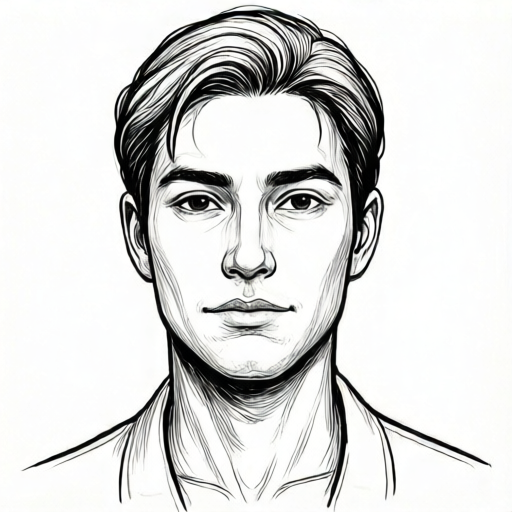
Use the stated measurements and conventions for each exercise.
Set up the mirror and define the contour box
Place a mirror so you can see your full face without turning your head. Tape a sheet of paper beside the mirror at the same height as your eyes. Draw a rectangle on the paper; for this lesson a hypothetical box of 12 cm by 16 cm is used, but any size that fits your paper works. Label it 'observation box'. Draw an identical rectangle below it and label it 'redraw box'.
The contour box is not a proportion grid. It is only a boundary that keeps your drawing on the page. Before drawing, decide which edges you will follow: the jaw from ear to chin, the nose from bridge to nostril, and the eye from inner corner around the lid to outer corner. These three edge groups are the checklist targets.
- Measure your paper and mirror distance; record the values you actually use.
- Draw two identical rectangles, one for observation and one for redraw.
- Write the three checklist targets at the top: jaw, nose, eye.
- Place the pencil on the paper and look only at the mirror edge you are drawing.
Draw continuous contour lines from the mirror
Start at the top of the jaw near one ear. Move the pencil slowly along the jaw edge toward the chin, then up the other side. If the edge disappears behind a shadow or hair, lift the pencil and restart where the edge becomes visible again. A continuous line means one stroke per visible edge segment, not one stroke for the whole face.
For the nose, begin at the bridge between the eyes and follow the side of the nose down to the nostril. For the eye, start at the inner corner and trace the upper lid to the outer corner, then return along the lower lid. Keep your hand moving at a steady speed; speed helps you resist the urge to correct the line into a familiar symbol.
- Draw the jaw edge first, ear to chin to ear.
- Draw the nose side edge from bridge to nostril.
- Draw the eye lid edge from inner to outer corner and back.
- Mark each completed edge group with a small tick beside the checklist.
Redraw and check edge continuity
In the redraw box, draw the same three edge groups from memory or by glancing back at the mirror. Do not trace the first drawing. After redrawing, compare the two boxes side by side. Check each edge group for continuity: does the line break only where the edge genuinely disappears, or does it break because your hand stopped?
Use a simple count. For each edge group, count the number of unintended breaks. A break is unintended if the edge was still visible in the mirror at that point. Record the count beside each checklist target. Lower counts indicate better edge continuity, not better likeness.
- Redraw jaw, nose, and eye edges in the second box.
- Compare each edge group between boxes.
- Count unintended breaks per edge group.
- Write the three counts beside the checklist targets.
Use a convention that allows valid alternatives
Letter styles and face shapes vary, so no single contour is universal. This lesson uses the convention that a contour line follows the visible edge and stops only when the edge is hidden. Under this convention, a rounded jaw and an angular jaw can both be correct if the line follows the observed edge. X-height is not used here because this is a face contour task, not lettering; however, if you label the boxes, write labels between baseline and midline so the text does not overlap the drawing area.
Valid alternatives include drawing the jaw in two strokes instead of one, or starting the eye at the outer corner. The rubric rewards edge continuity and checklist completion, not a specific face shape.
- State your starting point for each edge group.
- Allow two strokes per edge if the edge is long.
- Keep labels between baseline and midline.
- Judge continuity, not likeness.
Worked example
A student draws the jaw edge in the observation box with 3 unintended breaks, the nose with 1, and the eye with 2. In the redraw box the counts are 2, 1, and 3. What is the total unintended break count for each box, and which edge group improved?
Worked answer
Observation box total: 3 + 1 + 2 = 6. Redraw box total: 2 + 1 + 3 = 6. The jaw improved from 3 to 2; the eye worsened from 2 to 3; the nose stayed at 1. Totals are equal, so no overall improvement is claimed.
Four practice exercises
Exercise 1
In a hypothetical observation box, the jaw edge has 4 unintended breaks, the nose has 0, and the eye has 2. The redraw box has jaw 2, nose 1, eye 2. Calculate each box total and state which edge group improved most.
Show answer and check
Observation total = 4 + 0 + 2 = 6. Redraw total = 2 + 1 + 2 = 5. The jaw improved most, from 4 to 2.
Why: Add the three counts per box. Compare each group: jaw 4 to 2 improves by 2; nose 0 to 1 worsens by 1; eye 2 to 2 stays the same. The largest improvement is the jaw.
Check: Re-add each row and confirm the differences: 4-2=2, 0-1=-1, 2-2=0.
Exercise 2
A student draws the nose edge in three separate strokes because the edge is hidden twice by shadow. Is this allowed under the lesson convention? Explain using the definition of a contour line.
Show answer and check
Yes. The convention allows one stroke per visible edge segment. Three strokes are valid if two of them restart where the edge becomes visible again after being hidden.
Why: A contour line follows the visible edge and stops only when the edge is hidden. Multiple strokes are allowed when the edge is genuinely interrupted.
Check: Count the number of hidden segments in the description: two hidden points produce three visible segments, matching three strokes.
Exercise 3
The observation box has jaw 1, nose 2, eye 1. The redraw box has jaw 1, nose 1, eye 3. A student claims the redraw is better overall. Test the claim with totals.
Show answer and check
Observation total = 1 + 2 + 1 = 4. Redraw total = 1 + 1 + 3 = 5. The claim is false; the redraw has one more unintended break overall.
Why: Totals are compared directly. The nose improved by 1 and the eye worsened by 2, giving a net worsening of 1.
Check: Subtract totals: 5 - 4 = 1, so the redraw is worse by one break.
Exercise 4
A hypothetical box is 12 cm wide and 16 cm tall. A student draws the jaw edge 3 cm from the left side and the eye edge 9 cm from the left side. Are these measurements part of the contour checklist? Explain.
Show answer and check
No. The contour checklist records edge continuity for jaw, nose, and eye, not positions measured against the box sides. The 3 cm and 9 cm values are page positions, not contour checks.
Why: The box is only a page boundary. The lesson explicitly avoids proportion construction and does not measure features against box sides.
Check: Confirm that the checklist targets are jaw, nose, and eye edge groups, and that no rubric item mentions side distances.
Common mistakes
- Drawing a familiar symbol for the eye instead of the observed lid edge. Slow the pencil and look only at the mirror edge while the pencil moves.
- Lifting the pencil whenever the line feels wrong. Continue the stroke to the end of the visible edge, then compare; count only unintended breaks.
- Using the redraw box to trace the first drawing. Cover the observation box or redraw from the mirror only.
- Treating the contour box as a proportion grid. Use the box only as a page boundary; do not measure face features against its sides.
Self-check rubric
- Observation box contains jaw, nose, and eye edge groups.
- Redraw box contains the same three edge groups without tracing.
- Each edge group is marked with an unintended break count.
- Labels are written between baseline and midline and do not overlap drawings.
- Comparison states which edge groups improved, worsened, or stayed the same.
- Valid alternatives such as two-stroke edges are accepted if continuity is judged.
Questions and answers
Do I need a special mirror?
No. Any mirror that shows your full face works. Measure your actual setup and label any chosen distances as hypothetical examples.
How many breaks are acceptable?
There is no universal number. Count unintended breaks per edge group and compare your own two boxes; fewer unintended breaks means better continuity.
Can I draw the jaw in two strokes?
Yes. The convention allows multiple strokes per edge as long as each stroke follows a visible edge segment.
Should the redraw look exactly like the first drawing?
No. The redraw checks whether you can repeat edge continuity, not whether you can copy a shape.