Free original lessons
Cross-Contour Lines on a Side-Lying Bottle
Learn to draw a tilted bottle on its side using cross-contour wrap lines that follow the cylinder's curve, with a clear convention, rubric, and four practice tasks.
Free lesson
Four exercises
Worked answers
Object Drawing Lessons
Cross-contour lines describe form by wrapping around a surface rather than outlining its edge. In this lesson you will draw a bottle lying on its side with its long axis tilted at an angle, then add cross-contour lines that curve around the cylindrical body. The goal is not shading or isometric construction; it is showing the bottle's roundness through line direction alone. You will use a simple convention: each cross-contour is a smooth curve that crosses the bottle's long axis at roughly a right angle in the drawing, and its curvature changes as the axis tilt changes. Because letter styles and line spacing vary, the rubric rewards consistent wrap direction and believable curvature rather than one exact set of lines.
Practice materials: Printable downloads are not available for this lesson yet. Use the instructions and four exercises below.
Reference illustration
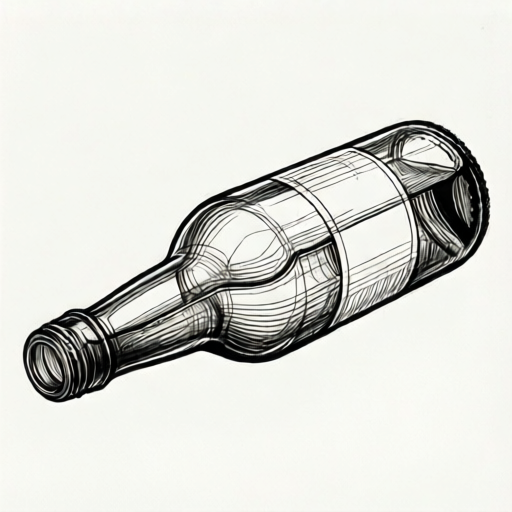
Use the stated measurements and conventions for each exercise.
Set up the tilted axis and the bottle outline
Begin by drawing a light straight line for the bottle's long axis. Tilt it, for example, 30 degrees above horizontal; this value is a hypothetical example, so choose any clear tilt and keep it consistent. Mark the bottle's length along this axis and its width across it. The body is a cylinder, so its sides are parallel to the axis, and the base and shoulder are short curves across the axis.
Keep the outline simple: two long sides, a rounded base, a shoulder, and a neck. Do not add shading or isometric boxes. The outline only establishes where the wrap lines will cross the surface.
- Draw a light axis line at your chosen tilt.
- Mark body length and width along and across the axis.
- Draw two parallel sides for the cylindrical body.
- Add a rounded base, shoulder, and neck.
- Erase or lighten construction marks before adding wrap lines.
Draw cross-contour wrap lines around the cylinder
A cross-contour line crosses the bottle's long axis at about a right angle in the drawing and curves to suggest the surface turning away from you. On a cylinder, these lines are like rings around the body. When the axis is tilted, the rings tilt with it: the curve's direction follows the axis angle, and the amount of curvature depends on where the line sits on the visible surface.
Space the lines evenly along the body. Near the middle of the visible surface, the curve is broad and gentle; near the sides, it turns more sharply. Keep each line continuous from one side of the outline to the other. Do not let lines cross each other or stop short.
- Choose four to six positions along the body for wrap lines.
- At each position, draw a smooth curve crossing the axis at roughly a right angle.
- Match the curve's tilt to the axis tilt.
- Increase curvature near the outline edges and flatten it near the center.
- Check that every line reaches both sides of the bottle outline.
Adapt the wrap lines to a different tilt
To redraw the same bottle at a different tilt, rotate the axis and repeat the wrap lines so their direction changes with it. If the axis tilts more steeply, the wrap curves tilt more steeply too. The spacing along the body stays even, and the curvature pattern stays consistent: gentle in the middle, sharper near the edges.
This adaptation is the core skill. It shows that cross-contour lines are not decorative stripes; they are a response to the object's orientation in space.
- Draw a new axis at a clearly different tilt.
- Repeat the bottle outline along the new axis.
- Place wrap lines at the same relative positions along the body.
- Tilt each wrap curve to match the new axis.
- Compare the two drawings: the line direction should change, but the wrap logic should stay the same.
Worked example
A bottle lies on its side with its long axis tilted 20 degrees above horizontal. The body is 12 cm long and 4 cm wide. Draw four cross-contour lines evenly spaced along the body and describe their direction.
Worked answer
The axis is a light line at 20 degrees above horizontal. The body sides are parallel to it, 4 cm apart, and the body length is 12 cm. Four wrap lines are placed at 2.4 cm intervals along the axis (12 divided by 5 spaces). Each wrap line is a smooth curve crossing the axis at about a right angle, tilted 20 degrees to match the axis. The middle curves are gentle; near the outline edges they turn more sharply. All lines reach both sides of the outline and do not cross.
Four practice exercises
Exercise 1
A bottle lies on its side with its axis tilted 15 degrees above horizontal. The body is 10 cm long and 3 cm wide. Place three cross-contour lines evenly along the body. Describe where they go and how they tilt.
Show answer and check
The axis is at 15 degrees. Three lines divide the 10 cm body into four spaces of 2.5 cm each. Each line crosses the axis at about a right angle and tilts 15 degrees with the axis. Curves are gentle in the middle and sharper near the edges.
Why: Even spacing means dividing the body length by the number of spaces, not by the number of lines. The tilt of each wrap line matches the axis tilt.
Check: Measure the body length and confirm three equal spaces. Check that each line reaches both sides and tilts consistently with the axis.
Exercise 2
A bottle lies on its side with its axis tilted 40 degrees above horizontal. The body is 8 cm long and 2 cm wide. Draw four wrap lines. Explain how their direction differs from a 20-degree version of the same bottle.
Show answer and check
The axis is at 40 degrees. Four lines create five spaces of 1.6 cm each along the 8 cm body. Each wrap line tilts 40 degrees with the axis. Compared with a 20-degree version, the wrap curves are steeper and follow the steeper axis, while the spacing and curvature pattern stay the same.
Why: Changing the axis tilt changes the direction of every wrap line, but the wrap logic and even spacing remain constant.
Check: Compare the two tilts side by side. Confirm that the line direction changes with the axis and that spacing is still even.
Exercise 3
A bottle lies on its side with its axis tilted 25 degrees. The body is 9 cm long and 3 cm wide. You draw five wrap lines but one stops halfway across the body. Identify the mistake and state the fix.
Show answer and check
The mistake is an incomplete wrap line that does not reach both sides of the outline. The fix is to continue the line smoothly to the opposite side so it crosses the full visible surface.
Why: A cross-contour line must describe the whole visible wrap; stopping halfway breaks the form and looks like a stray mark.
Check: Trace each line from one outline edge to the other. Any line that stops short needs to be extended.
Exercise 4
A bottle lies on its side with its axis tilted 30 degrees. The body is 12 cm long and 4 cm wide. You place wrap lines at 1 cm, 3 cm, 5 cm, 7 cm, 9 cm, and 11 cm along the axis. Are the lines evenly spaced? If not, state a corrected spacing for six lines.
Show answer and check
The lines are not evenly spaced: the gaps are 2 cm, 2 cm, 2 cm, 2 cm, 2 cm, and then 1 cm to the end, which is uneven. For six lines, divide the 12 cm body into seven spaces: 12 divided by 7 is about 1.71 cm. Place lines at approximately 1.71, 3.43, 5.14, 6.86, 8.57, and 10.29 cm.
Why: Even spacing means equal gaps between lines and equal gaps from the ends. Six lines create seven spaces.
Check: Subtract consecutive positions and compare the gaps. All gaps should be equal within a small drawing tolerance.
Common mistakes
- Drawing wrap lines as straight vertical stripes regardless of the axis tilt. Tilt each wrap curve to follow the axis, and check that it crosses the axis at roughly a right angle.
- Making every wrap line equally curved across the whole body. Flatten the curve near the center of the visible surface and sharpen it near the outline edges.
- Letting wrap lines stop before reaching the outline or cross each other. Draw each line continuously from one side of the outline to the other, and keep spacing even.
- Adding shading or isometric construction instead of cross-contour lines. Remove tonal shading and construction boxes; the lesson is about line direction only.
Self-check rubric
- Axis is clearly tilted and consistent with the bottle outline.
- Body sides are parallel to the axis and the width is consistent.
- Four to six cross-contour lines are evenly spaced along the body.
- Each wrap line crosses the axis at roughly a right angle and tilts with the axis.
- Curvature is gentle near the center and sharper near the outline edges.
- Lines are continuous, reach both sides of the outline, and do not cross.
- No shading or isometric construction is used.
- Valid alternatives: different tilt angles, line counts, and spacing are acceptable if the wrap logic and consistency are maintained.
Questions and answers
How many cross-contour lines should I draw?
Four to six lines along the body is enough to show the wrap. More lines can help, but keep spacing even and avoid clutter.
Do the lines have to be perfectly parallel?
No. They should follow the same wrap logic and tilt, but small variations in spacing and curvature are acceptable if the form reads clearly.
Can I use a ruler for the axis?
Yes, a light ruler line for the axis is fine. The wrap lines themselves should be smooth freehand curves.
What if my bottle is not a perfect cylinder?
Adjust the wrap lines slightly at the shoulder and base, but keep the same principle: curves cross the axis and suggest the surface turning away.