Free original lessons
Cross-Contour Pineapple Drawing: Wrap Lines to Show Rounded Form
Learn to draw a pineapple using cross-contour lines that wrap around its oval body and textured surface, without shading or outline-only drawing.
Free lesson
Four exercises
Worked answers
Object Drawing Lessons
Cross-contour drawing uses lines that travel across a form, like stripes on a beach ball, to describe volume. For a pineapple, these wrapped lines follow the fruit's oval body and the bumpy diamond pattern of its skin. This lesson teaches a clear convention: each cross-contour line is a continuous curve that changes direction as it passes over the surface, never a straight horizontal or vertical line. You will practice measuring proportions, placing guide lines, and drawing wrapped lines that suggest roundness without shading. The approach works for any oval fruit, but the pineapple's texture makes the wrapping especially visible. All measurements below are hypothetical examples; measure your own paper and reference to set real values.
Practice materials: Printable downloads are not available for this lesson yet. Use the instructions and four exercises below.
Reference illustration
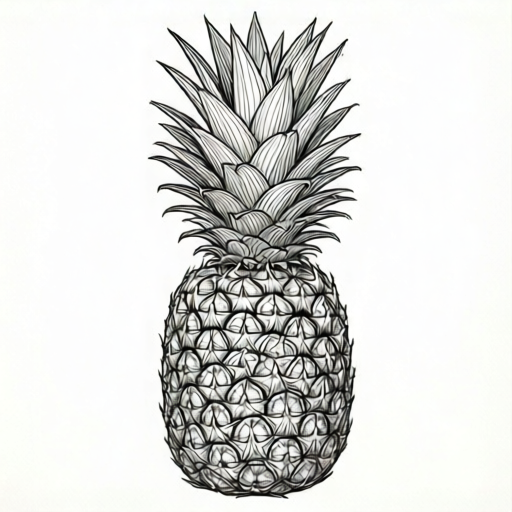
Use the stated measurements and conventions for each exercise.
Set Up the Oval Form and Proportion
Begin by drawing a light oval for the pineapple body. The oval should be taller than wide, roughly two parts height to one part width. Use a pencil and keep the line faint so you can adjust it. This oval is the boundary of the fruit, not a contour outline to be darkened later. Next, mark the crown: a cluster of stiff leaves at the top. The crown height is about one-third of the body height in a typical pineapple, but check your own reference. Draw the crown as a set of overlapping leaf shapes, each with a central vein line. Keep all lines light at this stage.
Measure the oval's height and width with a ruler or by marking with your pencil. For example, if the body is 12 cm tall, the width might be about 6 cm. These numbers are hypothetical; use your actual drawing size. Mark the vertical midline and a horizontal midline across the oval. These are guide lines, not final cross-contours. They help you place the wrapped lines evenly. Also mark the top and bottom of the oval and the left and right edges. Check that the oval is symmetric by folding the paper lightly or by comparing distances from the midline.
- Draw a light oval for the body, taller than wide, about 2:1 height to width.
- Mark the crown at the top with overlapping leaf shapes and central veins.
- Draw a vertical midline and a horizontal midline across the oval.
- Mark the top, bottom, left, and right edges of the oval.
- Check symmetry by comparing distances from the midline.
Place Cross-Contour Guide Lines
Cross-contour lines are curves that cross the form, not lines that outline it. For the pineapple body, imagine slicing the oval into horizontal bands, like rings around a barrel. Each band is a cross-contour. Because the pineapple is rounded, each band curves: it dips down at the center and rises at the edges, or vice versa depending on your viewpoint. Draw three to five faint guide curves across the body, spaced evenly. Start with one near the top, one at the middle, and one near the bottom. These guides are not straight; they bow gently to follow the oval's surface.
Next, add vertical cross-contours that wrap around the sides. These lines run from top to bottom but curve outward near the middle and inward near the ends, following the oval's bulge. Together, the horizontal and vertical guides create a grid that wraps the form. Keep the guides light and adjustable. The goal is to see how lines change direction as they travel over a rounded surface. Do not darken these guides yet; they are scaffolding for the textured lines that follow.
- Draw three to five faint horizontal curves across the body, bowing to follow the oval.
- Draw two or three vertical curves from top to bottom, bulging outward at the middle.
- Check that each guide changes direction as it crosses the oval.
- Adjust spacing so the guides are evenly distributed.
- Keep all guides light and erasable.
Draw Wrapped Lines for Texture and Volume
The pineapple's skin has a diamond pattern of bumps. Each bump can be suggested by a short cross-contour line that wraps over it. Work section by section between your guide lines. In each section, draw a small curved line that follows the bump's rounded top. The line should start on one side of the bump, curve over it, and end on the other side. Vary the curve's direction slightly to match the bump's shape. Do not draw outlines around each bump; instead, let the wrapped lines suggest the bump's volume. This is the key convention: a cross-contour line crosses the form, so it changes direction as it goes over a bump.
As you work, keep the lines connected to the larger cross-contours. The horizontal and vertical guides help you align the small wrapped lines so they flow across the body. For example, a horizontal guide might pass through the middle of several bumps; the wrapped lines over those bumps should curve in a way that respects the guide's direction. Use a slightly darker pencil for these texture lines, but avoid shading. The lines themselves create the sense of roundness. Check your work by stepping back: the body should look like a rounded oval covered with wrapped lines, not a flat outline with dots.
- Work between guide lines, section by section.
- For each bump, draw a short curved line that crosses over it, changing direction.
- Align the small wrapped lines with the larger horizontal and vertical guides.
- Vary curve direction slightly to match each bump's shape.
- Step back to check that the body reads as rounded, not flat.
Refine the Crown and Check the Whole Drawing
The crown leaves also have volume. Use cross-contour lines on each leaf: a line that runs from the leaf's base to its tip, curving with the leaf's twist. Add one or two cross-contours across each leaf's width to show its rounded surface. Keep these lines consistent with the body's wrapped lines. The crown should not look flat; the lines should suggest each leaf's curvature. Avoid shading the leaves; rely on the wrapped lines to show form.
Finally, check the whole drawing against the convention. Every cross-contour line should cross the form, not outline it. The body should look oval and rounded, with lines that wrap around it. The texture lines should suggest bumps without shading. The crown should have volume. If any line looks like a straight horizontal or vertical line, adjust it to curve with the form. Erase any guide lines that are no longer needed, but keep the wrapped lines. The drawing is complete when the lines alone convey the pineapple's rounded volume.
- Add cross-contour lines to each crown leaf, curving with its twist.
- Check that every line crosses the form rather than outlining it.
- Adjust any straight lines to curve with the oval or bump.
- Erase unnecessary guide lines but keep the wrapped lines.
- Confirm the drawing reads as a rounded pineapple without shading.
Worked example
A student draws a pineapple body 10 cm tall and 5 cm wide. They place three horizontal guide curves and two vertical guide curves. On one bump near the middle, they draw a short line that starts at the bump's left edge, curves over the top, and ends at the right edge. Explain why this line is a cross-contour and how it helps show volume.
Worked answer
The line is a cross-contour because it crosses the bump's form, changing direction as it goes over the rounded top. It helps show volume by suggesting the bump's curvature without shading. The line's curve indicates that the surface is rounded, and because it connects to the larger guide curves, it reinforces the oval body's roundness. The measurements 10 cm and 5 cm are hypothetical examples; the key is that the line wraps over the form rather than outlining it.
Four practice exercises
Exercise 1
A pineapple body is drawn as an oval 8 cm tall and 4 cm wide. A student draws a horizontal line straight across the middle from left to right. Is this a valid cross-contour? Explain and describe how to fix it.
Show answer and check
No. A straight horizontal line does not change direction as it crosses the oval, so it does not describe the rounded surface. To fix it, curve the line so it bows gently, dipping at the center and rising at the edges (or the reverse, depending on viewpoint), following the oval's form.
Why: Cross-contour lines must cross the form and change direction to suggest volume. A straight line reads as flat. The fix is to curve the line with the oval's surface.
Check: Check that the line is not straight and that it follows the oval's curvature. Compare it to the oval's edge; the line should bow in a way that matches the rounded surface.
Exercise 2
A student draws a bump on the pineapple skin by making a small closed circle around it. Is this a cross-contour? Explain and describe an alternative.
Show answer and check
No. A closed circle outlines the bump rather than crossing it. An alternative is to draw a single curved line that starts on one side of the bump, curves over its top, and ends on the other side. This line crosses the bump's form and suggests its volume.
Why: Cross-contour lines cross the form; they do not outline it. A closed shape is an outline. A wrapped line changes direction over the bump and shows roundness.
Check: Check that the line is open and crosses the bump. It should start and end on opposite sides, not form a closed loop.
Exercise 3
A pineapple body is 12 cm tall. The crown is drawn 6 cm tall. Is the crown proportion typical? Use the guideline that crown height is about one-third of body height. Show your arithmetic.
Show answer and check
One-third of 12 cm is 4 cm. The crown is 6 cm, which is half the body height, so it is taller than the typical guideline. A more typical crown would be about 4 cm tall. The numbers are hypothetical examples; measure your own reference.
Why: The guideline says crown height is about one-third of body height. 12 divided by 3 equals 4. Since 6 is greater than 4, the crown is too tall for the guideline.
Check: Divide body height by 3 and compare to crown height. If crown height is much larger, adjust it.
Exercise 4
A student draws vertical cross-contour lines on the pineapple body as straight lines from top to bottom. Describe how these lines should curve to show the oval's bulge, and explain why.
Show answer and check
The vertical lines should bulge outward near the middle of the oval and curve inward near the top and bottom, following the oval's rounded sides. This curvature shows that the body is widest at the middle and narrows toward the ends, suggesting volume.
Why: A vertical cross-contour on a rounded oval changes direction as it travels from top to bottom. It moves outward at the bulge and inward at the ends. Straight lines would read as flat.
Check: Check that each vertical line is not straight and that it bulges outward at the middle. Compare the line's shape to the oval's edge; it should follow the same curvature.
Common mistakes
- Drawing straight horizontal or vertical lines across the body. Curve each line to follow the oval's surface; a cross-contour changes direction as it crosses the form.
- Outlining each bump with a closed shape instead of wrapping a line over it. Draw a single curved line that crosses the bump, starting on one side and ending on the other.
- Shading the body to show volume. Remove shading and rely on wrapped lines; the lesson excludes shading.
- Making the oval too round or too narrow. Measure height and width; a typical pineapple body is about twice as tall as wide, but check your reference.
- Ignoring the crown's volume. Add cross-contour lines across each leaf's width to show its rounded surface.
Self-check rubric
- The body is drawn as an oval, taller than wide, with measured proportions.
- Cross-contour guide lines curve to follow the oval's surface.
- Texture lines wrap over bumps, changing direction, rather than outlining them.
- No shading is used; volume is shown by lines alone.
- The crown leaves have cross-contour lines that suggest volume.
- The drawing reads as a rounded pineapple when viewed from a step back.
- Valid alternatives are accepted: line spacing, number of bumps shown, and exact curve shapes may vary as long as lines cross the form and suggest volume.
Questions and answers
What is a cross-contour line?
A cross-contour line crosses a form, like a stripe on a ball, and changes direction as it travels over the surface. It is not an outline.
Can I use shading instead of wrapped lines?
No. This lesson excludes shading. The goal is to show volume using lines alone.
How many guide lines should I draw?
Three to five horizontal and two to three vertical guides are enough to start. Adjust as needed for your drawing size.
Do I need to draw every bump?
No. Suggest the texture with wrapped lines in key areas; you do not need to draw every bump.
What if my lines look flat?
Check that each line curves with the form. Step back and compare your lines to the oval's shape; adjust any straight lines.