Free original lessons
Basketball Cross-Contour Drawing: Wrapping Lines Around a Sphere
Learn to draw a basketball using cross-contour lines that wrap around its spherical volume, with guided steps, common fixes, and practice tasks.
Free lesson
Four exercises
Worked answers
Object Drawing Lessons
Cross-contour lines are lines that travel across a form, describing its surface curvature rather than its outer edge. On a basketball, these lines follow the seam curves and wrap around the sphere, making volume visible without shading. This lesson teaches a repeatable method: establish the sphere, map the seam curves, then draw wrapping lines that change direction as they cross the form. You will use a simple convention for line spacing and curvature, and a rubric that accepts valid alternatives. All measurements are hypothetical examples; measure your own paper and reference object if you use one.
Practice materials: Printable downloads are not available for this lesson yet. Use the instructions and four exercises below.
Reference illustration
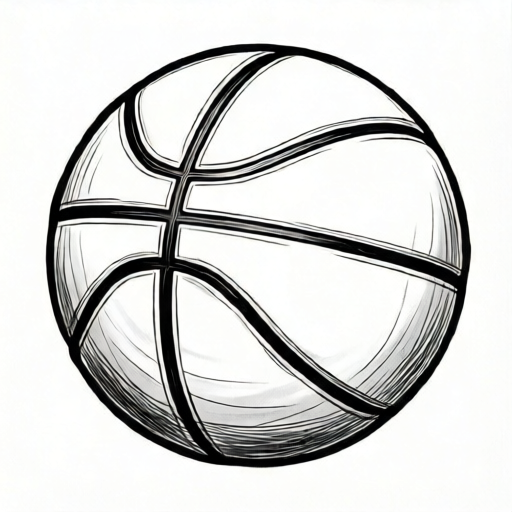
Use the stated measurements and conventions for each exercise.
Set Up the Sphere and Seam Map
Begin with a light circle to represent the basketball's outer boundary. Mark a vertical midline and a horizontal midline through the center; these are construction aids, not final lines. The basketball's seam pattern is a set of curves that meet at two poles and wrap around the sphere. For this study, simplify the seam map to one vertical great circle, one horizontal great circle, and two curved seams that arc between them. Keep all construction lines light so they can be erased or left as faint guides.
Define a drawing convention before adding cross-contour lines: lines should be spaced more widely near the center of the sphere and closer together near the edges, because the surface turns away from the viewer at the edges. Curvature should increase toward the edges as well. This convention is a choice, not a universal rule; other valid conventions exist, such as even spacing with stronger curvature at the edges. State your convention in a note beside the drawing so the rubric can be applied fairly.
- Draw a light circle about 10 cm in diameter on plain paper (hypothetical size; adjust to your paper).
- Mark a vertical midline and a horizontal midline through the center with a light pencil.
- Sketch one vertical seam curve and one horizontal seam curve, both following the sphere's surface.
- Add two curved seams that arc between the vertical and horizontal seams, meeting near the poles.
- Write your spacing and curvature convention in the margin before drawing cross-contour lines.
Draw Wrapping Cross-Contour Lines
Cross-contour lines should cross the seam curves at an angle, not run parallel to them. Start with three lines on the upper half of the sphere: one near the top edge, one through the middle, and one near the lower edge of that half. Each line should curve in the direction the surface turns. Near the center, lines are flatter; near the edge, they bend more sharply and become closer together under the stated convention.
Draw each line in one continuous motion where possible, lifting the pencil only when the line crosses a seam. Where a line crosses a seam, keep the line's direction consistent with the surface curvature on both sides. Do not shade; the goal is line description, not tone. If a line looks like a straight chord, redraw it with a slight bow that follows the sphere's curvature. Repeat on the lower half, then add two or three lines that wrap around the sides to complete the wrapped study.
- Draw the first cross-contour line near the top edge, bowing with the sphere's curvature.
- Draw a second line through the middle of the upper half, flatter than the first.
- Draw a third line near the lower edge of the upper half, with stronger curvature and closer spacing.
- Repeat the three-line pattern on the lower half, mirroring the curvature direction.
- Add two side-wrapping lines that cross the vertical seam and curve around the sphere's sides.
- Check that every cross-contour line crosses at least one seam at an angle and that spacing follows your stated convention.
Check Curvature and Spacing Against the Convention
Review the drawing against the convention you wrote in the margin. Under the example convention, lines near the center should be wider apart and flatter; lines near the edge should be closer and more curved. Measure spacing at three points along one line: center, mid-radius, and near-edge. For a 10 cm circle, a hypothetical spacing might be 2 cm at the center, 1.5 cm at mid-radius, and 1 cm near the edge. These numbers are examples only; your convention may differ, but it must be stated and applied consistently.
Check that no cross-contour line runs parallel to a seam for more than a short distance. Check that lines do not reverse curvature abruptly unless the seam map requires it. Valid alternatives include using dashed cross-contour lines, using a different number of wrapping lines, or emphasizing seam curves more strongly, provided the convention is stated and the lines still describe spherical volume. The rubric rewards consistent application of a stated convention, not a single correct line pattern.
- Measure spacing at center, mid-radius, and near-edge along one cross-contour line.
- Compare measured spacing to your stated convention and note any mismatch.
- Check that each cross-contour line crosses seams at an angle rather than running parallel.
- Confirm that curvature increases toward the edge under your convention, or that your alternative convention is consistently applied.
- Erase or lighten construction lines that interfere with reading the wrapped lines.
Worked example
A student draws a 10 cm circle and states the convention: wider spacing and flatter curvature near the center, closer spacing and stronger curvature near the edge. They draw one cross-contour line through the upper half. At the center, the line is nearly flat; at mid-radius it bows slightly; near the edge it bows strongly. Spacing to the next line is 2 cm at center, 1.5 cm at mid-radius, and 1 cm near edge. Evaluate whether the line follows the stated convention.
Worked answer
The line follows the convention. Curvature increases from center to edge, and spacing decreases from 2 cm to 1.5 cm to 1 cm, matching the stated pattern. The line also crosses the vertical seam at an angle, so it reads as a cross-contour line rather than a seam-following line. One improvement: add a second line on the opposite side of the seam to show wrapping continuity.
Four practice exercises
Exercise 1
On a 12 cm circle, state the convention: even spacing of 1.5 cm everywhere, with curvature increasing only near the outer edge. Draw four cross-contour lines across the upper half, each crossing the vertical seam at an angle. Describe where curvature should be strongest.
Show answer and check
Curvature should be strongest near the outer edge of the circle and flattest near the center, while spacing remains 1.5 cm throughout. Each line should cross the vertical seam at an angle, not run parallel to it.
Why: The stated convention fixes spacing as even and places curvature change only at the edge. Crossing the vertical seam at an angle ensures the lines are cross-contour rather than seam-following.
Check: Measure spacing between adjacent lines at three points; each should be about 1.5 cm. Check that each line crosses the vertical seam at a visible angle and that the bow is strongest near the edge.
Exercise 2
A drawing shows five cross-contour lines on a sphere. At the center, spacing is 1 cm; at mid-radius, 1.5 cm; near the edge, 2 cm. The stated convention is wider spacing near the center and closer spacing near the edge. Identify the mismatch and state one correction.
Show answer and check
The spacing pattern is reversed: it is closest at the center and widest at the edge, which contradicts the stated convention. Correction: redraw the lines so spacing is about 2 cm at the center, 1.5 cm at mid-radius, and 1 cm near the edge, or revise the stated convention to match the drawing and apply it consistently.
Why: The convention requires wider center spacing and closer edge spacing. The measured values show the opposite pattern, so either the drawing or the convention must change.
Check: Compare measured spacing at center, mid-radius, and edge to the convention. If the order is reversed, the mismatch is confirmed.
Exercise 3
Draw a sphere with one vertical seam and one horizontal seam. Add three cross-contour lines that wrap around the right side, crossing the vertical seam. State whether your lines use the example convention or an alternative, and give one reason your choice supports spherical volume.
Show answer and check
A valid response states either the example convention (wider center spacing, closer edge spacing) or an alternative such as even spacing with stronger edge curvature. The lines cross the vertical seam at an angle and curve around the right side. The reason should connect the convention to volume, for example: closer spacing near the edge makes the surface appear to turn away from the viewer.
Why: Cross-contour lines that wrap around the side and cross the vertical seam describe the sphere's turning surface. A stated convention makes the volume cue checkable.
Check: Confirm that three lines cross the vertical seam at an angle and curve around the right side. Check that the stated convention is written down and that the line spacing and curvature match it.
Exercise 4
A student draws cross-contour lines that are all straight and parallel to the horizontal seam. They claim the lines show volume because they are evenly spaced. Evaluate the claim and give two specific fixes.
Show answer and check
The claim is not supported: straight lines parallel to a seam do not describe surface curvature and read as flat. Fix 1: angle each line so it crosses the horizontal seam and bows with the sphere's curvature. Fix 2: state a spacing convention and apply it, for example wider spacing at the center and closer spacing near the edge, or an alternative stated convention.
Why: Cross-contour lines must cross the form and change direction to show turning. Parallel straight lines fail both conditions, so volume is not communicated.
Check: Check that each line crosses the horizontal seam at an angle and shows visible curvature. Check that a stated convention is present and that spacing matches it at center, mid-radius, and edge.
Common mistakes
- Drawing cross-contour lines as straight chords across the circle. Redraw each line with a slight bow that follows the sphere's curvature; near the edge, increase the bow under the stated convention.
- Running cross-contour lines parallel to the seam curves. Angle each cross-contour line so it crosses at least one seam; use the seam map as a guide, not as a path to follow.
- Using even spacing everywhere without stating a convention. Either apply the example convention of wider center spacing and closer edge spacing, or state an alternative convention and apply it consistently.
- Adding shading to suggest volume instead of relying on line curvature. Remove shading and strengthen the curvature and spacing of the cross-contour lines to communicate volume through line alone.
Self-check rubric
- Sphere boundary is clear and approximately circular; construction lines are light or removed.
- Seam map includes at least one vertical and one horizontal seam curve plus two arcing seams.
- At least six cross-contour lines are present and each crosses at least one seam at an angle.
- A spacing and curvature convention is stated in the margin or notes.
- Line spacing and curvature are consistent with the stated convention across the drawing.
- No shading is used; volume is communicated by line curvature and spacing alone.
- Valid alternatives (dashed lines, different line counts, stronger seam emphasis) are accepted if the convention is stated and applied consistently.
Questions and answers
What is the difference between a contour line and a cross-contour line?
A contour line describes an outer edge or a boundary. A cross-contour line travels across the surface, showing how the form turns. On a basketball, seam curves can act as contour-like guides, while the wrapping lines are cross-contour lines.
Do I have to use the example spacing convention?
No. The example convention is one valid choice. You may use even spacing with stronger edge curvature, dashed lines, or another stated convention, as long as it is written down and applied consistently.
How many cross-contour lines should I draw?
There is no fixed number. A useful study often uses six to ten wrapping lines across the sphere. Fewer lines may not describe volume clearly; more lines may become cluttered. Choose a number that supports the stated convention.
Can I use a real basketball as a reference?
Yes. If you use one, measure its actual diameter and note the measurement. Do not assume standard sizes. The lesson's numerical examples are hypothetical and should be replaced by your own measurements.