Free original lessons
How to Draw Male Anime Hair in Angled Perspective
Construct male anime hair from simple masses and strand arrows, then check foreshortening and silhouette under front, three-quarter, and tilted head angles.
Free lesson
Four exercises
Worked answers
Object Drawing Lessons
Angled perspective makes male anime hair read as a solid shape rather than a flat cap. Start by placing the skull and a hairline, block the hair as a few large masses, then add strand arrows that follow the head's curve. Use a simple convention: x-height is the distance from baseline to midline, and letter styles vary, so treat all measurements as guides rather than fixed rules. This lesson covers front, three-quarter, and tilted views, with checks you can perform on your own paper.
Practice materials: Printable downloads are not available for this lesson yet. Use the instructions and four exercises below.
Reference illustration
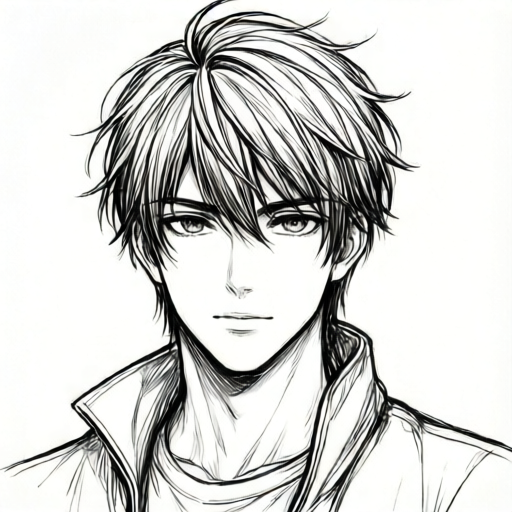
Use the stated measurements and conventions for each exercise.
Set the head angle and hairline first
Draw an oval for the cranium and mark a baseline and midline. The x-height is baseline to midline; use it to compare hair mass height consistently. For a three-quarter view, shift the midline toward the visible side and narrow the far side of the oval. For a tilted view, rotate the oval and move the hairline with it.
Place the hairline as a curved line across the forehead. Male anime hair often starts with a fringe that covers part of the forehead, so leave a clear gap between hairline and eyebrow line. Mark the crown point and the sideburn points before adding any strands.
- Draw the cranium oval and label baseline and midline.
- Shift the midline for three-quarter or tilt the oval for a tilted view.
- Draw the hairline curve and mark crown and sideburn points.
- Check that the hairline follows the head angle, not the page edge.
Block hair as three masses
Use three masses: top mass, side mass, and fringe mass. The top mass sits above the crown and follows the skull curve. The side mass drops toward the ear on the visible side. The fringe mass hangs from the hairline. Keep each mass as a simple polygon or curved blob before adding detail.
In angled perspective, the far side mass becomes narrower and may hide behind the head. The near side mass widens. If the head tilts down, the top mass compresses; if it tilts up, the top mass stretches. Label any numerical example as hypothetical: for instance, a top mass might be about one x-height tall in a neutral front view, but this is only a guide.
- Draw the top mass above the crown.
- Draw the near side mass and the far side mass, narrowing the far one.
- Draw the fringe mass from the hairline.
- Compare mass widths to the oval; adjust until the silhouette reads as hair.
Add strand arrows for foreshortening
Strand arrows show direction, not individual hairs. Draw two or three arrows per mass, pointing from root to tip. On the near side, arrows curve outward and down. On the far side, arrows shorten and point more steeply because the surface turns away. On the top mass, arrows sweep back or to the side depending on the hairstyle.
Use arrow length to suggest depth: longer arrows on surfaces facing the viewer, shorter arrows on receding surfaces. Keep arrow spacing even within a mass. Avoid crossing arrows unless the hairstyle explicitly has layered locks. Check that every arrow starts inside a mass and ends at its edge.
- Draw root-to-tip arrows on each mass.
- Shorten arrows on the far side and on receding surfaces.
- Keep spacing even and avoid accidental crossings.
- Trace each arrow to confirm it stays within its mass.
Refine silhouette and check perspective
Refine the outer silhouette before adding interior lines. The silhouette should show the three masses clearly. In three-quarter view, the far side of the hair should not extend beyond the far side of the cranium oval. In tilted view, the fringe should overlap the forehead according to the tilt.
Use a simple check: measure the distance from crown to hairline along the midline, then compare it to the x-height. If the ratio changes drastically between views without a corresponding head tilt, adjust the hairline. Keep line weight consistent and erase construction lines only after the silhouette is stable.
- Trace the outer silhouette and label each mass.
- Check far-side hair against the cranium oval.
- Compare crown-to-hairline distance to x-height.
- Erase construction lines and confirm the silhouette reads clearly.
Worked example
A head is drawn in three-quarter view facing left. The cranium oval is 6 units wide and 8 units tall. The midline is shifted 1 unit left. The hairline is 2 units below the top of the oval. Block the top mass, near side mass, and far side mass, then add strand arrows. Describe the result.
Worked answer
The top mass sits above the crown and spans about 4 units wide, following the oval curve. The near side mass (right side of the page) is about 2 units wide and drops toward the ear. The far side mass (left side) is about 1 unit wide and partly hidden. Strand arrows on the near side curve outward and down, about 2 units long. Far-side arrows are about 1 unit long and point more steeply. The fringe mass hangs from the hairline and overlaps the forehead by about 1 unit. The silhouette shows three clear masses, and the far hair stays within the oval.
Four practice exercises
Exercise 1
Front view: cranium oval 5 units wide and 7 units tall. Hairline 2 units below the top. Draw top mass, left side mass, right side mass, and fringe mass. Add two strand arrows per mass. State one check you can perform.
Show answer and check
Top mass spans about 4 units wide above the crown. Left and right side masses are each about 1.5 units wide and drop toward the ears. Fringe mass hangs from the hairline and overlaps the forehead by about 1 unit. Arrows point root to tip, roughly equal length on both sides because the view is symmetrical. Check: left and right side masses should be similar in width.
Why: In front view, the head is symmetrical, so side masses should be similar. The hairline placement keeps the fringe from covering the whole forehead. Arrows show direction without implying individual hairs.
Check: Measure left and right side mass widths; they should differ by no more than half a unit in this hypothetical example.
Exercise 2
Three-quarter view facing right: cranium oval 6 units wide and 8 units tall. Midline shifted 1 unit right. Hairline 2 units below the top. Block three masses and add strand arrows. Describe how the far side differs from the near side.
Show answer and check
Near side mass (right) is about 2 units wide; far side mass (left) is about 1 unit wide and partly hidden. Top mass spans about 4 units. Fringe overlaps the forehead by about 1 unit. Near-side arrows are about 2 units long and curve outward; far-side arrows are about 1 unit long and point more steeply. The far hair stays within the cranium oval.
Why: The shifted midline indicates the visible side. The far side recedes, so its mass narrows and its arrows shorten. The silhouette must still read as hair, not as a flat cap.
Check: Trace the far side of the hair; it should not extend beyond the far side of the oval. Compare near and far arrow lengths.
Exercise 3
Tilted view: cranium oval tilted 20 degrees to the left. Hairline follows the tilt. Top mass is compressed. Draw three masses and two strand arrows per mass. State how you check the fringe.
Show answer and check
The oval is rotated 20 degrees left. The hairline rotates with it. The top mass is shorter than in front view, about half an x-height tall in this hypothetical example. Side masses follow the tilt; the near side is wider. Fringe mass hangs from the tilted hairline and overlaps the forehead on the lower side. Arrows follow the tilt direction. Check: the fringe should overlap more on the side toward which the head tilts.
Why: Tilting the head changes the apparent height of the top mass and the overlap of the fringe. Keeping the hairline attached to the oval prevents the hair from floating.
Check: Compare fringe overlap on left and right; the lower side of the tilt should show more overlap.
Exercise 4
Three-quarter view facing left with a short hairstyle: cranium oval 6 units wide and 8 units tall. Hairline 3 units below the top. Top mass is small, side masses are short. Add strand arrows. Describe one valid alternative and one check.
Show answer and check
Top mass is about 2 units wide and 1 unit tall. Near side mass (right) is about 1.5 units wide and ends above the ear. Far side mass (left) is about 1 unit wide and mostly hidden. Fringe is short, overlapping the forehead by about half a unit. Arrows are short, about 1 unit on the near side and half a unit on the far side. A valid alternative is a spiky top mass with the same silhouette checks. Check: the far side must not extend beyond the oval.
Why: Short hairstyles reduce mass height but still require perspective checks. Alternative spiky shapes are valid if the far side stays within the oval and arrows show direction.
Check: Measure far-side hair against the oval boundary; confirm arrow lengths are shorter on the far side.
Common mistakes
- Drawing hair as a flat cap that ignores the head angle. Block the cranium oval first, then make the top mass follow its curve; narrow the far side in three-quarter view.
- Making all strand arrows the same length. Shorten arrows on receding surfaces and lengthen them on surfaces facing the viewer.
- Letting the fringe cover the entire forehead in every view. Place the hairline first and keep a gap to the eyebrow line; adjust the fringe mass to the tilt.
- Adding many thin strands before the masses are stable. Refine the three masses and silhouette first, then add a few strand arrows for direction.
Self-check rubric
- Cranium oval and hairline are placed before hair masses.
- Three masses (top, near side, far side) are distinguishable in the silhouette.
- Far side mass is narrower than near side mass in angled views.
- Strand arrows show direction and are shorter on receding surfaces.
- Fringe mass follows the hairline and head tilt.
- Construction lines are removed or clearly subordinate.
- Valid alternative hairstyles are accepted if masses and perspective checks hold.
Questions and answers
Do I need to measure x-height exactly?
No. X-height is a comparison tool from baseline to midline. Use it to keep hair mass proportions consistent, but letter styles vary, so treat it as a guide.
How many strand arrows should I draw?
Two or three per mass is enough to show direction. More arrows can help layered styles, but keep spacing even and avoid crossings unless intended.
What if my three-quarter view looks flat?
Narrow the far side mass, shorten far-side arrows, and check that the far hair does not extend beyond the cranium oval.
Can I use numerical examples as rules?
No. Any numbers in this lesson are hypothetical examples. Measure your own drawing and adjust to the head angle you chose.