Free original lessons
Drawing Mouths from Front, Angled, and Open Perspectives
Learn to construct mouths in front, three-quarter, and open views using alignment guides, lip thickness comparison, and jaw-opening checks.
Free lesson
Four exercises
Worked answers
Object Drawing Lessons
A mouth is not a single outline but a set of aligned landmarks: the lip seam, the corners, the upper and lower lip masses, and the opening between them. When the head turns or the jaw drops, those landmarks shift in predictable ways. This lesson teaches a construction method for front, angled, and open mouths using simple alignment guides and a comparison grid. You will measure lip thickness and jaw opening in consistent units, then test each drawing against checkable relationships rather than a single ideal shape. Letter styles and lip shapes vary, so the rubric rewards valid alternatives that preserve alignment and proportion.
Practice materials: Printable downloads are not available for this lesson yet. Use the instructions and four exercises below.
Reference illustration
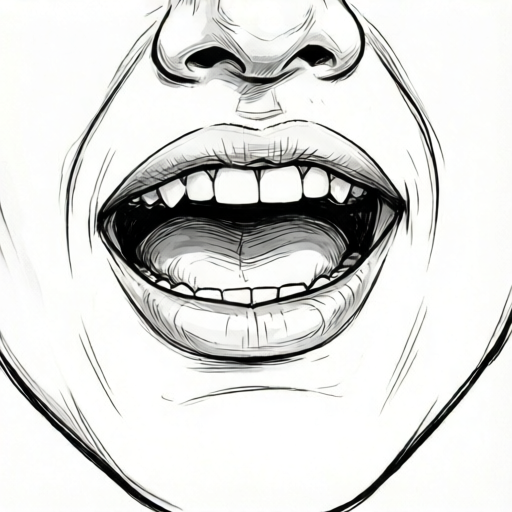
Use the stated measurements and conventions for each exercise.
Front view: seam, corners, and lip masses
Begin with a horizontal midline for the lip seam and a vertical centerline. Mark the mouth corners at equal distances from the centerline. The upper lip mass sits above the seam and the lower lip mass below it; their thicknesses can differ, so measure each separately.
Use a small unit, such as one grid square, to record upper-lip thickness, lower-lip thickness, and mouth width. These three numbers form a proportion record you can compare across views.
- Draw a vertical centerline and a horizontal seam line.
- Mark left and right corners at equal distances from the centerline.
- Measure upper-lip thickness above the seam and lower-lip thickness below it in grid units.
- Check that the seam curves gently and that both corners sit on the same horizontal level in a front view.
Three-quarter view: compression and corner shift
When the head turns, the far corner moves toward the centerline and the near corner moves outward. The seam becomes a curve whose far half is compressed. Lip thickness on the far side appears narrower because it is foreshortened, not because the lip is thinner.
Keep the vertical centerline as a reference, but shift the corner marks along the seam curve. Record the new corner distances and compare them with the front-view record.
- Draw the turned centerline and a curved seam.
- Place the near corner farther from the centerline and the far corner closer to it.
- Reduce the far-side lip thickness in grid units to show foreshortening.
- Check that the far corner is higher or lower than the near corner only if the head tilt requires it; otherwise keep both on the seam curve.
Open view: jaw drop and the inner gap
An open mouth adds a gap between the upper and lower lip masses. The jaw drop is measured as the vertical distance between the inner edges of the lips. The corners usually stay near the seam line while the lower lip moves down.
Measure jaw opening in the same grid units used for lip thickness. A hypothetical example is an opening of three units with upper-lip thickness of one unit and lower-lip thickness of two units. Label such values as examples, not standards.
- Draw the seam and corners first, then mark the inner edge of the upper lip.
- Drop the lower lip by the chosen jaw-opening distance in grid units.
- Keep the corners aligned with the seam unless the expression requires a shift.
- Check that the opening distance is consistent across the width of the mouth.
Comparison grid and alignment checks
A comparison grid records mouth width, upper-lip thickness, lower-lip thickness, and jaw opening for each view. Use the same units throughout. The grid reveals whether a change is due to perspective or to an inconsistent measurement.
Alignment guides connect the corners, the seam, and the centerline. A valid drawing may vary in lip shape and letter style, but the recorded proportions should remain internally consistent.
- Create a grid with columns for view, width, upper thickness, lower thickness, and opening.
- Fill in measured values for front, angled, and open views.
- Compare angled values with front values to confirm foreshortening.
- Compare open values with closed values to confirm the jaw drop.
Worked example
A front-view mouth has width 6 units, upper-lip thickness 1 unit, and lower-lip thickness 2 units. In a three-quarter view, the near corner is 4 units from the centerline and the far corner is 2 units. The far upper lip measures 0.5 units. Check whether the far thickness is consistent with foreshortening.
Worked answer
The far corner is compressed from 3 units to 2 units, a ratio of 2/3. The far upper lip at 0.5 units is half the front value of 1 unit, which is stronger compression than the corner ratio. A consistent foreshortening example would be about 0.67 units. The drawing is valid only if the stronger compression is intentional and recorded; otherwise adjust to about 0.67 units.
Four practice exercises
Exercise 1
Front view: width 8 units, upper lip 1 unit, lower lip 2 units. Mark corners at 4 units from the centerline. Describe the seam and corner alignment.
Show answer and check
Corners sit 4 units left and right of the centerline on the same horizontal level; the seam curves gently between them.
Why: Equal corner distances and a level seam follow the front-view construction.
Check: Measure both corner distances and confirm they equal 4 units; confirm the seam endpoints share a horizontal level.
Exercise 2
Three-quarter view: the front-view half-width is 4 units (corners 4 units from the centerline). In the angled view the near corner is 3 units from the centerline and the far corner is 2 units. If the front upper lip is 1 unit thick, what far upper-lip thickness is consistent with foreshortening?
Show answer and check
About 0.5 units, because the far corner is compressed to 2/4 of the front half-width, and 1 times 2/4 equals 0.5.
Why: Foreshortening compresses the far side in proportion to how far the far corner has moved toward the centerline relative to the front half-width.
Check: Divide the far corner distance by the front half-width (2 divided by 4 equals 0.5), multiply the front upper-lip thickness by that ratio (1 times 0.5 equals 0.5), and compare with the recorded value.
Exercise 3
Open view: upper lip 1 unit, lower lip 2 units, jaw opening 3 units. The mouth width is 6 units. Check whether the opening is consistent across the width if the left opening is 3 units and the right opening is 2 units.
Show answer and check
No; the opening should be consistent, so both sides should measure 3 units or the difference should be recorded as an intentional asymmetry.
Why: Jaw opening is a vertical distance that should remain consistent unless deliberately varied.
Check: Measure the opening at left, center, and right; compare values in the same units.
Exercise 4
A comparison grid shows front upper lip 1 unit, angled far upper lip 0.5 units, and far-corner ratio 2/3. Is the angled value consistent with foreshortening?
Show answer and check
No; the consistent example is about 0.67 units, so 0.5 units is stronger compression and must be labeled intentional or adjusted.
Why: Multiply front thickness by the far-corner ratio to estimate foreshortened thickness.
Check: Compute 1 times 2/3, compare with 0.5, and record the difference.
Common mistakes
- Making the far lip thinner in an angled view without recording foreshortening. Record the reduced thickness in grid units and note it as foreshortened, not as a different lip shape.
- Dropping the lower lip in an open view while moving the corners far from the seam. Keep corners near the seam unless the expression requires a shift, and check corner alignment against the seam curve.
- Using different units for width and thickness. Use one grid unit for all measurements and convert any mixed values before comparing.
- Treating one lip shape as the only correct answer. Use the rubric to accept valid alternatives that preserve alignment and proportion.
Self-check rubric
- Corners are marked at equal distances from the centerline in front view.
- Seam curve and corner positions are consistent with the chosen view.
- Upper and lower lip thicknesses are measured separately in the same units.
- Angled view records foreshortening rather than changing lip shape arbitrarily.
- Open view keeps corners near the seam and measures jaw opening consistently.
- Valid alternative lip shapes and letter styles are accepted when alignment and proportion checks pass.
Questions and answers
Do I need to shade lip highlights for this lesson?
No. This lesson covers construction and alignment only; lip highlight shading is outside the boundary.
Can I use different lip thicknesses?
Yes. Measure each lip separately and keep the values consistent across views.
How do I check an angled mouth without a full face?
Use the centerline, seam curve, and corner distances as alignment guides, then compare recorded grid values.
Are the numerical examples standards?
No. Any numbers given are hypothetical examples; measure your own drawing and label chosen values as examples.