Free original lessons
Random Plant Drawing Practice: Sketching Plant Forms from Shape Prompts
Use shape prompts to sketch varied plant silhouettes with stems, leaves, and overall-shape notes. Build quick, confident plant-form drawing skills.
Free lesson
Four exercises
Worked answers
Object Drawing Lessons
Random plant drawing practice trains you to invent believable plant silhouettes quickly from simple shape cues. Instead of copying one reference, you respond to prompts such as a tall narrow form, a low spreading form, or a rounded clump. Each sketch focuses on three decisions: the stem path, the leaf arrangement, and the overall silhouette. This page explains a repeatable method, shows a worked example, lists common mistakes, and gives four self-contained exercises. All sketches use a simple convention: draw the stem as a single line, attach leaves as simple closed shapes, and note the overall silhouette in words. Letter styles and leaf shapes vary, so the rubric rewards clear decisions rather than one universal answer.
Practice materials: Printable downloads are not available for this lesson yet. Use the instructions and four exercises below.
Reference illustration
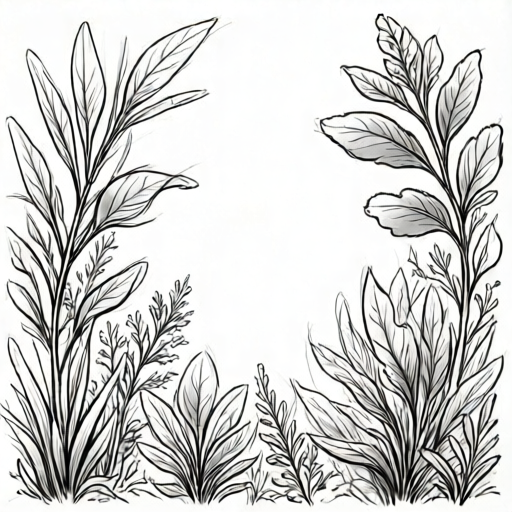
Use the stated measurements and conventions for each exercise.
The three-decision method for plant-form sketching
Every plant sketch in this practice is built from three decisions made in order. First, choose the stem path: upright, arching, trailing, or branching. Second, choose the leaf arrangement: alternate, opposite, whorled, or clustered. Third, choose the overall silhouette: tall and narrow, low and spreading, rounded, or irregular. Making these decisions in order prevents the common problem of drawing leaves before the stem direction is settled.
Use a simple convention so sketches stay comparable. Draw the stem as one continuous line. Draw each leaf as a closed shape attached to the stem by a short stalk line. Write the overall-shape note beside the sketch in plain words, such as tall narrow or low spreading. This convention is not a botanical standard; it is a drawing aid that keeps attention on form rather than detail.
- Read the shape prompt and say the overall silhouette aloud in two or three words.
- Draw the stem path first as a single line that matches the silhouette.
- Add leaves as simple closed shapes, spacing them according to one arrangement choice.
- Write a short overall-shape note beside the sketch.
- Check that the stem, leaves, and note all support the same silhouette.
Working from varied prompts without copying one plant
A prompt such as low spreading with opposite leaves gives you constraints, not a finished picture. Two sketchers can satisfy the same prompt with different leaf shapes and still both be correct. The goal is to make the three decisions visible and consistent. If the prompt says low spreading, the stem should not shoot straight up, and the leaves should not cluster only at the top.
Vary one decision at a time when practicing. Keep the stem path upright but change the leaf arrangement from alternate to opposite. Then keep the arrangement and change the silhouette from tall narrow to rounded. This isolates each decision and makes your sketches easier to check against the prompt.
- Underline the silhouette word in the prompt before drawing.
- Choose one stem path that matches the underlined word.
- Choose one leaf arrangement and keep it consistent across the sketch.
- Add the overall-shape note in the same words as the prompt.
- Compare the finished sketch to the prompt and adjust one decision if needed.
Checking sketches with a simple rubric
A useful check is to score each sketch on three items: stem path matches the prompt, leaf arrangement is consistent, and the overall-shape note matches the drawing. Each item is scored as clear, partly clear, or unclear. This rubric allows valid alternatives because it checks consistency rather than a single correct leaf shape.
Measure your own equipment if you use a ruler or grid. Any numerical values in this practice, such as a sketch box of 8 cm by 6 cm, are hypothetical examples only. Measure your actual paper and label your own values. The arithmetic in the exercises uses simple whole numbers and consistent units so you can check your work without special tools.
- Score stem path as clear if one line direction dominates the sketch.
- Score leaf arrangement as clear if leaves repeat in one pattern.
- Score the note as clear if it uses the prompt words and matches the drawing.
- Record the three scores beside the sketch.
- Redraw only the item scored unclear.
Worked example
Sketch a plant form for the prompt tall narrow with alternate leaves. Use a stem line, simple closed leaf shapes, and an overall-shape note.
Worked answer
Draw one upright stem line slightly curved near the top. Attach five simple oval leaves one at a time, alternating left and right along the stem. Write the note tall narrow beside the sketch. The stem dominates the height, the leaves alternate consistently, and the note matches the prompt.
Four practice exercises
Exercise 1
Sketch a plant form for the prompt low spreading with opposite leaves. Draw a stem line, add four leaves in opposite pairs, and write an overall-shape note.
Show answer and check
A low, wide stem line with two pairs of leaves attached at the same points on opposite sides, plus the note low spreading.
Why: The stem stays low and spreads sideways, the leaves appear in opposite pairs, and the note repeats the prompt words. This satisfies all three decisions.
Check: Confirm the stem does not rise tall, count two opposite pairs, and read the note aloud against the prompt.
Exercise 2
Sketch a plant form for the prompt rounded clump with whorled leaves. Draw a short central stem, add three leaves at one node in a whorl, and write an overall-shape note.
Show answer and check
A short stem with three leaves radiating from one point, forming a rounded outline, plus the note rounded clump.
Why: A whorl means three or more leaves at one node. The short stem and radiating leaves create a rounded silhouette that matches the prompt.
Check: Check that three leaves meet at one node and that the outline reads as rounded rather than tall.
Exercise 3
Sketch a plant form for the prompt arching with alternate leaves. Draw one stem line that curves to one side, add five leaves alternating along the curve, and write an overall-shape note.
Show answer and check
A single arching stem line with five leaves alternating left and right along its length, plus the note arching.
Why: The stem curve creates the arch, alternate leaves repeat consistently, and the note matches the prompt. The leaf shape can vary.
Check: Trace the stem curve, confirm leaves alternate rather than pair, and compare the note to the prompt.
Exercise 4
Sketch a plant form for the prompt tall narrow with clustered leaves. Draw one upright stem, add three leaves clustered near the top, and write an overall-shape note.
Show answer and check
A tall upright stem with three leaves grouped closely near the top, plus the note tall narrow.
Why: The upright stem gives height, the clustered leaves sit together rather than alternating, and the note matches the prompt.
Check: Check that the stem is the tallest element, that the three leaves are grouped, and that the note uses the prompt words.
Common mistakes
- Drawing leaves before deciding the stem path. Draw the stem line first, then attach leaves to it. This keeps the silhouette consistent.
- Changing leaf arrangement halfway through a sketch. Choose one arrangement at the start and repeat it. If you change, redraw the whole sketch.
- Writing an overall-shape note that does not match the drawing. Use the prompt words in the note and compare the note to the stem and leaf spread before finishing.
- Treating one leaf shape as the only correct answer. Check consistency with the prompt instead. Different leaf shapes can satisfy the same prompt.
Self-check rubric
- Stem path is a single clear line that matches the prompt silhouette.
- Leaf arrangement is consistent across the sketch.
- Overall-shape note uses the prompt words and matches the drawing.
- Sketch follows the convention: stem line, closed leaf shapes, short stalk lines.
- Valid alternatives are accepted when the three decisions are consistent.
Questions and answers
Do I need to label plant parts?
No. This practice excludes botanical labeling. Focus on stem path, leaf arrangement, and overall silhouette.
Can I use any leaf shape?
Yes, as long as the leaf arrangement and silhouette match the prompt. The rubric rewards consistency, not one universal shape.
How large should each sketch be?
Measure your own paper. A box of 8 cm by 6 cm is a hypothetical example only; use whatever size fits your sheet.
How do I know a sketch is finished?
A sketch is finished when the stem, leaves, and overall-shape note all support the same prompt.