Free original lessons
Sky Contour Lines: Cloud Edges and Blind Contour Comparison
Learn to draw cloud edges with slow contour lines, then compare them to a blind contour study. Includes a worked example, four practice tasks, and a rubric.
Free lesson
Four exercises
Worked answers
Object Drawing Lessons
Contour drawing trains your eye to follow an edge and your hand to record its changes in direction. Clouds are ideal subjects because their edges are soft, irregular, and full of small turns that reward careful looking. This lesson focuses on capturing cloud edges with a slow contour line, then making a blind contour version of the same or similar cloud shape to compare line quality. You will use a simple convention: each drawing sits in a labeled box of stated size, and the contour line stays continuous except where the cloud edge genuinely breaks. All numerical values below are hypothetical examples for practice, not manufacturing standards. Measure your own paper and tools if you adapt the tasks.
Practice materials: Printable downloads are not available for this lesson yet. Use the instructions and four exercises below.
Reference illustration
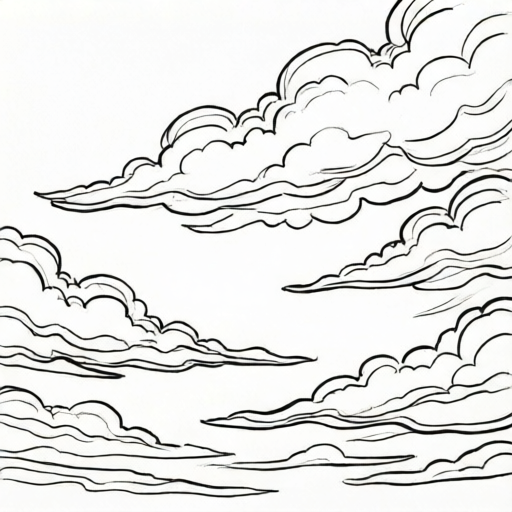
Use the stated measurements and conventions for each exercise.
Following a Cloud Edge with Slow Contour
A contour line describes the boundary of a form. For clouds, the boundary is rarely a single smooth arc; it usually contains bumps, flat runs, small notches, and gradual curves. Slow contour means you move your pencil at the same pace as your eye, pausing when the edge pauses and turning when the edge turns. Keep the line continuous unless the edge genuinely breaks. Do not shade or add interior detail during this stage.
Choose one cloud edge from a reference plate or from a photograph you have permission to use. If you use the planned plate described in the resource plan, it will show a cloud-edge reference with a slow-contour box and a blind-contour box. Until that plate is built, you can use any clear cloud photograph or draw a simple cloud shape from imagination and treat it as the reference. Work at a comfortable scale: for example, a hypothetical 12 cm by 8 cm box on A4 paper.
- Place your reference where you can see it without moving your head much.
- Draw a light box on your paper, for example 12 cm by 8 cm, and label it slow contour.
- Start at one end of the cloud edge and move your pencil slowly, matching the edge's direction changes.
- When the edge flattens, let the line flatten; when it bulges, let the line bulge.
- Keep the line single and continuous; do not lift the pencil unless the edge truly stops.
- Stop when you have followed the chosen edge from start to end, then compare the line to the reference.
Making a Blind Contour of a Cloud Edge
Blind contour means you draw without looking at your paper. Your eye stays on the reference edge while your hand records what the eye sees. The result will look distorted, and that is expected. The purpose is to strengthen the connection between observation and hand movement, not to produce a polished drawing. Use the same cloud edge or a similar one so the comparison is fair.
Set a time limit that suits your pace, for example a hypothetical 3 minutes for one edge. Keep your pencil on the paper and move slowly. If you lose your place, pause, find the edge again with your eye, and continue without looking down. After the blind contour, place it beside the slow contour and compare line quality: continuity, direction changes, and how closely the line follows the edge's rhythm.
- Draw a second box of the same size and label it blind contour.
- Look only at the cloud edge, not at your paper.
- Move your pencil slowly, matching the edge's turns as your eye follows them.
- Keep the line continuous and do not lift the pencil unless the edge breaks.
- Work for a set time, for example 3 minutes, then stop and look at the result.
- Place the blind contour next to the slow contour and note two differences in line quality.
Comparing Line Quality
Comparison is where the learning happens. Look at both drawings and ask: which line changes direction more often? Which line stays continuous? Which line captures the cloud's overall rhythm? The slow contour may be more accurate but stiffer; the blind contour may be looser but more responsive to small turns. Neither is automatically better. The goal is to notice how your hand behaves under each condition.
Use a simple comparison note beside the boxes. Write two observations about continuity and two about direction changes. For example: the slow contour kept a continuous line but flattened two small bumps; the blind contour captured the bumps but drifted in scale. Keep the note short and specific. This note becomes evidence for the rubric.
- Place the slow contour and blind contour side by side.
- Check continuity: does each line stay unbroken except at genuine edge breaks?
- Check direction changes: does each line turn where the cloud edge turns?
- Check rhythm: does each line suggest the cloud's overall pace of bumps and flats?
- Write two continuity observations and two direction-change observations.
- Decide which line quality you want to practice next and why.
Worked example
A reference cloud edge has three bumps and one flat run. Draw a slow contour in a 12 cm by 8 cm box, then a blind contour in a second box of the same size. Write two comparison notes about continuity and two about direction changes.
Worked answer
The slow contour follows the three bumps and the flat run with a continuous line; the line pauses at each bump top and flattens along the run. The blind contour also shows three bumps but the second bump is exaggerated and the flat run drifts downward. Comparison notes: continuity—both lines are unbroken except at the start and end; the slow contour is more even in pressure. Direction changes—the slow contour turns at each bump top; the blind contour turns earlier on the second bump and later on the third. The blind contour captures the rhythm but loses scale control.
Four practice exercises
Exercise 1
Draw a slow contour of a cloud edge with two bumps and one notch in a 10 cm by 6 cm box. Then draw a blind contour of the same edge in a second box of the same size. Write one continuity note and one direction-change note.
Show answer and check
The slow contour should show a continuous line that rises over the first bump, dips into the notch, and rises over the second bump. The blind contour may exaggerate one bump or shift the notch. A valid continuity note: both lines are unbroken. A valid direction-change note: the slow contour turns at the notch; the blind contour turns before the notch.
Why: The task isolates two edge features so comparison is simple. The boxes are hypothetical examples; any equal-sized boxes work. The notes must be specific to the drawn lines.
Check: Place the two boxes side by side. Confirm each line is continuous except at start and end. Confirm the slow contour turns at the notch and the blind contour shows at least one direction change. Read the notes and check they mention continuity and direction change.
Exercise 2
Using a cloud edge with one long flat run and one small bump, draw a slow contour in a 12 cm by 8 cm box. Then draw a blind contour in a second box of the same size. Compare which line better captures the flat run and explain why in two sentences.
Show answer and check
The slow contour likely keeps the flat run flatter because the eye can correct the hand. The blind contour may curve the flat run or add unintended bumps. A valid explanation: the slow contour stays closer to the flat run because visual feedback corrects drift; the blind contour drifts because the hand works without paper feedback.
Why: Flat runs are sensitive to hand drift, so they reveal differences between the two methods. The explanation should refer to visual feedback, not to artistic talent.
Check: Check that both boxes are the same size. Check that the slow contour's flat run is straighter than the blind contour's flat run. Read the explanation and confirm it mentions visual feedback or correction.
Exercise 3
Draw a blind contour of a cloud edge with three small bumps in a 9 cm by 9 cm box. Do not look at the paper. After finishing, draw a slow contour of the same edge in a second 9 cm by 9 cm box. Write two observations about line quality differences.
Show answer and check
The blind contour may show three bumps with uneven spacing or exaggerated size. The slow contour may show more even spacing but less lively turns. Valid observations: the blind contour has more variation in bump size; the slow contour has more consistent spacing but flatter turns.
Why: Reversing the order tests whether the comparison holds when the blind contour comes first. The observations should describe line quality, not just accuracy.
Check: Confirm the blind contour was drawn without looking by checking for expected distortion. Confirm both boxes are 9 cm by 9 cm. Read the two observations and check they mention line quality terms such as spacing, size, or turns.
Exercise 4
Choose a cloud edge with one large curve and one small notch. Draw a slow contour in a 14 cm by 7 cm box. Then draw a blind contour in a second box of the same size. Write a comparison note with one sentence about continuity and one about rhythm.
Show answer and check
The slow contour should keep the large curve smooth and place the notch at the correct point. The blind contour may smooth out the notch or exaggerate the curve. A valid continuity sentence: both lines are continuous. A valid rhythm sentence: the slow contour pauses at the notch; the blind contour rushes past it.
Why: The large curve and small notch create a clear rhythm contrast. The note must separate continuity from rhythm to show two distinct judgments.
Check: Check that both boxes are 14 cm by 7 cm. Check that the slow contour includes the notch and the blind contour shows at least one difference from it. Read the note and confirm one sentence addresses continuity and one addresses rhythm.
Common mistakes
- Looking at the paper during the blind contour. Keep your eye on the reference edge and accept a distorted result. The distortion is the point of the exercise.
- Drawing too fast and skipping small edge changes. Slow down until your pencil pauses when your eye pauses. Match the pace of looking to the pace of drawing.
- Adding shading or interior detail during contour drawing. Keep only the edge line. Save shading and interior marks for a later stage, if at all.
- Comparing the two drawings only by accuracy. Compare line quality: continuity, direction changes, and rhythm. Accuracy is one measure, not the only one.
Self-check rubric
- Slow contour line is continuous except at genuine edge breaks.
- Slow contour line changes direction where the cloud edge changes direction.
- Blind contour was drawn without looking at the paper, as evidenced by expected distortion.
- Comparison note includes at least two continuity observations and two direction-change observations.
- Line quality is described using specific terms such as continuous, paused, flattened, or turned.
- Valid alternatives are accepted: different cloud edges, different box sizes, and different time limits are allowed if the comparison remains fair and the convention is stated.
Questions and answers
Do I need a real cloud photograph?
No. You can use any clear cloud reference you have permission to use, or draw a simple cloud shape from imagination and treat it as the reference. The planned plate is not yet built, so use what you have.
How long should each contour take?
There is no universal time. A hypothetical example is 5 minutes for the slow contour and 3 minutes for the blind contour. Adjust to your pace and keep the comparison fair by using similar time limits for similar edges.
Why does the blind contour look so distorted?
Because you are not correcting your hand with visual feedback from the paper. The distortion shows where your hand and eye are not yet synchronized. That information is useful for practice.
Can I use a pen instead of a pencil?
Yes. A pen makes a continuous line easier to see and prevents erasing. If you use a pencil, avoid erasing during the contour stage so the line quality remains visible.