Free original lessons
Drawing Symmetry Flowers: Axis Lines and Petal Mirroring
Learn to draw symmetrical flowers using axis lines, petal counts, and mirroring steps. Includes a worked example, practice tasks, and a convention-based rubric.
Free lesson
Four exercises
Worked answers
Object Drawing Lessons
Symmetrical flowers are built from a center point, an axis line, and repeated petals mirrored across that axis. This lesson teaches a simple convention: draw one half, mirror it, then check petal count and spacing. You will use axis lines and petal-count guides to make clean, balanced flower drawings without needing botanical identification or shading. All measurements are in centimeters, and any numerical values are hypothetical examples you can adjust to your paper size.
Practice materials: Printable downloads are not available for this lesson yet. Use the instructions and four exercises below.
Reference illustration
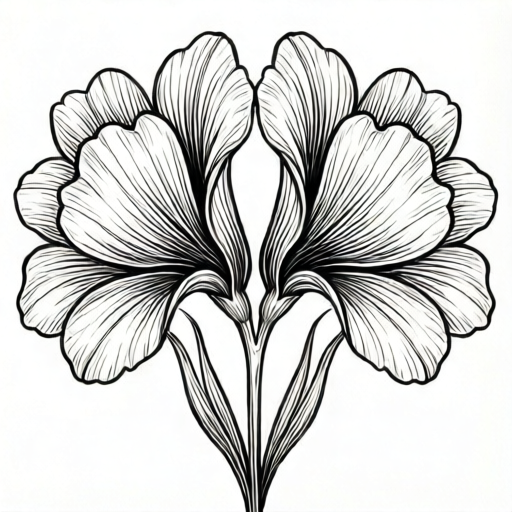
Use the stated measurements and conventions for each exercise.
Setting Up the Axis and Center
Start with a light vertical axis line. Mark a center point on it. This axis is the mirror line for the flower. Decide how many petals the flower will have. For a simple flower, use 6 or 8 petals. Petal count must be even so each petal has a mirror partner across the axis.
Draw a horizontal guide line through the center point to help space petals evenly. The angle between adjacent petals is 360 divided by the petal count. For 8 petals, each petal is 45 degrees apart. For 6 petals, each is 60 degrees apart. These are hypothetical examples; use a protractor or estimate carefully.
- Draw a light vertical axis line about 10 cm long.
- Mark the center point at the middle of the axis.
- Draw a light horizontal guide through the center point.
- Choose an even petal count, such as 6 or 8.
- Calculate the angle between petals: 360 divided by petal count.
Drawing One Petal and Mirroring It
Draw the first petal on one side of the vertical axis. Keep its tip at a consistent distance from the center, for example 4 cm. The petal shape can vary: rounded, pointed, or teardrop. Measure each petal's angle clockwise from the top of the vertical axis. The mirroring convention is that a petal at angle θ clockwise from the top has a partner at angle 360° − θ clockwise from the top (equivalently −θ), at the same tip distance. For example, a petal at 22.5° pairs with one at 337.5°, and a petal at 67.5° pairs with one at 292.5°. A petal drawn exactly on the vertical axis (at 0° or 180°) lies on the mirror line and is its own mirror partner. A petal at 90° lies on the horizontal guide and pairs with one at 270°.
To mirror a petal, measure its tip distance from the center and its angle from the vertical axis. Then draw the matching petal on the opposite side at the same distance and at angle 360° minus the original angle (equivalently −θ), adding 360° if the result is negative. Repeat for each petal pair. Check that the petal count is even and that every petal has a partner.
- Draw the first petal on the right side of the axis.
- Measure the tip distance from the center, for example 4 cm.
- Measure the angle clockwise from the top of the vertical axis, for example 22.5 degrees for an 8-petal flower.
- Draw the mirror petal on the opposite side at the same distance and at angle 360 minus the original angle (for example, 360 − 22.5 = 337.5 degrees).
- Repeat for each petal pair until all petals are drawn.
Checking Symmetry and Petal Spacing
After drawing all petals, check symmetry by folding the paper along the vertical axis or by using a mirror. Each petal should align with its partner. Check petal spacing by measuring the angle between adjacent petals. For 8 petals, adjacent petals should be about 45 degrees apart. Small differences are acceptable if the overall flower looks balanced.
Use a simple rubric: axis line present, even petal count, each petal has a mirror partner, and spacing is roughly even. Valid alternatives include different petal shapes and slight variations in tip distance, as long as the mirroring convention is followed.
- Fold the paper along the vertical axis to check mirroring.
- Count petals and confirm the number is even.
- Measure the angle between two adjacent petals.
- Compare with the expected angle: 360 divided by petal count.
- Adjust any petal that is clearly out of place.
Using a Symmetry Box for Practice
A symmetry box is a rectangle with a vertical axis line drawn through the middle. Use it to practice mirroring petals. Draw one half of the flower in the left half of the box, then mirror it into the right half. This helps focus on the mirroring step before drawing a full flower.
Keep the axis line light so it can be erased later. The symmetry box can be any size, for example 12 cm by 8 cm. These are hypothetical examples; measure your own paper and adjust.
- Draw a rectangle and a vertical axis line through its middle.
- Draw one half of the flower on the left side.
- Mirror each petal to the right side.
- Check that the flower is symmetrical across the axis.
Worked example
Draw an 8-petal symmetrical flower with a vertical axis. Use a center point, a tip distance of 4 cm, and petals spaced 45 degrees apart. Describe the steps and the final check.
Worked answer
Draw a light vertical axis and mark the center. Draw a horizontal guide. Measure angles clockwise from the top of the vertical axis. Draw the first petal on the right at 22.5 degrees with tip 4 cm from center. Its mirror partner is on the left at 360 − 22.5 = 337.5 degrees, same tip distance. Continue with the pair 67.5° with 360 − 67.5 = 292.5°. The remaining four petals are the same two pairs reflected below the horizontal guide: 112.5° with 360 − 112.5 = 247.5°, and 157.5° with 360 − 157.5 = 202.5°. This gives 8 petals in total. Check by folding along the vertical axis: each petal should align with its partner. Count 8 petals and confirm adjacent petals are about 45 degrees apart.
Four practice exercises
Exercise 1
Draw a 6-petal symmetrical flower with a vertical axis. Use a tip distance of 3 cm. Describe how you space the petals and check symmetry.
Show answer and check
Draw a vertical axis and center point. For 6 petals, adjacent petals are 60 degrees apart. Measure angles clockwise from the top of the vertical axis. Draw the first petal on the right at 30 degrees, tip 3 cm from center. Its mirror partner is on the left at 360 − 30 = 330 degrees. Draw the next pair at 90° and 360 − 90 = 270°; these two petals lie on the horizontal guide and mirror each other across the vertical axis. Draw the third pair at 150° and 360 − 150 = 210°. This gives 6 petals. Check by folding: each petal should align with its partner. Count 6 petals and confirm adjacent petals are about 60 degrees apart.
Why: An even petal count ensures each petal has a mirror partner. The angle 360 divided by 6 equals 60 degrees, so petals are spaced evenly. Mirroring each petal across the vertical axis creates symmetry.
Check: Fold the paper along the vertical axis and see if petals align. Count petals to confirm 6. Measure or estimate the angle between two adjacent petals; it should be about 60 degrees.
Exercise 2
A student draws a flower with 5 petals and claims it is symmetrical across one vertical axis. Explain why this is a problem and how to fix it.
Show answer and check
With 5 petals, one petal cannot have a mirror partner across a single vertical axis, so the flower is not symmetrical in the mirroring convention. Fix it by changing to an even petal count, such as 6 or 8, and redrawing so each petal has a partner across the axis.
Why: Mirror symmetry across one axis requires pairs of petals. An odd count leaves one petal unpaired. Changing to an even count allows every petal to be mirrored.
Check: Count the petals. If the number is odd, check whether one petal lacks a partner when folded along the axis. Redraw with an even count and fold again to confirm.
Exercise 3
You want to draw an 8-petal flower with tip distance 5 cm. What is the angle between adjacent petals? Describe how you would draw and check the flower.
Show answer and check
The angle is 360 divided by 8, which equals 45 degrees. Draw a vertical axis and center point. Measure angles clockwise from the top of the vertical axis. Draw the first petal on the right at 22.5 degrees with tip 5 cm from center. Its mirror partner is on the left at 360 − 22.5 = 337.5 degrees. Draw the pair 67.5° with 360 − 67.5 = 292.5°. The remaining four petals are the same two pairs reflected below the horizontal guide: 112.5° with 360 − 112.5 = 247.5°, and 157.5° with 360 − 157.5 = 202.5°. This gives 8 petals. Check by folding along the axis and counting 8 petals.
Why: Dividing 360 by the petal count gives the spacing angle. Mirroring each petal across the vertical axis ensures symmetry. Measuring tip distance keeps petals consistent.
Check: Fold along the vertical axis to check mirroring. Count petals to confirm 8. Measure the angle between adjacent petals; it should be about 45 degrees. Check that each petal tip is about 5 cm from the center.
Exercise 4
Describe how to use a symmetry box to practice mirroring petals for a 4-petal flower. Include the angle between petals and a check method.
Show answer and check
Draw a rectangle with a vertical axis through the middle. For 4 petals, adjacent petals are 90 degrees apart. Measure angles clockwise from the top of the vertical axis. Draw one petal on the right at 45 degrees, tip 3 cm from center, and mirror it on the left at 360 − 45 = 315 degrees. Draw the second pair below the horizontal guide at 135 degrees on the right and 360 − 135 = 225 degrees on the left. Check by folding along the axis and counting 4 petals. Confirm adjacent petals are about 90 degrees apart.
Why: A symmetry box focuses attention on one half at a time. The angle 360 divided by 4 equals 90 degrees. Mirroring each petal across the axis creates a balanced flower.
Check: Fold the paper along the vertical axis and check that petals align. Count petals to confirm 4. Measure or estimate the angle between adjacent petals; it should be about 90 degrees.
Common mistakes
- Using an odd petal count, which leaves one petal without a mirror partner. Choose an even petal count such as 6 or 8 so every petal has a partner across the axis.
- Drawing petals at uneven angles, making the flower look lopsided. Calculate the angle between petals as 360 divided by petal count, and measure or estimate carefully.
- Making the axis line too dark, which distracts from the flower. Draw the axis line lightly so it can be erased or left as a faint guide.
- Mirroring only the petal shape but not the distance from the center. Measure both the tip distance and the angle from the axis for each petal pair.
Self-check rubric
- Vertical axis line is present and light.
- Center point is marked.
- Petal count is even.
- Each petal has a mirror partner across the axis.
- Petal tip distances are roughly consistent.
- Angles between adjacent petals are roughly even.
- Flower looks balanced when folded along the axis.
Questions and answers
Do I need a protractor to draw symmetrical flowers?
A protractor helps with precise angles, but you can estimate. For 8 petals, each petal is 45 degrees apart; for 6 petals, 60 degrees. Practice estimating these angles.
Can I use an odd number of petals?
For simple mirror symmetry across one axis, use an even number so every petal has a partner. Odd counts can work with rotational symmetry but are harder to mirror cleanly.
What if my petals are not exactly the same shape?
Small variations are acceptable. The convention is that each petal has a mirror partner at the same distance and angle. Focus on overall balance rather than perfect identical shapes.
How do I check my flower for symmetry?
Fold the paper along the vertical axis or use a mirror. Each petal should align with its partner. Also count petals and check that the number is even.