Free original lessons
Car Symmetry Drawing: Complete the Mirror Half
Learn to draw a car by mirroring a half-car across a vertical axis. Practice with a guided plate, then draw your own symmetric car from scratch.
Free lesson
Four exercises
Worked answers
Object Drawing Lessons
Mirror symmetry is a reliable way to draw a balanced car. This lesson uses a vertical mirror line: every point on the left half has a matching point on the right at the same height and the same distance from the line. You will first complete a half-drawn car, then draw a full car independently. The convention for judging symmetry is simple: compare matching features by their distance from the mirror line and their height above the baseline. Letter styles and small stylistic choices may vary, so the rubric rewards consistent mirroring rather than one universal shape.
Practice materials: Printable downloads are not available for this lesson yet. Use the instructions and four exercises below.
Reference illustration
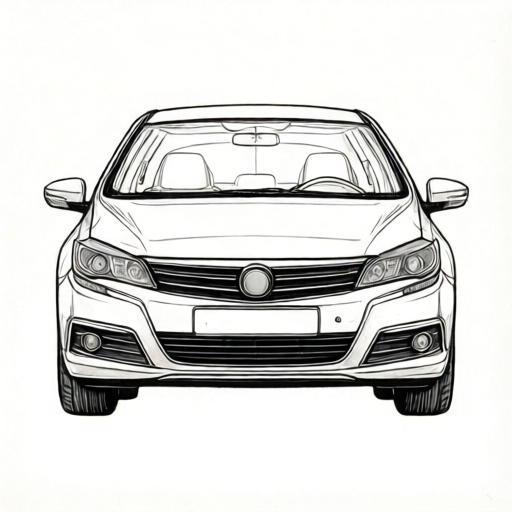
Use the stated measurements and conventions for each exercise.
Set Up the Mirror Line and Baseline
Draw a light vertical line down the center of your paper. This is the mirror line. Draw a horizontal baseline near the bottom for the wheels to sit on. Keep both lines faint so they can be erased later.
Choose a simple front view: a body, a roof, two wheels, and a windshield. Because the car is viewed head-on, the vertical mirror line runs down the center of the car, so the left and right halves are mirror images. Mark the highest point of the roof and the lowest point of the wheels on the mirror line to anchor the drawing.
- Draw a faint vertical mirror line and a horizontal baseline.
- Mark the roof height and wheel-bottom height on the mirror line.
- Lightly sketch the half-car on one side only, keeping all features at measured heights.
- Check each feature's distance from the mirror line before committing.
Mirror Points by Distance and Height
For any point on the drawn half, find its mirror point by counting squares or using a ruler: same height above the baseline, same distance from the mirror line, but on the opposite side. A wheel center 3 squares left of the line becomes a wheel center 3 squares right of the line at the same height.
Work feature by feature: roof, windshield, headlights, wheel arches, wheels. Draw light guide marks first, then connect them. This reduces erasing and keeps the car balanced.
- Pick a feature on the drawn half, such as the top of the windshield.
- Measure its distance from the mirror line and its height above the baseline.
- Mark the matching point on the blank half at the same height and equal distance.
- Repeat for each feature, then connect the marks smoothly.
Refine and Self-Check
After mirroring all features, compare pairs: each wheel should be the same size and at the same height; the roof should meet the mirror line at one point; headlights and windshield edges should match in height and distance from the line. Small differences in line style are acceptable, but matching features must stay consistent in position.
Erase construction lines only after the check. If a feature is off, adjust the guide mark rather than redrawing the whole car.
- Compare wheel centers: equal distance from the line, equal height.
- Check that the roof peak lies on the mirror line.
- Verify headlights and windshield edges match in height and distance.
- Erase faint construction lines and darken final outlines.
Draw a Full Car Independently
On a blank panel, draw the mirror line and baseline again. Sketch one half fully, then mirror it using the same distance-and-height method. This independent task tests whether you can apply the convention without a pre-drawn half.
Keep the design simple: a boxy body, two wheels, one windshield, and two headlights. Simple shapes make symmetry easier to check.
- Draw the mirror line and baseline on a blank panel.
- Sketch one half of a simple car.
- Mirror each feature by equal distance and height.
- Self-check pairs and adjust before finalizing.
Worked example
A half-car is drawn on the left of a vertical mirror line on square paper. The roof peak is on the mirror line at 6 squares above the baseline. The left wheel center is 3 squares left of the line and 1 square above the baseline. The left window top is 4 squares above the baseline and 2 squares left of the line. Describe where to place the matching features on the right half.
Worked answer
The roof peak stays on the mirror line at 6 squares above the baseline. The right wheel center goes 3 squares right of the line and 1 square above the baseline. The right window top goes 2 squares right of the line and 4 squares above the baseline. Connect these marks to complete the right half.
Four practice exercises
Exercise 1
On square paper, a vertical mirror line is drawn. A half-car on the left has its roof peak on the mirror line at 5 squares above the baseline. The left wheel center is 2 squares left of the line and 1 square above the baseline. State the position of the right wheel center.
Show answer and check
2 squares right of the mirror line and 1 square above the baseline.
Why: Mirroring keeps the same height and equal distance from the line but on the opposite side. The left wheel is 2 left and 1 above, so the right wheel is 2 right and 1 above.
Check: Count from the mirror line: 2 squares right; count from the baseline: 1 square up. Confirm both wheels are at the same height.
Exercise 2
A half-car has a window top at 3 squares above the baseline and 1 square left of the mirror line. The roof peak is on the mirror line at 6 squares above the baseline. Describe where the right window top goes and whether the roof peak moves.
Show answer and check
The right window top goes 1 square right of the mirror line and 3 squares above the baseline. The roof peak stays on the mirror line at 6 squares above the baseline.
Why: Points on the mirror line map to themselves, so the roof peak does not move. The window top mirrors to the opposite side at the same height and equal distance.
Check: Verify the window top is 1 square from the line on the right and 3 squares above the baseline; confirm the roof peak is still on the line at 6 squares.
Exercise 3
A student draws the left wheel center 3 squares left of the mirror line and 1 square above the baseline, but draws the right wheel center 3 squares right of the line and 2 squares above the baseline. Is the drawing symmetric by the convention? Explain and give the correct position.
Show answer and check
No. The right wheel is at the wrong height. The correct position is 3 squares right of the mirror line and 1 square above the baseline.
Why: Mirroring requires equal height. The right wheel is 2 squares above the baseline instead of 1, so it does not match the left wheel.
Check: Compare heights from the baseline: both wheel centers must be 1 square above. Compare distances: both must be 3 squares from the line.
Exercise 4
On a blank panel with a vertical mirror line and baseline, you must draw a simple front-view car with a roof peak on the line at 7 squares above the baseline, two wheel centers at 1 square above the baseline and 4 squares from the line, and a windshield top at 4 squares above the baseline and 2 squares from the line. Describe the sequence of marks for both halves and one check you would perform.
Show answer and check
Mark the roof peak on the line at 7 squares up. Mark the left wheel center 4 squares left and 1 square up; mark the right wheel center 4 squares right and 1 square up. Mark the left windshield top 2 squares left and 4 squares up; mark the right windshield top 2 squares right and 4 squares up. Connect the marks to form the body, roof, wheels, and windshield. Check that both wheel centers are 1 square above the baseline and 4 squares from the line.
Why: Each feature is placed by its distance from the mirror line and its height above the baseline. Features on the line stay on the line. Connecting matching marks produces a symmetric front-view car.
Check: Measure each wheel center from the baseline and from the mirror line; both must read 1 square up and 4 squares out. Confirm the roof peak is a single point on the line.
Common mistakes
- Mirroring only the outline and forgetting internal features like the windshield or headlights. List features before drawing and mirror each one, not just the body outline.
- Placing the second wheel at a different height than the first. Measure both wheel centers from the baseline; they must match.
- Making the roof cross the mirror line at two points instead of one peak. Mark a single roof peak on the mirror line and build the roof from that point.
- Counting distance from the paper edge instead of from the mirror line. Always measure from the mirror line outward; the paper edge is irrelevant.
Self-check rubric
- Mirror line is vertical and clearly marked.
- Baseline is horizontal and wheels sit on it.
- Each major feature on one side has a matching feature on the other at the same height.
- Matching features are at equal distances from the mirror line.
- Roof peak lies on the mirror line at a single point.
- Internal features such as the windshield and headlights are mirrored, not just the outline.
- Construction lines are erased or faint in the final drawing.
- Valid alternative styles are accepted if position checks pass.
Questions and answers
Does the car have to be perfectly symmetrical in every detail?
No. The convention requires matching position of major features by distance and height. Small stylistic differences in line shape are allowed if the rubric's position checks pass.
What if my car faces the other way?
The method is the same only if you keep the front view. The mirror line must remain vertical and run down the center of the car; features are mirrored by equal distance and height. A side view would not be symmetric across a vertical line, so do not switch to a side view.
Can I use squares or a ruler?
Yes. Counting squares or measuring with a ruler are both valid ways to keep distances equal.
How do I know the drawing is balanced?
Check pairs: each feature on one side should have a matching feature on the other at the same height and equal distance from the mirror line.