Free original lessons
Civil War Cannon Scale Drawing: Barrel, Carriage, and Wheel Proportions
Learn to draw a Civil War cannon to scale by measuring barrel, carriage, and wheel proportions, using a simple convention and checkable arithmetic.
Free lesson
Four exercises
Worked answers
Object Drawing Lessons
This lesson teaches a reliable method for drawing a Civil War cannon to scale. You will define a drawing convention, measure real or reference proportions, convert them with a scale factor, and lay out the barrel, carriage, and wheels so the result is checkable. The focus is the cannon as a scaled object, not battle scenes or other artillery. All measurements use one unit, and any numerical values are hypothetical examples you can replace with your own reference measurements. A printable scale plate is planned but not yet built; the steps below let you work from any clear reference photo or measured object.
Practice materials: Printable downloads are not available for this lesson yet. Use the instructions and four exercises below.
Reference illustration
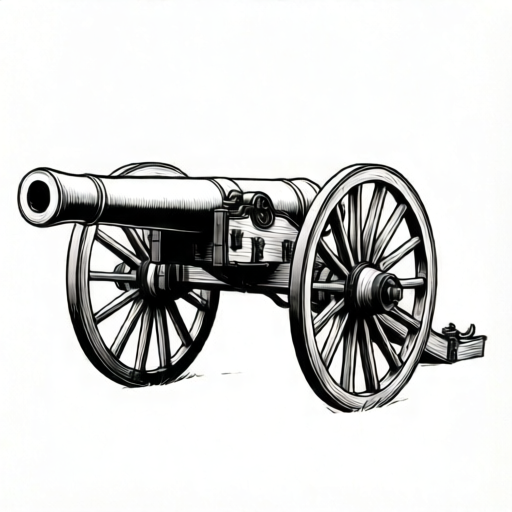
Use the stated measurements and conventions for each exercise.
Set a drawing convention and scale factor
Choose a convention before drawing: for example, let one drawing centimetre represent ten real centimetres. Write the scale as 1:10 and keep it visible. Measure the longest real dimension you will draw, such as the barrel length from muzzle to breech, and divide by ten to get its drawing length. If the barrel is 210 cm long, the drawing length is 21 cm. Use the same unit throughout; do not mix centimetres and millimetres without converting.
Define what counts as the barrel, the carriage, and the wheel. The barrel is the tube from muzzle to breech. The carriage is the frame that holds the barrel and rests on the wheels. The wheel is the circular support; its diameter is measured across the rim. Record each measurement in a simple table with real size and drawing size.
- Write the scale factor, for example 1:10, at the top of the page.
- Measure barrel length, barrel diameter at muzzle, carriage length, carriage height, and wheel diameter in one unit.
- Divide each real measurement by the scale factor and record the drawing size.
- Check that the drawing sizes fit your paper before starting the outline.
Lay out the barrel and carriage
Draw a horizontal baseline for the ground. Mark the carriage length along the baseline. The barrel sits above the carriage, so mark the barrel length as a horizontal guide above the baseline, centred over the carriage. Use light construction lines. The barrel is usually tapered: wider at the breech and narrower at the muzzle. Draw two parallel lines for the barrel sides, then taper them slightly toward the muzzle. Add the muzzle circle as an ellipse, not a perfect circle, because the barrel points sideways in a side view.
The carriage connects the barrel to the wheels. Draw the carriage as a trapezoid or angled frame between the baseline and the barrel. Its height should match your measured carriage height converted to drawing size. Keep the carriage centred under the barrel so the cannon looks balanced.
- Draw the ground baseline and mark carriage length.
- Mark barrel length above the carriage as a centred guide.
- Draw the tapered barrel sides and the muzzle ellipse.
- Draw the carriage frame from baseline to barrel, using the converted carriage height.
- Check that barrel and carriage lengths match your table.
Draw wheels and check proportions
Wheels are the easiest proportion to check because a wheel is circular. Convert the real wheel diameter to drawing size, then draw a circle with that diameter. Place the wheel centre at the carriage height so the rim touches the baseline. If there are two wheels in side view, draw the near wheel fully and the far wheel partly hidden behind the carriage. Use the same diameter for both unless your reference clearly shows different sizes.
After drawing, measure the drawing with a ruler. Compare each measured drawing size to your table. A small difference is acceptable if you note it; a large difference means you should adjust the construction lines. This check makes the drawing verifiable rather than a guess.
- Convert wheel diameter to drawing size and draw the near wheel circle.
- Place the wheel centre so the rim touches the baseline.
- Draw the far wheel partly behind the carriage if shown.
- Measure barrel length, carriage length, and wheel diameter on the drawing.
- Compare each measurement to the table and adjust if needed.
Worked example
A reference cannon has a barrel length of 180 cm, carriage length of 120 cm, carriage height of 60 cm, and wheel diameter of 90 cm. Use a scale of 1:10. Calculate the drawing sizes and describe the layout.
Worked answer
Barrel drawing length = 180 ÷ 10 = 18 cm. Carriage drawing length = 120 ÷ 10 = 12 cm. Carriage drawing height = 60 ÷ 10 = 6 cm. Wheel drawing diameter = 90 ÷ 10 = 9 cm, so wheel radius = 4.5 cm. Draw a baseline, mark 12 cm for the carriage, and centre an 18 cm barrel guide above it. Draw the carriage 6 cm high. Draw the near wheel as a 9 cm circle with its centre 4.5 cm above the baseline so the rim touches the ground line.
Four practice exercises
Exercise 1
A cannon reference gives barrel length 240 cm, carriage length 150 cm, carriage height 75 cm, and wheel diameter 120 cm. Use scale 1:20. Calculate all drawing sizes and state the wheel radius.
Show answer and check
Barrel = 12 cm, carriage length = 7.5 cm, carriage height = 3.75 cm, wheel diameter = 6 cm, wheel radius = 3 cm.
Why: Divide each real measurement by 20. The wheel radius is half the drawing diameter: 6 ÷ 2 = 3 cm.
Check: Multiply each drawing size by 20 and confirm it returns the original real measurement.
Exercise 2
A drawing uses scale 1:15. The drawn barrel is 14 cm and the drawn wheel diameter is 8 cm. What are the real barrel length and real wheel diameter?
Show answer and check
Real barrel length = 210 cm; real wheel diameter = 120 cm.
Why: Multiply each drawing size by 15: 14 × 15 = 210, and 8 × 15 = 120.
Check: Divide the answers by 15 and confirm they return 14 cm and 8 cm.
Exercise 3
A cannon has a wheel diameter of 100 cm and a carriage height of 70 cm. At scale 1:10, what is the wheel radius in the drawing, and how high above the baseline is the wheel centre?
Show answer and check
Wheel radius = 5 cm; wheel centre is 5 cm above the baseline.
Why: Drawing wheel diameter = 100 ÷ 10 = 10 cm, so radius = 5 cm. The centre sits one radius above the baseline so the rim touches it.
Check: Confirm that centre height plus radius equals the wheel diameter above the baseline: 5 + 5 = 10 cm.
Exercise 4
A student draws a barrel 20 cm long, a carriage 10 cm long, and a wheel 8 cm in diameter at scale 1:10. The real barrel is 200 cm and the real carriage is 100 cm. The real wheel is 90 cm. Which drawing size is incorrect, and what should it be?
Show answer and check
The wheel is incorrect. It should be 9 cm in diameter.
Why: Barrel 200 ÷ 10 = 20 cm and carriage 100 ÷ 10 = 10 cm are correct. Wheel 90 ÷ 10 = 9 cm, not 8 cm.
Check: Multiply each drawing size by 10 and compare to the real values: 20→200, 10→100, 8→80, which does not match 90.
Common mistakes
- Mixing units, such as measuring the barrel in centimetres and the wheel in millimetres. Convert every measurement to one unit before dividing by the scale factor.
- Drawing the wheel as an ellipse in a side view. In a side view the wheel is a circle; use a compass or trace a circular guide.
- Forgetting to taper the barrel from breech to muzzle. Measure the muzzle diameter and breech diameter separately, convert both, and draw the taper.
- Placing the wheel centre too high so the rim floats above the baseline. Set the wheel centre at the wheel radius above the baseline so the rim touches the ground line.
Self-check rubric
- Scale factor is stated and used consistently for all measurements.
- Barrel length, carriage length, and wheel diameter match the converted table values within a small stated tolerance.
- Wheel is drawn as a circle in side view with the rim touching the baseline.
- Barrel shows a visible taper from breech to muzzle.
- Carriage is centred under the barrel and its height matches the converted value.
- Construction lines are light and the final outline is clear.
- Valid alternative conventions are accepted if stated and applied consistently.
Questions and answers
Do I need exact historical measurements?
No. Use any clear reference and record your own measurements. The method works with hypothetical values as long as you keep the scale factor consistent.
What if my drawing does not fit the paper?
Choose a smaller scale factor, such as 1:20, and recalculate all drawing sizes before starting.
How do I check the wheel proportion?
Measure the drawn wheel diameter with a ruler and compare it to the converted value in your table.
Can I use a different convention for the barrel?
Yes. State your convention clearly, such as measuring barrel length including or excluding the breech, and apply it consistently.