Free original lessons
Closet Contour Drawing: Hangers, Clothes, and Shelf Edges
Learn to draw a closet interior in contour line, capturing hanging clothes and shelf edges with clear edge-following guides and a blank practice panel.
Free lesson
Four exercises
Worked answers
Object Drawing Lessons
Contour drawing asks you to trace the visible edges of an object without shading or texture. In this lesson you will draw a closet interior: the vertical sides, the shelf edges, the hanging rod, and the clothes that hang from it. The goal is accurate edge observation, not clothing design. You will use a simple convention for line weight and spacing, and you will check your work with measurable comparisons rather than a single correct picture.
Practice materials: Printable downloads are not available for this lesson yet. Use the instructions and four exercises below.
Reference illustration
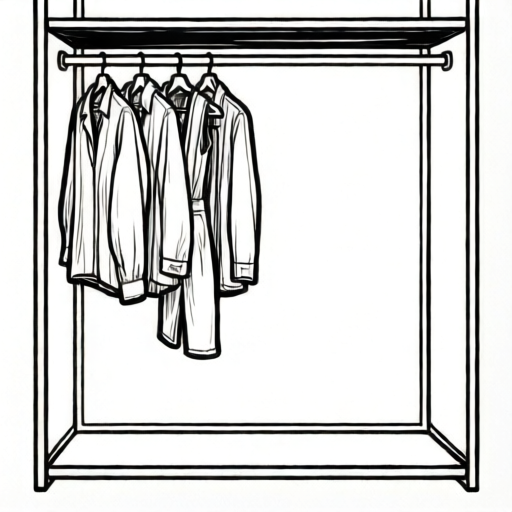
Use the stated measurements and conventions for each exercise.
Setting Up the Closet Contour
Begin by defining the closet opening as a rectangle. Measure its width and height on your reference or on the actual closet, and record both in the same unit, such as centimeters. If you are using a printed plate, treat the printed rectangle as your measured frame. Mark the top shelf line as a horizontal edge inside that rectangle, and mark the hanging rod as a second horizontal line below it.
Use one continuous line for each visible edge. Do not lift the pencil to add shading. Where a shelf edge meets a side wall, let the line stop at the corner and begin a new line for the next edge. This keeps the contour readable and prevents accidental diagonal connections.
- Measure the closet opening width and height; write both numbers beside your paper.
- Draw the outer rectangle using those measurements scaled to your page.
- Mark the shelf edge as a horizontal line at a measured distance from the top.
- Mark the hanging rod below the shelf, again using a measured distance.
- Draw each hanging garment as a closed contour that touches the rod at its hanger.
Following Edges of Hanging Clothes
Hanging clothes produce overlapping contours. Start with the garment nearest the front and draw its outer edge from shoulder to hem. Then draw the next garment behind it, allowing its line to stop where the front garment hides it. Do not draw hidden edges. A hanger is drawn as a simple hook and shoulder line; the hook touches the rod, and the shoulders support the garment.
Letter styles and clothing shapes vary, so there is no single correct outline. Use the convention that every visible edge receives one line, and that lines do not cross unless the edges actually cross in the closet. If two garments overlap, the front contour interrupts the back contour.
- Identify the frontmost garment and draw its full visible outline.
- Draw the next garment, stopping its line where the front garment covers it.
- Add hanger hooks as short curves that meet the rod.
- Check that no line passes through a region that is hidden by another garment.
Shelf Edges and Interior Lines
Shelf edges are straight contours. Draw the front edge of each shelf as a horizontal line, and draw the side edge only if it is visible from your viewpoint. If the shelf is above eye level, you may see its underside edge; if below, you may see its top edge. Choose one viewpoint and stay consistent.
Keep the spacing between shelf lines even if the shelves are evenly spaced. Measure the gap between shelf edges on the reference and compare it with your drawing. A simple arithmetic check: if the closet height is 200 cm and there are four equal gaps, each gap is 50 cm. Scale that proportion to your page.
- Draw the front edge of the top shelf as a horizontal line.
- Add lower shelf edges only where they are visible.
- Measure the gap between shelf lines and compare with the reference proportion.
- Erase any line that represents a hidden edge.
Checking Your Contour Drawing
A contour drawing is checked by comparing visible edges, not by matching a single ideal image. Use a ruler to compare the width-to-height ratio of your closet rectangle with the measured ratio. Count the number of visible garment contours and confirm that each one touches the rod at a hanger. Check that no contour line crosses a hidden region.
Because clothing shapes vary, accept any outline that follows the visible edge convention. The rubric rewards consistent edge-following, correct overlap, and measurable proportion, not a particular style of dress or shirt.
- Compare the rectangle ratio: width divided by height should match the measured ratio within a small tolerance.
- Trace each garment contour to its hanger and confirm contact with the rod.
- Check that overlapping garments interrupt rather than cross.
- Confirm that shelf lines are horizontal and evenly spaced according to your measurements.
Worked example
A closet opening measures 120 cm wide and 200 cm high. The top shelf edge is 40 cm below the top. The rod is 30 cm below the shelf. Draw the outer rectangle, shelf edge, and rod line to scale on a page where 1 cm represents 10 cm.
Worked answer
On the page, the rectangle is 12 cm wide and 20 cm high. The shelf edge is a horizontal line 4 cm below the top. The rod is a horizontal line 3 cm below the shelf, so it is 7 cm below the top. All lines are drawn as single continuous contours, and no hidden edges are added.
Four practice exercises
Exercise 1
A closet opening is 90 cm wide and 180 cm high. On a page scaled at 1 cm per 10 cm, what are the page dimensions of the outer rectangle?
Show answer and check
9 cm wide and 18 cm high.
Why: Divide each measurement by 10: 90 divided by 10 is 9, and 180 divided by 10 is 18.
Check: Multiply the page dimensions by 10 and confirm they return to 90 cm and 180 cm.
Exercise 2
A closet is 200 cm high with four equal shelf gaps. What is the height of each gap in centimeters?
Show answer and check
50 cm.
Why: Four equal gaps divide the total height into four parts: 200 divided by 4 equals 50.
Check: Add four gaps of 50 cm to confirm the total is 200 cm.
Exercise 3
In a contour drawing, a front garment covers part of a back garment. Describe what happens to the back garment line at the overlap.
Show answer and check
The back garment line stops where the front garment edge begins and does not continue through the hidden region.
Why: Contour drawing shows only visible edges, so hidden edges are omitted.
Check: Trace the back line and confirm it does not cross the front garment outline.
Exercise 4
A shelf edge is drawn 6 cm from the top on a page scaled at 1 cm per 10 cm. What real distance does this represent?
Show answer and check
60 cm.
Why: Multiply the page distance by the scale: 6 cm times 10 equals 60 cm.
Check: Divide 60 cm by 10 to return to 6 cm on the page.
Common mistakes
- Drawing hidden edges behind overlapping clothes. Stop the back garment line where the front garment begins; only draw visible edges.
- Making shelf lines uneven without measuring. Measure the gap between shelf edges and scale it consistently across the page.
- Letting hanger hooks float away from the rod. End each hook curve exactly on the rod line so the garment is supported.
- Changing viewpoint halfway through the drawing. Choose one eye level and draw all shelf edges as seen from that level.
Self-check rubric
- Outer closet rectangle matches the measured width-to-height ratio within a small tolerance.
- Shelf edges are horizontal and spaced according to measured proportions.
- Each hanging garment contour touches the rod at a hanger hook.
- Overlapping garments interrupt rather than cross hidden edges.
- Lines are continuous and follow visible edges only.
- Valid alternative clothing outlines are accepted if they follow the edge convention.
Questions and answers
Do I need to draw every fold in the clothes?
No. This is a contour exercise. Draw the outer visible edges and major overlaps; omit small folds unless they create a visible edge.
What if my closet has no shelf?
Use the rod and the closet sides as your main contours. You can add a single horizontal line for the top of the opening if it is visible.
How do I know my proportions are right?
Measure the closet width and height, divide width by height, and compare that ratio with your drawing. A small difference is acceptable.
Can I use a ruler for the contour lines?
Yes for shelf edges and the outer rectangle. For clothes, draw freehand but keep the line continuous and on the visible edge.