Free original lessons
Draw a Lamppost in Perspective: Base Ellipse and Cast Shadow
Learn to draw a vertical lamppost in one-point perspective with a correct ground ellipse and a directional cast shadow, using simple checkable geometry.
Free lesson
Four exercises
Worked answers
Object Drawing Lessons
This lesson teaches a focused drawing skill: placing a vertical lamppost in one-point perspective so its base sits convincingly on the ground and its cast shadow points consistently from a chosen sun direction. You will use a horizon line, a single vanishing point, a ground ellipse, and a sun-direction arrow. The method is geometric but forgiving; lettering and line style are yours to choose. All measurements below are hypothetical examples unless you measure your own paper and tools. Work in pencil so you can check and adjust.
Practice materials: Printable downloads are not available for this lesson yet. Use the instructions and four exercises below.
Reference illustration
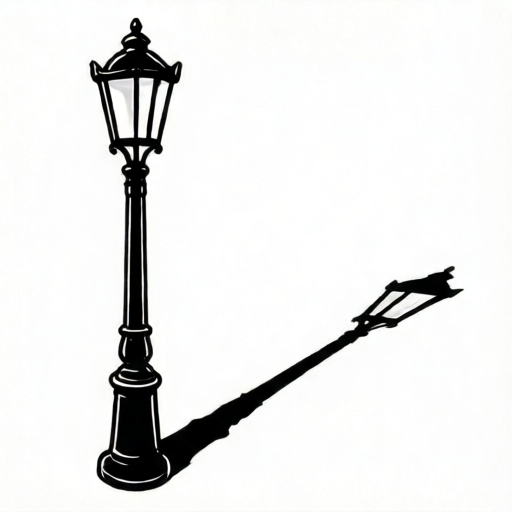
Use the stated measurements and conventions for each exercise.
Set the horizon, vanishing point, and ground line
Draw a horizontal horizon line across the middle of your page. Mark one vanishing point on it, slightly left or right of center. Decide where the lamppost base will sit: draw a short ground line or tick mark below the horizon. The lower the base, the closer the post appears. Keep the post vertical on the page; in one-point perspective, verticals stay vertical.
Choose a sun direction as an arrow on the ground plane, for example pointing down-right at roughly 30 degrees from horizontal. This arrow is a convention you define, not a universal rule. Label it lightly so you can keep the shadow consistent.
- Draw the horizon line and mark the vanishing point.
- Mark the base center point below the horizon.
- Draw a light sun-direction arrow on the ground near the base.
Build the vertical post and base ellipse
From the base center, draw two vertical lines upward to form the post width. Their tops can be capped with a simple rectangle or circle for the lamp head. Because the post is vertical, its sides remain parallel on the page; only the ground ellipse and shadow use perspective.
The base ellipse represents a circular foot seen in perspective. Draw a light horizontal line through the base center; this is the ellipse's major axis. Its minor axis is vertical and shorter. A practical convention: make the minor axis about one-third of the major axis for a low viewing angle. This ratio is a hypothetical starting value; adjust until the ellipse looks like a circle lying on the ground. The ellipse should touch the ground at its lowest point and sit symmetrically around the base center.
- Draw the post sides as vertical parallel lines.
- Mark the major axis horizontally through the base center.
- Draw the ellipse with a shorter vertical minor axis, checking symmetry.
- Cap the post top with a simple lamp shape.
Project the cast shadow from the sun arrow
The shadow starts at the base ellipse and extends opposite the sun arrow. If the sun arrow points down-right, the shadow points up-left on the ground plane. Draw a light line from the base center in the shadow direction. The shadow length depends on post height and sun angle; for this lesson, use a simple ratio such as shadow length equal to twice the post height. That ratio is a hypothetical example, not a standard.
Shape the shadow as a tapered band: wide at the base, narrowing slightly toward the tip. Keep its edges parallel to the shadow direction line. Where the shadow meets the base ellipse, let it begin at the ellipse edge rather than the center so the contact looks natural.
- Draw the shadow direction line opposite the sun arrow.
- Mark a shadow tip using your chosen length ratio.
- Draw two edges from the base ellipse to the tip, tapering slightly.
- Darken the shadow lightly and keep the post edges crisp.
Check consistency and redraw at a new position
Check three things: the post is vertical, the ellipse is symmetric about its center, and the shadow points opposite the sun arrow. If any check fails, adjust lightly before darkening. Then redraw the same lamppost at a new base position on a blank perspective grid, keeping the same horizon and vanishing point. The post height may change with distance, but the verticality and shadow direction must stay consistent.
Use a simple convention for labels: write 'H' for horizon, 'VP' for vanishing point, and 'S' for sun arrow. These labels are for your own checking and are not part of the final drawing.
- Verify vertical post sides with a straight edge.
- Verify ellipse symmetry by comparing left and right halves.
- Verify shadow direction against the sun arrow.
- Redraw at a new base position and repeat the checks.
Worked example
A lamppost base center is 6 cm below the horizon. The post is 10 cm tall on paper. The sun arrow points down-right. Using a shadow length of twice the post height, describe the shadow placement and one check.
Worked answer
Draw the shadow up-left from the base ellipse edge, mark a tip 20 cm from the base center along that direction, taper the band slightly, and check that both shadow edges are parallel to the up-left direction line.
Four practice exercises
Exercise 1
A base center is 4 cm below the horizon. The post is 8 cm tall. The sun arrow points down-left. Using a shadow length equal to 1.5 times the post height, state the shadow direction and tip distance from the base center.
Show answer and check
Shadow points up-right; tip is 12 cm from the base center along the up-right direction.
Why: Opposite the down-left arrow is up-right. 1.5 times 8 cm equals 12 cm.
Check: Confirm the direction is exactly opposite the arrow and multiply 8 by 1.5 to verify 12 cm.
Exercise 2
An ellipse has a major axis of 6 cm. Using the lesson's hypothetical one-third ratio for the minor axis, what is the minor axis length, and which axis is horizontal?
Show answer and check
Minor axis is 2 cm; the major axis is horizontal.
Why: One-third of 6 cm is 2 cm. The convention places the major axis horizontally through the base center.
Check: Divide 6 by 3 to get 2, and confirm the longer axis is drawn horizontally.
Exercise 3
A post is drawn 9 cm tall with its base 5 cm below the horizon. The shadow tip is marked 18 cm from the base center. What shadow-length ratio was used, and is the shadow direction toward or opposite the sun arrow?
Show answer and check
Ratio is 2 to 1; the shadow is opposite the sun arrow.
Why: 18 divided by 9 equals 2. Cast shadows extend opposite the light direction.
Check: Divide the tip distance by post height to get 2, and verify the shadow line points away from the arrow.
Exercise 4
A student draws a post with sides leaning toward the vanishing point and a shadow pointing toward the sun arrow. Name the two errors and give one fix for each.
Show answer and check
Error one: tilted post; fix by keeping verticals vertical. Error two: shadow toward the sun; fix by reversing it to point opposite the arrow.
Why: In one-point perspective verticals stay vertical, and shadows fall away from the light source.
Check: Use a straight edge to confirm verticality and compare the shadow line with the arrow to confirm opposite direction.
Common mistakes
- Tilting the post to follow the vanishing point. Keep verticals vertical in one-point perspective; only receding ground lines go to the vanishing point.
- Drawing the base as a flat circle or a very tall ellipse. Use a horizontal major axis and a shorter vertical minor axis, then check symmetry around the base center.
- Making the shadow point toward the sun arrow. Draw the shadow opposite the arrow and keep both shadow edges parallel to that direction.
- Starting the shadow at the ellipse center instead of its edge. Begin the shadow where the ellipse meets the ground on the shadow side.
Self-check rubric
- Post sides are vertical and parallel within a small tolerance.
- Base ellipse has a horizontal major axis and a shorter vertical minor axis.
- Ellipse is symmetric about the base center and touches the ground at its lowest point.
- Shadow points opposite the sun arrow and its edges are parallel to that direction.
- Shadow begins at the ellipse edge on the shadow side.
- Redraw at a new position keeps verticality and shadow direction consistent.
- Labels and line style follow the stated convention; valid alternative styles are accepted if checks pass.
Questions and answers
Do I need a ruler?
A ruler helps for the horizon and post sides, but freehand is acceptable if you check verticality and symmetry afterward.
How long should the shadow be?
Use a chosen ratio such as twice the post height as a hypothetical example, then keep it consistent across redraws.
Can the sun arrow point any direction?
Yes, as long as the shadow points opposite it and all shadow edges stay parallel to that direction.
What if my ellipse looks wrong?
Compare left and right halves, confirm the major axis is horizontal, and shorten or lengthen the minor axis until it reads as a circle on the ground.