Free original lessons
How to Draw a Mouth in Side Profile: Lip Projection and Jaw Alignment
Learn side-profile mouth construction: set jaw alignment, project lips with measured steps, and check your drawing with a simple convention and rubric.
Free lesson
Four exercises
Worked answers
Object Drawing Lessons
Side-profile mouths fail for two reasons: the jaw line is placed without a reference, and the lips are projected as if seen from the front. This lesson fixes both. You will establish a jaw alignment line first, then build lip projection from that line using a repeatable convention: the lip midline is the vertical midpoint between the upper lip crest and the lower lip base, and x-height means baseline to midline for lettering checks only. Because profile mouths vary by person, the rubric rewards consistent construction and plausible proportion rather than one universal shape. All measurements below are hypothetical examples; measure your own reference or drawing surface and label any chosen numbers as examples.
Practice materials: Printable downloads are not available for this lesson yet. Use the instructions and four exercises below.
Reference illustration
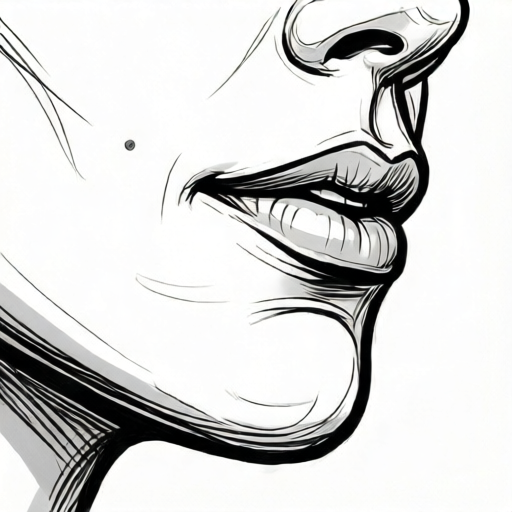
Use the stated measurements and conventions for each exercise.
Set the jaw alignment before drawing lips
A profile mouth sits on the jaw, not floating on the face. Begin with a light vertical guide for the face plane and a horizontal jaw alignment line. The jaw alignment line passes through the ear-to-chin structure and gives you a stable reference for where the mouth corner sits. Place the mouth corner on the jaw alignment line, slightly behind the front of the chin by a small, consistent distance you choose and record.
Next, mark the upper lip crest and the lower lip base along the face plane. The vertical distance between these two marks is your lip height. The lip midline is the midpoint of that distance. This convention keeps projection decisions checkable: every lip point you add is described relative to the midline and the jaw alignment line.
- Draw a light vertical face-plane guide and a horizontal jaw alignment line.
- Mark the mouth corner on the jaw alignment line, slightly behind the chin front.
- Mark upper lip crest and lower lip base on the face plane; measure lip height.
- Mark the lip midline at the midpoint of lip height and label it.
Project the lips forward in measured increments
Lip projection is the forward distance from the face plane to the lip surface. Choose a projection unit, such as one small grid square, and state it as a hypothetical example. Project the upper lip forward by one unit at the crest and the lower lip forward by one unit at its base, then connect these points to the mouth corner with gentle curves. The upper lip usually projects slightly less than the lower lip in many profiles, but valid alternatives exist; record your choice.
Keep the lip midline visible while projecting. If a projected point sits above the midline, it belongs to the upper lip; below, the lower lip. This prevents the common error of swapping lip volumes. Check symmetry of construction, not of shape: both lips should be built from the same corner and midline references.
- Choose and record a projection unit as a hypothetical example.
- Project upper lip crest forward by one unit; project lower lip base forward by one unit.
- Connect projected points to the mouth corner with gentle curves.
- Verify each projected point is on the correct side of the lip midline.
Check jaw alignment and lip closure
With lips closed, the upper and lower lip surfaces should meet along a closure line that follows the jaw alignment. Draw a light closure line from the mouth corner forward, then adjust lip curves so they meet without gaps or overlaps. If the closure line drifts far from the jaw alignment, move the mouth corner or re-measure lip height rather than stretching the lips.
Finally, compare the chin front, mouth corner, and lip projection. The mouth corner should sit behind the chin front by a small consistent distance you chose. Use a simple arithmetic check: measure lip height, divide by two, and confirm the midline mark matches. Measure projection distances and confirm they equal your chosen unit. These checks are checkable and use consistent units.
- Draw a light closure line from the mouth corner forward.
- Adjust lip curves to meet along the closure line without gaps.
- Measure lip height, divide by two, and confirm the midline position.
- Measure projection distances and confirm they match the recorded unit.
Worked example
A profile face has lip height 8 units. The mouth corner is 2 units behind the chin front. Project the upper lip crest forward by 1 unit and the lower lip base forward by 1 unit. Find the lip midline position and state one closure check.
Worked answer
Lip midline is at 4 units from the upper lip crest (8 divided by 2). Both projected points are 1 unit forward of the face plane. Closure check: the upper and lower lip surfaces meet along a closure line from the corner without gaps, and the corner remains 2 units behind the chin front.
Four practice exercises
Exercise 1
Lip height is 10 units. Mark the lip midline and state its distance from the upper lip crest.
Show answer and check
Midline is 5 units from the upper lip crest.
Why: The midline is the midpoint of lip height, so 10 divided by 2 equals 5.
Check: Measure lip height, divide by two, and confirm the midline mark matches.
Exercise 2
The mouth corner is 3 units behind the chin front. The upper lip projects 1 unit and the lower lip projects 2 units. State the total forward span from corner to lower lip base.
Show answer and check
The lower lip base is 2 units forward of the face plane; the corner is 3 units behind the chin front, so the corner-to-lower-lip span is 5 units.
Why: Add the corner offset and the lower lip projection: 3 plus 2 equals 5.
Check: Measure the corner offset and projection separately, then add and compare.
Exercise 3
A drawing shows the upper lip projected 2 units and the lower lip projected 1 unit, with lip height 6 units. Identify one likely construction error and one fix.
Show answer and check
Likely error: upper and lower lip volumes may be swapped or the midline side is misread. Fix: keep the midline visible and recheck each projected point against it.
Why: Lip height 6 gives a midline at 3 units; projection choices must be checked against that midline rather than assumed.
Check: Confirm midline at 3 units and verify each projected point is on the correct side.
Exercise 4
The closure line drifts 2 units away from the jaw alignment. State a checkable adjustment using lip height 8 units.
Show answer and check
Re-measure lip height as 8 units, confirm midline at 4 units, and move the mouth corner or lip curves so closure follows the jaw alignment without stretching lips.
Why: The midline check at 4 units gives a stable reference before adjusting closure.
Check: Measure lip height, divide by two, and confirm closure line distance from jaw alignment is reduced to your recorded tolerance.
Common mistakes
- Drawing front-view lips on a profile face. Build lips from the mouth corner and lip midline; project forward in measured units instead of drawing symmetrical lip shapes.
- Placing the mouth corner without a jaw alignment reference. Draw the jaw alignment line first and mark the corner slightly behind the chin front by a recorded distance.
- Swapping upper and lower lip volumes. Keep the lip midline visible and check each projected point is above or below it correctly.
- Leaving a gap or overlap at lip closure. Draw a closure line from the corner and adjust curves to meet cleanly along it.
Self-check rubric
- Jaw alignment line is drawn and the mouth corner is placed relative to it.
- Lip height is measured and the lip midline is marked at the midpoint.
- Upper and lower lip projection use a recorded unit and correct midline side.
- Closure line connects lips cleanly from the mouth corner.
- Chin front, corner, and projection distances are consistent and checkable.
- Valid alternatives are accepted when construction and proportion are plausible.
Questions and answers
Do I need a specific lip projection amount?
No universal amount exists. Choose a projection unit, label it as a hypothetical example, and keep it consistent so your drawing is checkable.
What does x-height mean here?
X-height is baseline to midline, used only for lettering checks. It does not define lip height or jaw alignment.
Can valid alternatives differ from my example?
Yes. The rubric rewards consistent construction and plausible proportion, not one universal mouth shape.
How do I check jaw alignment quickly?
Confirm the mouth corner sits behind the chin front by your recorded distance and that the closure line follows the jaw alignment.