Free original lessons
Perspective Drawing Formulas
Use a one-point drawing with the eye 4 units above the ground and 4 units in front of the picture plane. You will construct posts, compare two equal depth intervals, and move the vanishing point while keeping those two distances fixed.
Letter & A4
PDF & SVG
The working formulas
Lines perpendicular to the picture plane converge at a vanishing point on the horizon. Lines parallel to the picture plane keep their direction on the drawing.
Let f be the distance from the eye to the picture plane, and let d measure depth behind that plane. A vertical post projects to f / (f + d) of its true height. In this lesson f and eye height h both equal 4, so we can write s = h / (h + d). Eye height sets the horizon; the choice of f sets this scale factor.
Worked example
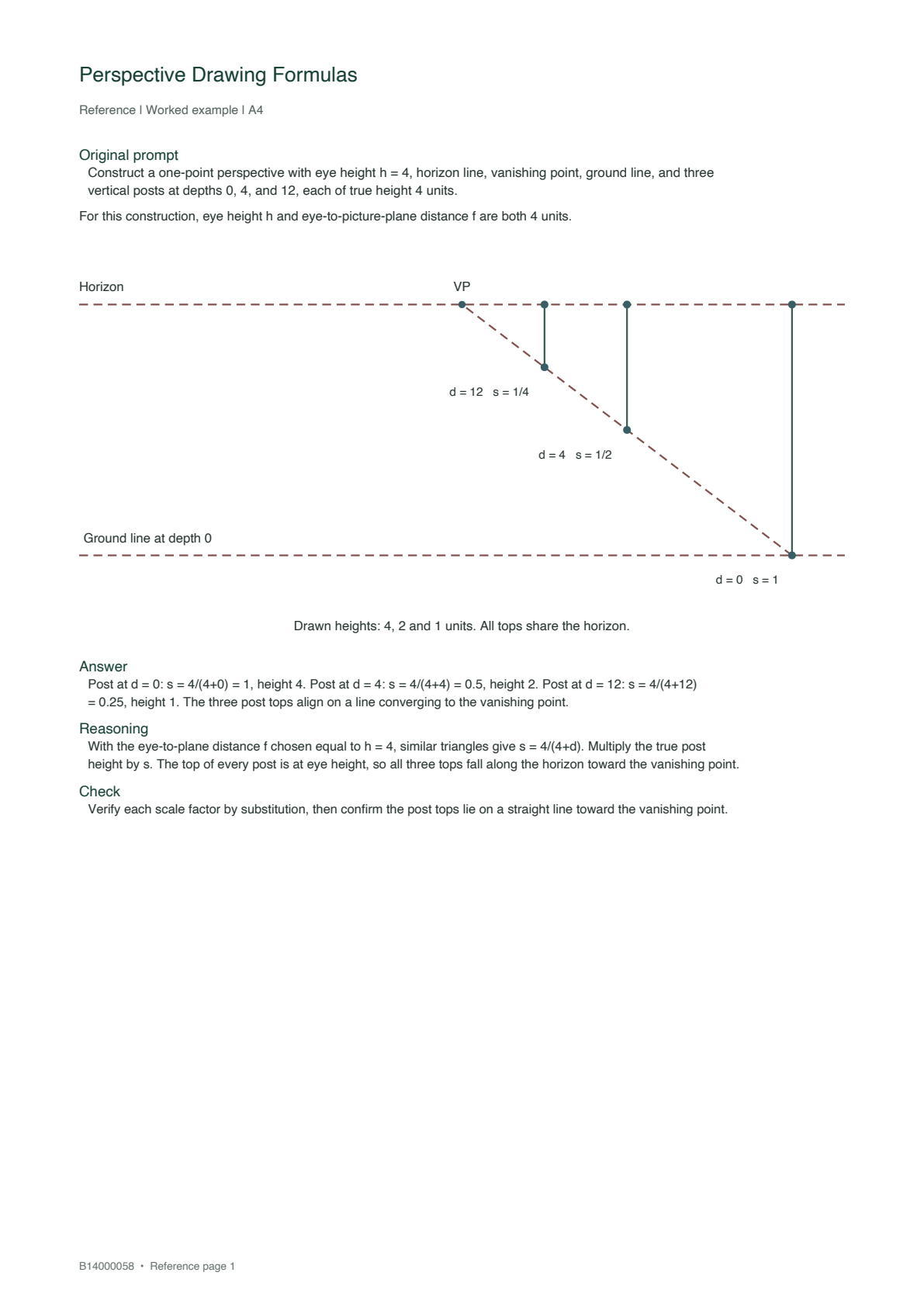
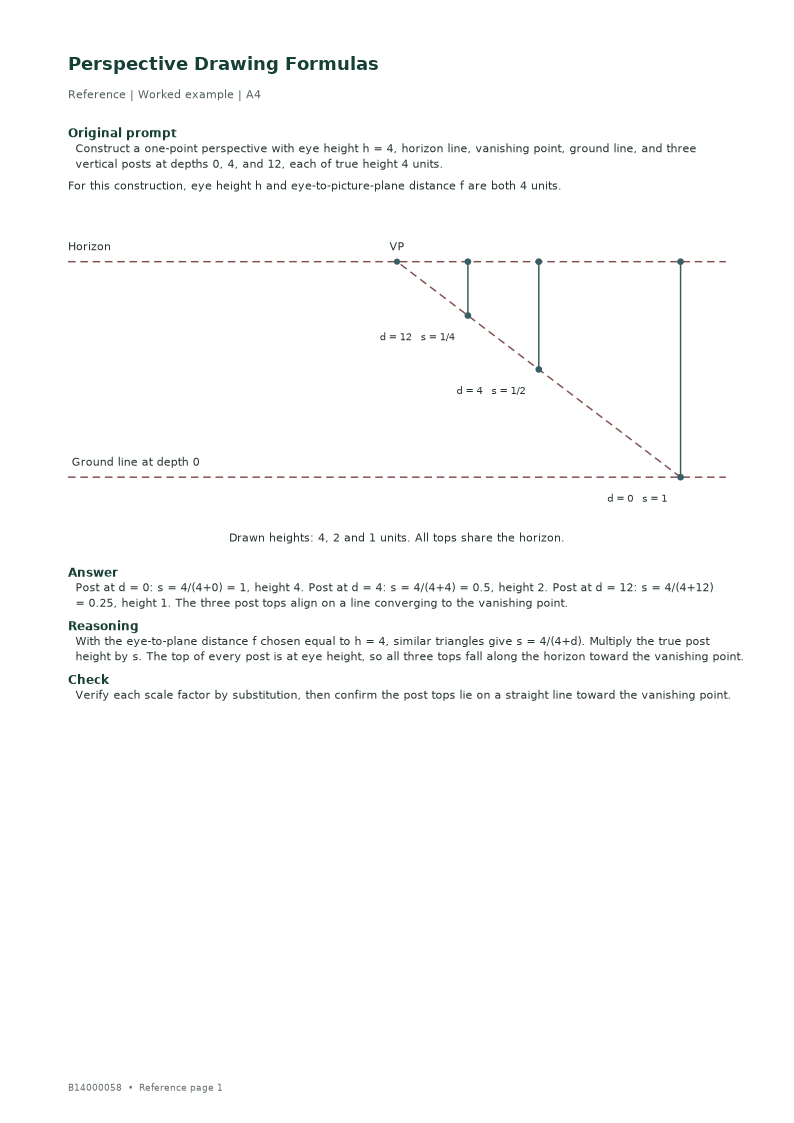
Set the horizon line at eye height h = 4 units above the ground line. Place the vanishing point on the horizon. Draw a vertical post of true height 4 units at the ground line (depth d = 0). Its scale factor is s = 4 / (4 + 0) = 1, so it draws at full height.
Now place an identical post at depth d = 4 units. Its scale factor is s = 4 / (4 + 4) = 0.5, so it draws at half height, 2 units. At depth d = 12, s = 4 / (4 + 12) = 0.25, so the post draws at 1 unit. The posts shrink in a predictable ratio, and their tops lie on a line that converges to the vanishing point.
Practice tasks
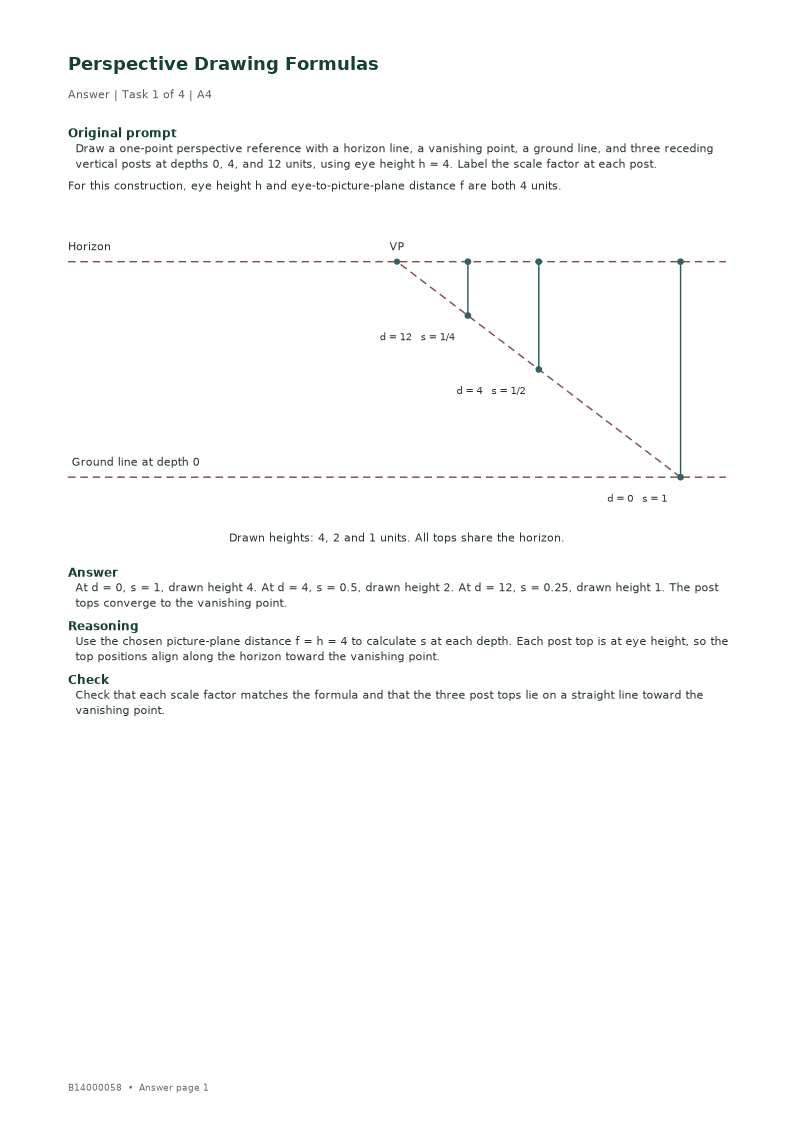
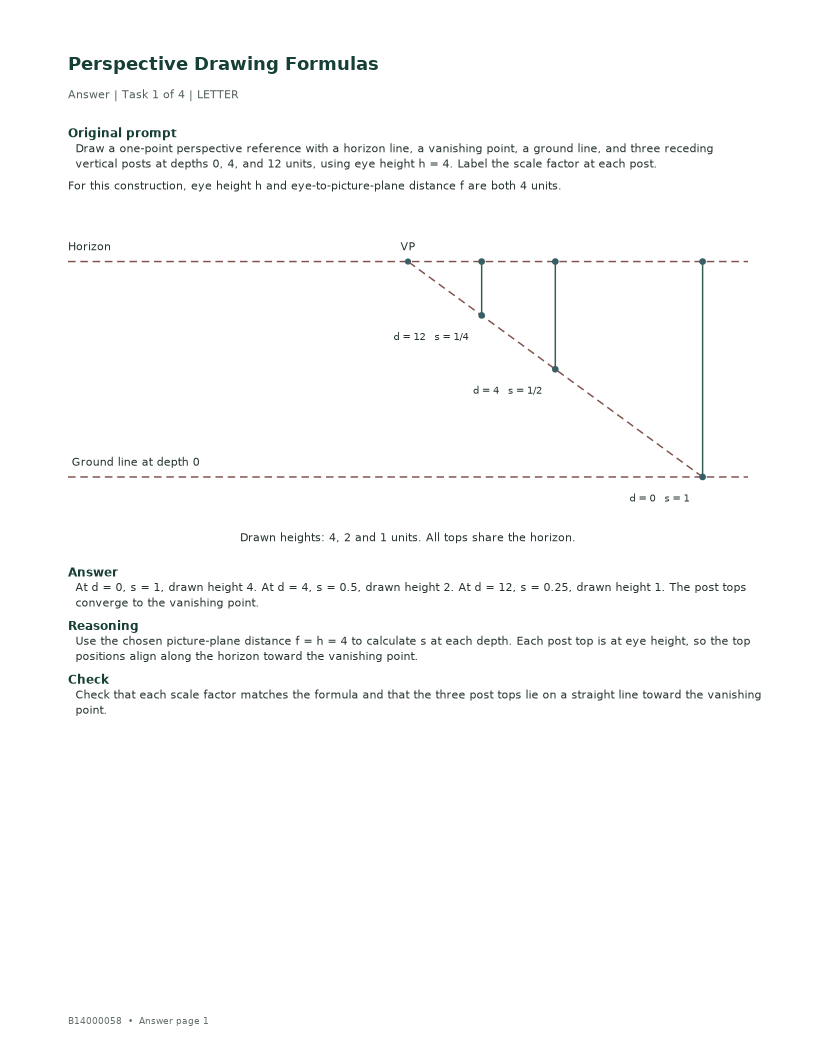
Task 1: Draw a one-point perspective reference with a horizon line, a vanishing point, a ground line, and three receding vertical posts at depths 0, 4, and 12 units, using eye height h = 4. Label the scale factor at each post.
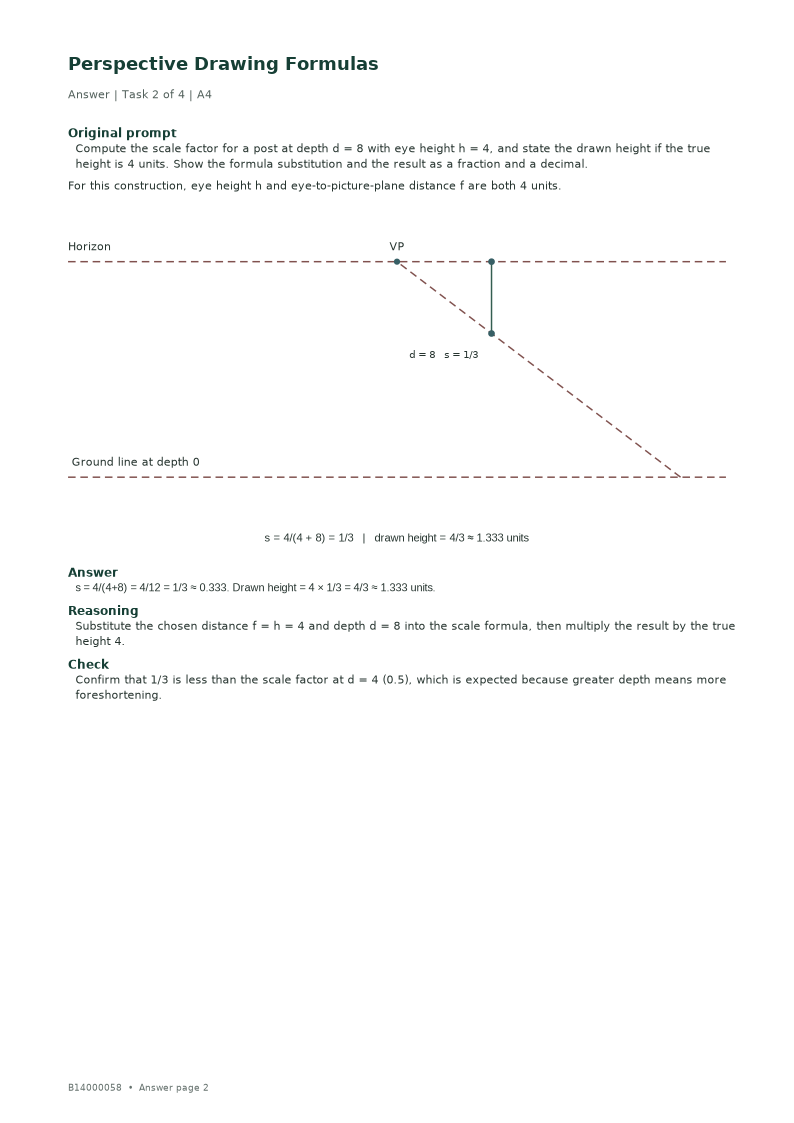
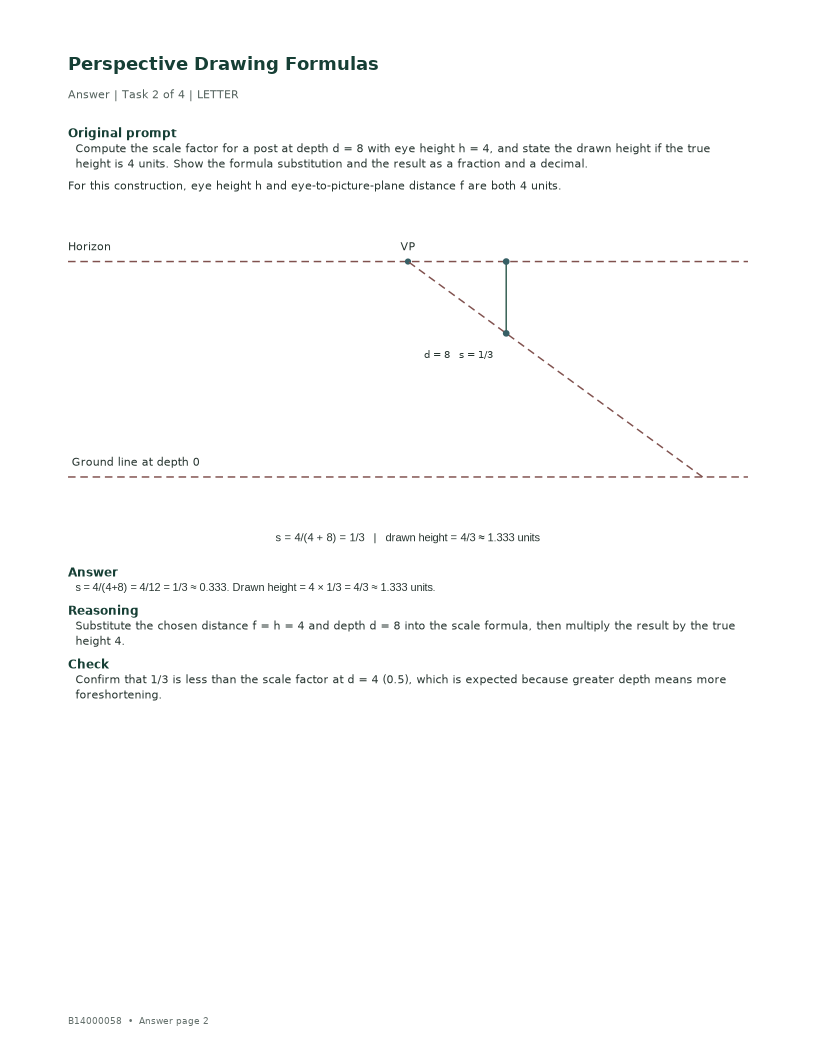
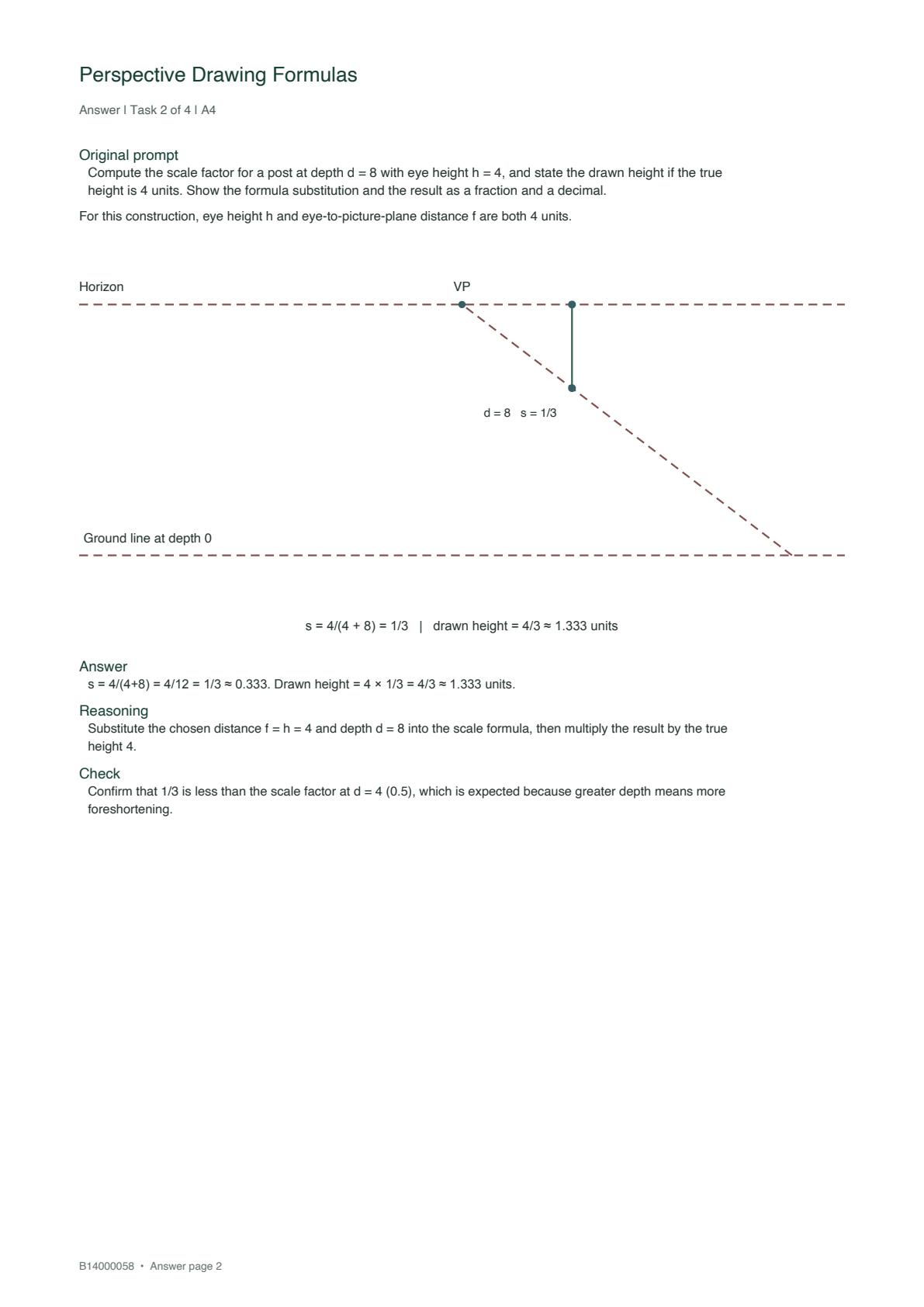
Task 2: Compute the scale factor for a post at depth d = 8 with eye height h = 4, and state the drawn height if the true height is 4 units. Show the formula substitution and the result as a fraction and a decimal.
Task 3 and Task 4
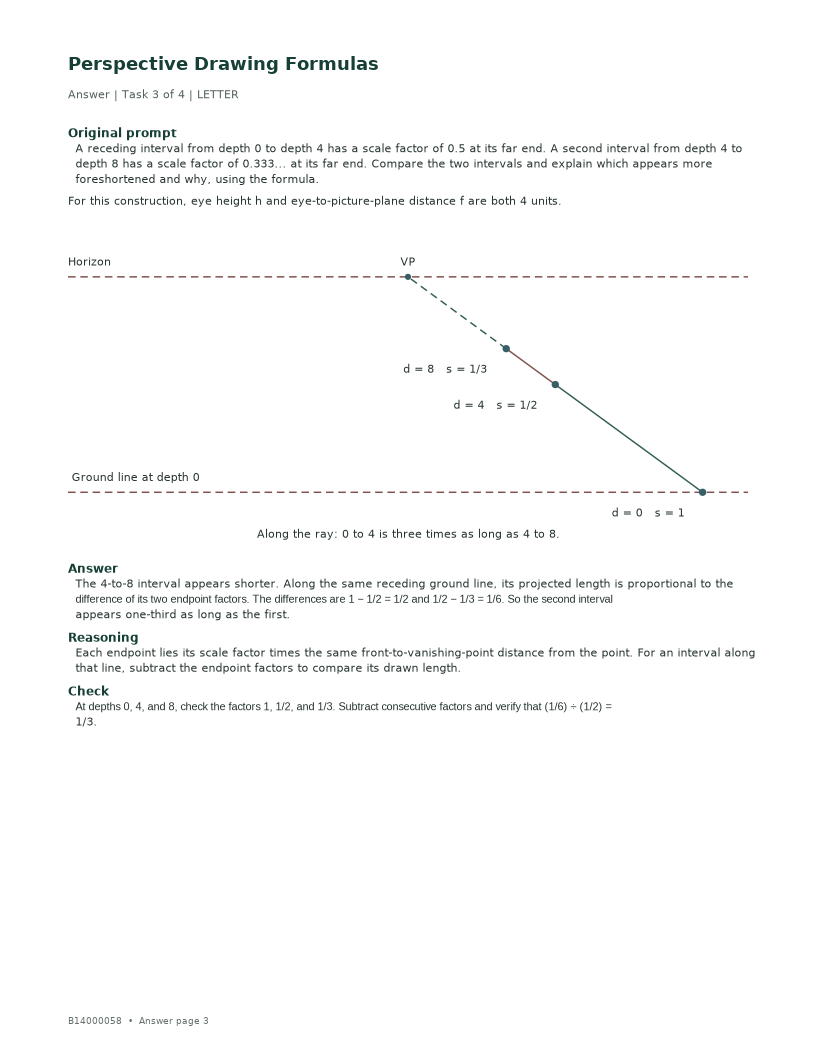
Task 3: A receding interval from depth 0 to depth 4 has a scale factor of 0.5 at its far end. A second interval from depth 4 to depth 8 has a scale factor of 0.333... at its far end. Compare the two intervals and explain which appears more foreshortened and why, using the formula.
Task 4: Redraw the three-post construction from Task 1 but move the vanishing point to the left of center. Describe how the receding lines change and confirm that the scale factors at each depth remain the same.
Answers and checks
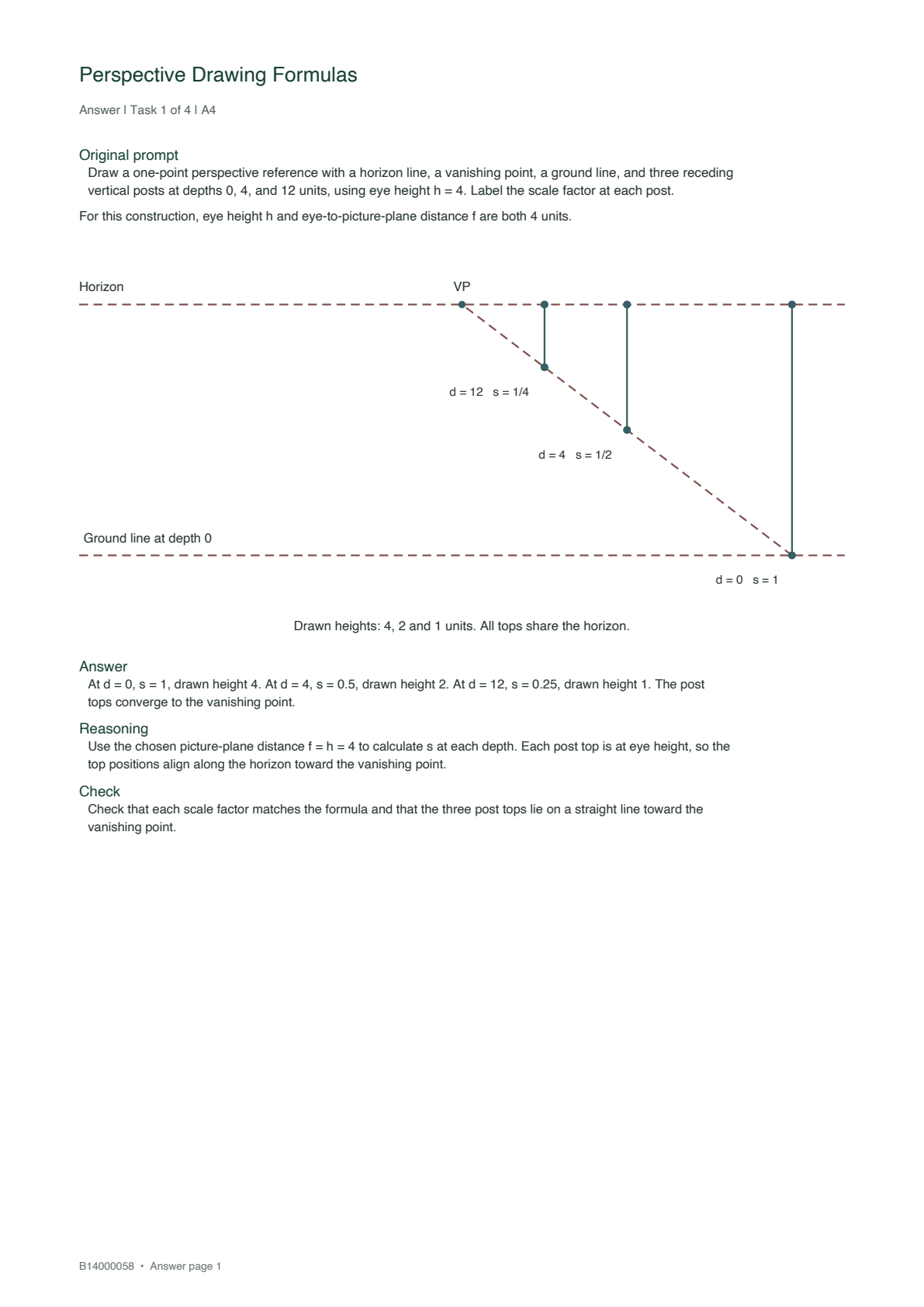
Task 1 answer: At d = 0, s = 4/(4+0) = 1, drawn height 4. At d = 4, s = 4/(4+4) = 0.5, drawn height 2. At d = 12, s = 4/(4+12) = 0.25, drawn height 1. Check: the tops of the three posts should lie on a straight line converging to the vanishing point.
Task 2 answer: s = 4/(4+8) = 4/12 = 1/3 ≈ 0.333. Drawn height = 4 × 1/3 = 4/3 ≈ 1.333 units. Check: the drawn height is one-third of the true height, consistent with the formula as depth increases from 0 to 8.
Download the complete resource pack
All individual SVG pages (18)
- A4 reference page 1
- A4 student page 1
- A4 student page 2
- A4 student page 3
- A4 student page 4
- A4 answer page 1
- A4 answer page 2
- A4 answer page 3
- A4 answer page 4
- LETTER reference page 1
- LETTER student page 1
- LETTER student page 2
- LETTER student page 3
- LETTER student page 4
- LETTER answer page 1
- LETTER answer page 2
- LETTER answer page 3
- LETTER answer page 4


Print at 100% / actual size. Use the stated scale on any schematic diagram; physical cutting templates are identified separately. A4 and US Letter are separate files. Free access, no signup; CC BY 4.0.
How to use these pages
- The working formulas
- Worked example
- Practice tasks
- Task 3 and Task 4
- Answers and checks
Worked example
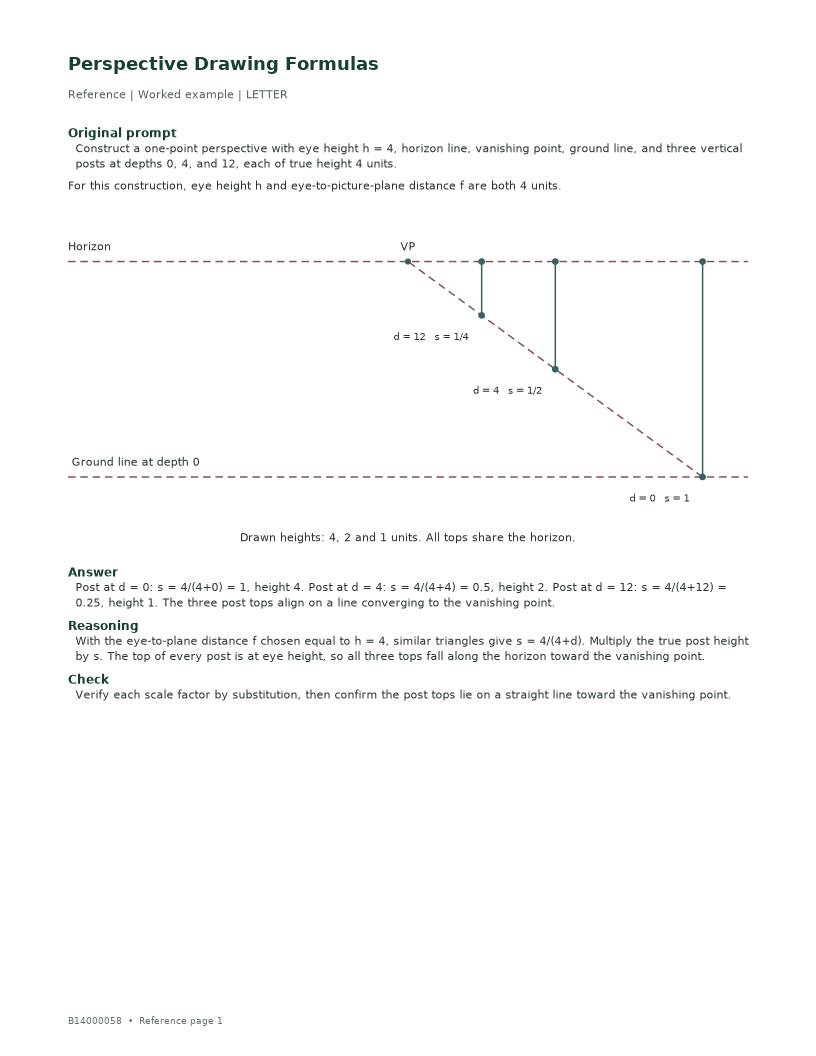
Example: Construct a one-point perspective with eye height h = 4, horizon line, vanishing point, ground line, and three vertical posts at depths 0, 4, and 12, each of true height 4 units.
Answer: Post at d = 0: s = 4/(4+0) = 1, height 4. Post at d = 4: s = 4/(4+4) = 0.5, height 2. Post at d = 12: s = 4/(4+12) = 0.25, height 1. The three post tops align on a line converging to the vanishing point.
Reasoning: With the eye-to-plane distance f chosen equal to h = 4, similar triangles give s = 4/(4+d). Multiply the true post height by s. The top of every post is at eye height, so all three tops fall along the horizon toward the vanishing point.
Check: Verify each scale factor by substitution, then confirm the post tops lie on a straight line toward the vanishing point.
Four practice tasks and complete answers
Task 1
Draw a one-point perspective reference with a horizon line, a vanishing point, a ground line, and three receding vertical posts at depths 0, 4, and 12 units, using eye height h = 4. Label the scale factor at each post.
Show answer 1
At d = 0, s = 1, drawn height 4. At d = 4, s = 0.5, drawn height 2. At d = 12, s = 0.25, drawn height 1. The post tops converge to the vanishing point.
Use the chosen picture-plane distance f = h = 4 to calculate s at each depth. Each post top is at eye height, so the top positions align along the horizon toward the vanishing point.
Check: Check that each scale factor matches the formula and that the three post tops lie on a straight line toward the vanishing point.
Task 2
Compute the scale factor for a post at depth d = 8 with eye height h = 4, and state the drawn height if the true height is 4 units. Show the formula substitution and the result as a fraction and a decimal.
Show answer 2
s = 4/(4+8) = 4/12 = 1/3 ≈ 0.333. Drawn height = 4 × 1/3 = 4/3 ≈ 1.333 units.
Substitute the chosen distance f = h = 4 and depth d = 8 into the scale formula, then multiply the result by the true height 4.
Check: Confirm that 1/3 is less than the scale factor at d = 4 (0.5), which is expected because greater depth means more foreshortening.
Task 3
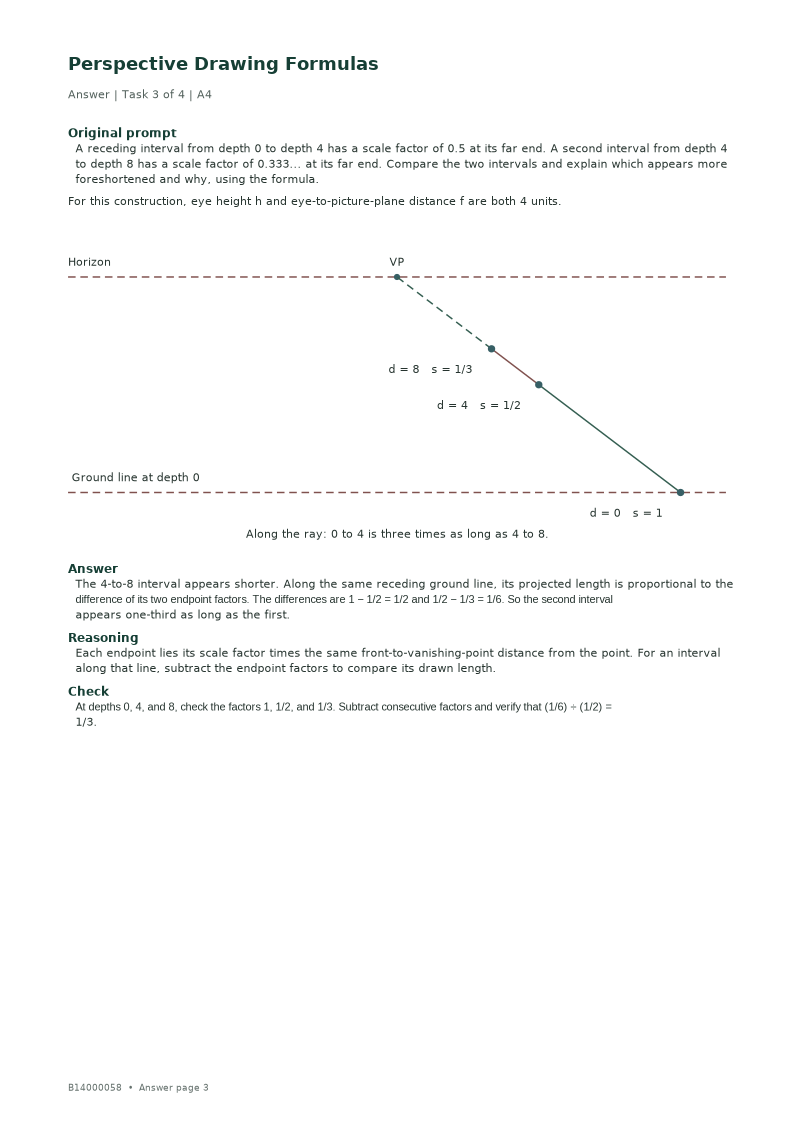
A receding interval from depth 0 to depth 4 has a scale factor of 0.5 at its far end. A second interval from depth 4 to depth 8 has a scale factor of 0.333... at its far end. Compare the two intervals and explain which appears more foreshortened and why, using the formula.
Show answer 3
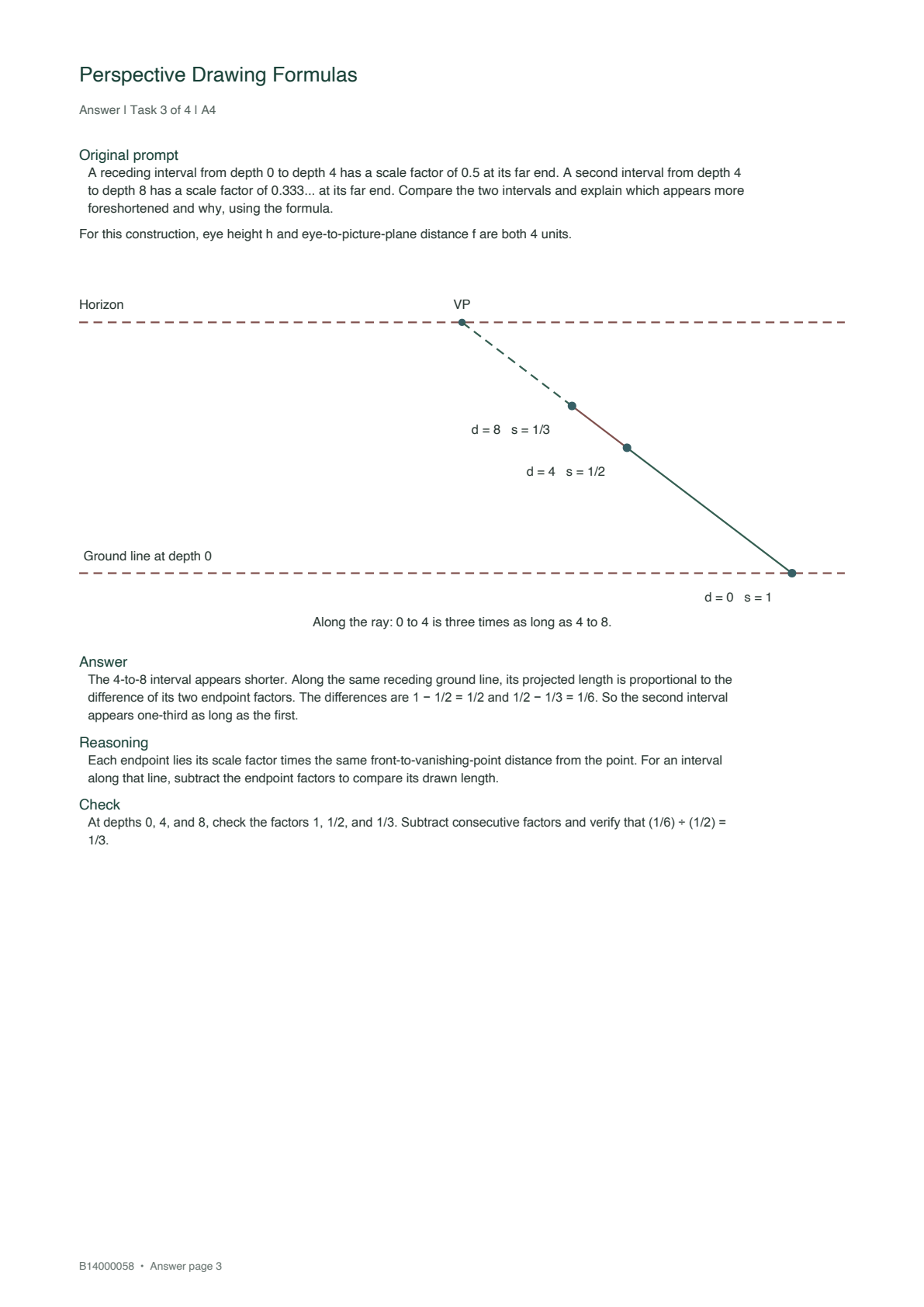
The 4-to-8 interval appears shorter. Along the same receding ground line, its projected length is proportional to the difference of its two endpoint factors. The differences are 1 − 1/2 = 1/2 and 1/2 − 1/3 = 1/6. So the second interval appears one-third as long as the first.
Each endpoint lies its scale factor times the same front-to-vanishing-point distance from the point. For an interval along that line, subtract the endpoint factors to compare its drawn length.
Check: At depths 0, 4, and 8, check the factors 1, 1/2, and 1/3. Subtract consecutive factors and verify that (1/6) ÷ (1/2) = 1/3.
Task 4
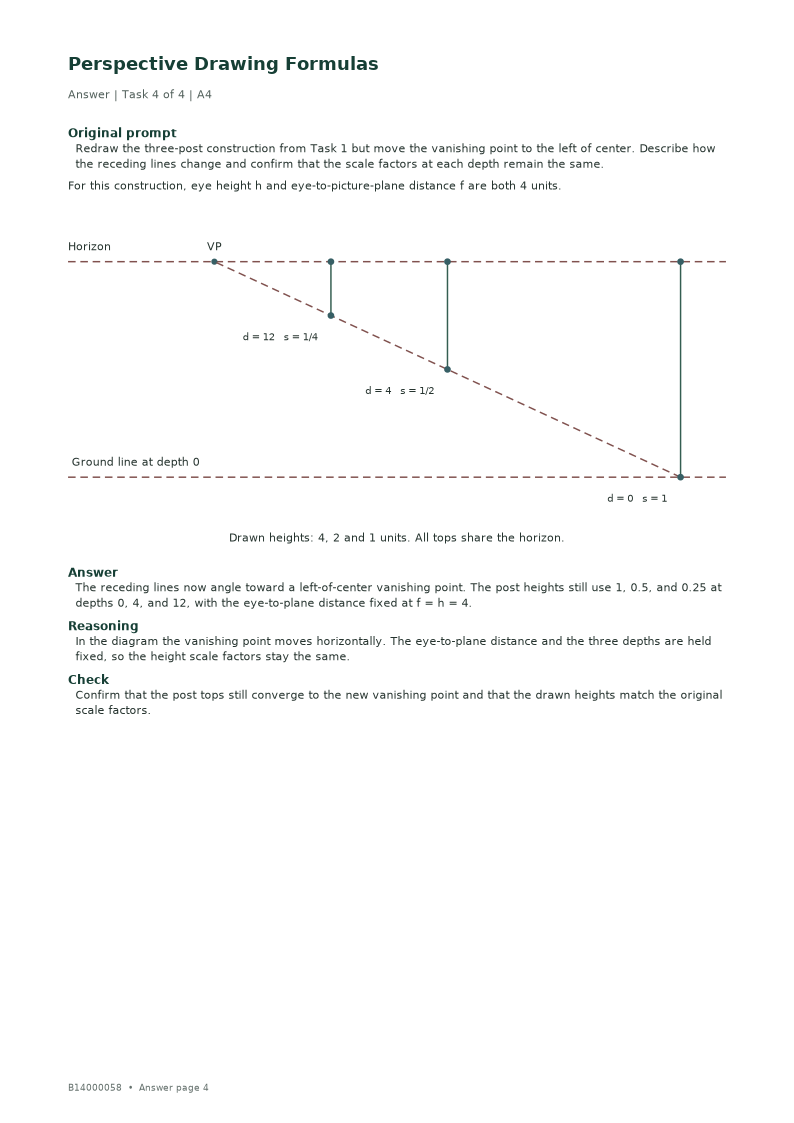
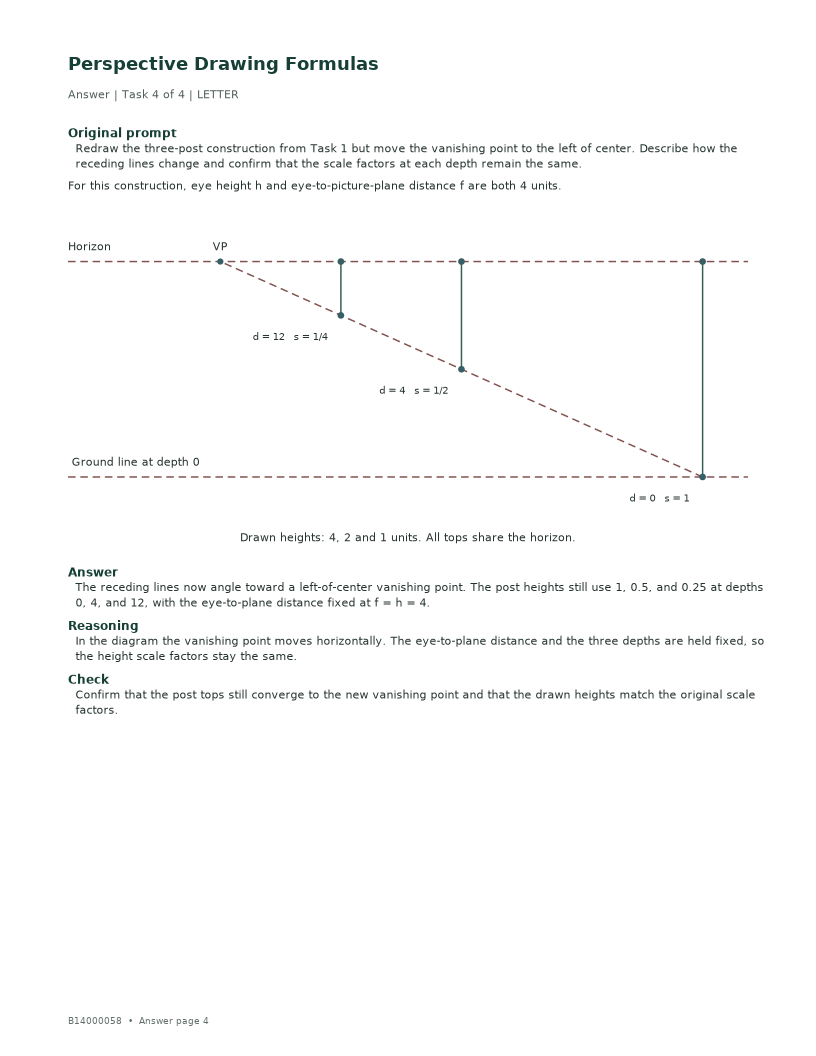
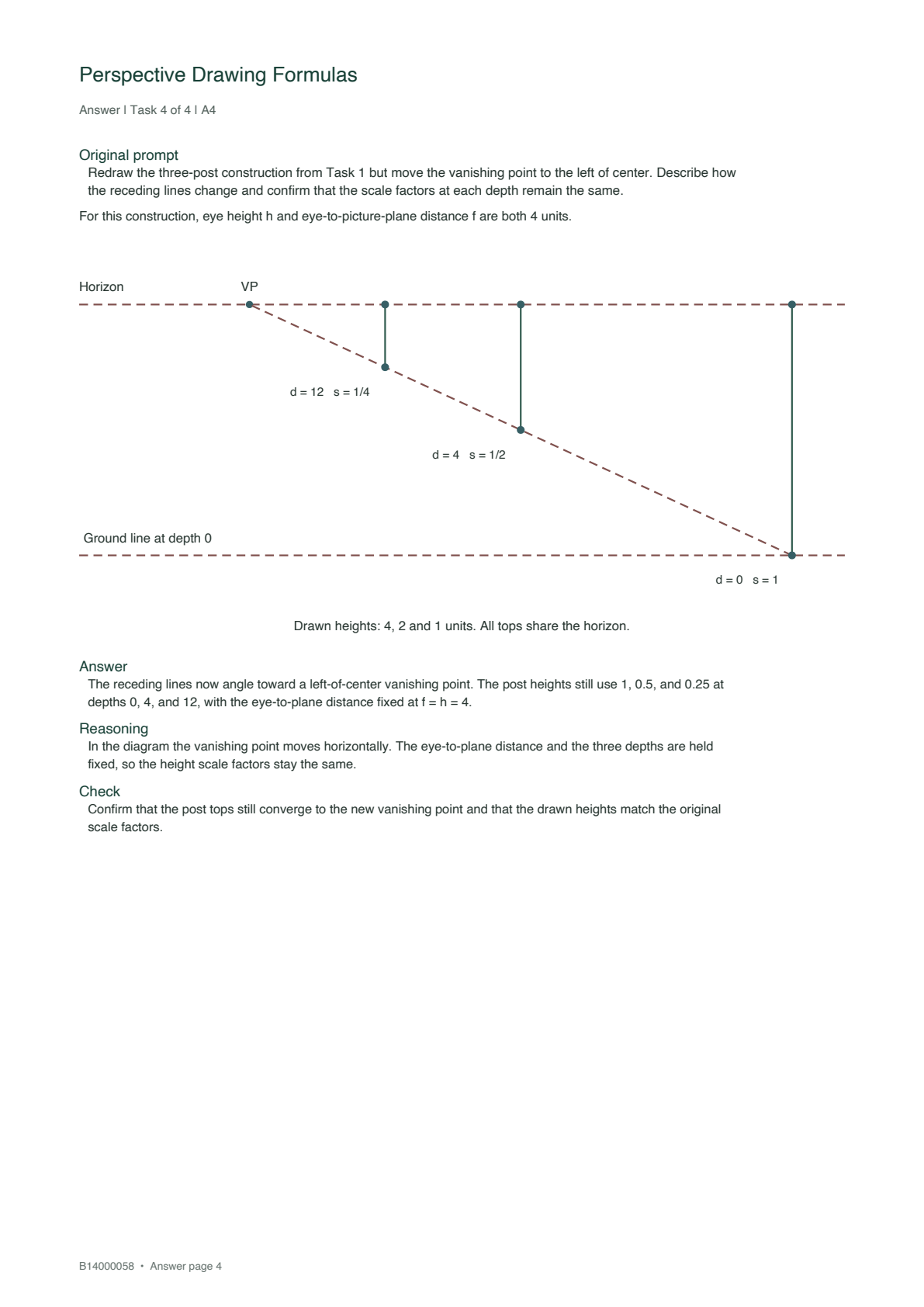
Redraw the three-post construction from Task 1 but move the vanishing point to the left of center. Describe how the receding lines change and confirm that the scale factors at each depth remain the same.
Show answer 4
The receding lines now angle toward a left-of-center vanishing point. The post heights still use 1, 0.5, and 0.25 at depths 0, 4, and 12, with the eye-to-plane distance fixed at f = h = 4.
In the diagram the vanishing point moves horizontally. The eye-to-plane distance and the three depths are held fixed, so the height scale factors stay the same.
Check: Confirm that the post tops still converge to the new vanishing point and that the drawn heights match the original scale factors.
Useful checks
- Using the vanishing point as the only reference and ignoring the horizon line. Always draw the horizon line first; the vanishing point must lie on it, and eye height is measured from the ground line to the horizon.
- Applying the scale factor to the depth instead of the height. The scale factor s = h/(h+d) multiplies the true height of the object, not its depth. Depth is used only inside the formula.
Questions about this resource
Why does the scale factor decrease as depth increases?
Because the denominator h + d grows while the numerator h stays fixed, so the fraction shrinks. This matches the visual effect of objects appearing smaller farther away.
Does moving the vanishing point change the scale factors?
In this construction, moving the vanishing point horizontally keeps the eye-to-plane distance and depths fixed. The converging lines change direction, and the height scale factors stay the same.