Free original lessons
Draw with Pencil on Black Paper
Black paper reverses the usual pencil logic: the paper supplies the dark, and the pencil supplies the light. Graphite on black paper reads as a light mark, and how bright it appears depends on how much graphite you build up and how hard you press. This pack teaches you to make and compare a light mark and a mid-tone mark on black paper, then to use those two values in a simple drawing. Work on black or very dark paper with an ordinary graphite pencil; a soft pencil (such as a 2B or softer) builds visible light marks more easily than a hard one. Keep your hand light at first and build up in layers rather than pressing hard straight away.
Letter & A4
PDF & SVG
What changes on black paper
The same graphite can look dark on white paper and show a gray sheen on some black papers. Compare the marks in steady light at a fixed angle, because reflected sheen can change as you turn the sheet. First test whether the pencil and paper give two distinct grays above bare black.
Making a light mark
Use the side of a soft pencil or a broad tip with gentle overlapping passes. Try for a soft, low-contrast gray. Compare it from the angle you will keep for the other mark, and adjust the light or test another graphite grade if you cannot distinguish it from the paper.
Making a mid-tone mark
Build the second mark in several gentle passes. Aim for a continuous, denser-looking patch. Pick the mark whose visible gray falls between the bare black and the lighter mark for the middle value. If more layers make it look brighter at your viewing angle, adjust the second patch or test another pencil and repeat the comparison.
Comparing the two marks
Compare the two similar-length marks side by side on the same sheet without changing the light or angle. For this exercise, call the brighter gray the light value and the next darker gray the mid-tone. Both can be faint relative to white; they must remain distinct against the dark support.
Download the complete resource pack
All individual SVG pages (18)
- A4 reference page 1
- A4 student page 1
- A4 student page 2
- A4 student page 3
- A4 student page 4
- A4 answer page 1
- A4 answer page 2
- A4 answer page 3
- A4 answer page 4
- LETTER reference page 1
- LETTER student page 1
- LETTER student page 2
- LETTER student page 3
- LETTER student page 4
- LETTER answer page 1
- LETTER answer page 2
- LETTER answer page 3
- LETTER answer page 4
Print at 100% / actual size. Use the stated scale on any schematic diagram; physical cutting templates are identified separately. A4 and US Letter are separate files. Free access, no signup; CC BY 4.0.
How to use these pages
- What changes on black paper
- Making a light mark
- Making a mid-tone mark
- Comparing the two marks
Worked example
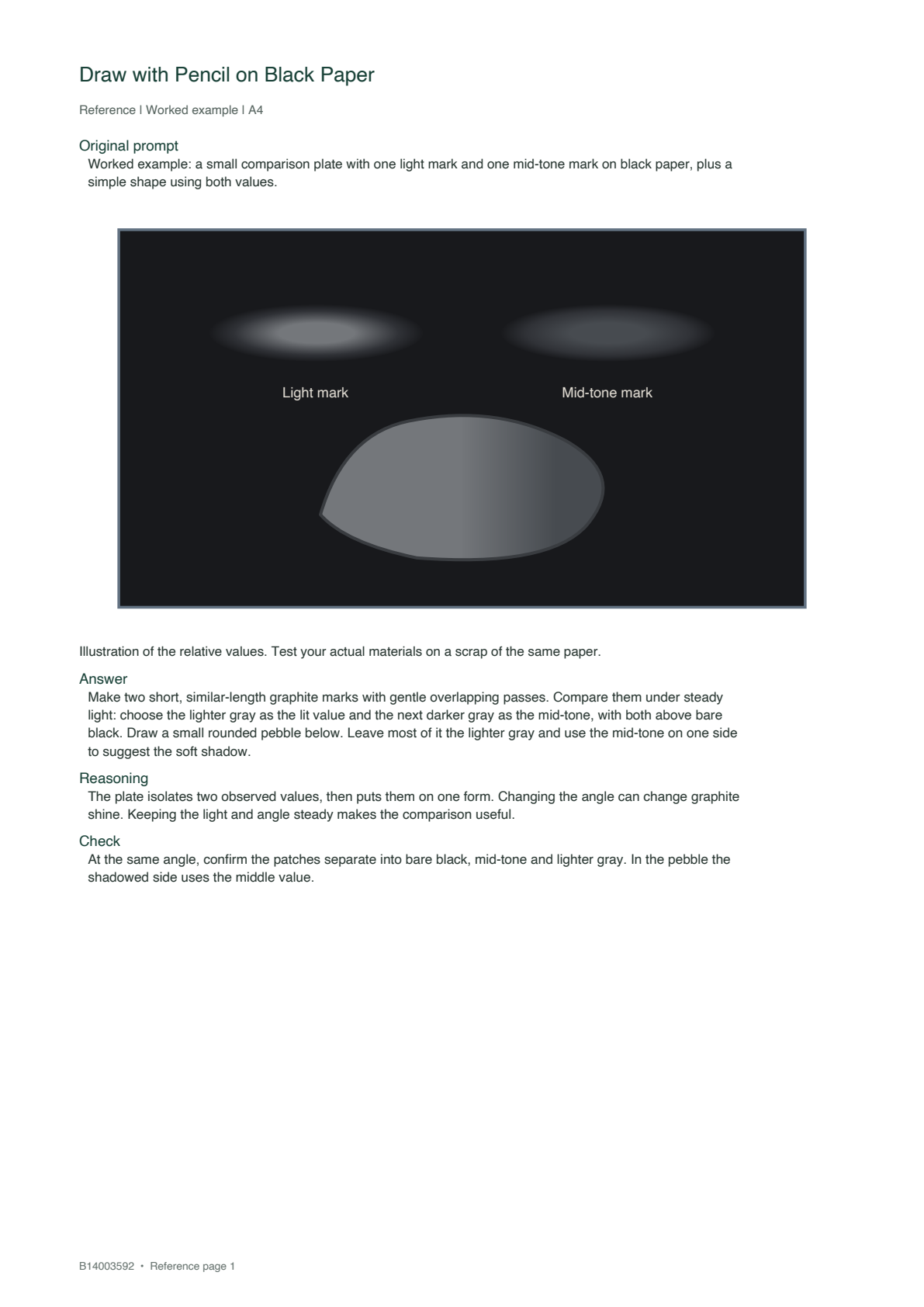
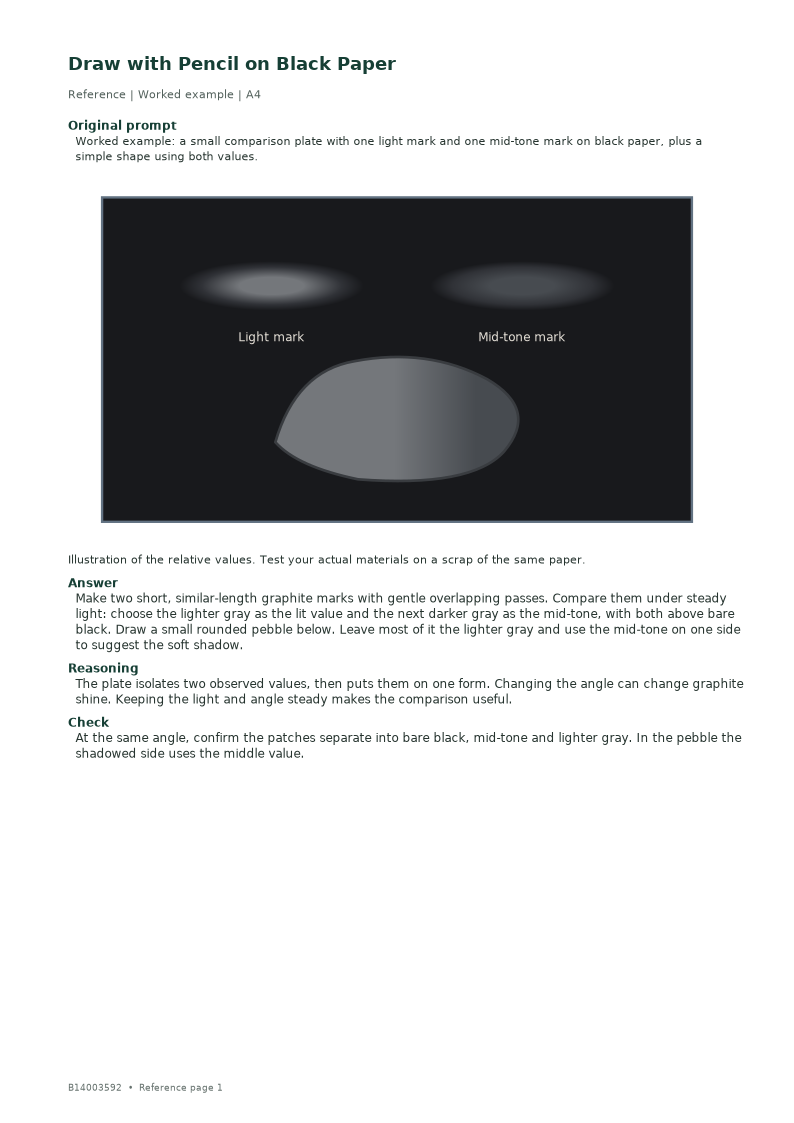
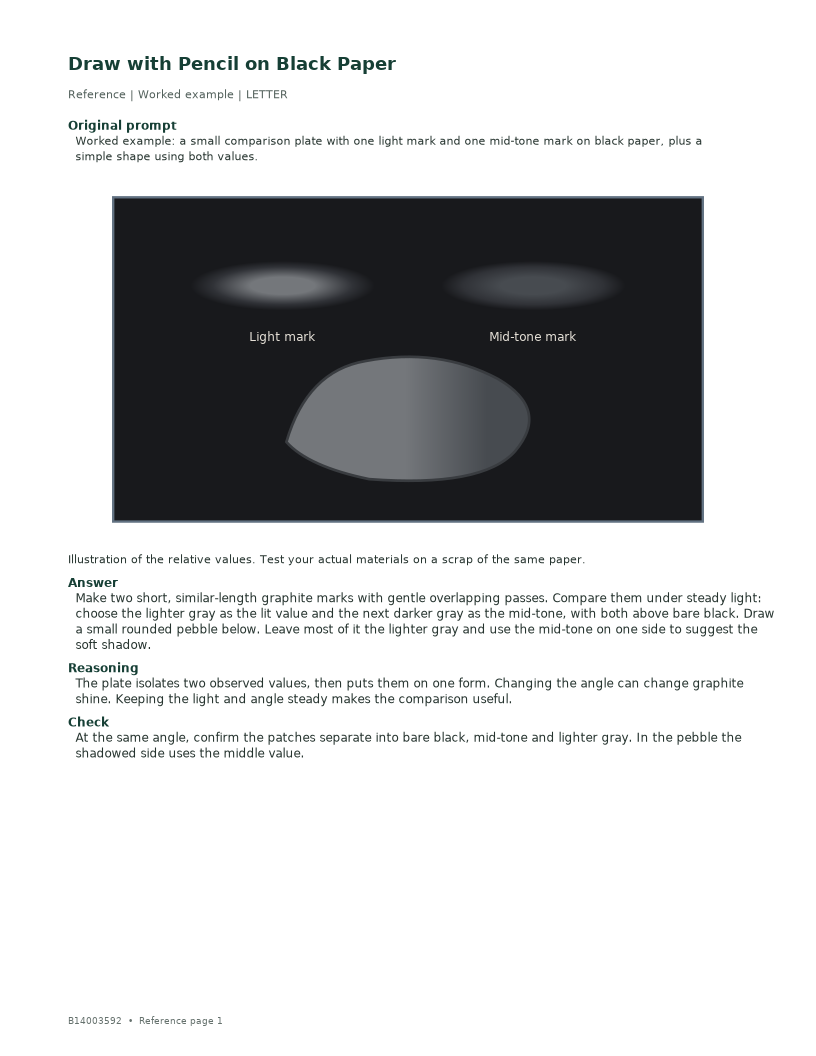
Example: Worked example: a small comparison plate with one light mark and one mid-tone mark on black paper, plus a simple shape using both values.
Answer: Make two short, similar-length graphite marks with gentle overlapping passes. Compare them under steady light: choose the lighter gray as the lit value and the next darker gray as the mid-tone, with both above bare black. Draw a small rounded pebble below. Leave most of it the lighter gray and use the mid-tone on one side to suggest the soft shadow.
Reasoning: The plate isolates two observed values, then puts them on one form. Changing the angle can change graphite shine. Keeping the light and angle steady makes the comparison useful.
Check: At the same angle, confirm the patches separate into bare black, mid-tone and lighter gray. In the pebble the shadowed side uses the middle value.
Four practice tasks and complete answers
Task 1
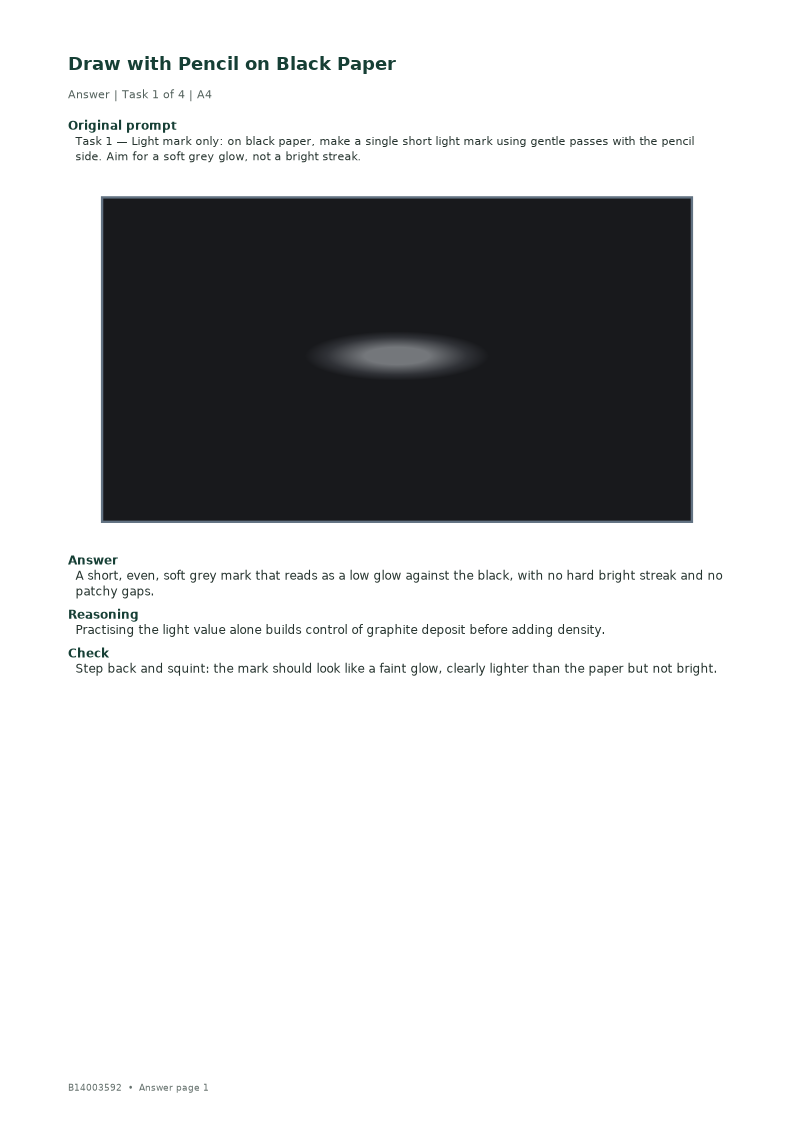
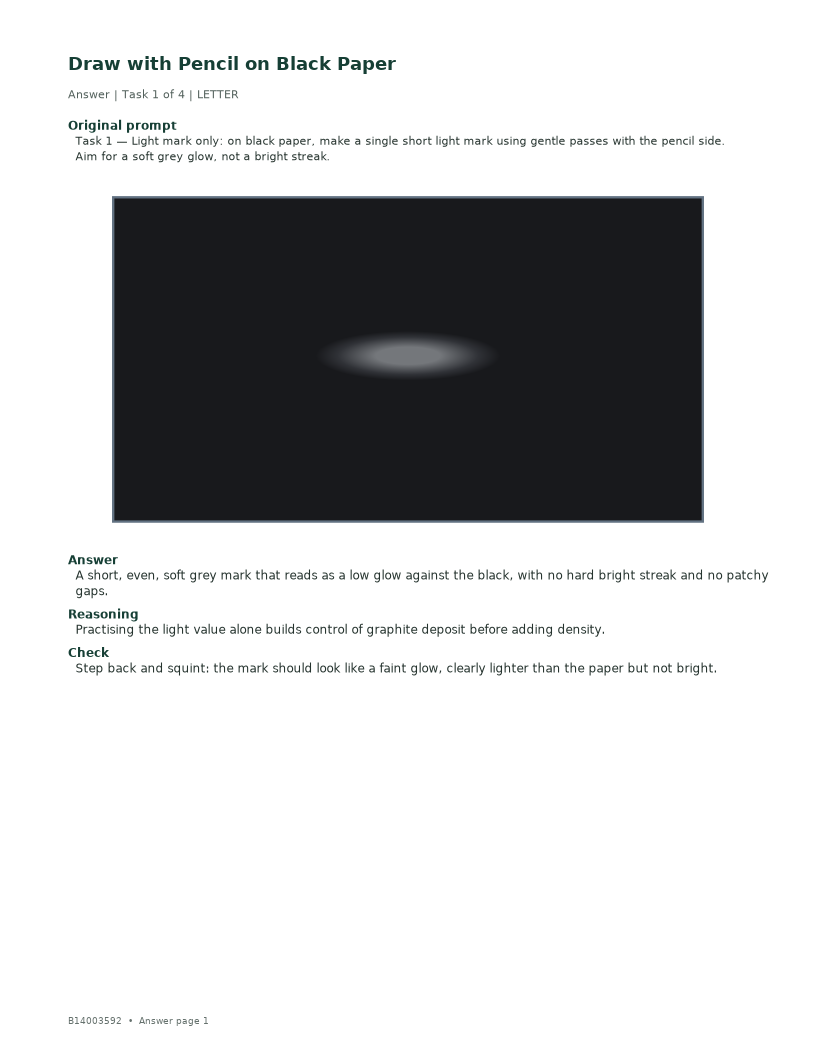
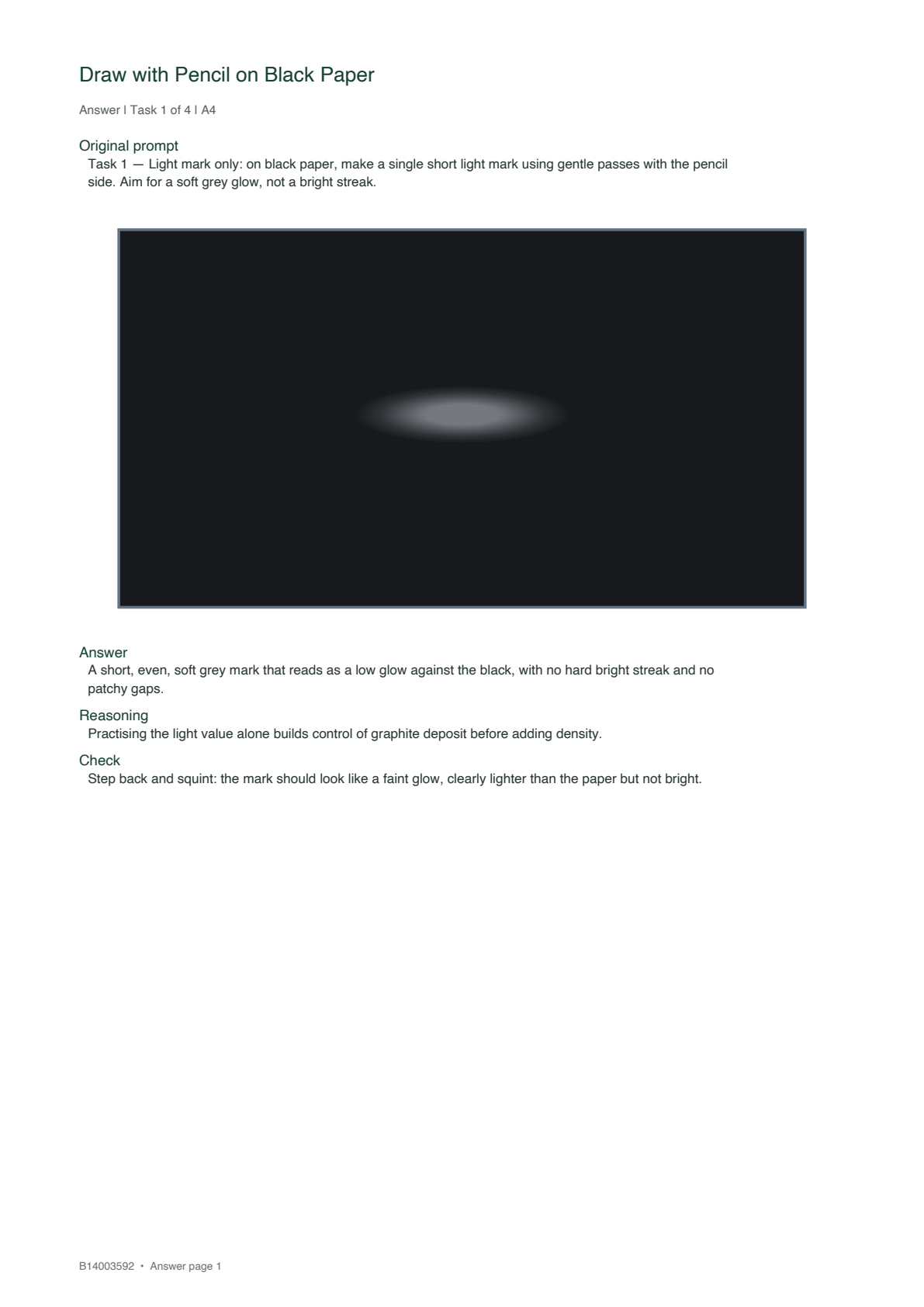
Task 1 — Light mark only: on black paper, make a single short light mark using gentle passes with the pencil side. Aim for a soft grey glow, not a bright streak.
Show answer 1
A short, even, soft grey mark that reads as a low glow against the black, with no hard bright streak and no patchy gaps.
Practising the light value alone builds control of graphite deposit before adding density.
Check: Step back and squint: the mark should look like a faint glow, clearly lighter than the paper but not bright.
Task 2
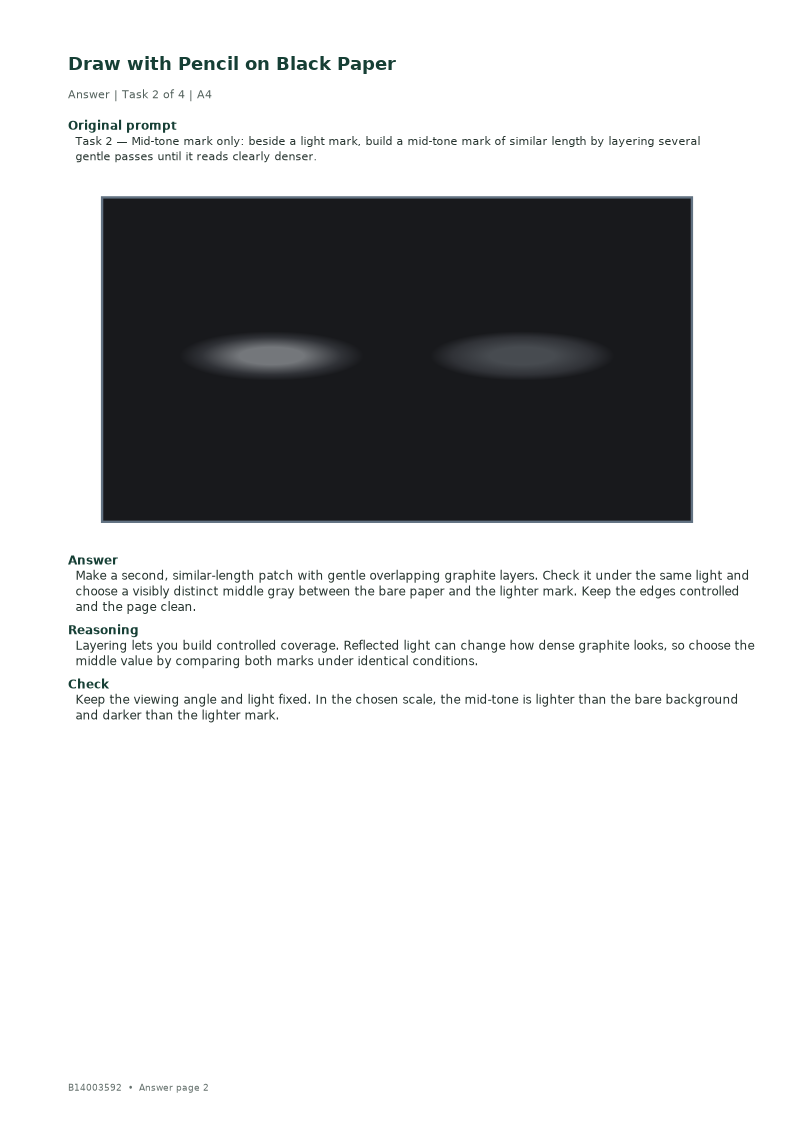
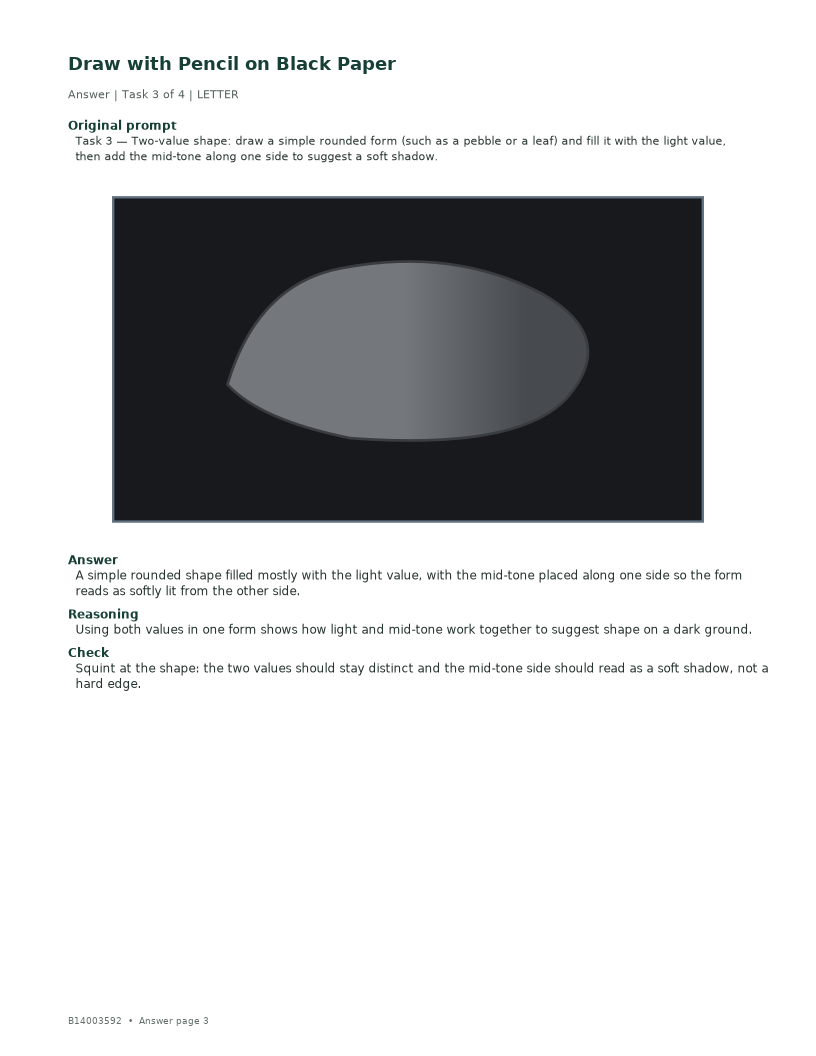
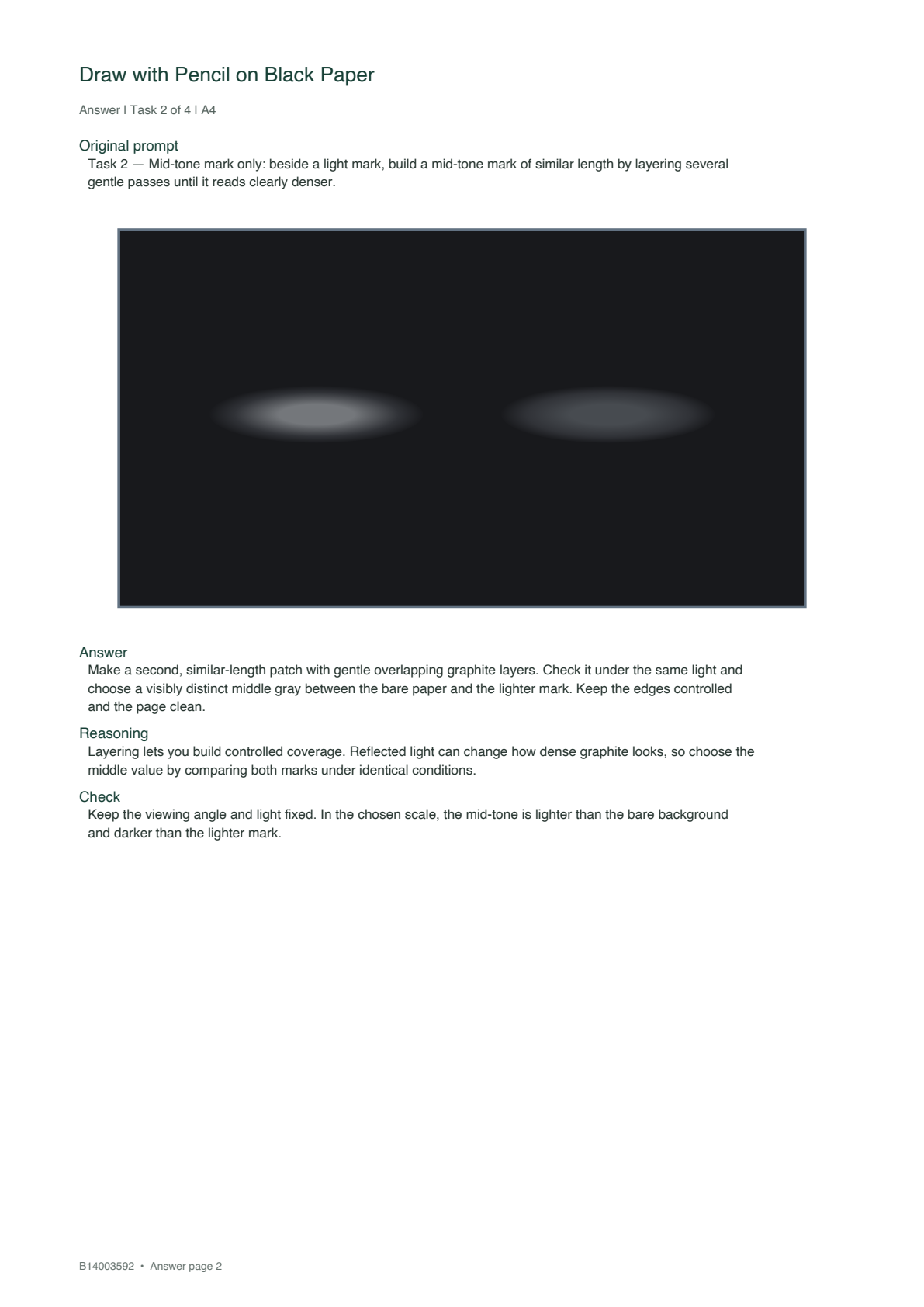
Task 2 — Mid-tone mark only: beside a light mark, build a mid-tone mark of similar length by layering several gentle passes until it reads clearly denser.
Show answer 2
Make a second, similar-length patch with gentle overlapping graphite layers. Check it under the same light and choose a visibly distinct middle gray between the bare paper and the lighter mark. Keep the edges controlled and the page clean.
Layering lets you build controlled coverage. Reflected light can change how dense graphite looks, so choose the middle value by comparing both marks under identical conditions.
Check: Keep the viewing angle and light fixed. In the chosen scale, the mid-tone is lighter than the bare background and darker than the lighter mark.
Task 3
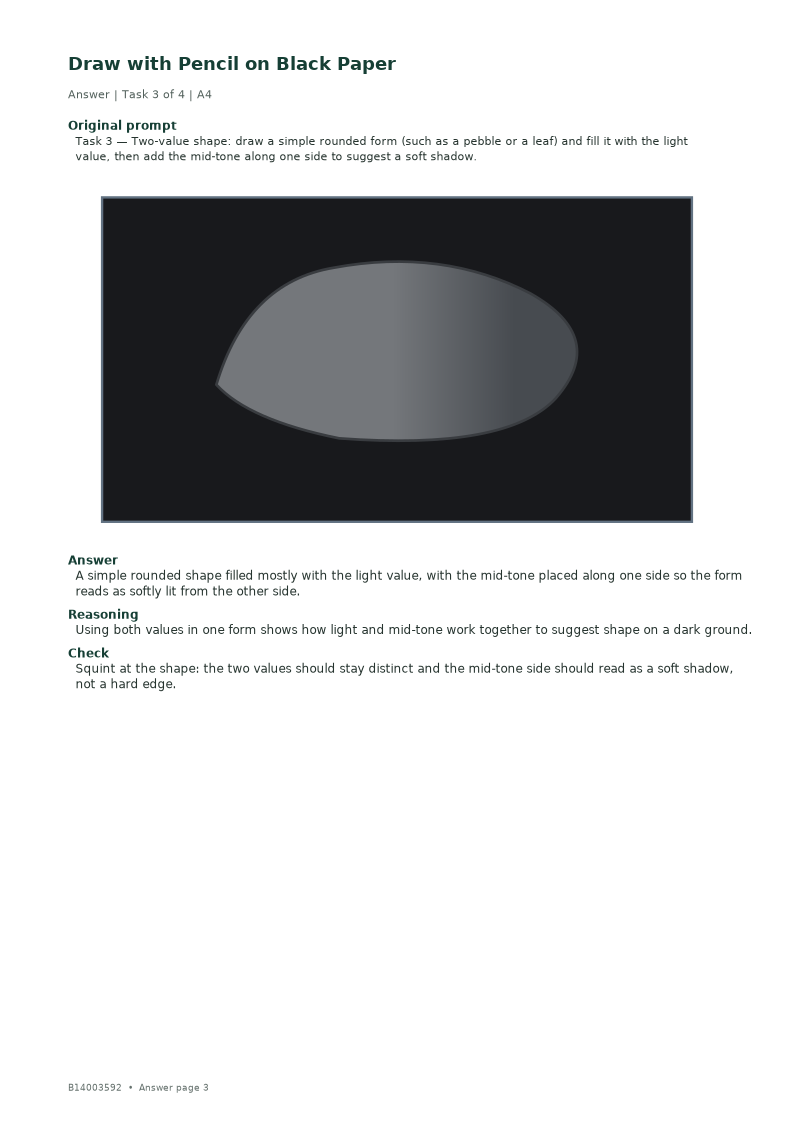
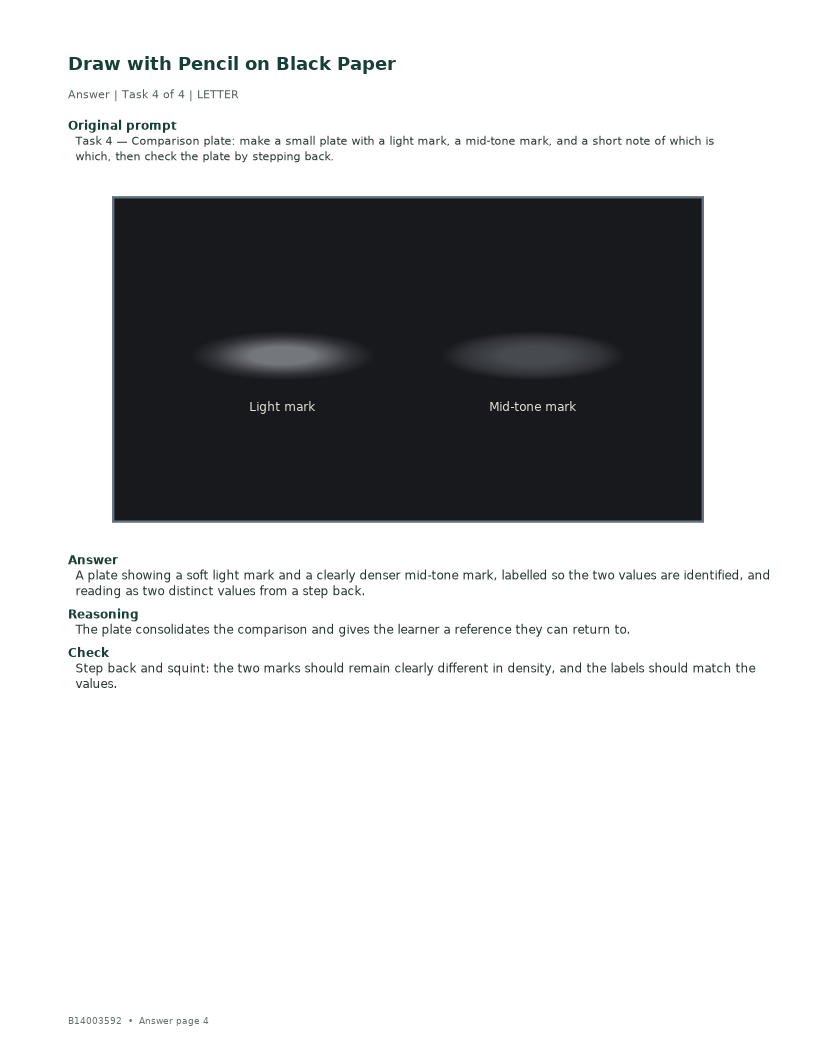
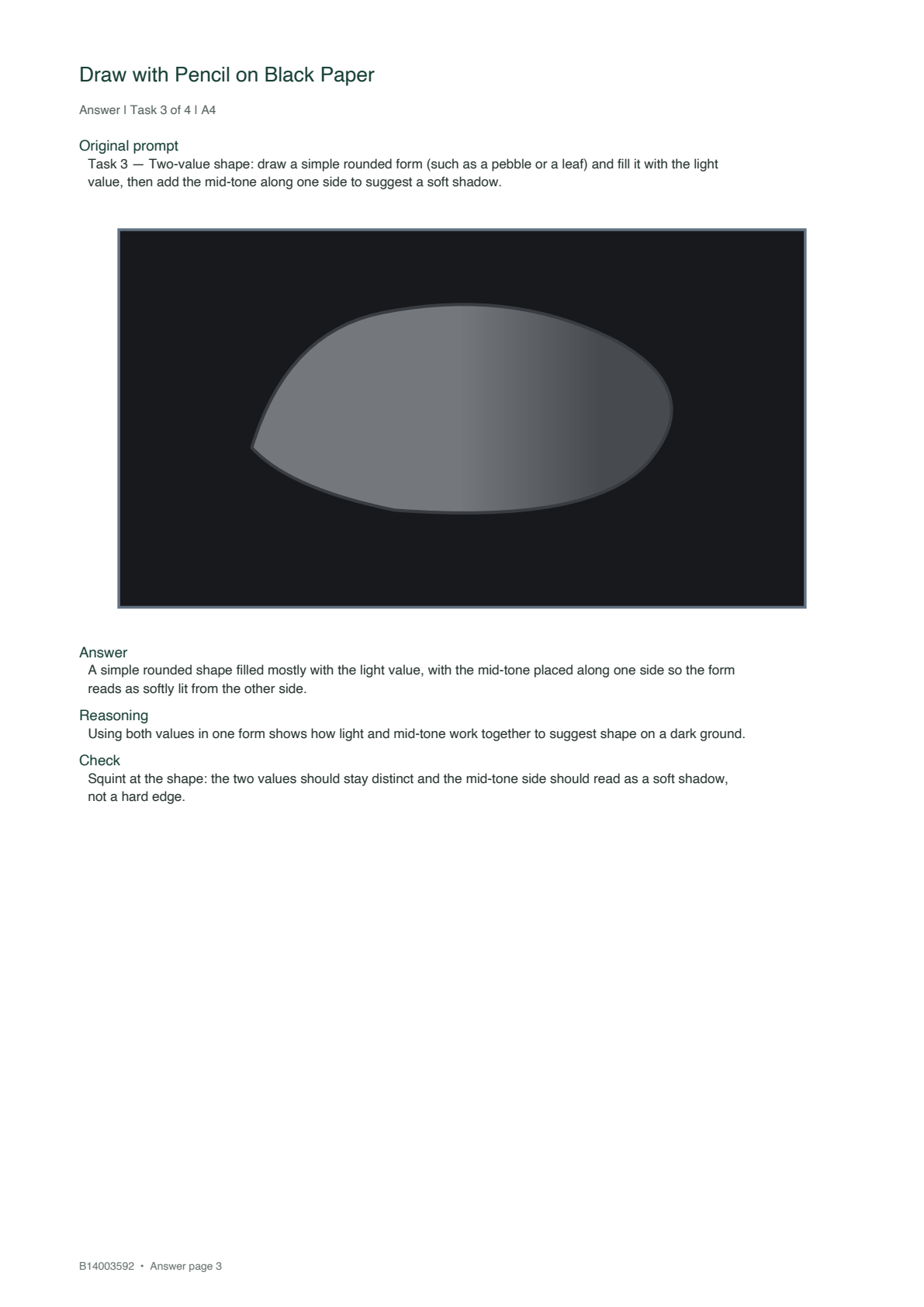
Task 3 — Two-value shape: draw a simple rounded form (such as a pebble or a leaf) and fill it with the light value, then add the mid-tone along one side to suggest a soft shadow.
Show answer 3
A simple rounded shape filled mostly with the light value, with the mid-tone placed along one side so the form reads as softly lit from the other side.
Using both values in one form shows how light and mid-tone work together to suggest shape on a dark ground.
Check: Squint at the shape: the two values should stay distinct and the mid-tone side should read as a soft shadow, not a hard edge.
Task 4
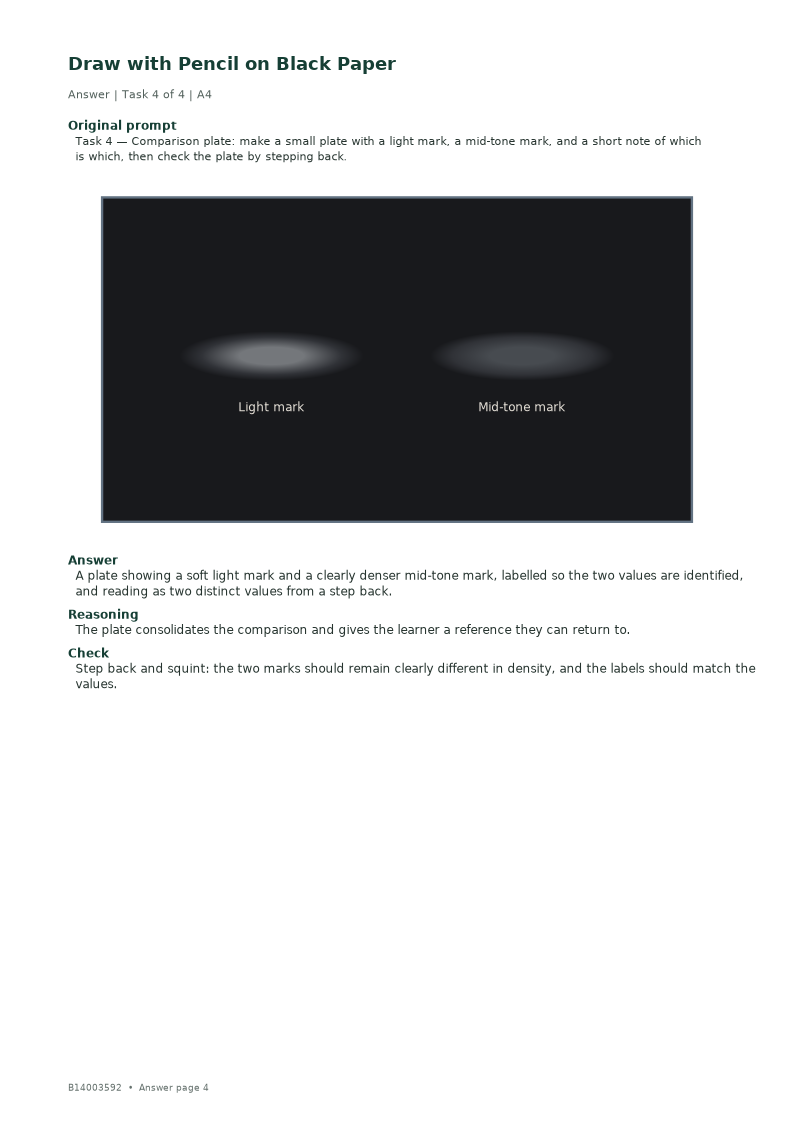
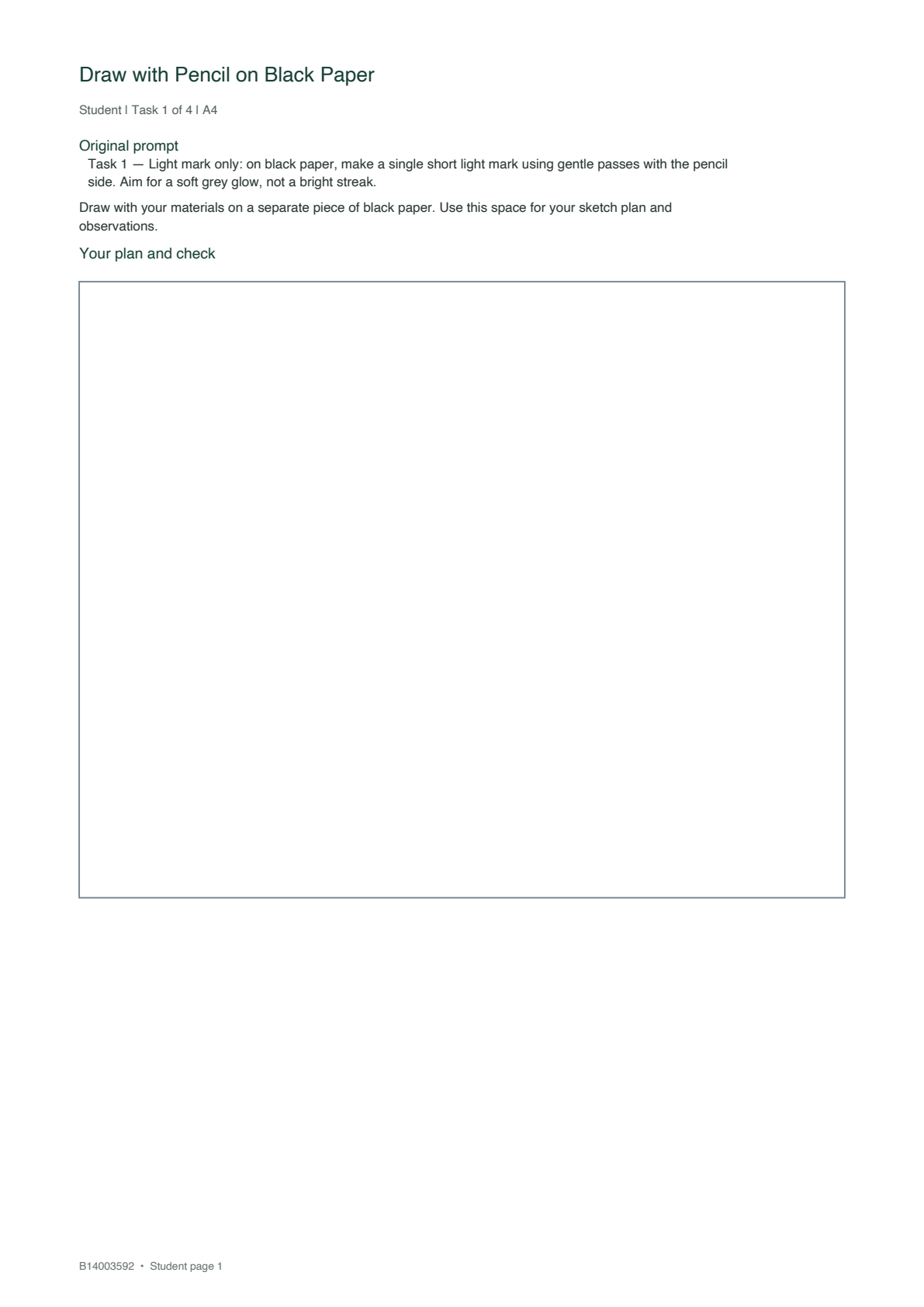
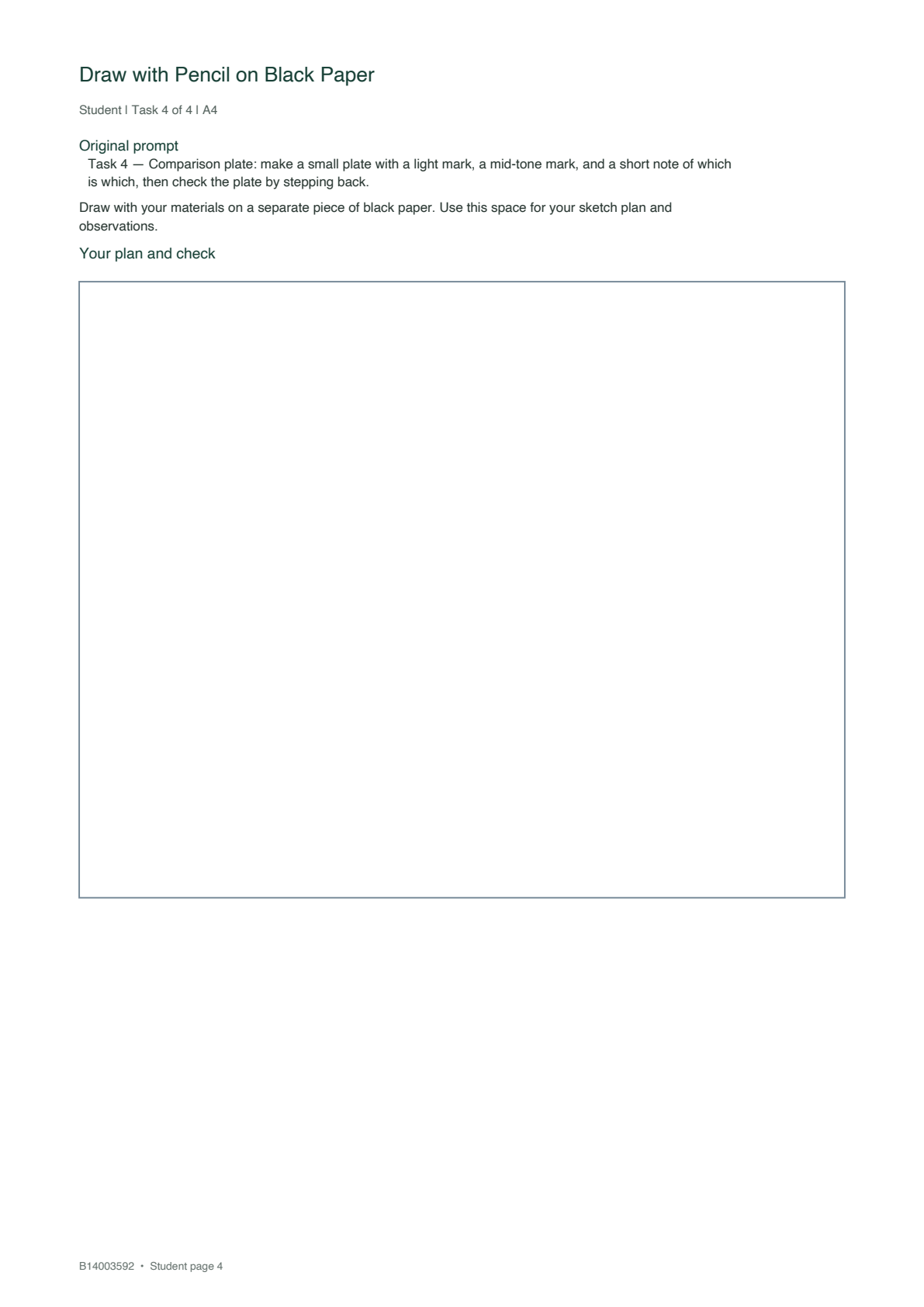
Task 4 — Comparison plate: make a small plate with a light mark, a mid-tone mark, and a short note of which is which, then check the plate by stepping back.
Show answer 4
A plate showing a soft light mark and a clearly denser mid-tone mark, labelled so the two values are identified, and reading as two distinct values from a step back.
The plate consolidates the comparison and gives the learner a reference they can return to.
Check: Step back and squint: the two marks should remain clearly different in density, and the labels should match the values.
Useful checks
- Pressing hard to make a bright mark straight away. Use gentle layers and compare while keeping the light and sheet angle steady. Heavy pressure can change graphite's sheen as well as the mark.
- Making the light and mid-tone marks look the same. Compare the test patches under the same light. Adjust the graphite grade or coverage until the second patch looks clearly distinct, then identify the mid-tone by its position between the bare paper and the lighter gray.
- Smudging the marks with the hand. Rest your hand on a spare sheet and work from the top of the plate downward.
Questions about this resource
Which pencil should I use?
Start with an ordinary graphite pencil and make test marks on your own sheet. Compare grades under the same light and choose one that gives the two visible values you need.
Why can graphite look light on black paper?
Graphite can reflect light as a gray or silvery sheen, especially when the light strikes at a shallow angle. What you see depends on the pencil, paper, and viewing conditions.