Free original lessons
Draw a Rug in One-Point Perspective
A rug in one-point perspective is a flat patterned rectangle lying on a floor that recedes to a single vanishing point. The floor recession sets the rug's outline; the rug pattern is then carried across that outline so its depth lines also converge to the same vanishing point. This pack teaches that combined construction: floor and rug outline first, then the pattern, then a visual check that the rug sits convincingly on the receding floor.
Letter & A4
PDF & SVG
What the task actually asks
The task is to draw a rug in one-point perspective with two linked parts: a rug pattern and a floor recession construction. The floor recession is the set of lines running from the viewer toward a single vanishing point on the horizon. The rug is a flat rectangle on that floor, so its side edges follow recession lines and its front and back edges stay parallel to the picture plane.
The rug pattern is not drawn flat and pasted on. It is carried across the rug outline so pattern lines running away from the viewer also converge to the same vanishing point. That is what makes the rug look like it lies on the floor rather than standing upright.
The construction in order
Step 1: Set the horizon line and mark one vanishing point on it. Step 2: Draw two recession lines from the lower part of the page toward the vanishing point; these become the rug's side edges. Step 3: Close the rug with a front edge and a back edge, both parallel to the picture plane, so the rug reads as a flat rectangle on the floor.
Step 4: Add floor recession lines around the rug so the floor itself is visibly receding. Step 5: Carry the rug pattern across the rug outline, letting pattern lines that run away from the viewer converge to the same vanishing point. Step 6: Check that the rug's side edges and the pattern's depth lines all point to the one vanishing point, and that the front and back edges stay parallel to the picture plane.
Worked example
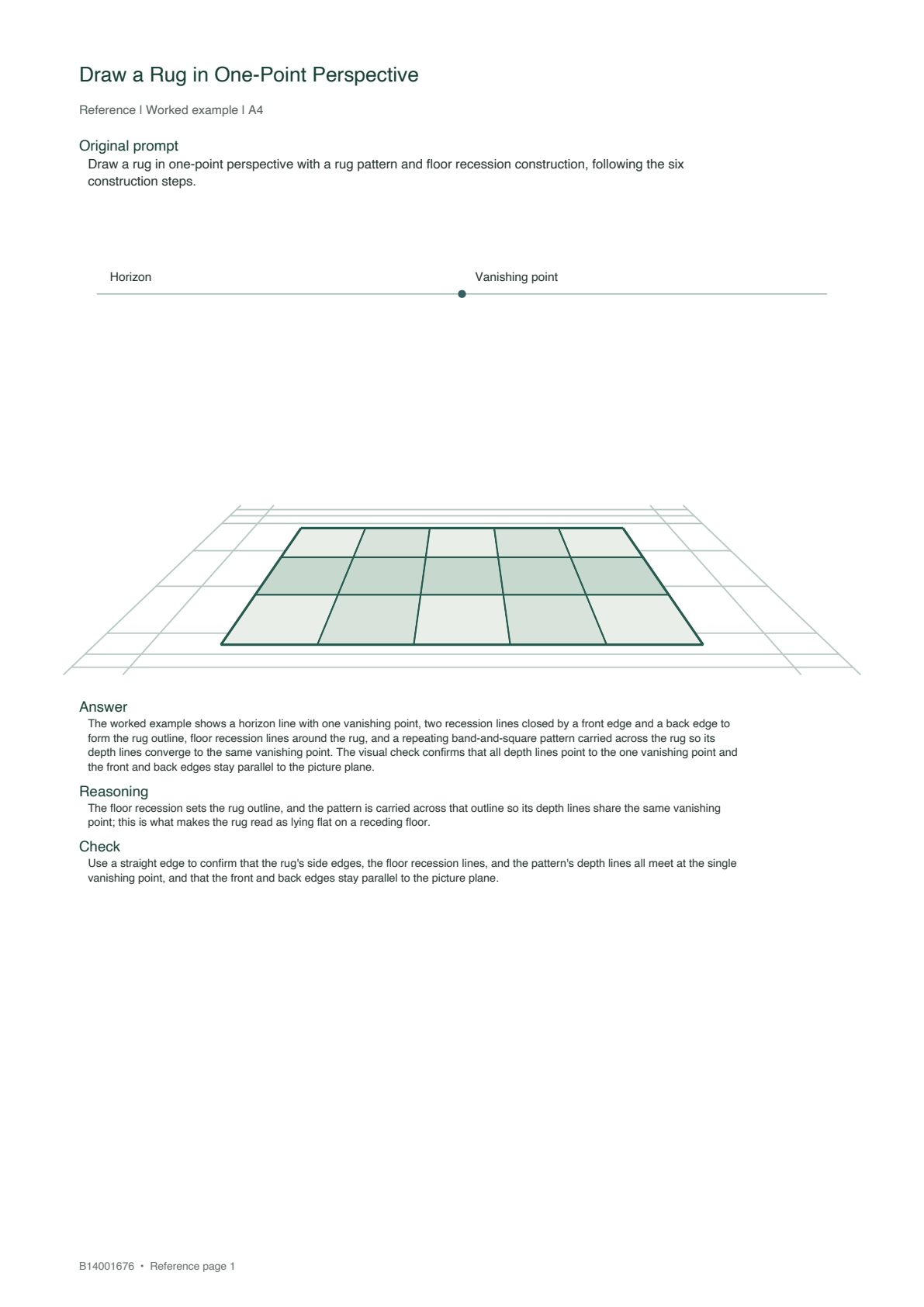
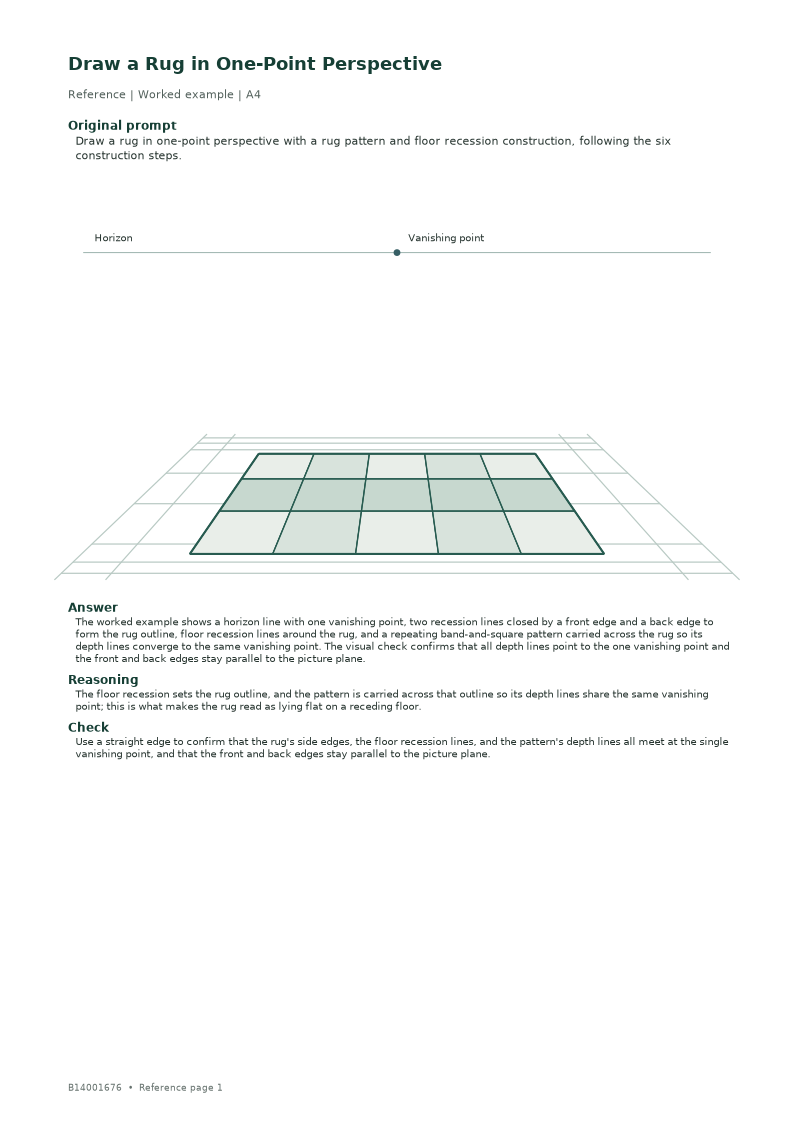
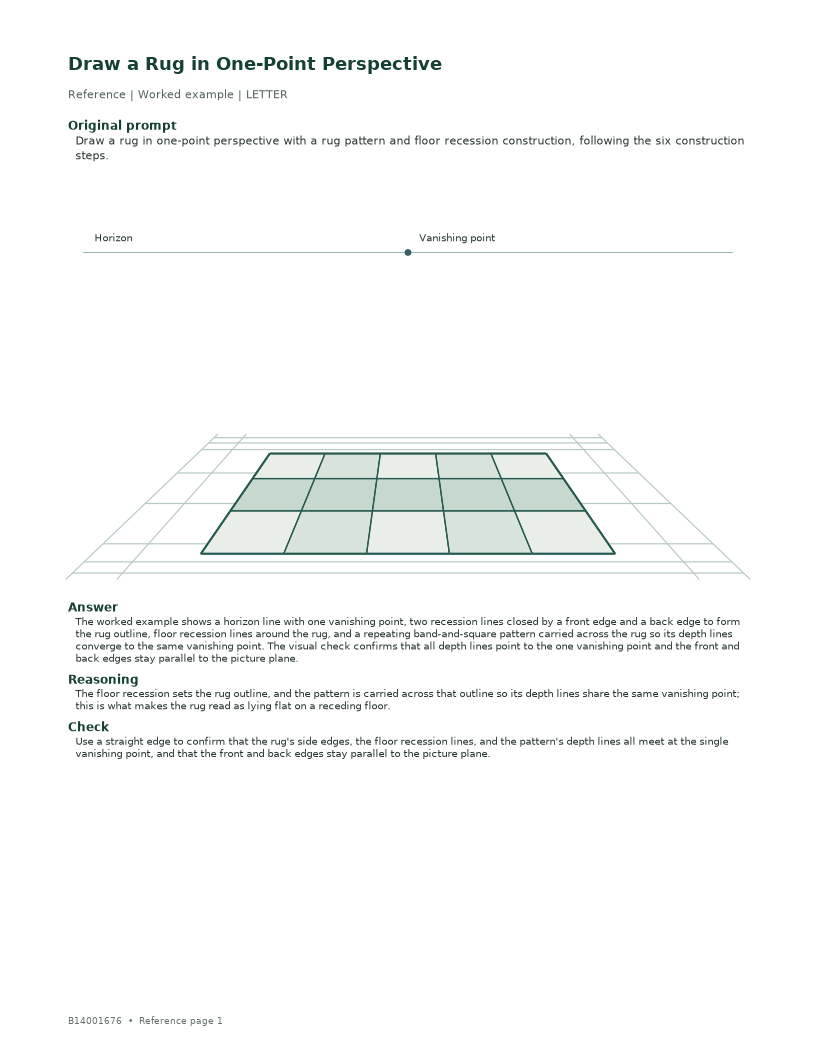
The worked-example figure shows the full construction. The horizon line crosses the upper middle of the page with one vanishing point marked on it. Two recession lines run from the lower page toward that point and are closed by a front edge and a back edge to form the rug outline. Floor recession lines are added around the rug, and a simple repeating pattern of bands and squares is carried across the rug so its depth lines converge to the same vanishing point. The check is visual: every depth line in the rug and floor points to the one vanishing point, and the front and back edges stay parallel to the picture plane.
Practice tasks
Each task below is self-contained: the prompt states the starting state and the goal, and the answer gives the completed construction, the reasoning, and a visual check. Task 1 builds the floor recession and rug outline. Task 2 adds a banded pattern to a rug outline you draw from stated starting conditions. Task 3 adds floor recession lines around a rug you draw from stated starting conditions. Task 4 combines all three parts into one complete drawing and performs the visual check.
Download the complete resource pack
All individual SVG pages (18)
- A4 reference page 1
- A4 student page 1
- A4 student page 2
- A4 student page 3
- A4 student page 4
- A4 answer page 1
- A4 answer page 2
- A4 answer page 3
- A4 answer page 4
- LETTER reference page 1
- LETTER student page 1
- LETTER student page 2
- LETTER student page 3
- LETTER student page 4
- LETTER answer page 1
- LETTER answer page 2
- LETTER answer page 3
- LETTER answer page 4
Print at 100% / actual size. Use the stated scale on any schematic diagram; physical cutting templates are identified separately. A4 and US Letter are separate files. Free access, no signup; CC BY 4.0.
How to use these pages
- What the task actually asks
- The construction in order
- Worked example
- Practice tasks
Worked example
Example: Draw a rug in one-point perspective with a rug pattern and floor recession construction, following the six construction steps.
Answer: The worked example shows a horizon line with one vanishing point, two recession lines closed by a front edge and a back edge to form the rug outline, floor recession lines around the rug, and a repeating band-and-square pattern carried across the rug so its depth lines converge to the same vanishing point. The visual check confirms that all depth lines point to the one vanishing point and the front and back edges stay parallel to the picture plane.
Reasoning: The floor recession sets the rug outline, and the pattern is carried across that outline so its depth lines share the same vanishing point; this is what makes the rug read as lying flat on a receding floor.
Check: Use a straight edge to confirm that the rug's side edges, the floor recession lines, and the pattern's depth lines all meet at the single vanishing point, and that the front and back edges stay parallel to the picture plane.
Four practice tasks and complete answers
Task 1
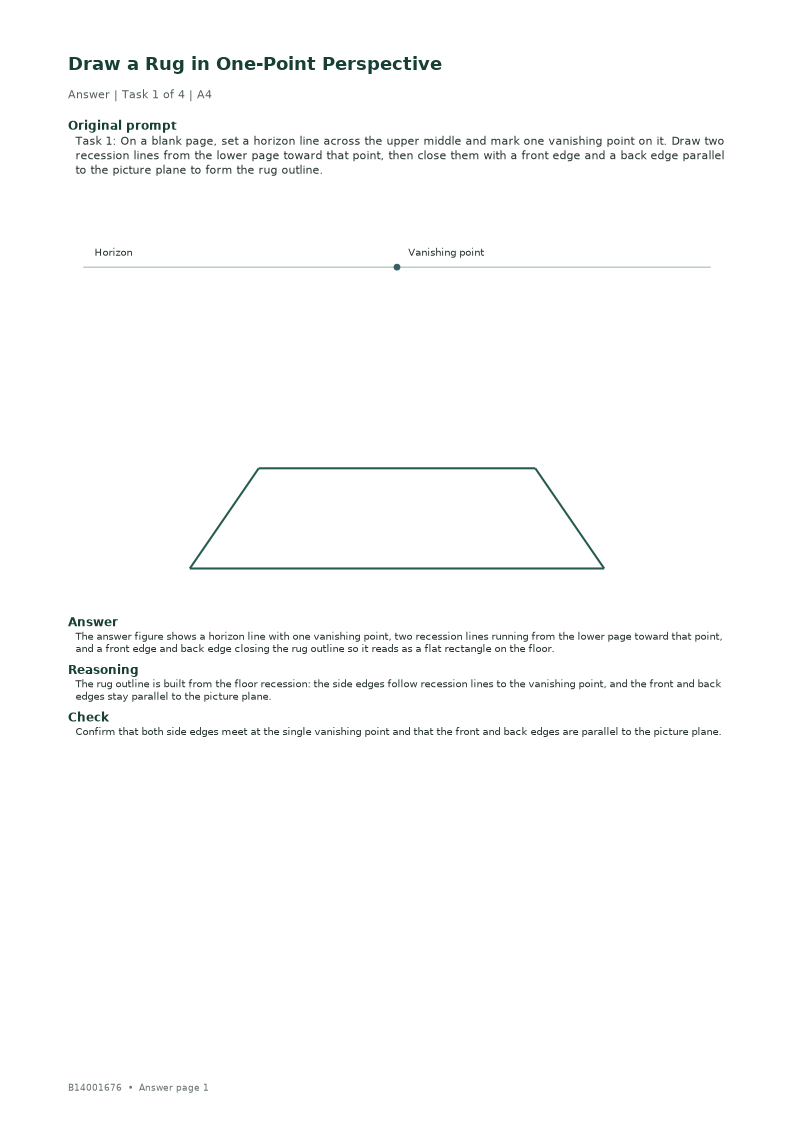
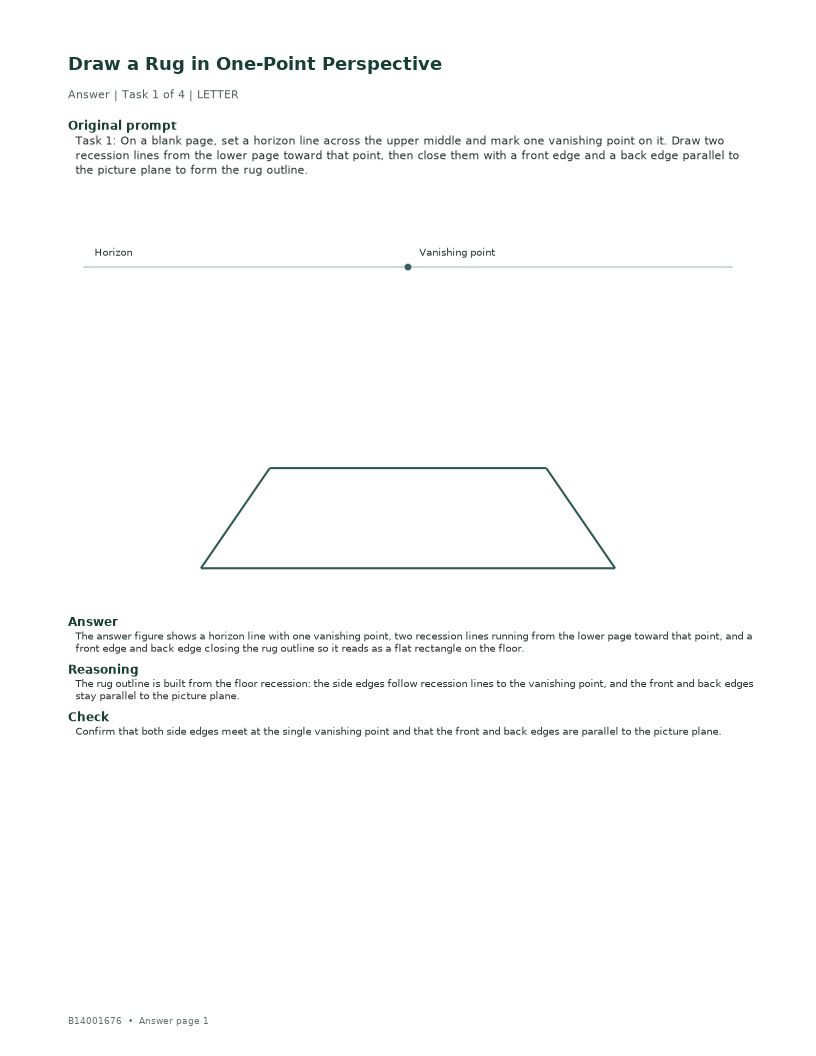
Task 1: On a blank page, set a horizon line across the upper middle and mark one vanishing point on it. Draw two recession lines from the lower page toward that point, then close them with a front edge and a back edge parallel to the picture plane to form the rug outline.
Show answer 1
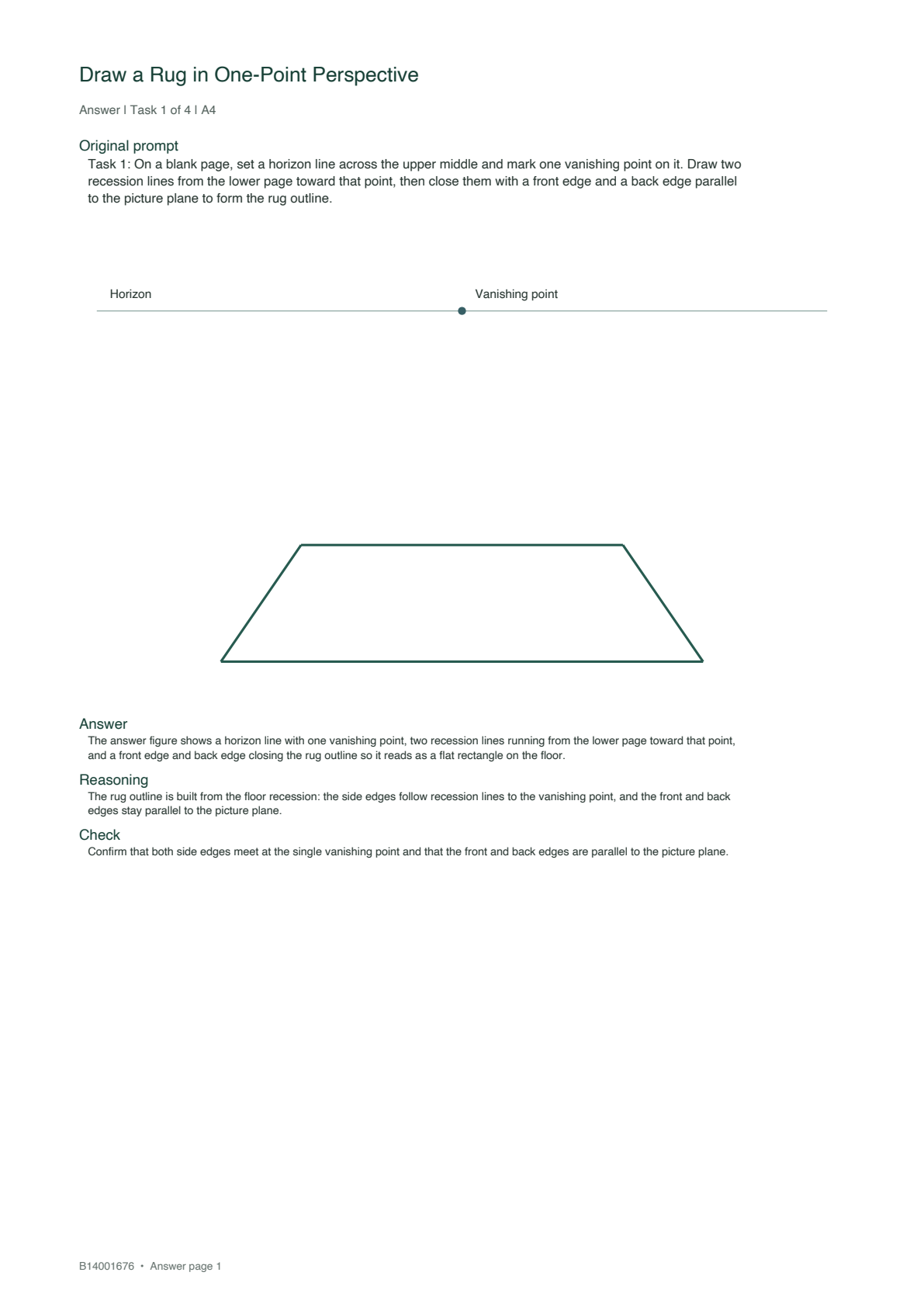
The answer figure shows a horizon line with one vanishing point, two recession lines running from the lower page toward that point, and a front edge and back edge closing the rug outline so it reads as a flat rectangle on the floor.
The rug outline is built from the floor recession: the side edges follow recession lines to the vanishing point, and the front and back edges stay parallel to the picture plane.
Check: Confirm that both side edges meet at the single vanishing point and that the front and back edges are parallel to the picture plane.
Task 2
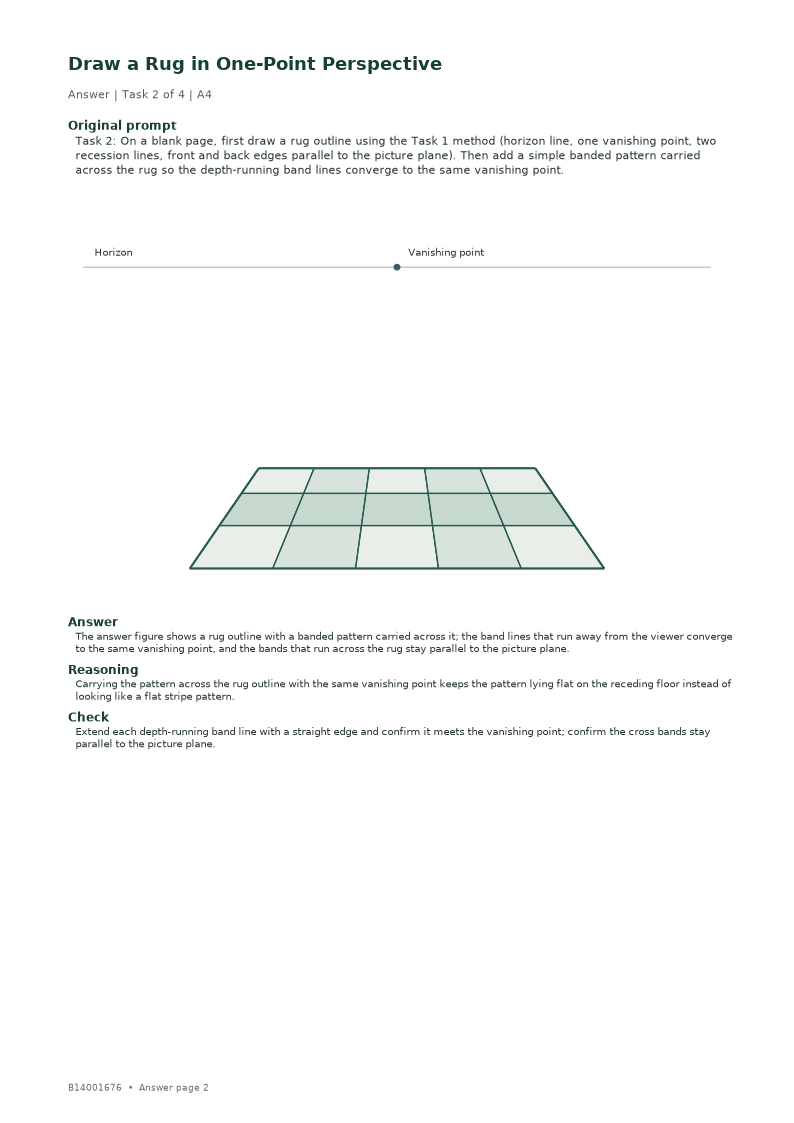
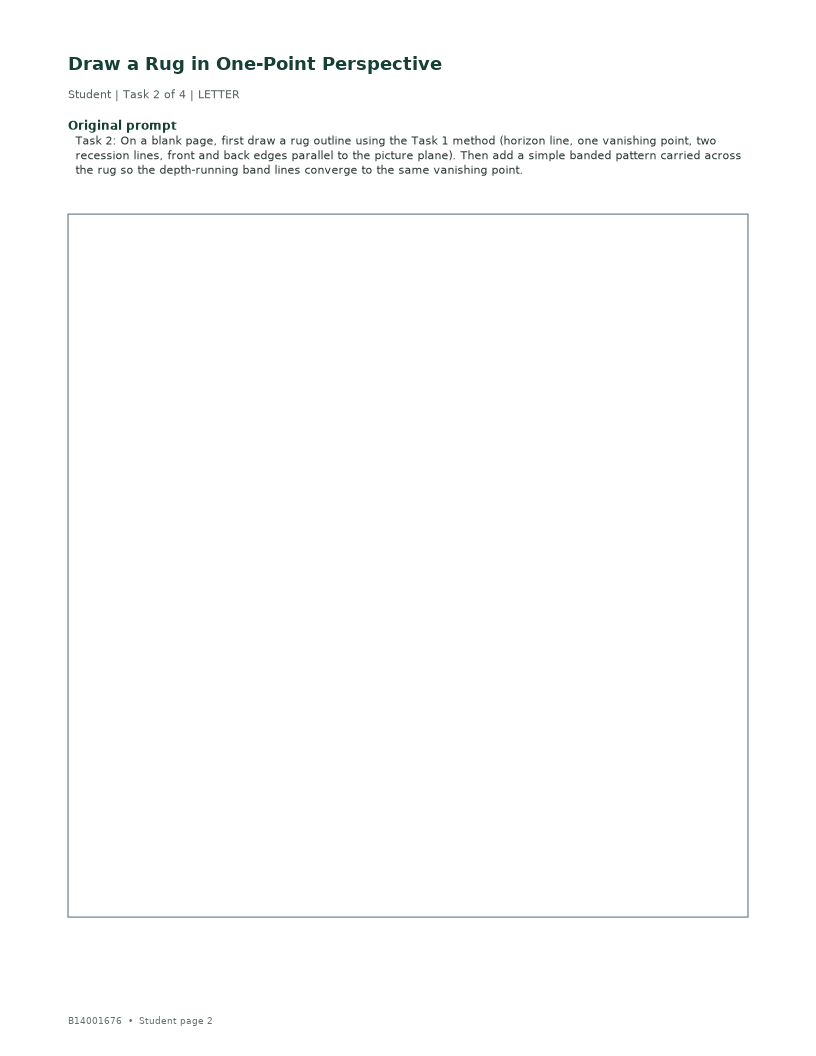
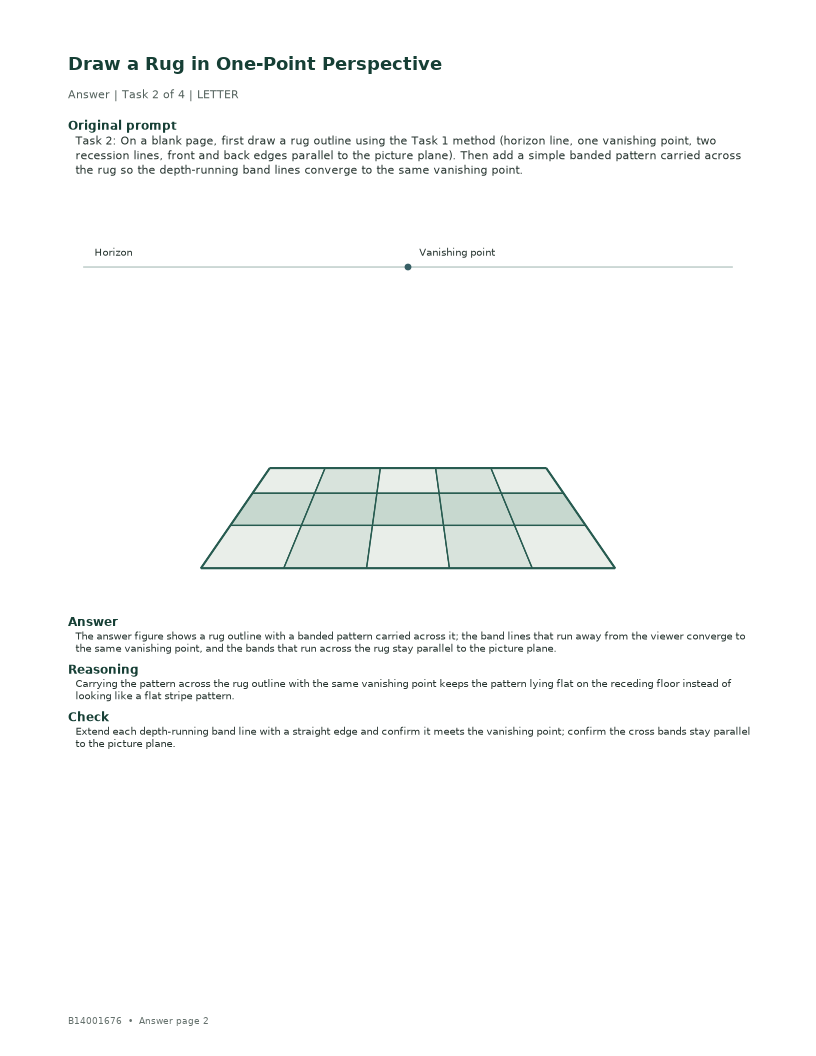
Task 2: On a blank page, first draw a rug outline using the Task 1 method (horizon line, one vanishing point, two recession lines, front and back edges parallel to the picture plane). Then add a simple banded pattern carried across the rug so the depth-running band lines converge to the same vanishing point.
Show answer 2
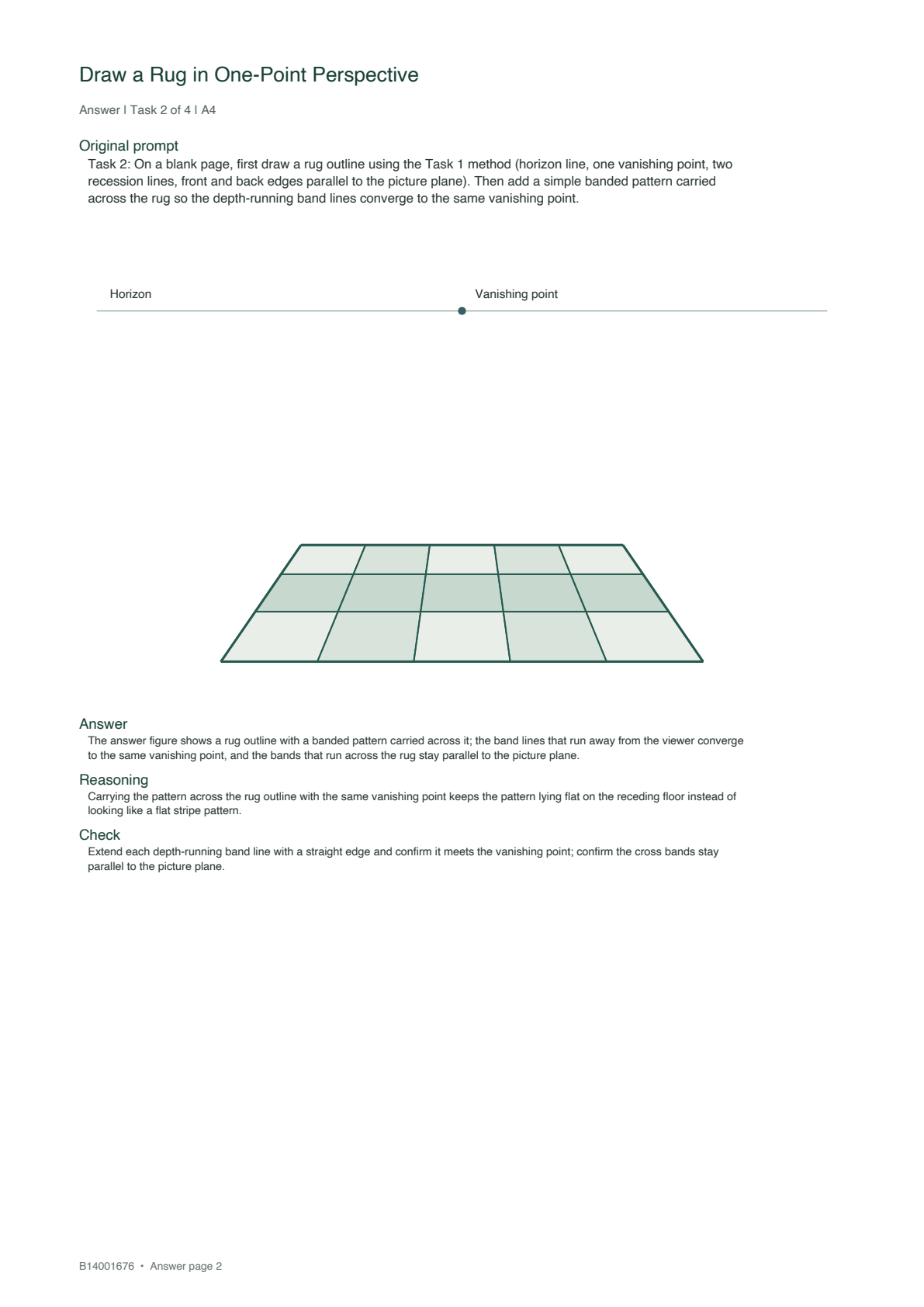
The answer figure shows a rug outline with a banded pattern carried across it; the band lines that run away from the viewer converge to the same vanishing point, and the bands that run across the rug stay parallel to the picture plane.
Carrying the pattern across the rug outline with the same vanishing point keeps the pattern lying flat on the receding floor instead of looking like a flat stripe pattern.
Check: Extend each depth-running band line with a straight edge and confirm it meets the vanishing point; confirm the cross bands stay parallel to the picture plane.
Task 3
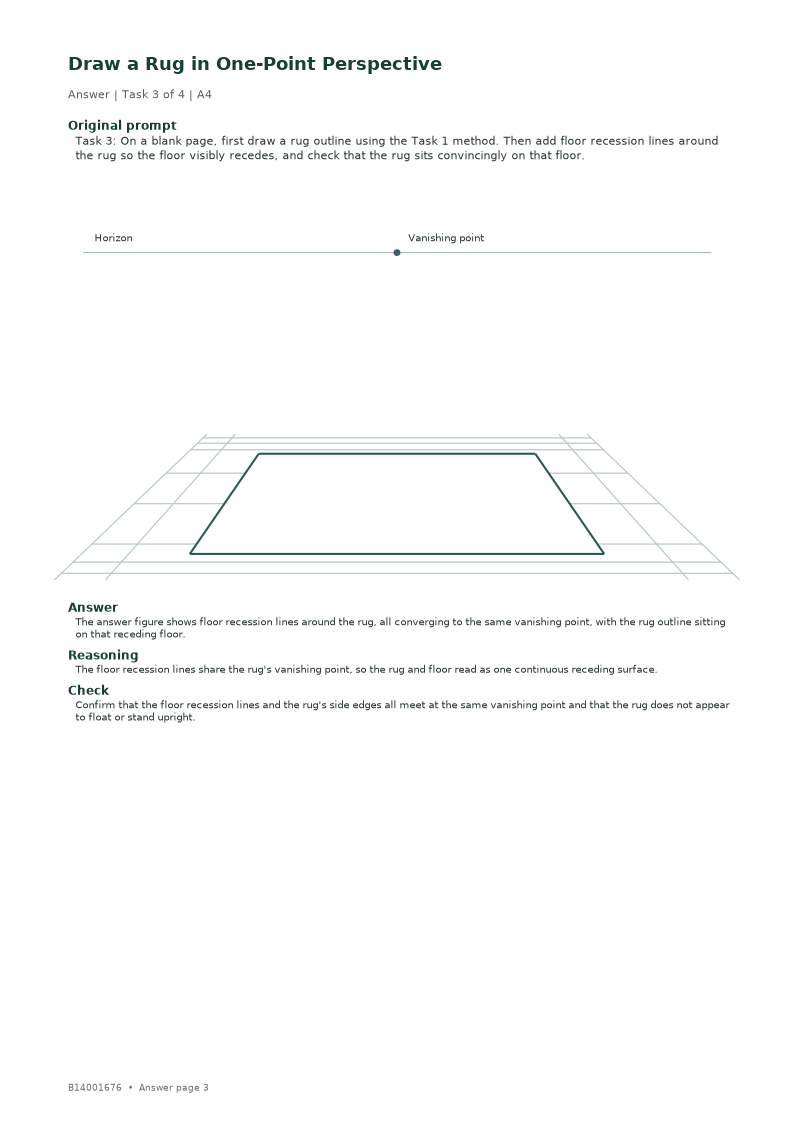
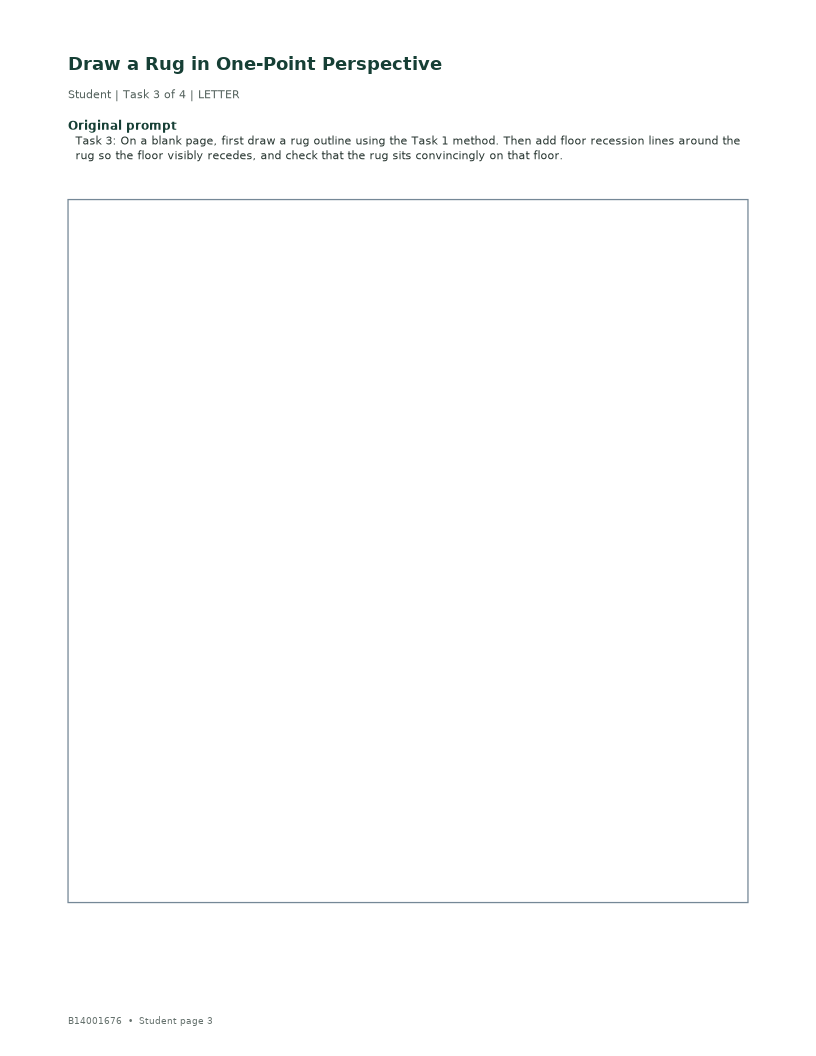
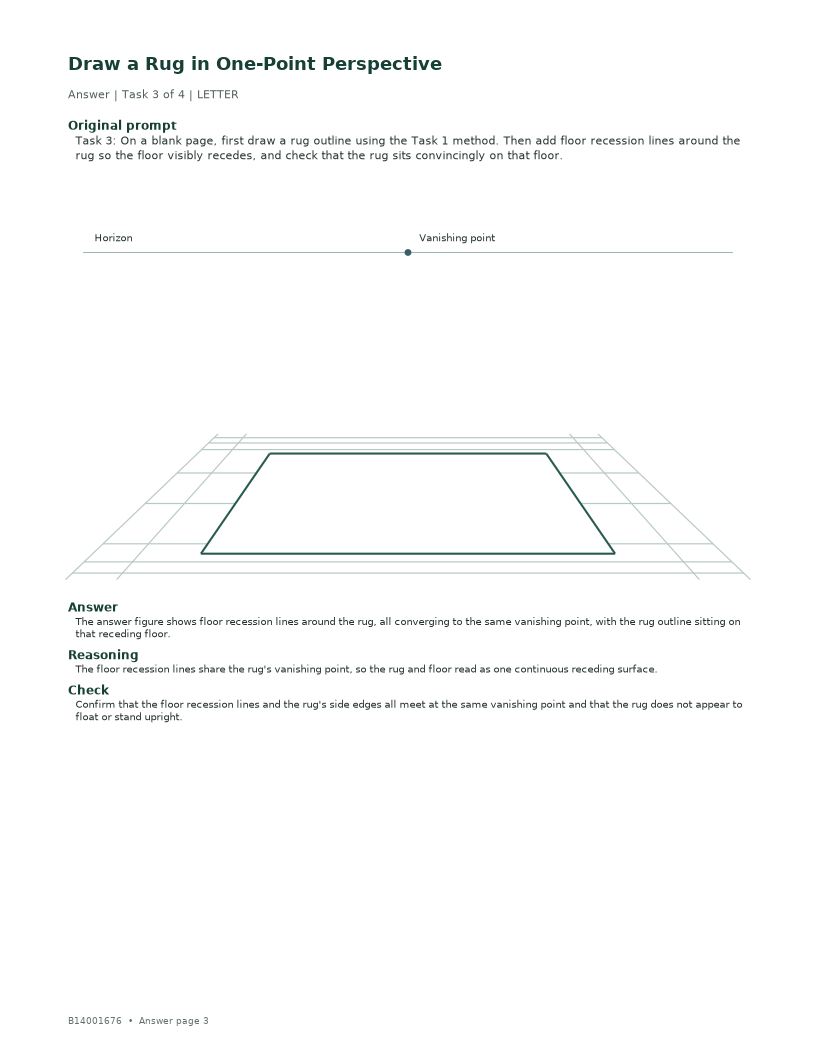
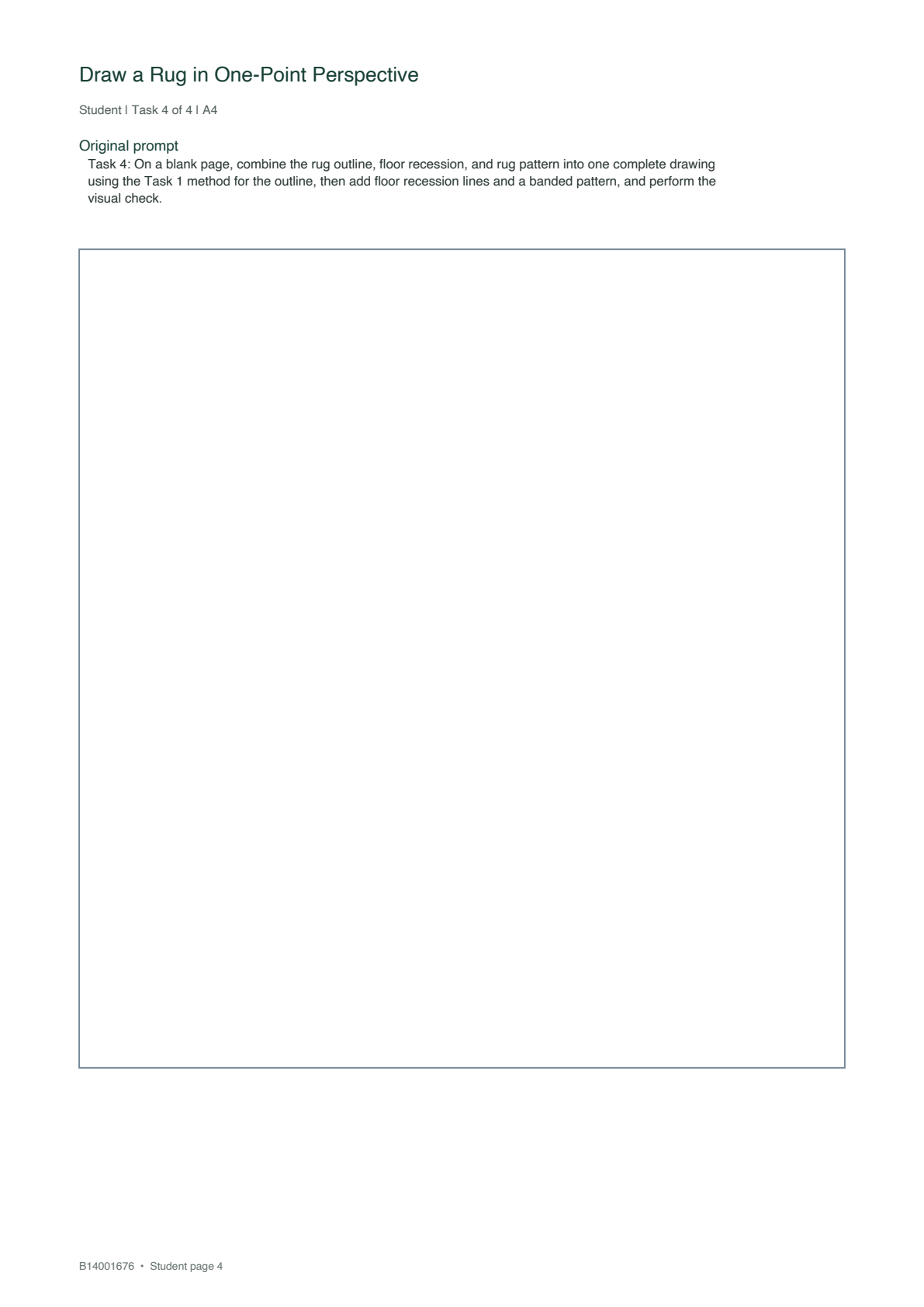
Task 3: On a blank page, first draw a rug outline using the Task 1 method. Then add floor recession lines around the rug so the floor visibly recedes, and check that the rug sits convincingly on that floor.
Show answer 3
The answer figure shows floor recession lines around the rug, all converging to the same vanishing point, with the rug outline sitting on that receding floor.
The floor recession lines share the rug's vanishing point, so the rug and floor read as one continuous receding surface.
Check: Confirm that the floor recession lines and the rug's side edges all meet at the same vanishing point and that the rug does not appear to float or stand upright.
Task 4
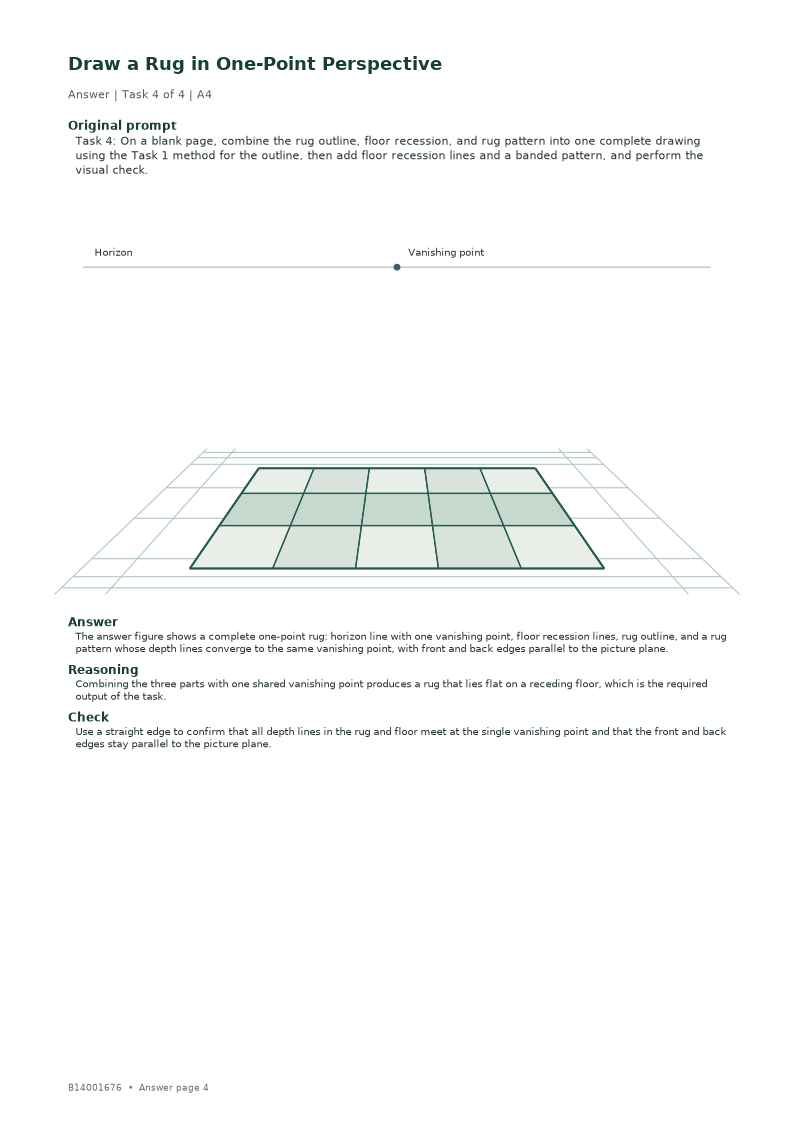
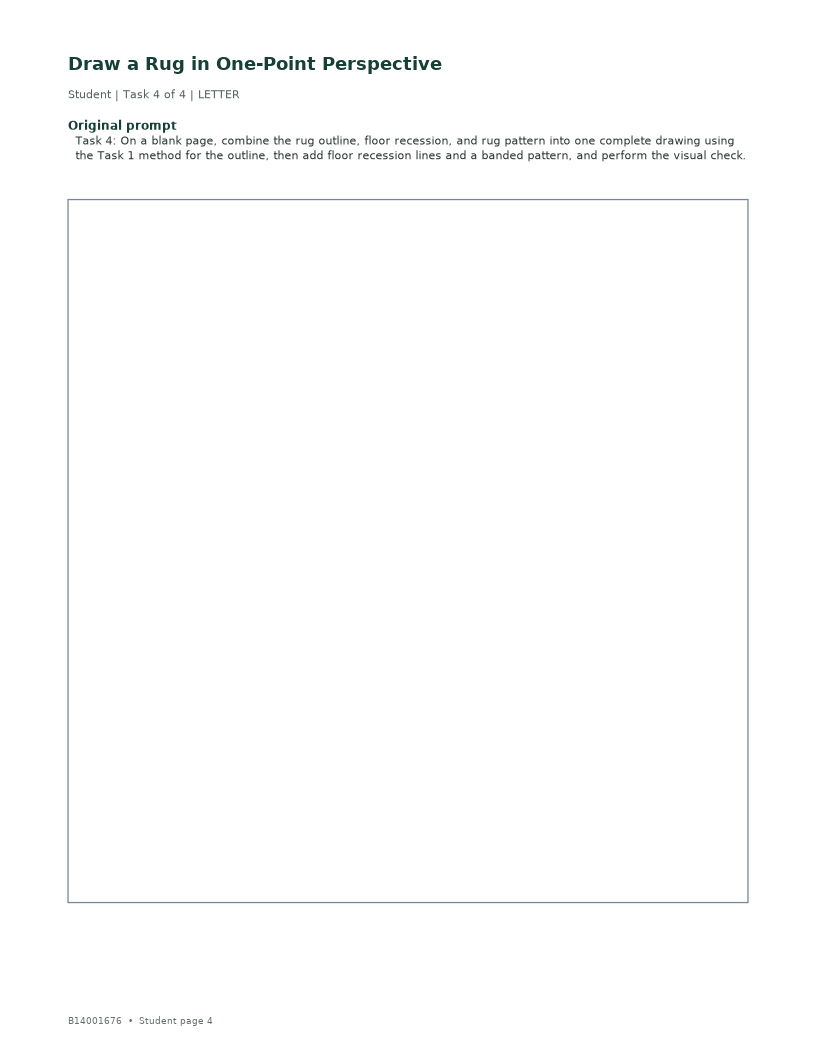
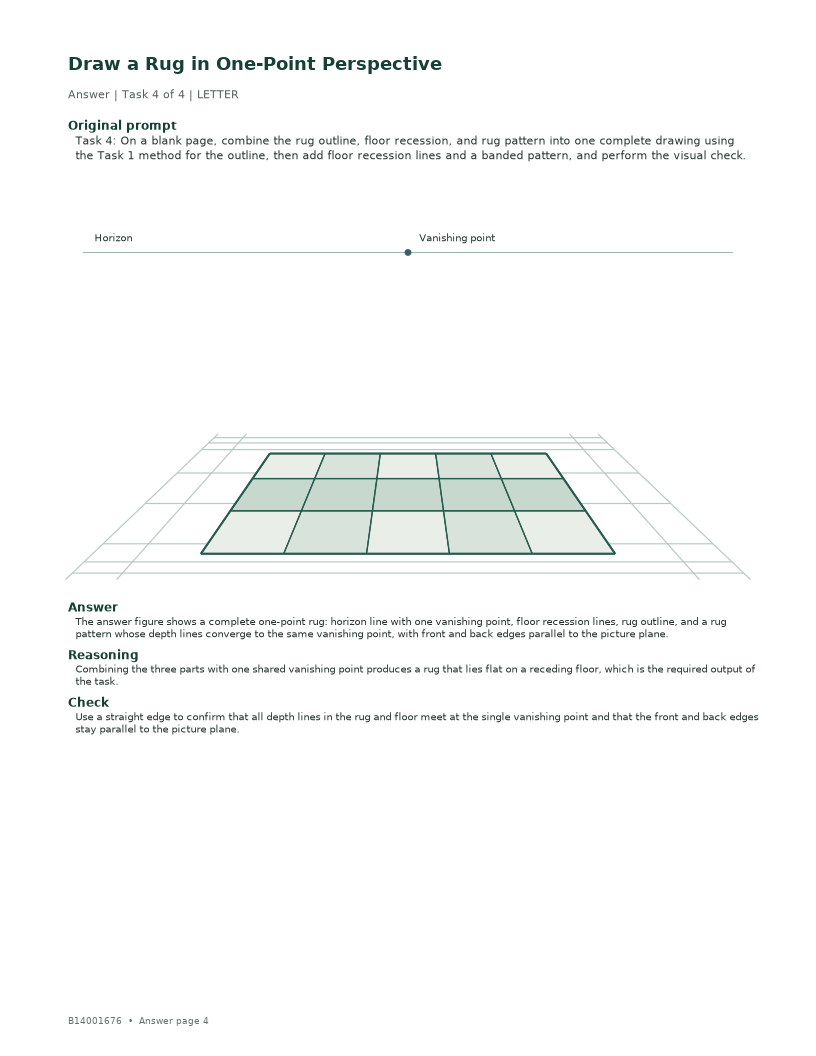
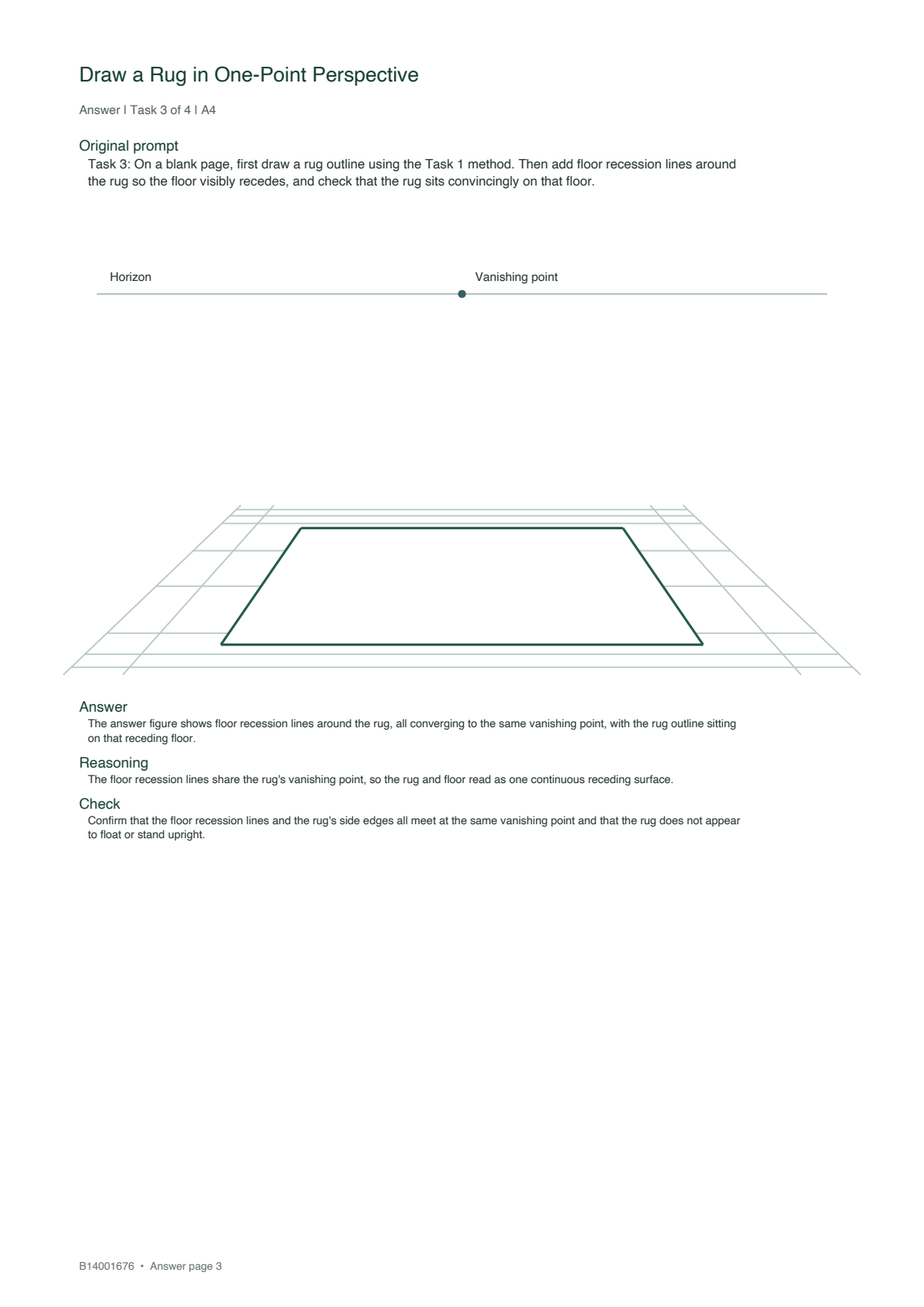
Task 4: On a blank page, combine the rug outline, floor recession, and rug pattern into one complete drawing using the Task 1 method for the outline, then add floor recession lines and a banded pattern, and perform the visual check.
Show answer 4
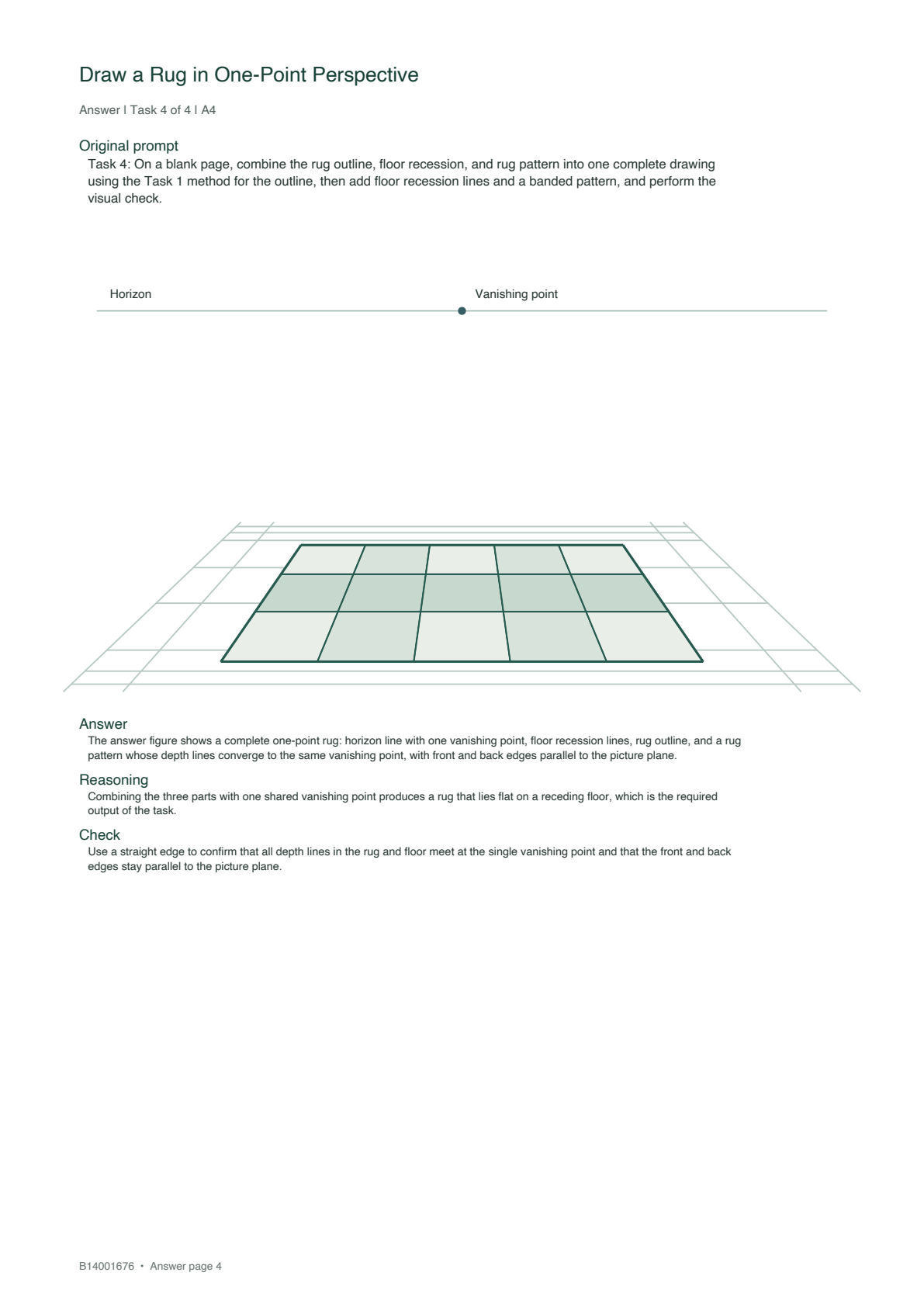
The answer figure shows a complete one-point rug: horizon line with one vanishing point, floor recession lines, rug outline, and a rug pattern whose depth lines converge to the same vanishing point, with front and back edges parallel to the picture plane.
Combining the three parts with one shared vanishing point produces a rug that lies flat on a receding floor, which is the required output of the task.
Check: Use a straight edge to confirm that all depth lines in the rug and floor meet at the single vanishing point and that the front and back edges stay parallel to the picture plane.
Useful checks
- Drawing the rug pattern as evenly spaced flat stripes. Let the depth-running pattern lines converge to the vanishing point and let the bands appear to compress toward the back of the rug.
- Letting the rug's side edges drift away from the vanishing point. Re-check that both side edges meet at the same vanishing point before adding the pattern.
- Drawing the front and back edges at an angle instead of parallel to the picture plane. Keep the front and back edges parallel to the picture plane so the rug reads as a flat rectangle on the floor.
Questions about this resource
Why does the rug pattern need to follow the vanishing point?
Because the rug lies flat on a receding floor; if the pattern's depth lines do not converge to the same vanishing point, the rug looks upright or pasted on rather than lying on the floor.
What is the difference between the floor recession and the rug outline?
The floor recession is the set of lines showing the floor receding to the vanishing point; the rug outline is the flat rectangle on that floor, built from two recession lines closed by a front edge and a back edge parallel to the picture plane.