Free original lessons
Draw a Gingerbread House in Two-Point Perspective
Two-point perspective shows a box-like house with one vertical corner facing you and two receding wall faces. Both wall directions converge to separate vanishing points on a horizon line, while all vertical edges stay vertical. This pack teaches that construction on a gingerbread house, then adds candy detail on the walls.
Letter & A4
PDF & SVG
Set the stage: horizon and two vanishing points
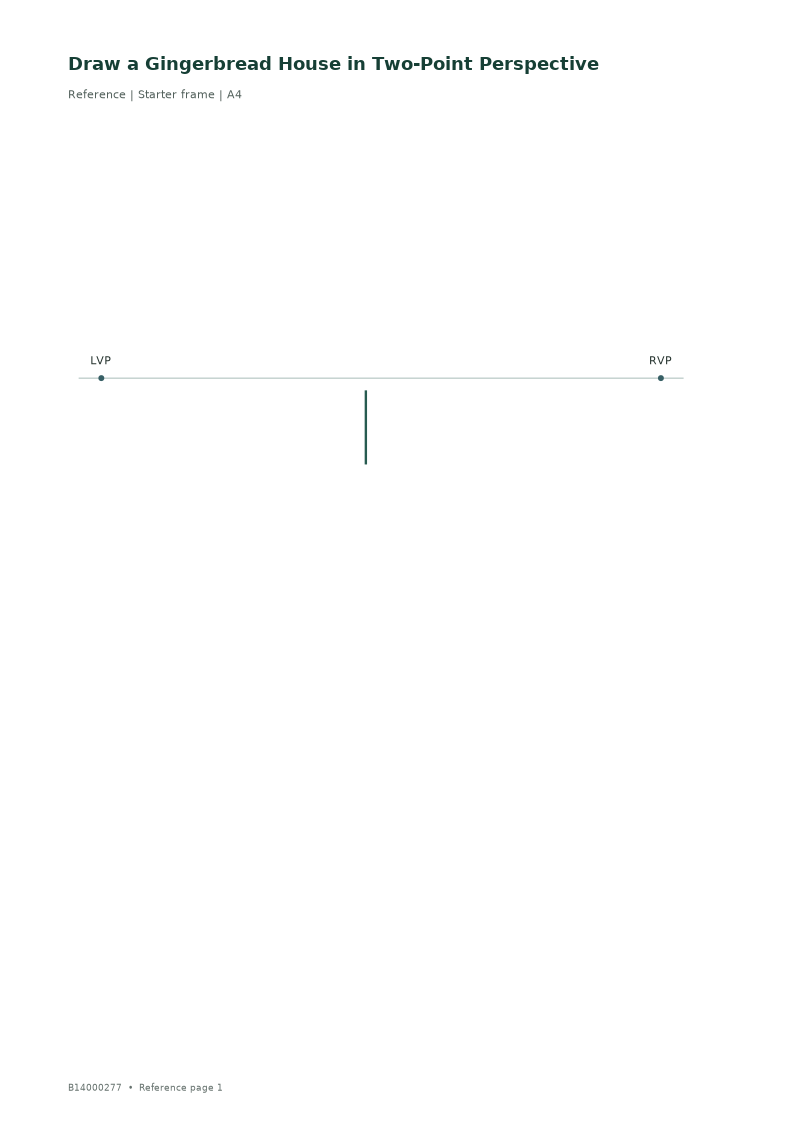
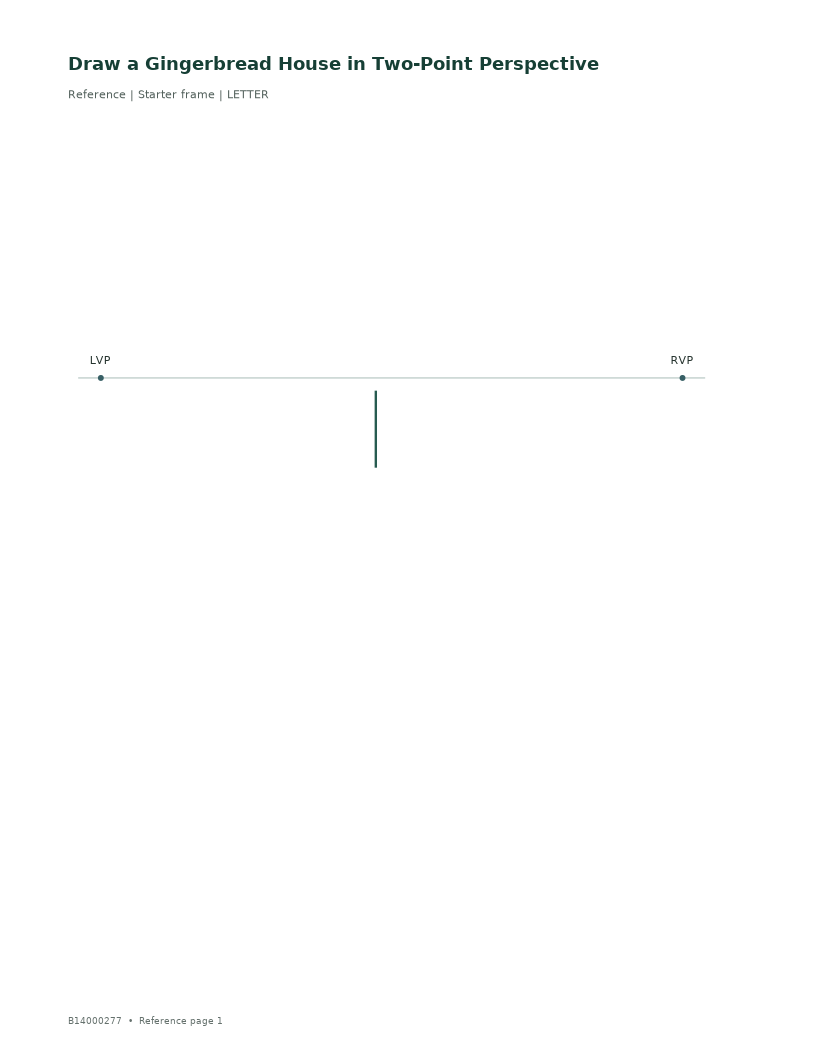
Draw a horizontal horizon line across the page. Mark a left vanishing point (LVP) near the left edge and a right vanishing point (RVP) near the right edge, both on the horizon. These are your choices of placement, not fixed standards.
Place the house so its nearest vertical corner sits between the two vanishing points, usually below the horizon. From that corner, the left wall face recedes toward the LVP and the right wall face recedes toward the RVP.
Build the walls from converging lines
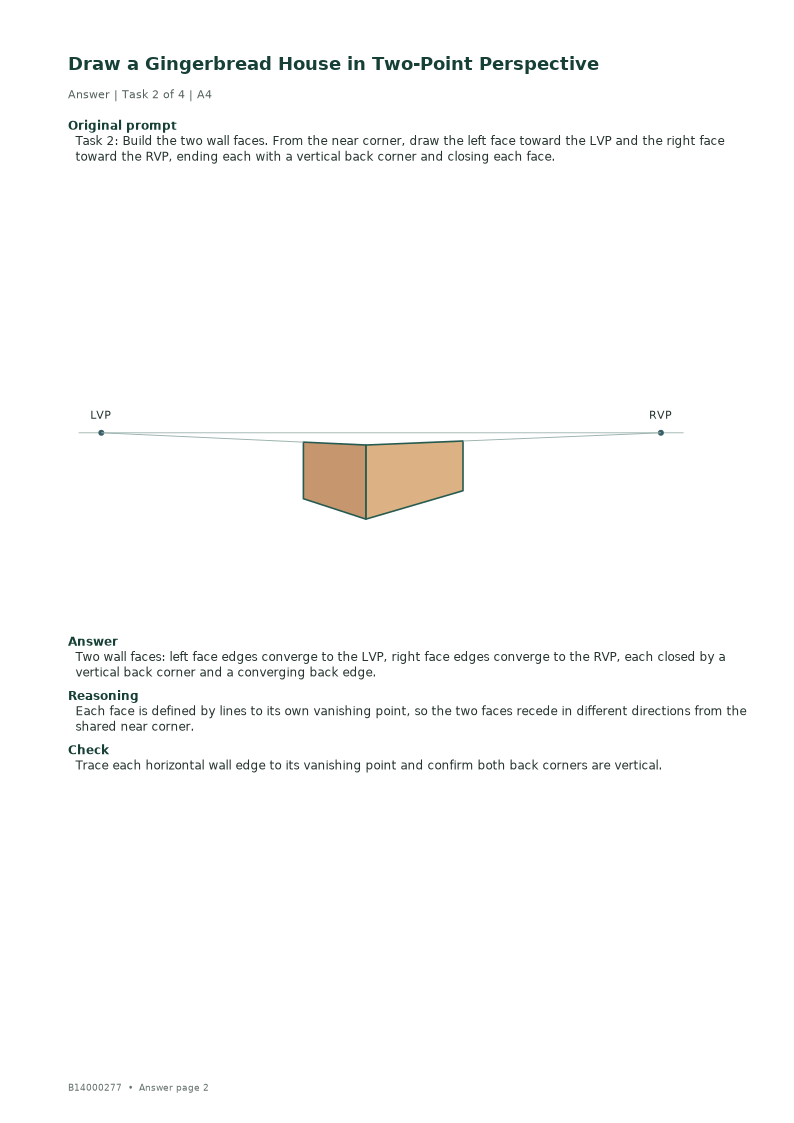
Draw the near vertical corner first. From its top and bottom, draw lines angling toward the LVP for the left face and toward the RVP for the right face. Choose where each wall ends and mark a vertical back corner there.
Connect the back corners with lines that also converge to the correct vanishing point, closing each wall face. Every vertical edge stays vertical; only the horizontal wall edges tilt toward a vanishing point.
Add the roof and candy walls
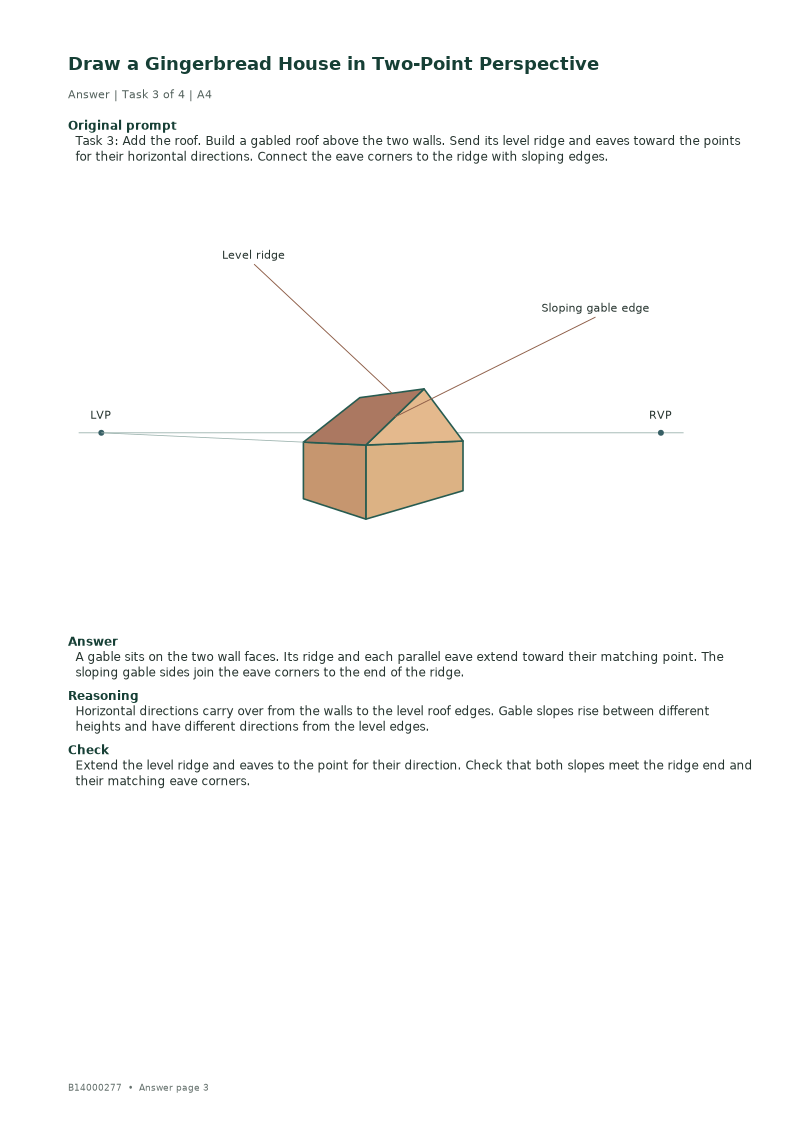
Raise a level ridge over the wall footprint. Its long direction and each parallel eave share a horizontal vanishing point. Join the gable end's eave corners to the ridge end with two sloping edges. Their directions are different from the horizontal guides.
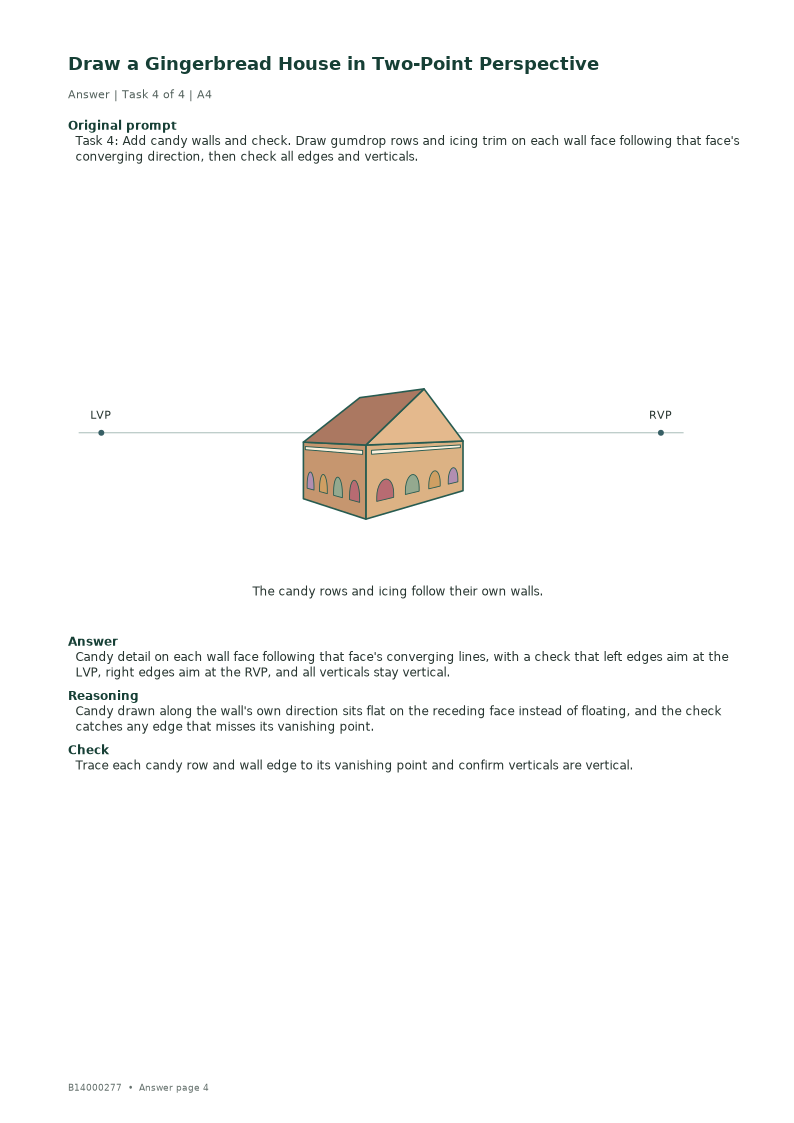
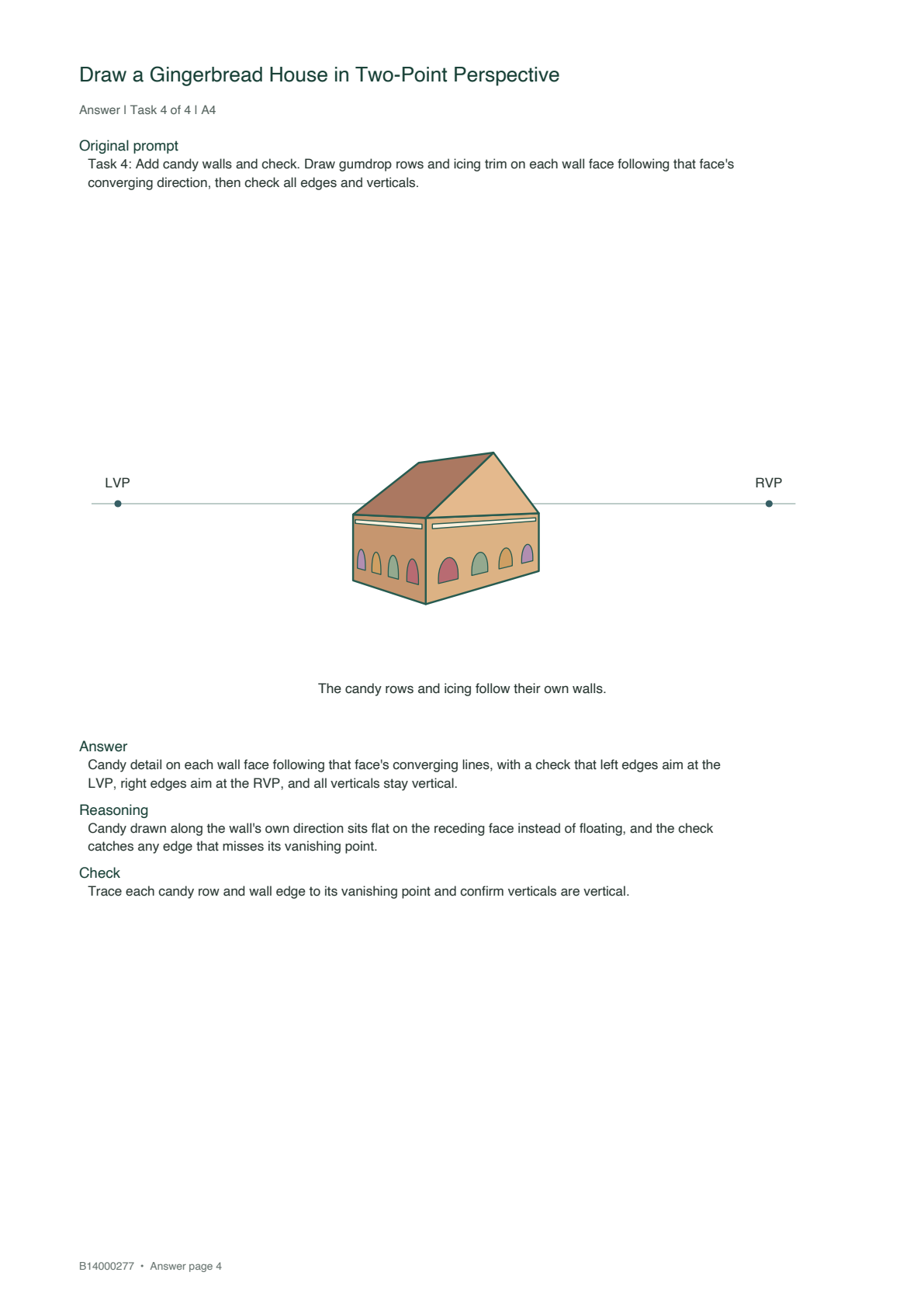
Add gumdrops and icing trim inside the wall faces. Place each row of candy bases and each level ribbon on a line converging to that wall's point. Shapes can have curved tops and upright details.
Check the construction
Check that every left-face horizontal edge points to the LVP and every right-face horizontal edge points to the RVP. Check that all vertical edges are truly vertical. Check that candy detail follows the same directions as the wall it sits on.
Download the complete resource pack
All individual SVG pages (20)
- A4 reference page 1
- A4 reference page 2
- A4 student page 1
- A4 student page 2
- A4 student page 3
- A4 student page 4
- A4 answer page 1
- A4 answer page 2
- A4 answer page 3
- A4 answer page 4
- LETTER reference page 1
- LETTER reference page 2
- LETTER student page 1
- LETTER student page 2
- LETTER student page 3
- LETTER student page 4
- LETTER answer page 1
- LETTER answer page 2
- LETTER answer page 3
- LETTER answer page 4
Print at 100% / actual size. Use the stated scale on any schematic diagram; physical cutting templates are identified separately. A4 and US Letter are separate files. Free access, no signup; CC BY 4.0.
How to use these pages
- Set the stage: horizon and two vanishing points
- Build the walls from converging lines
- Add the roof and candy walls
- Check the construction
Worked example
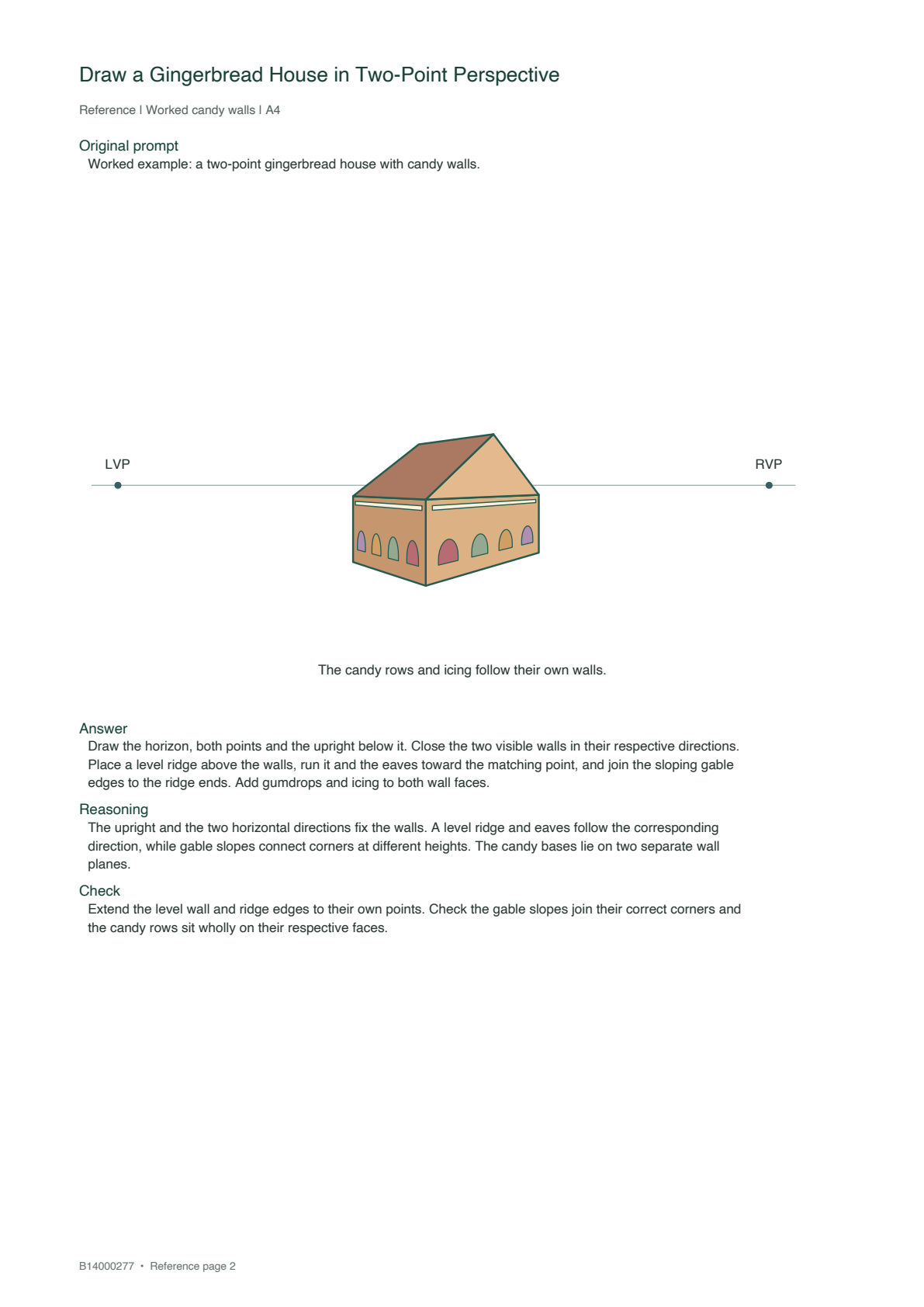
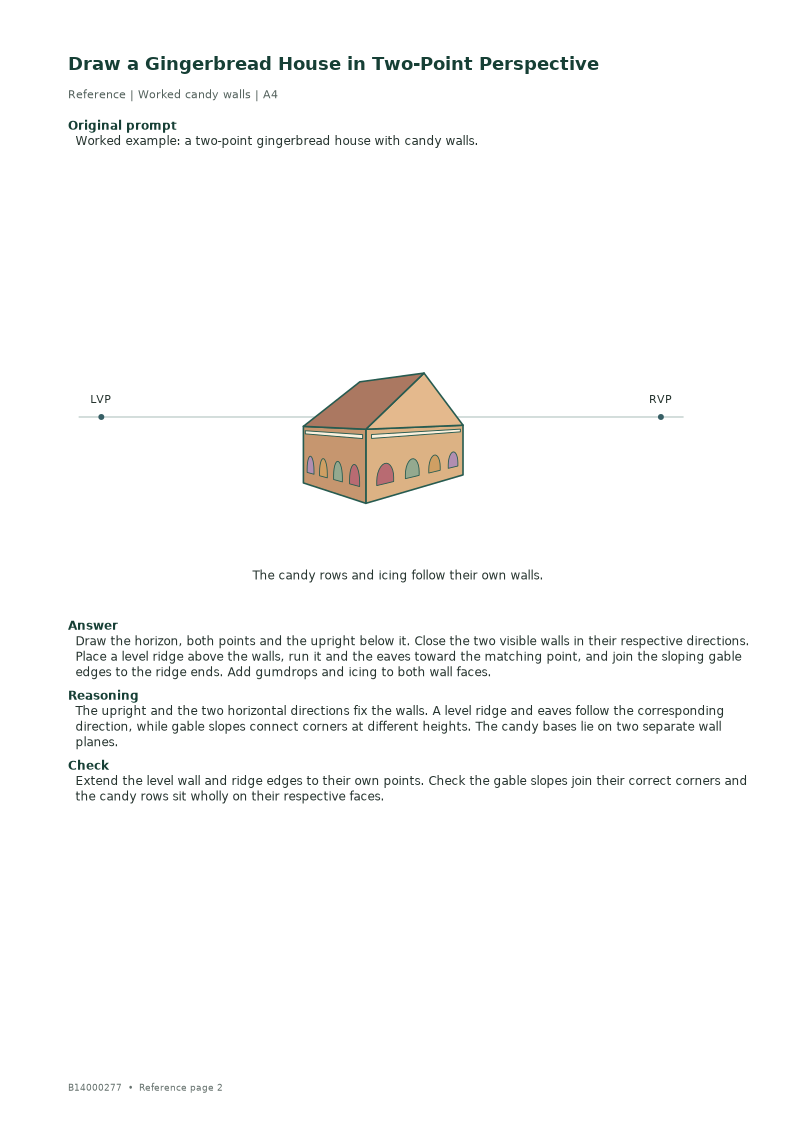
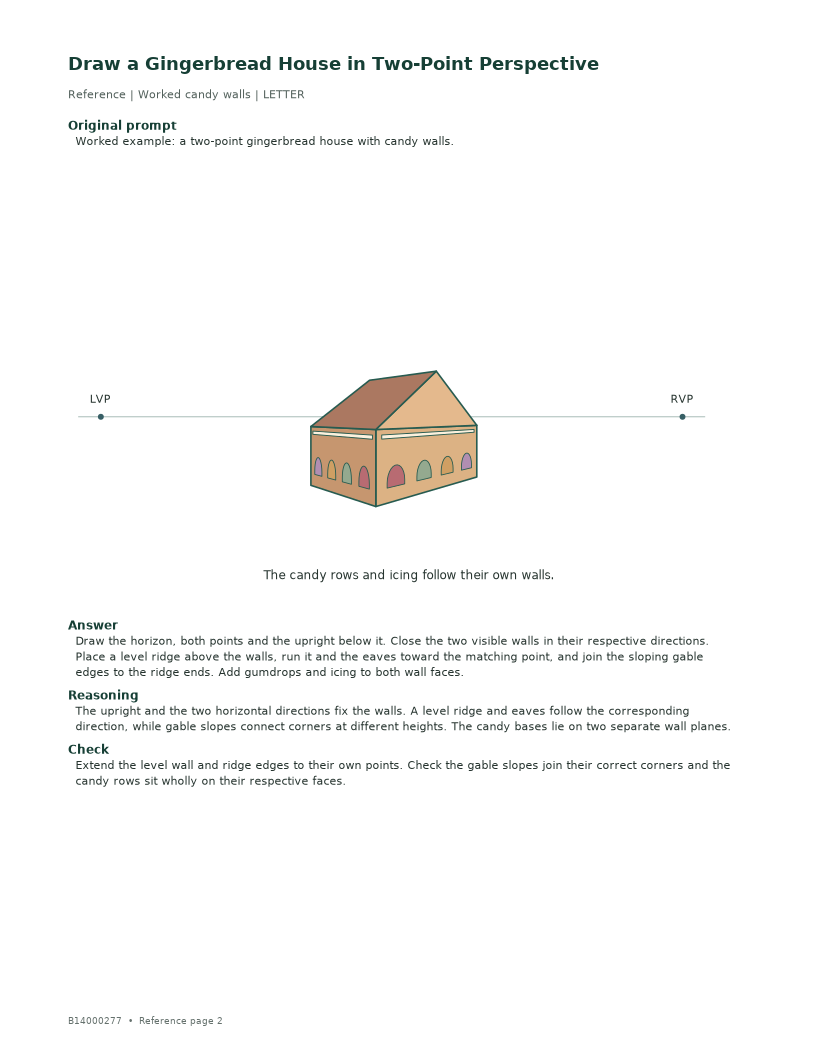
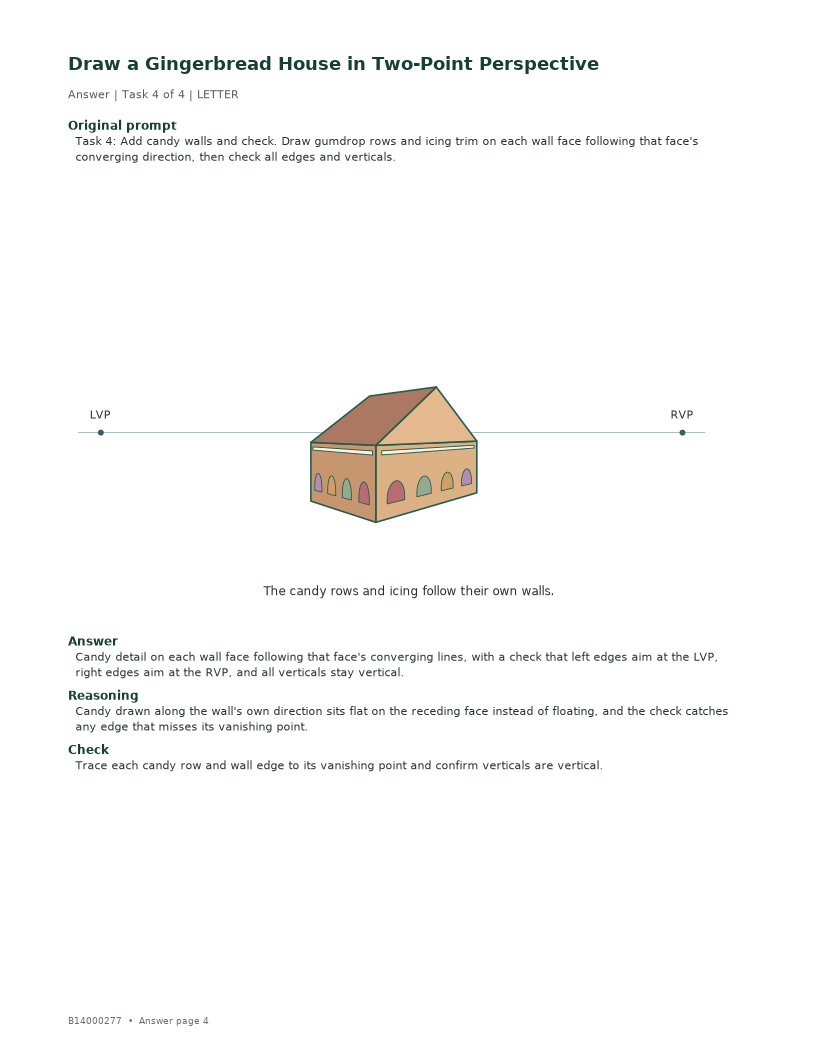
Example: Worked example: a two-point gingerbread house with candy walls.
Answer: Draw the horizon, both points and the upright below it. Close the two visible walls in their respective directions. Place a level ridge above the walls, run it and the eaves toward the matching point, and join the sloping gable edges to the ridge ends. Add gumdrops and icing to both wall faces.
Reasoning: The upright and the two horizontal directions fix the walls. A level ridge and eaves follow the corresponding direction, while gable slopes connect corners at different heights. The candy bases lie on two separate wall planes.
Check: Extend the level wall and ridge edges to their own points. Check the gable slopes join their correct corners and the candy rows sit wholly on their respective faces.
Four practice tasks and complete answers
Task 1
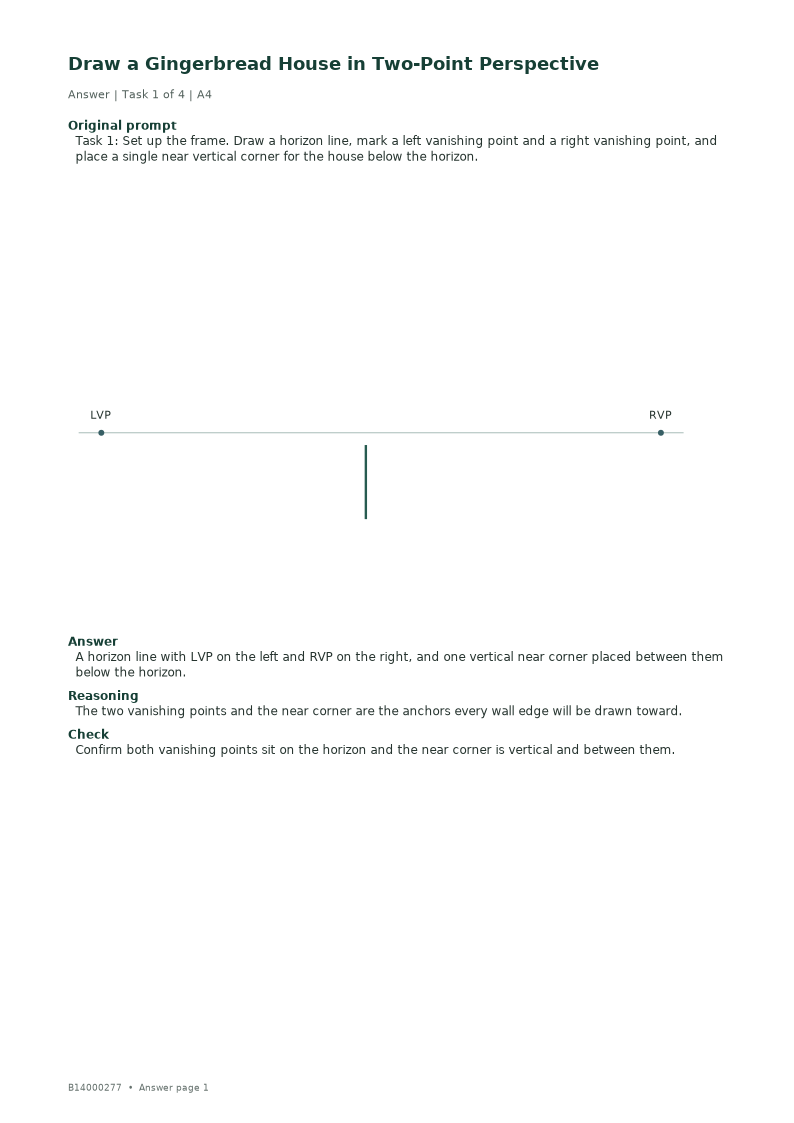
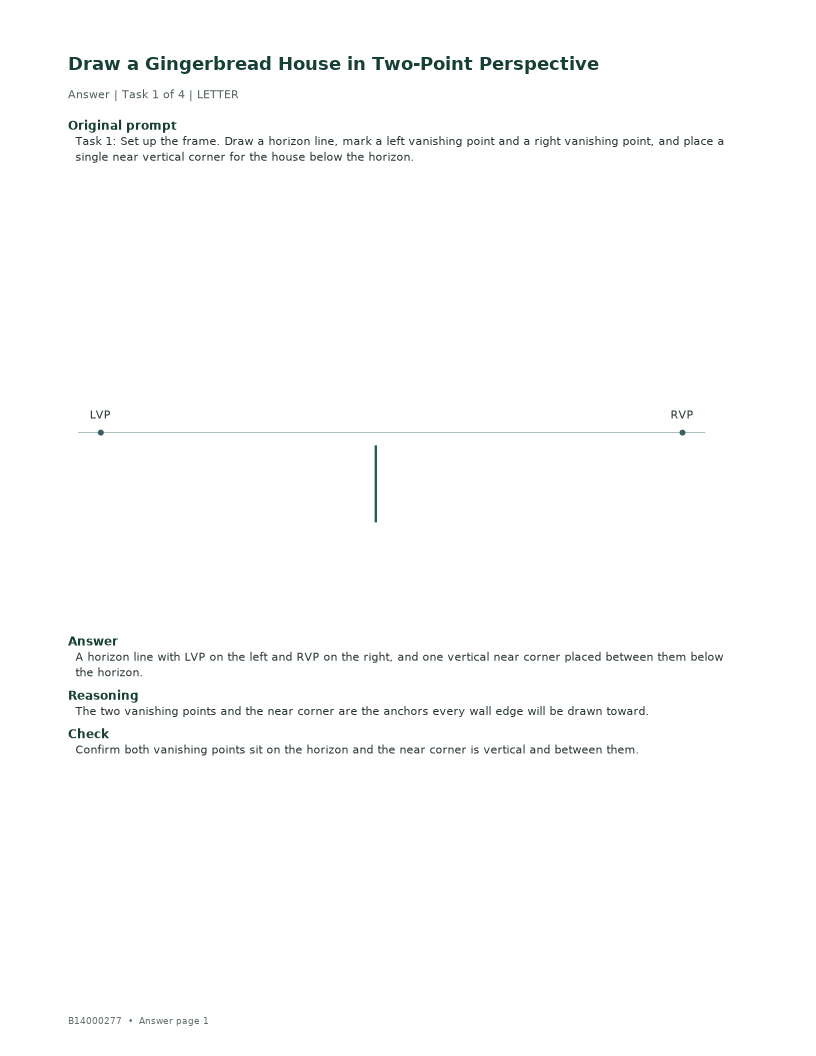
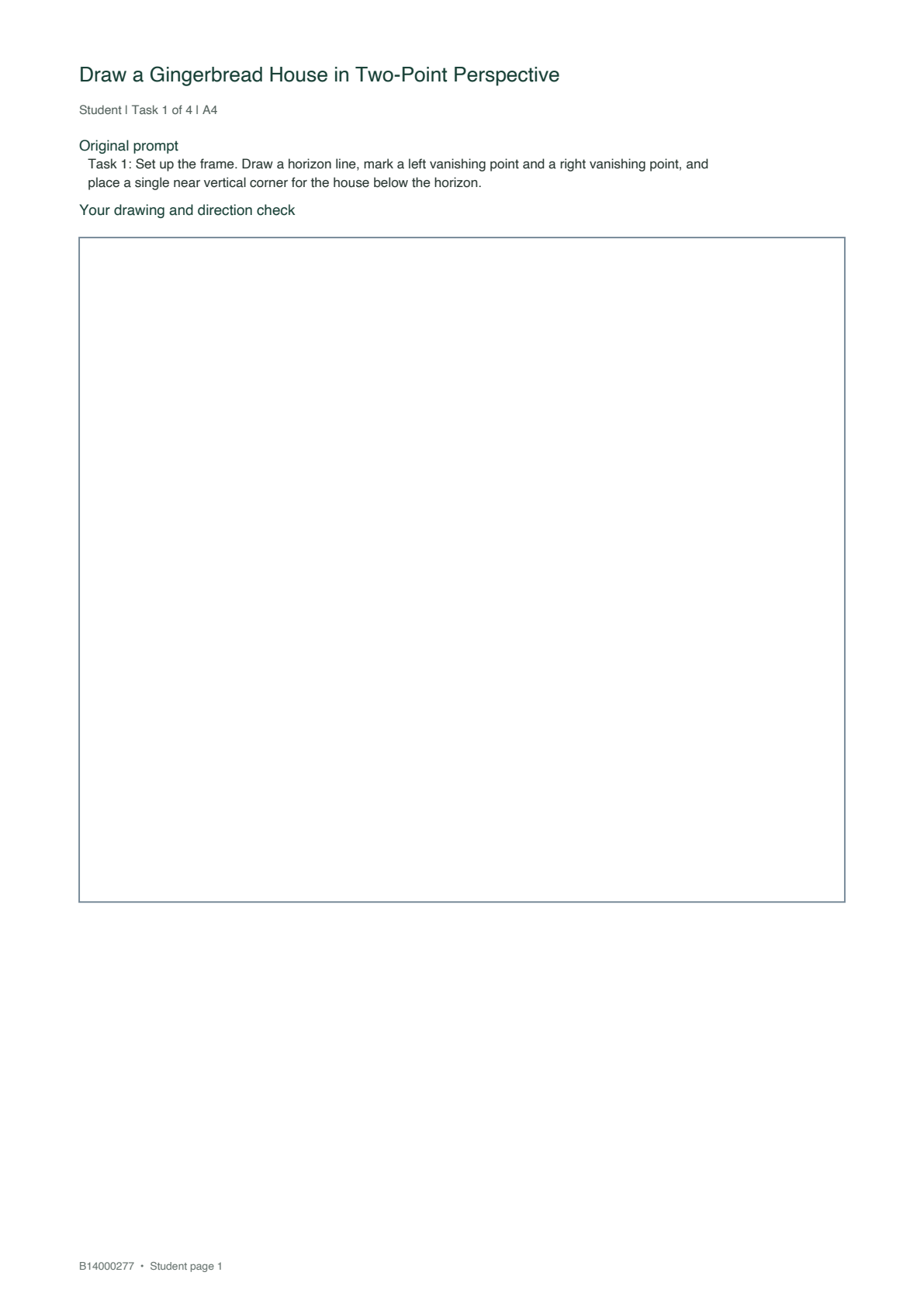
Task 1: Set up the frame. Draw a horizon line, mark a left vanishing point and a right vanishing point, and place a single near vertical corner for the house below the horizon.
Show answer 1
A horizon line with LVP on the left and RVP on the right, and one vertical near corner placed between them below the horizon.
The two vanishing points and the near corner are the anchors every wall edge will be drawn toward.
Check: Confirm both vanishing points sit on the horizon and the near corner is vertical and between them.
Task 2
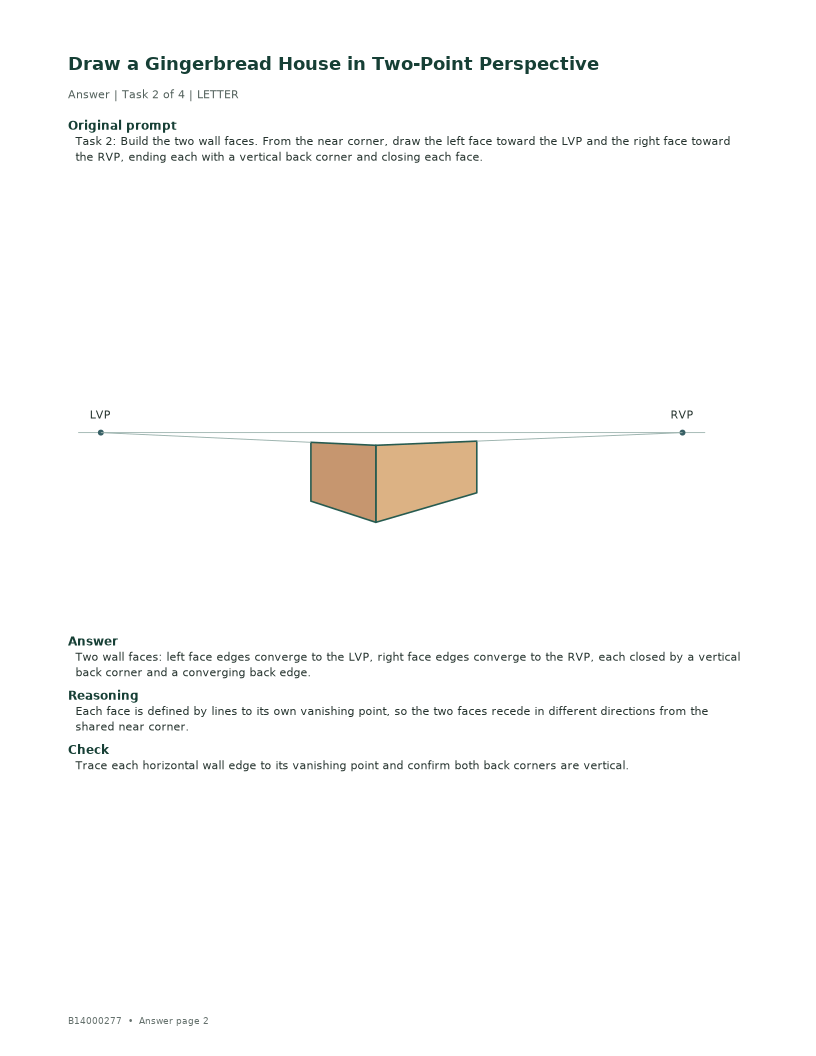
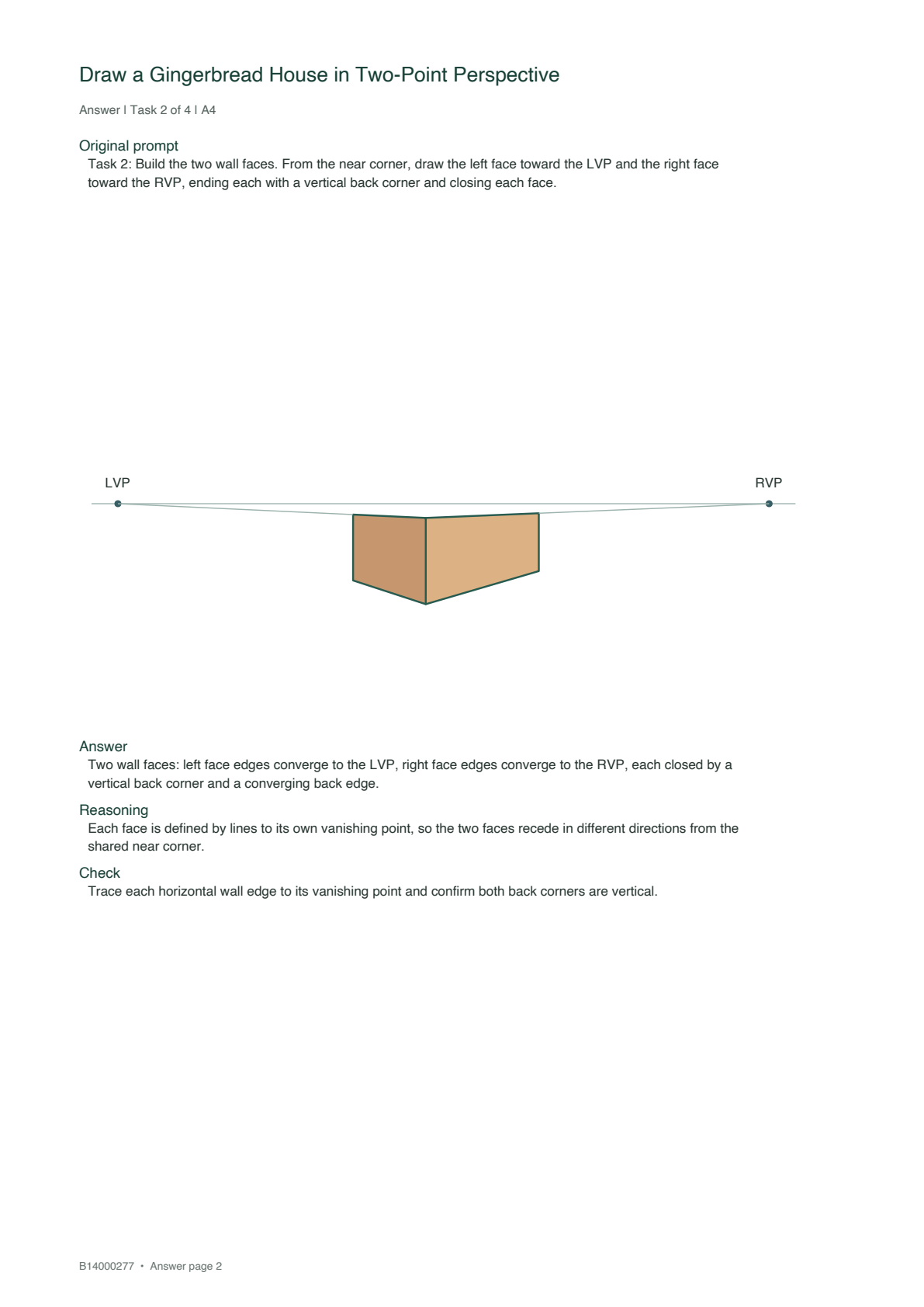
Task 2: Build the two wall faces. From the near corner, draw the left face toward the LVP and the right face toward the RVP, ending each with a vertical back corner and closing each face.
Show answer 2
Two wall faces: left face edges converge to the LVP, right face edges converge to the RVP, each closed by a vertical back corner and a converging back edge.
Each face is defined by lines to its own vanishing point, so the two faces recede in different directions from the shared near corner.
Check: Trace each horizontal wall edge to its vanishing point and confirm both back corners are vertical.
Task 3
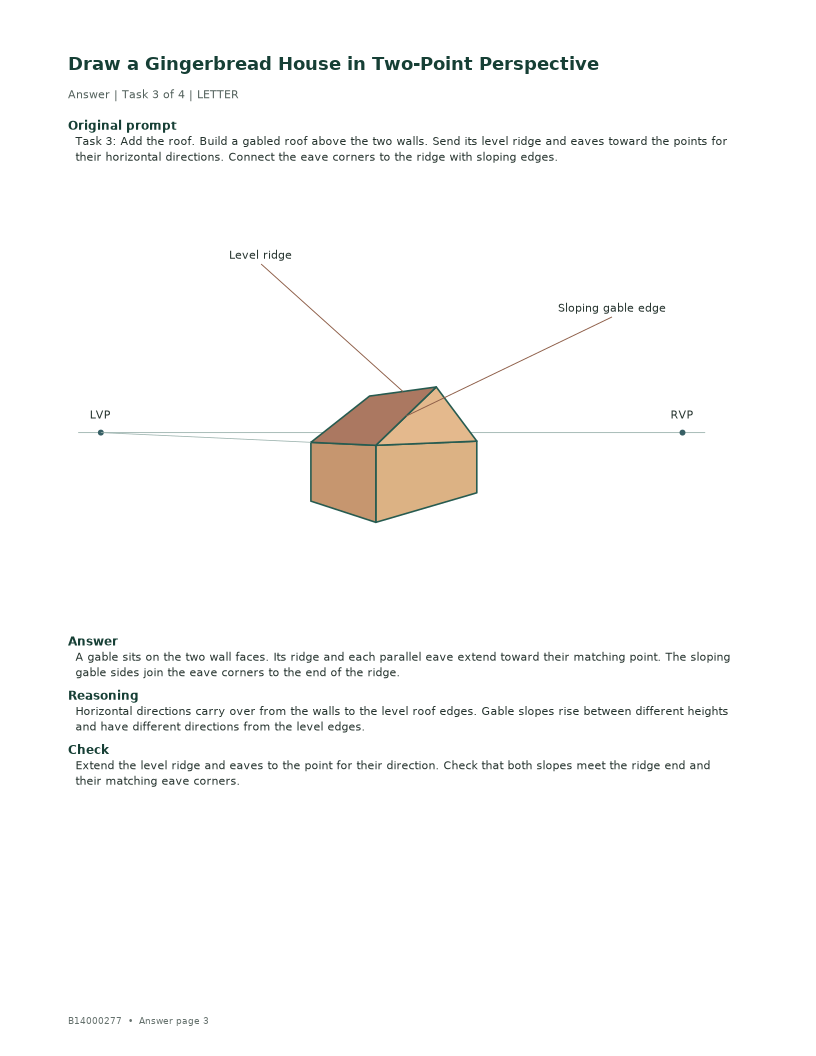
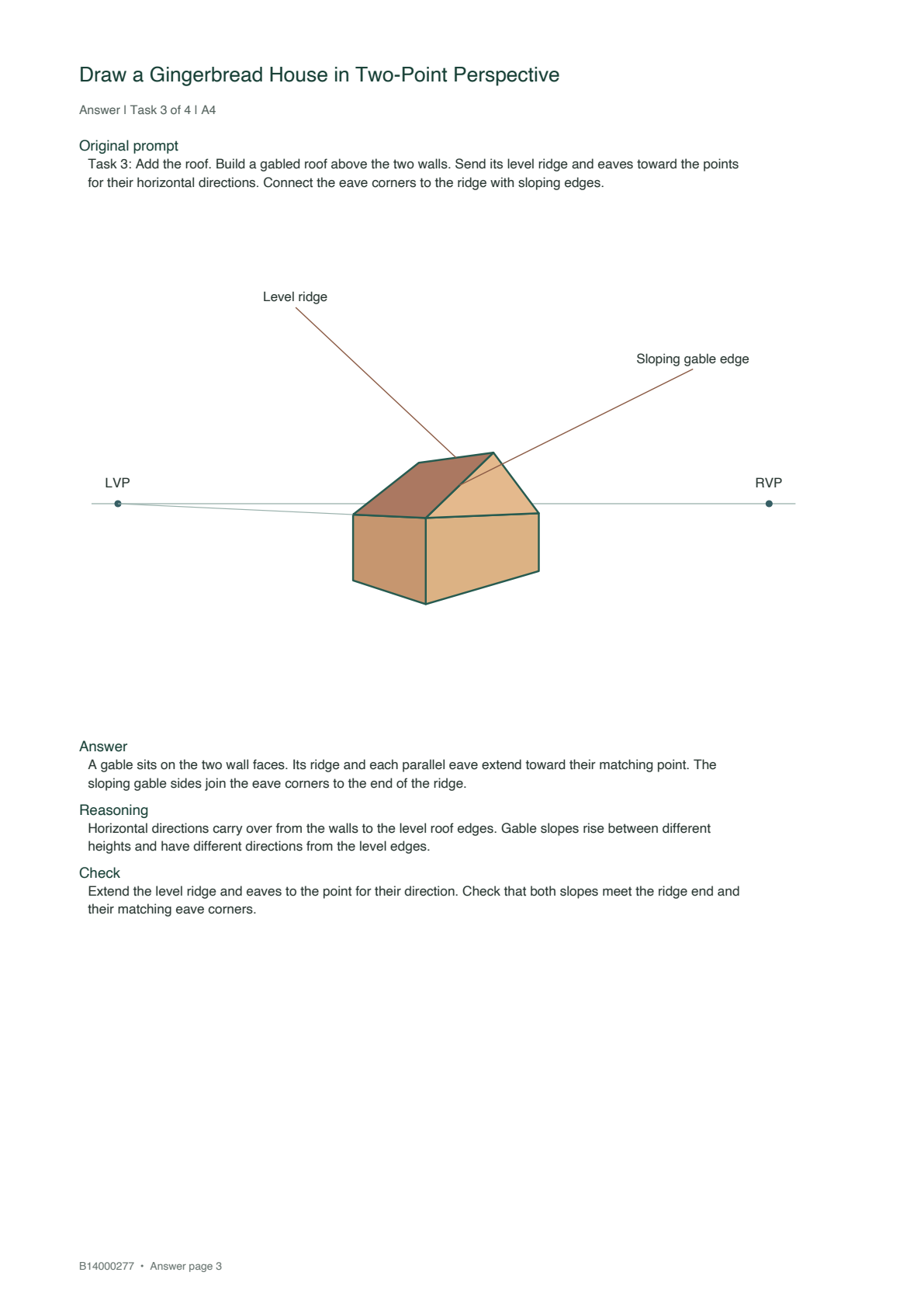
Task 3: Add the roof. Build a gabled roof above the two walls. Send its level ridge and eaves toward the points for their horizontal directions. Connect the eave corners to the ridge with sloping edges.
Show answer 3
A gable sits on the two wall faces. Its ridge and each parallel eave extend toward their matching point. The sloping gable sides join the eave corners to the end of the ridge.
Horizontal directions carry over from the walls to the level roof edges. Gable slopes rise between different heights and have different directions from the level edges.
Check: Extend the level ridge and eaves to the point for their direction. Check that both slopes meet the ridge end and their matching eave corners.
Task 4
Task 4: Add candy walls and check. Draw gumdrop rows and icing trim on each wall face following that face's converging direction, then check all edges and verticals.
Show answer 4
Candy detail on each wall face following that face's converging lines, with a check that left edges aim at the LVP, right edges aim at the RVP, and all verticals stay vertical.
Candy drawn along the wall's own direction sits flat on the receding face instead of floating, and the check catches any edge that misses its vanishing point.
Check: Trace each candy row and wall edge to its vanishing point and confirm verticals are vertical.
Useful checks
- Sending both wall faces to the same vanishing point. Left face edges go to the LVP and right face edges go to the RVP; each face has its own vanishing point.
- Tilting vertical edges. In two-point perspective all vertical edges stay vertical; only horizontal wall edges tilt toward a vanishing point.
- Drawing candy detail in a flat grid that ignores the wall direction. Make candy rows follow the converging direction of the wall face they sit on.
Questions about this resource
Where should the vanishing points go?
Their placement is your choice; keep both on the horizon and the near corner between them so both wall faces are visible.
Do I need exact measurements?
No. This is a qualitative drawing task; the construction is checked by directions to the vanishing points and vertical edges, not by fixed lengths.