Free original lessons
Fall Grid Drawing
Grid drawing means copying a picture one square at a time. You look at what fills each square of the reference grid, then draw that same content in the matching square of a blank grid. This pack teaches that square-by-square copying method using a fall maple leaf, then gives four practice tasks with full answers and checks.
Letter & A4
PDF & SVG
What grid drawing is and why it works
A grid drawing sheet has two parts: a reference picture divided into squares, and an empty grid with the same number of squares. The squares are a locating tool, not a measurement standard. Each square tells you where a shape sits and how much of the square it fills.
The method is simple: pick one square, study what is inside it, then draw that content in the matching square of the blank grid. Work square by square, then join the parts and check the whole picture against the reference.
How to copy square by square
Step 1: Look at the whole reference first. Note the main shapes and where they sit in the grid.
Step 2: Start in a square with a clear piece of the leaf and match it within the corresponding grid lines. Step 3: Move to an adjacent square and connect strokes at matching boundary crossings. Step 4: Check all 16 cells, leaving any empty reference cells empty. Compare the outline and adjust any cells that differ.
Worked example
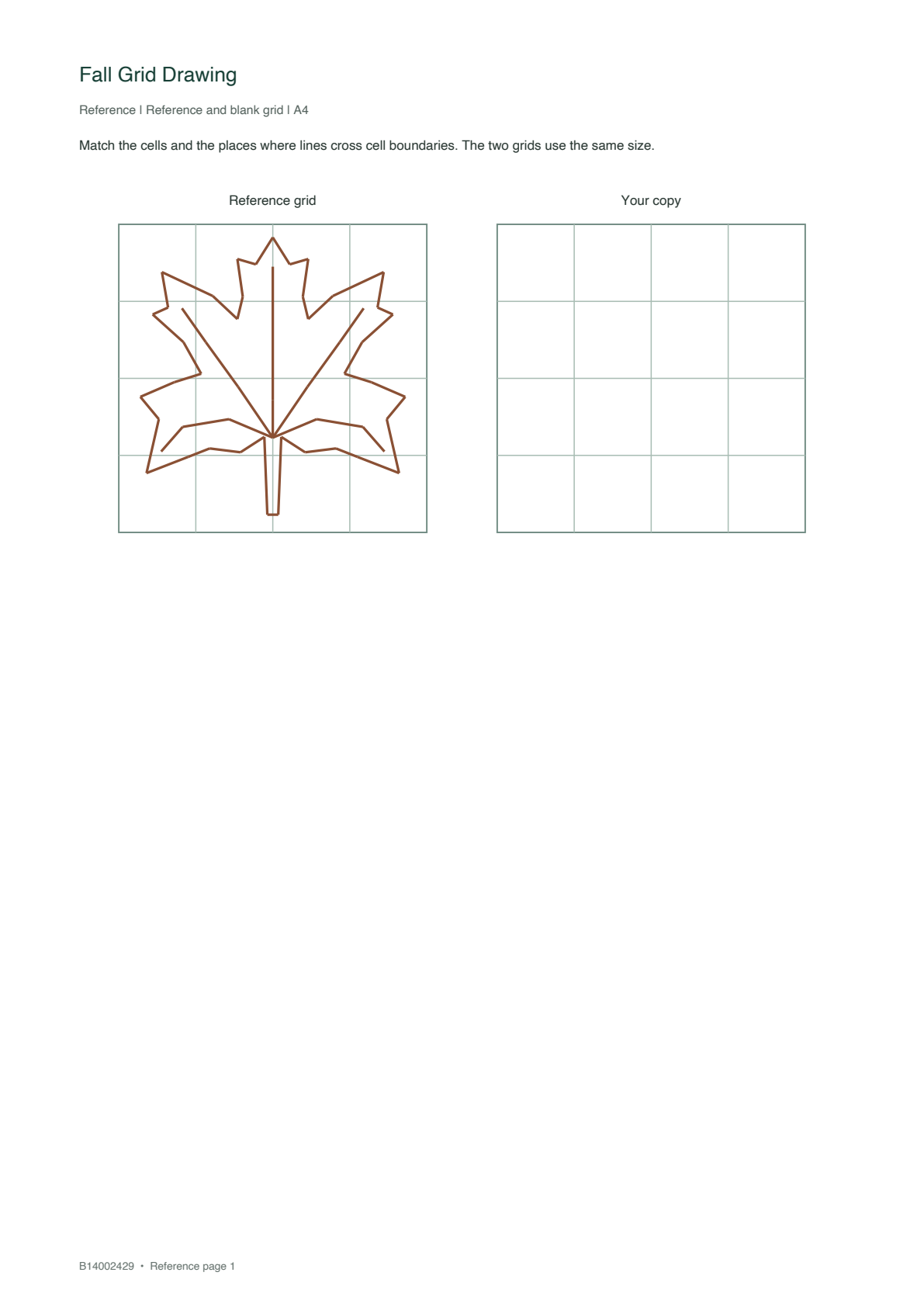
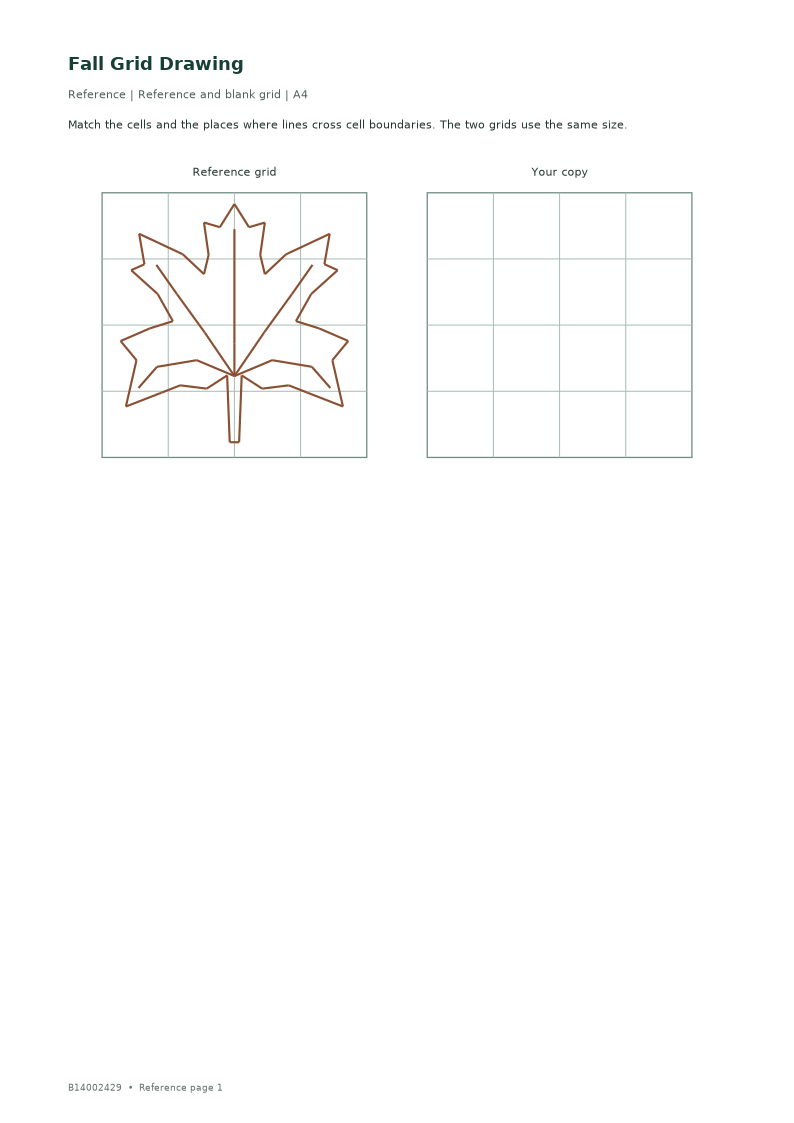
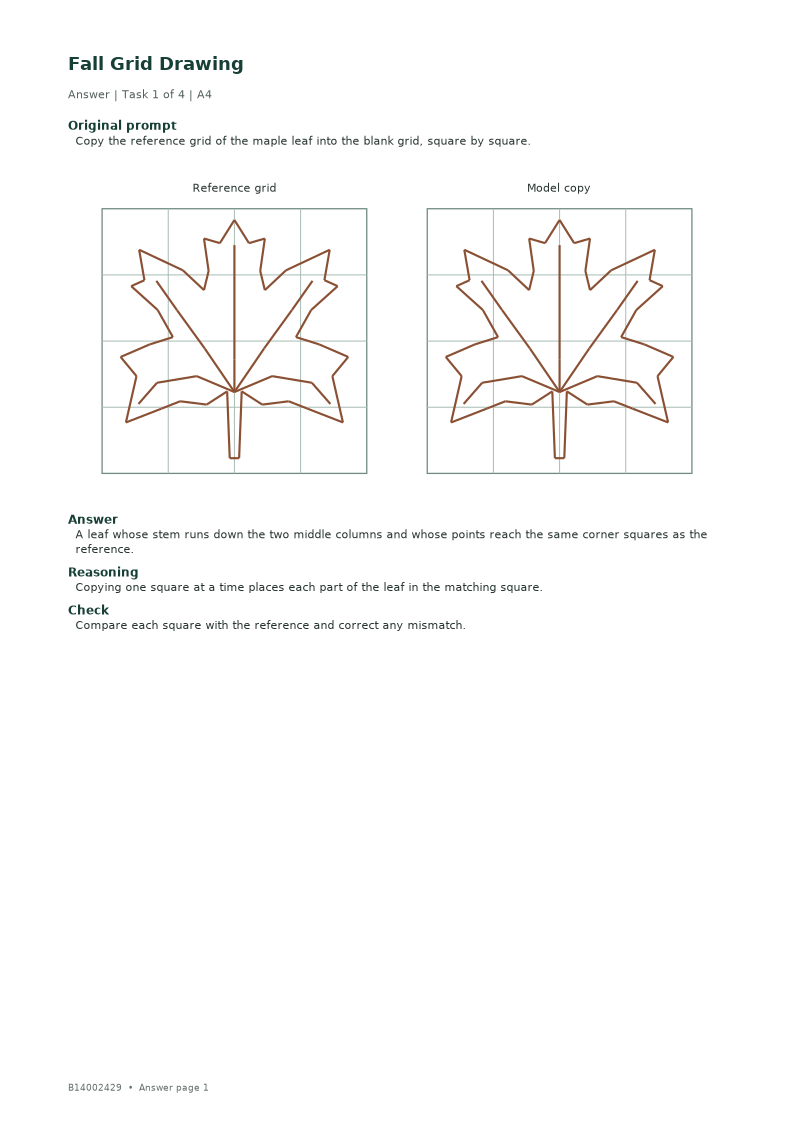
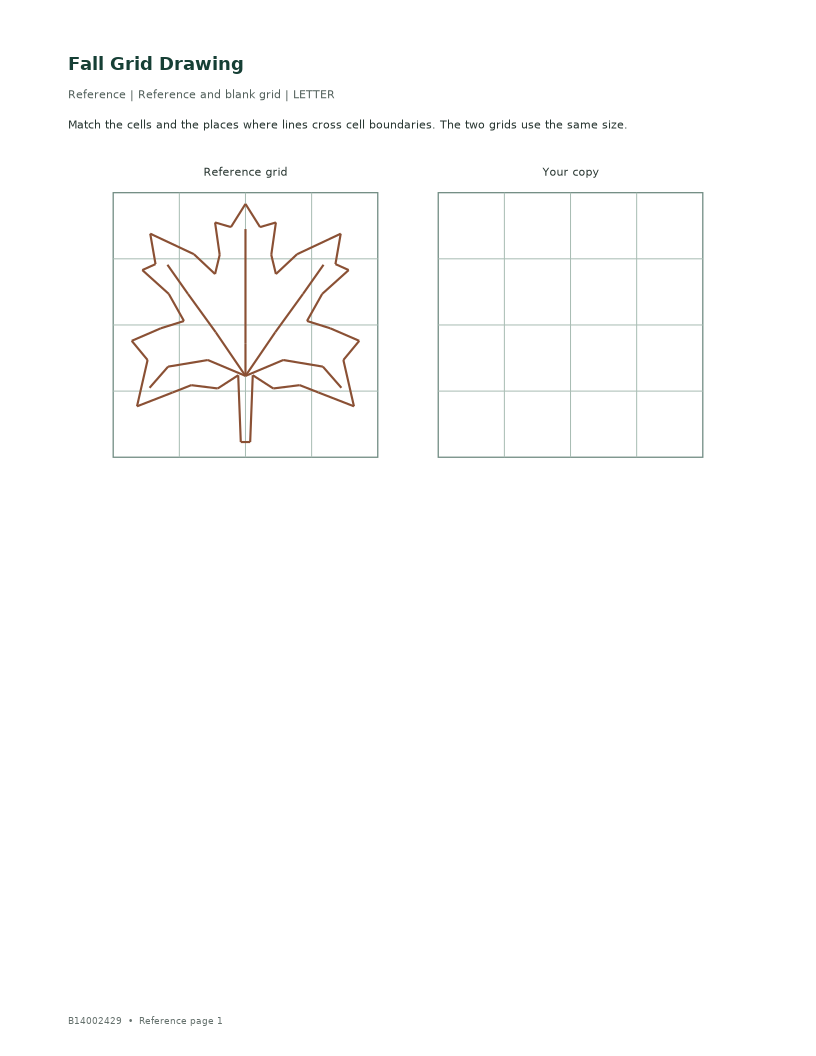
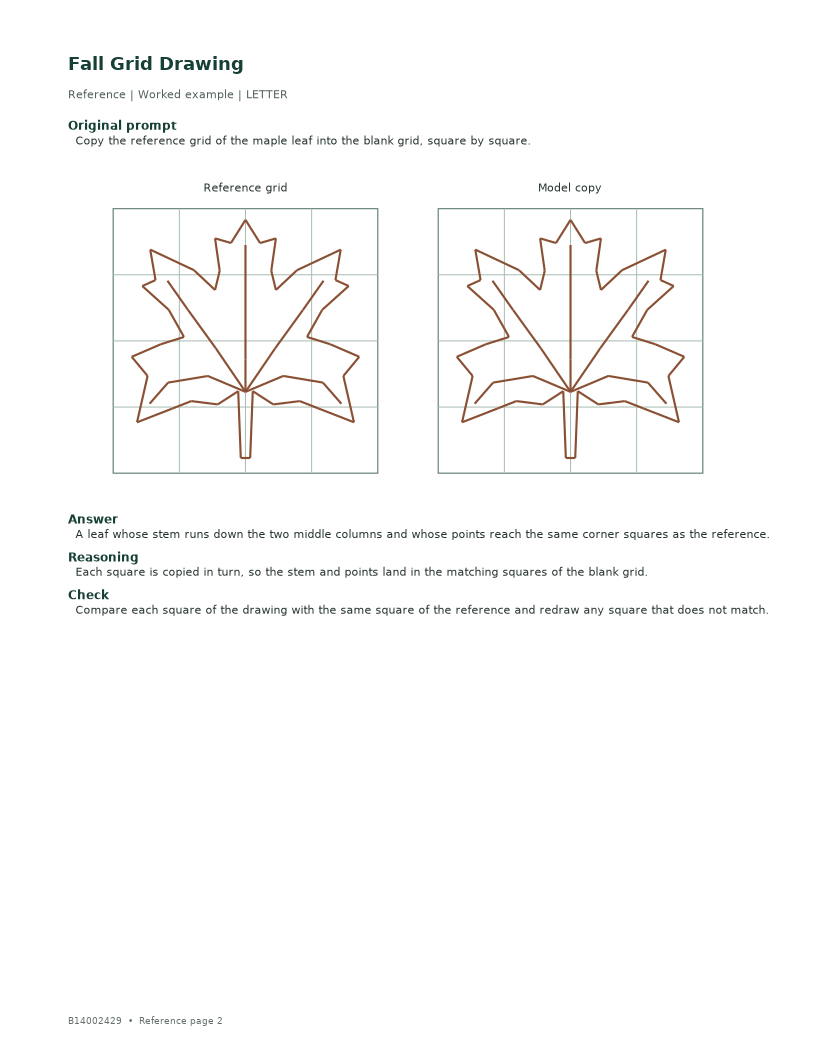
The reference grid for this pack is a 4 by 4 grid holding one maple leaf. The stem runs down the two middle columns, the leaf body spreads across the centre squares, and the points reach into the corner squares. In the blank grid, draw the stem in the middle squares first, then add each point in the square where it appears in the reference.
The correct result is a leaf whose stem and points sit in the same squares as the reference. The check is to compare each square of your drawing with the same square of the reference: if a point is in the wrong square or the wrong part of a square, redraw that square.
Practice tasks
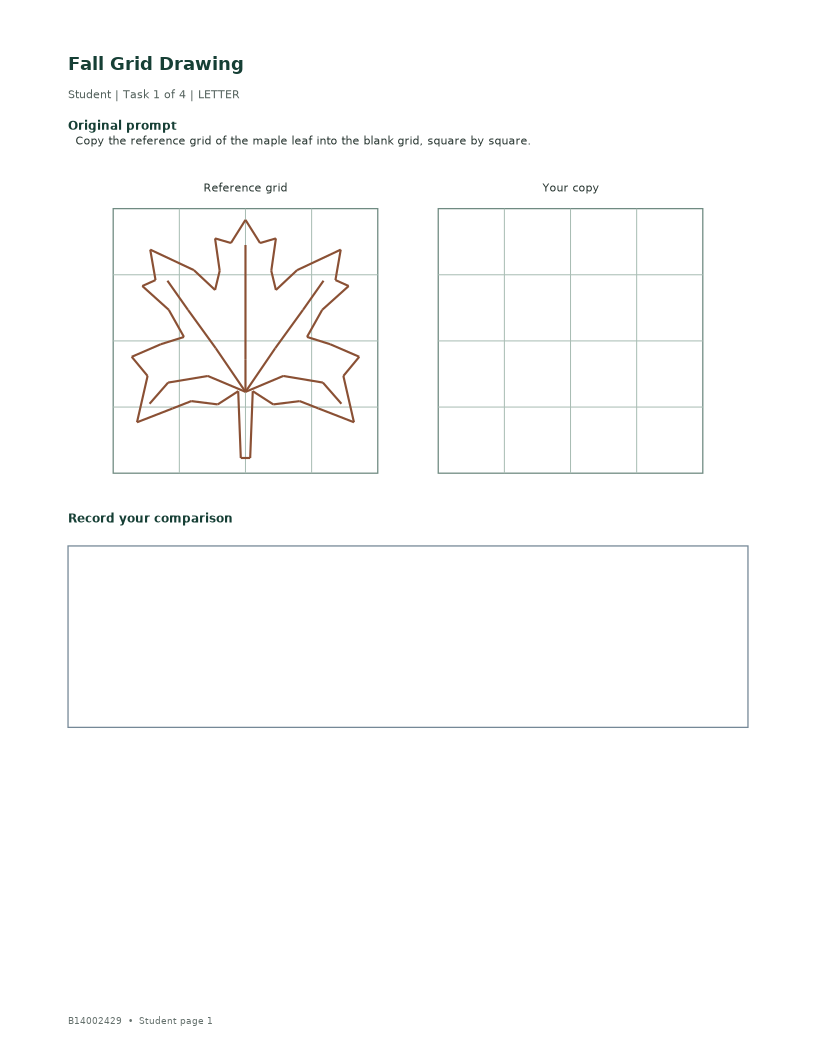
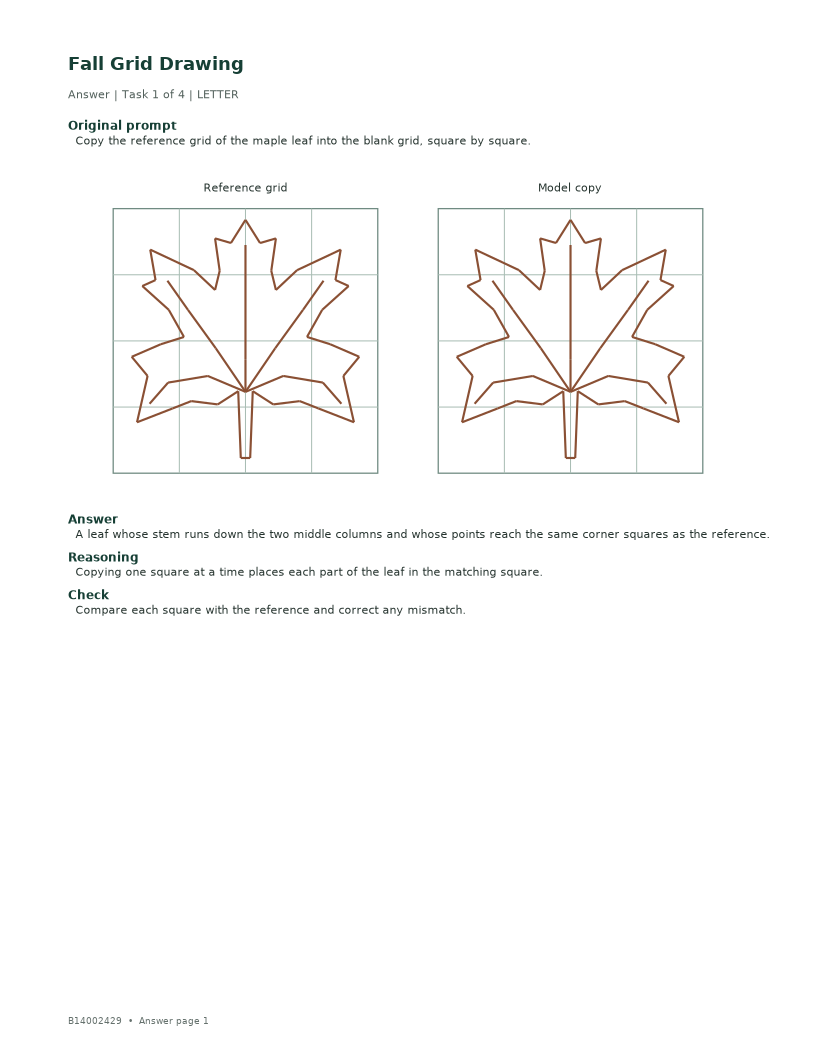
Task 1: Copy the reference grid of the maple leaf into the blank grid, square by square. Answer: a leaf whose stem runs down the two middle columns and whose points reach the same corner squares as the reference. Check: compare each square with the reference and correct any mismatch.
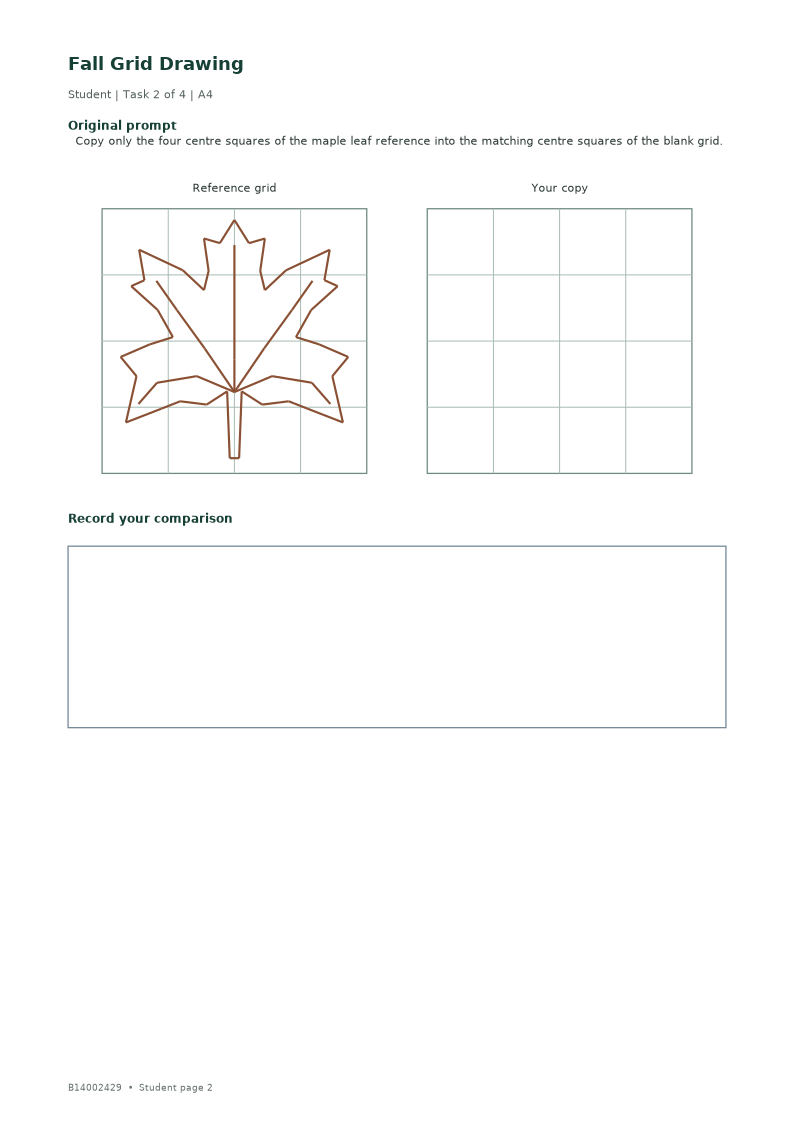
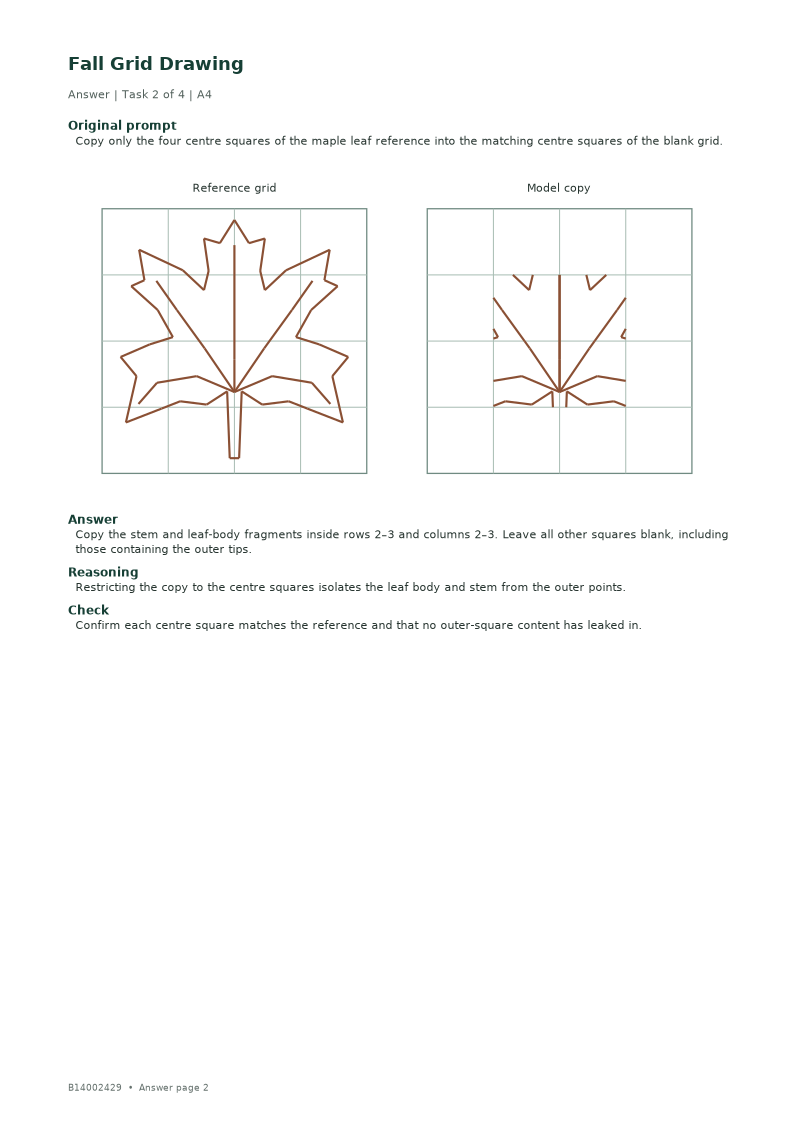
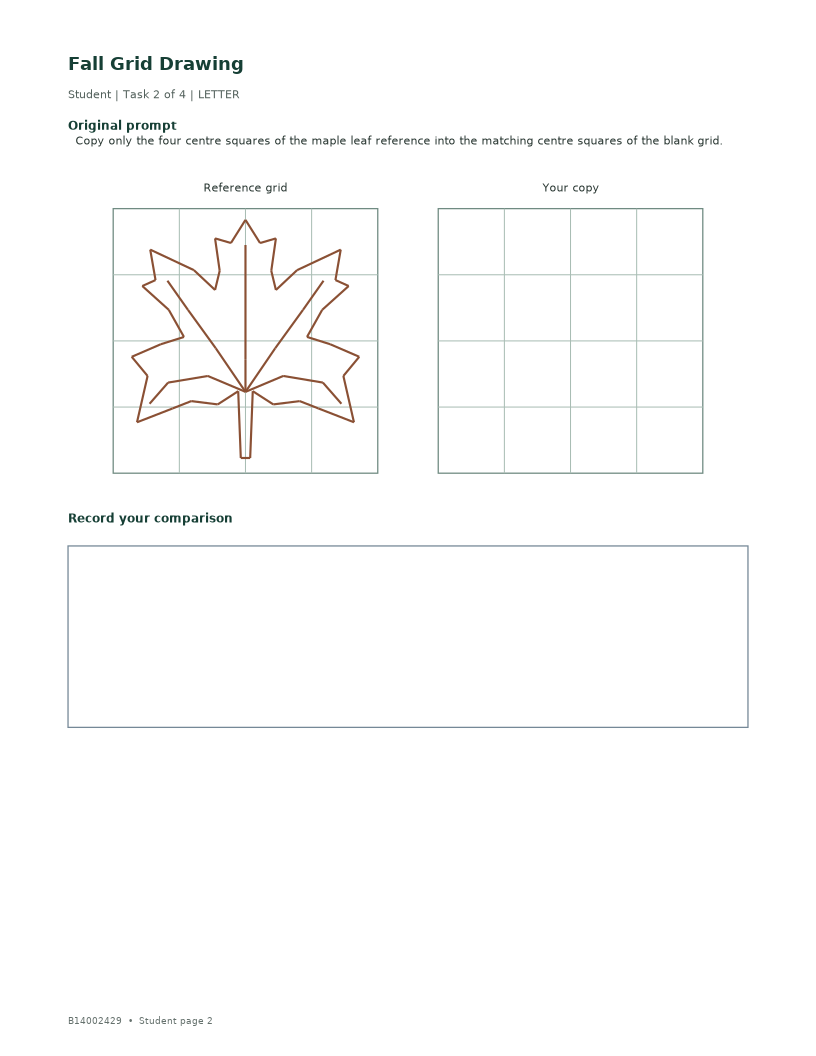
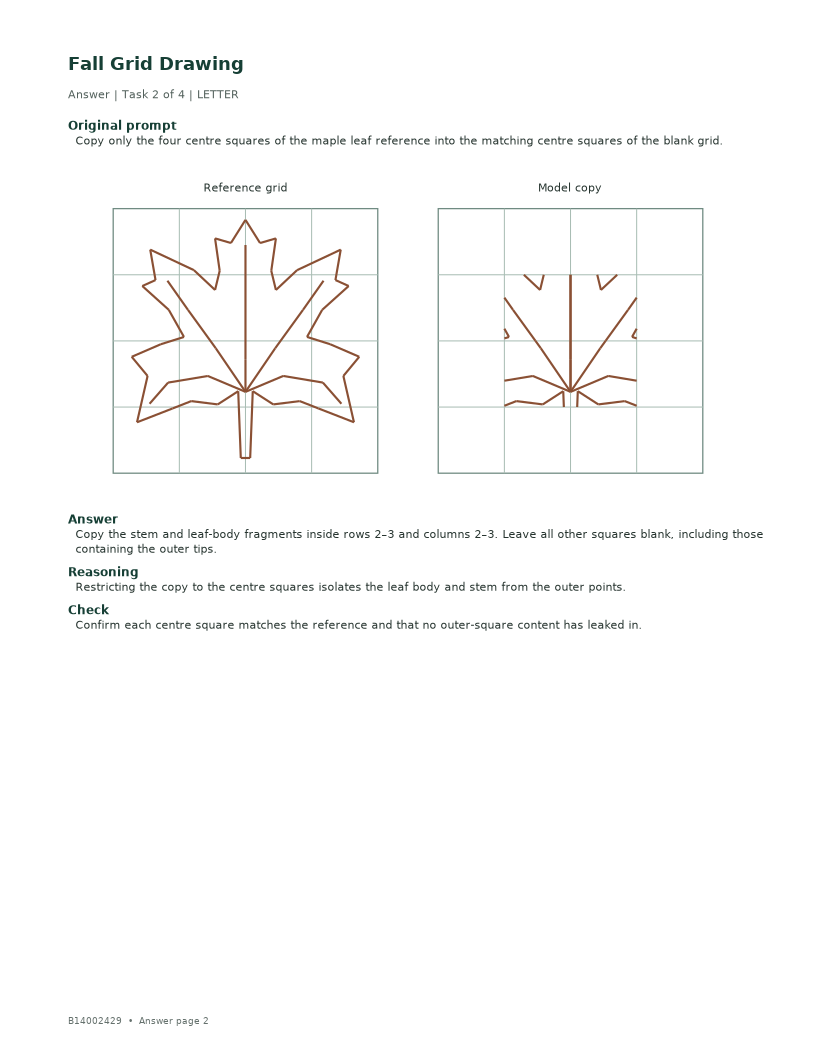
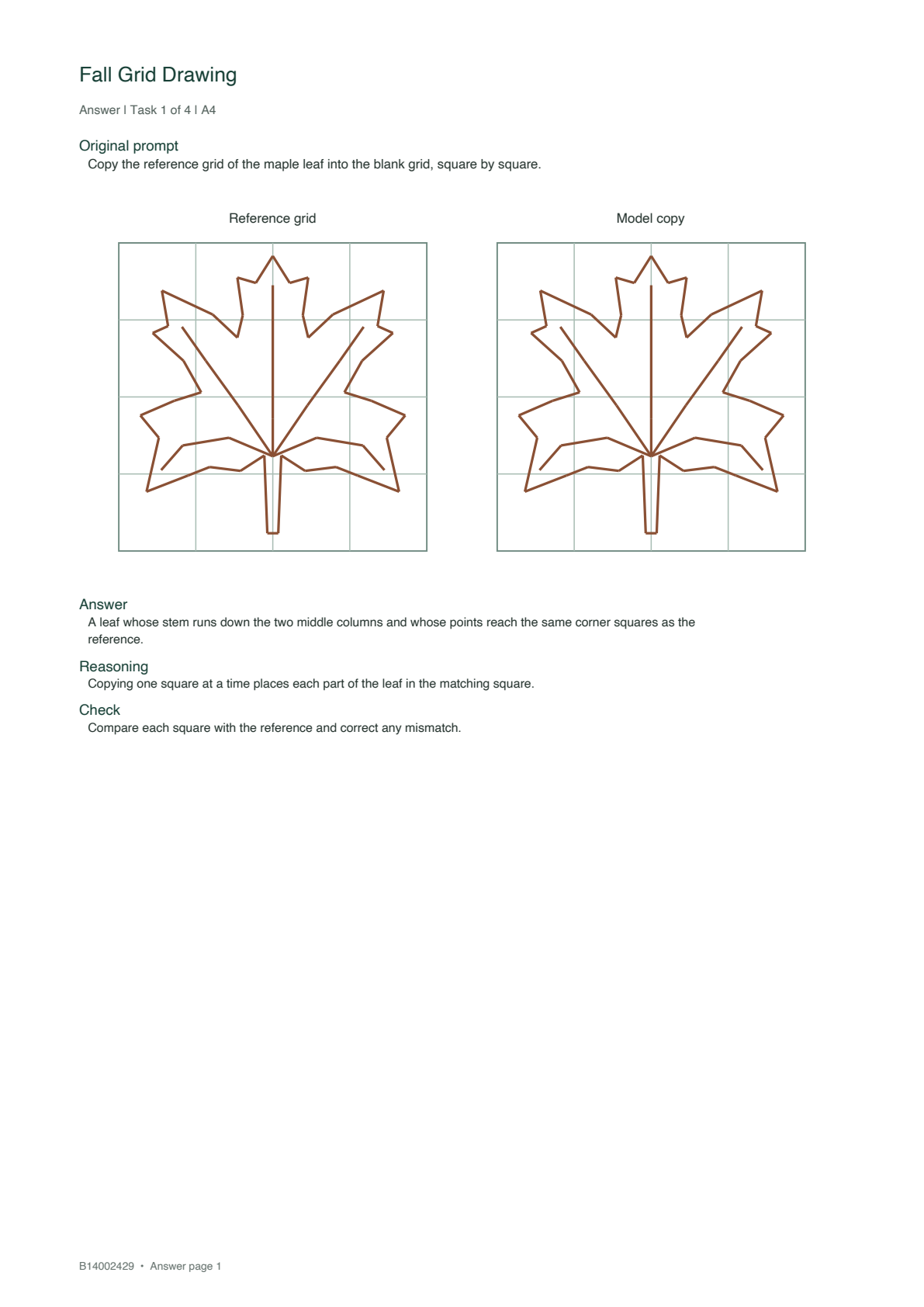
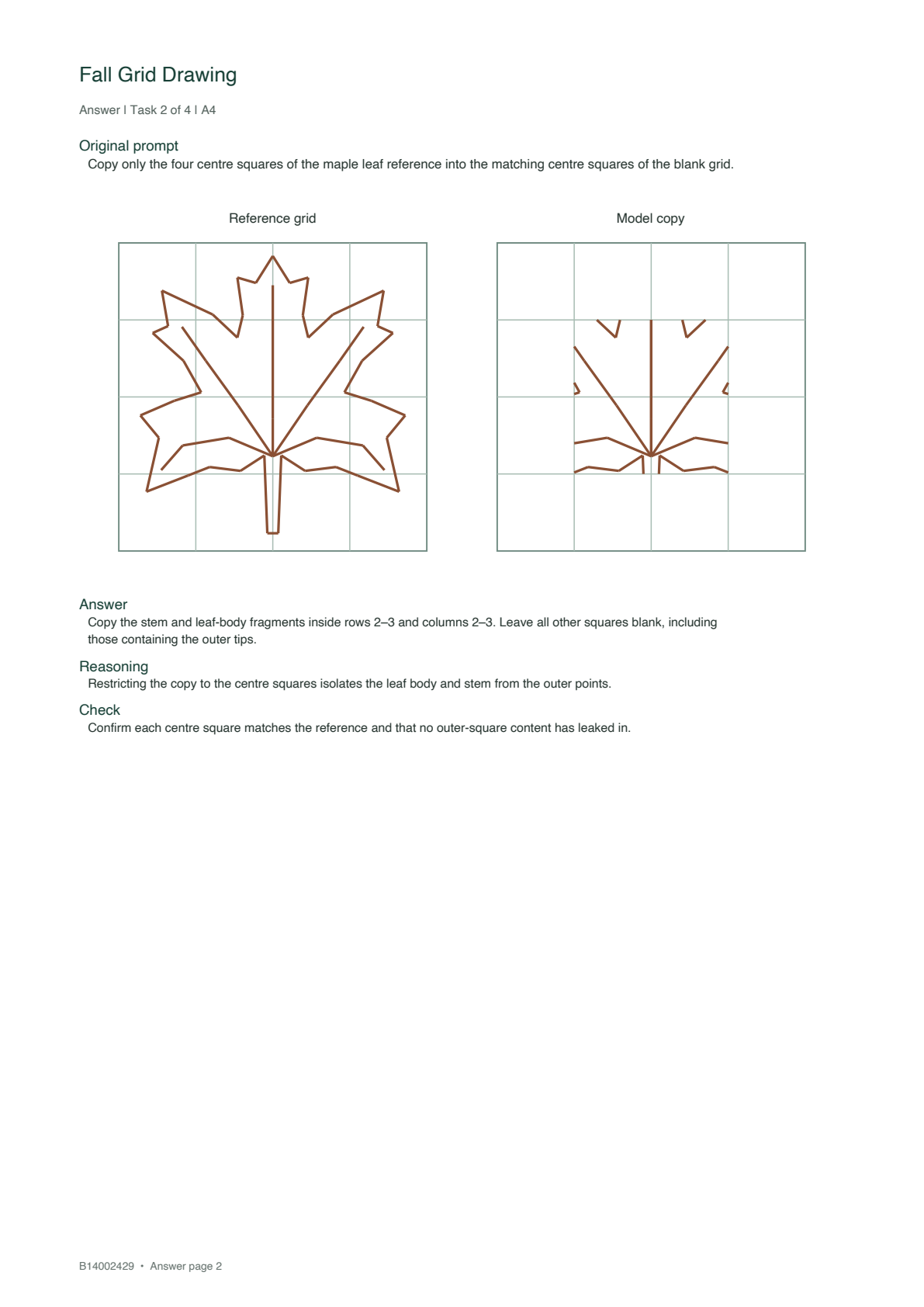
Task 1 asks for the full reference, with every stroke in its corresponding square. Task 2 limits the copy to the four central squares. Include the stem and body fragments visible inside those cells, and leave the outer corner tips out.
More practice tasks
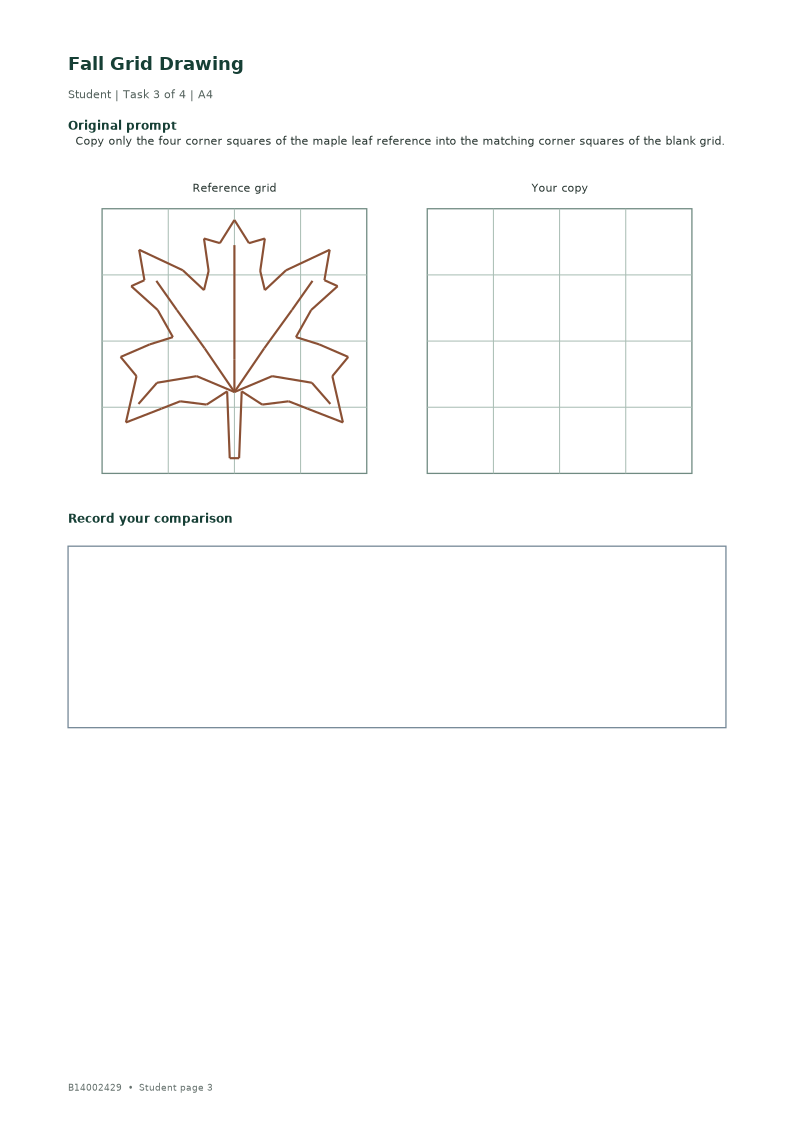
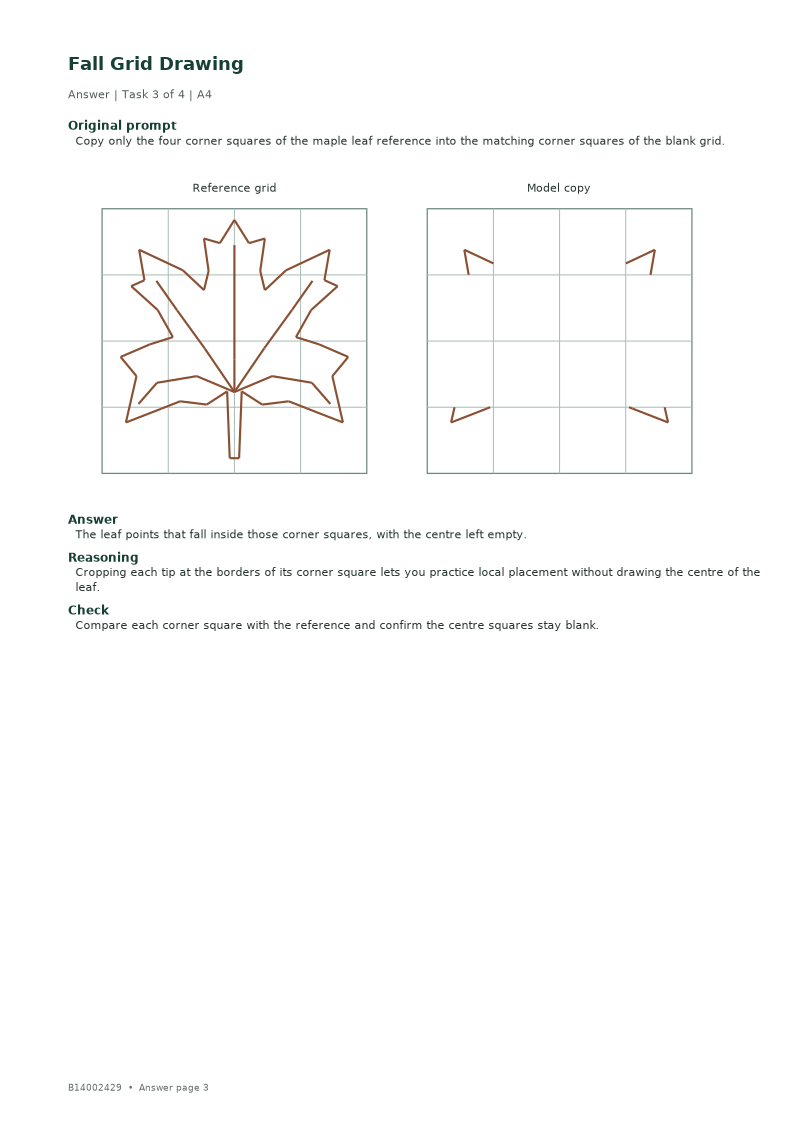
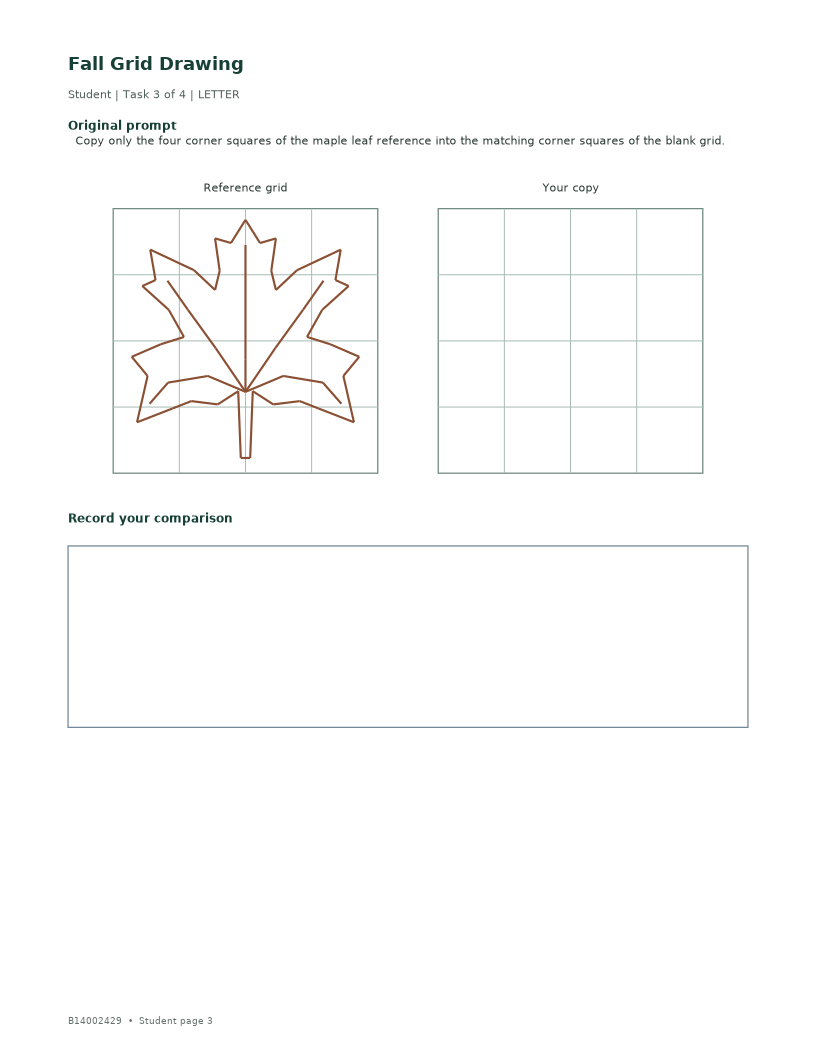
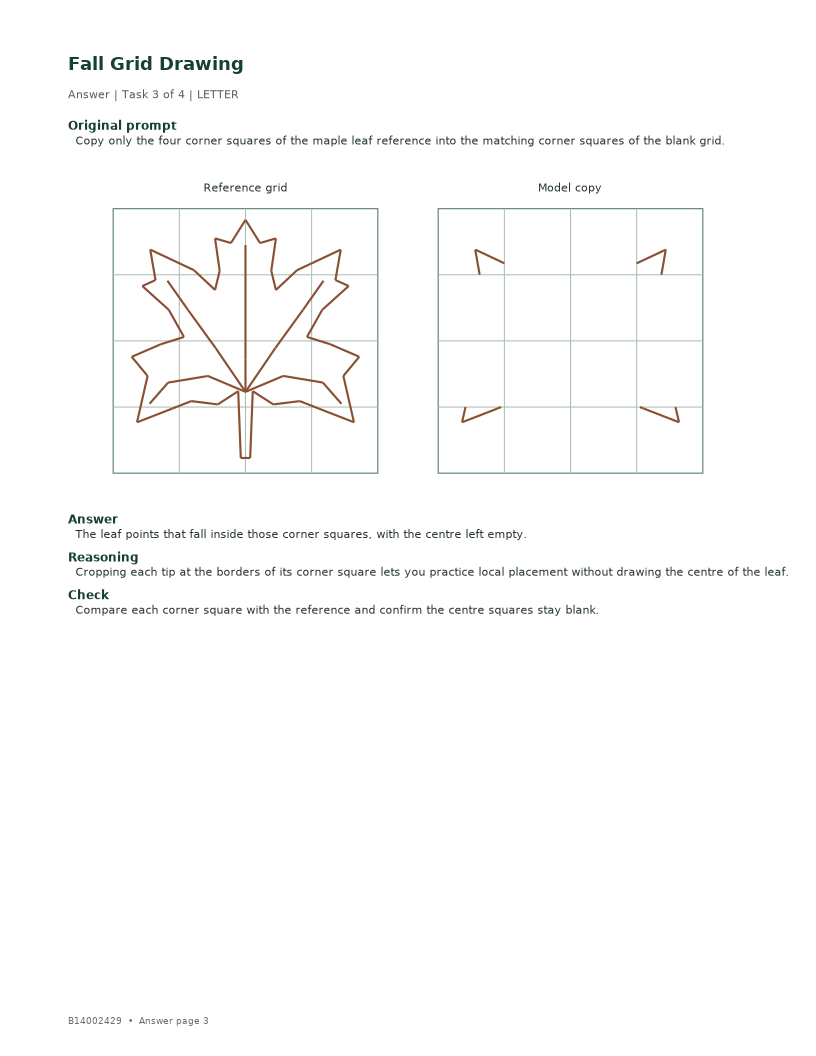
Task 3: Copy only the four corner squares of the maple leaf reference into the matching corner squares of the blank grid. Answer: the leaf points that fall inside those corner squares, with the centre left empty. Check: compare each corner square with the reference and confirm the centre squares stay blank.
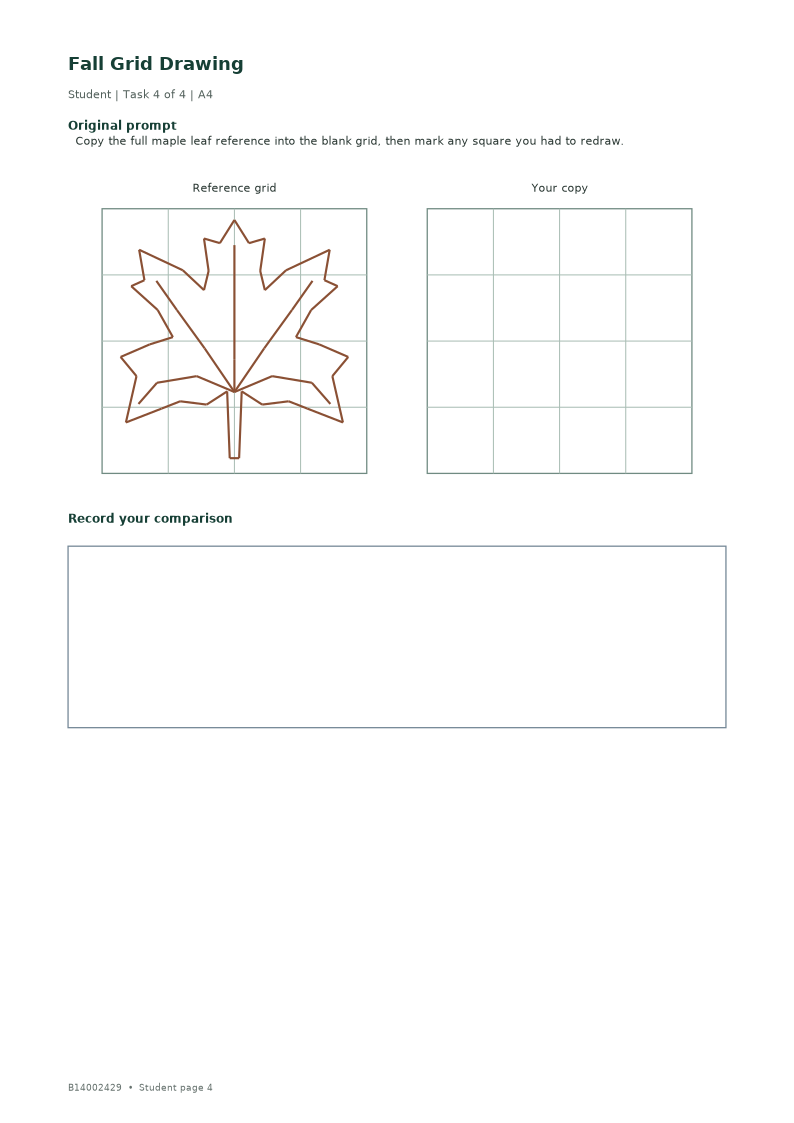
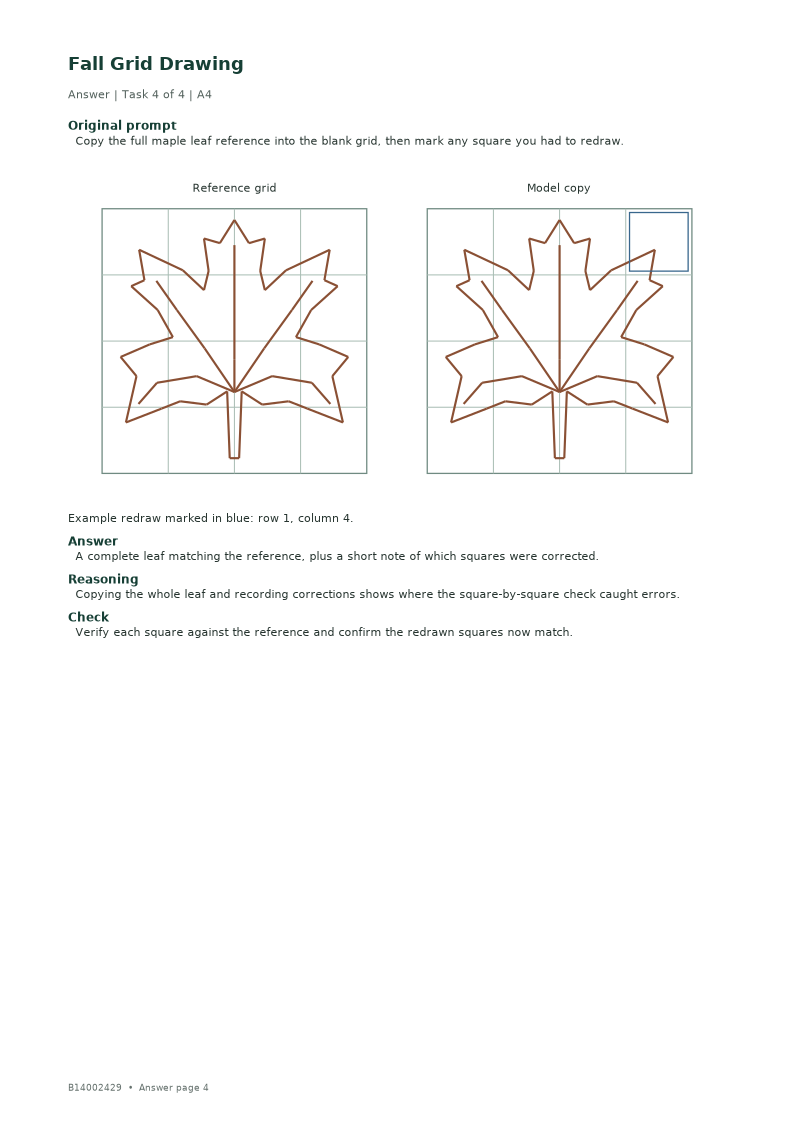
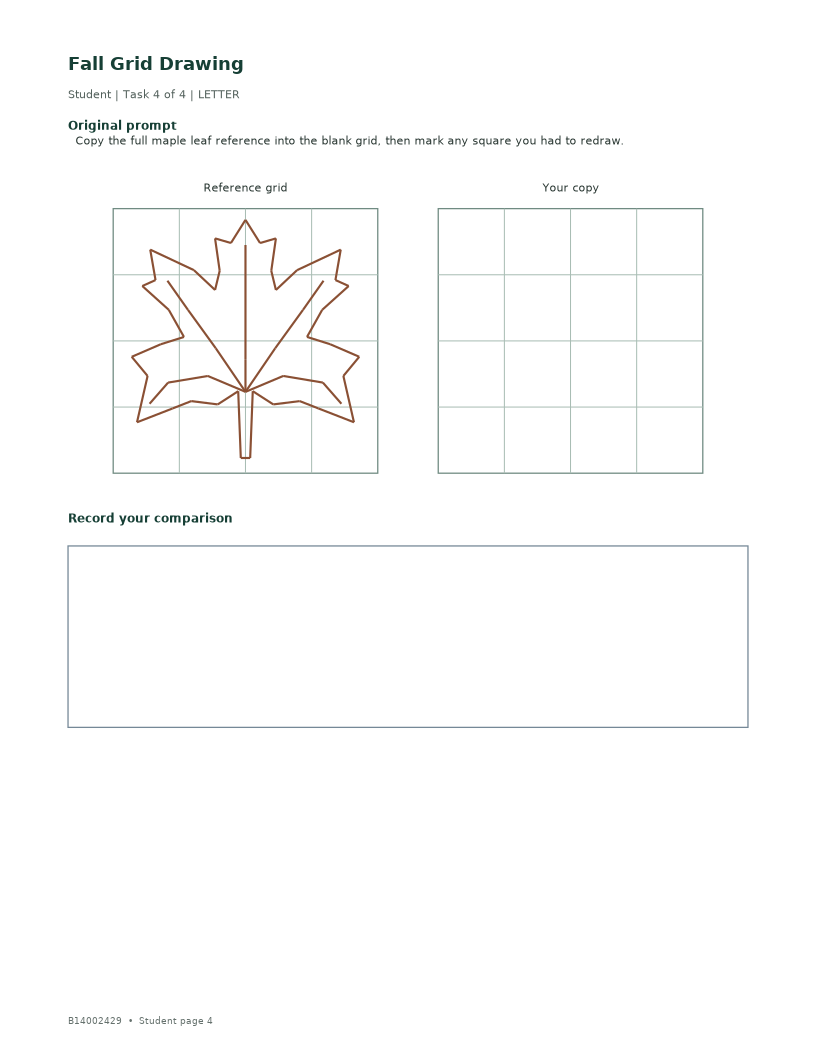
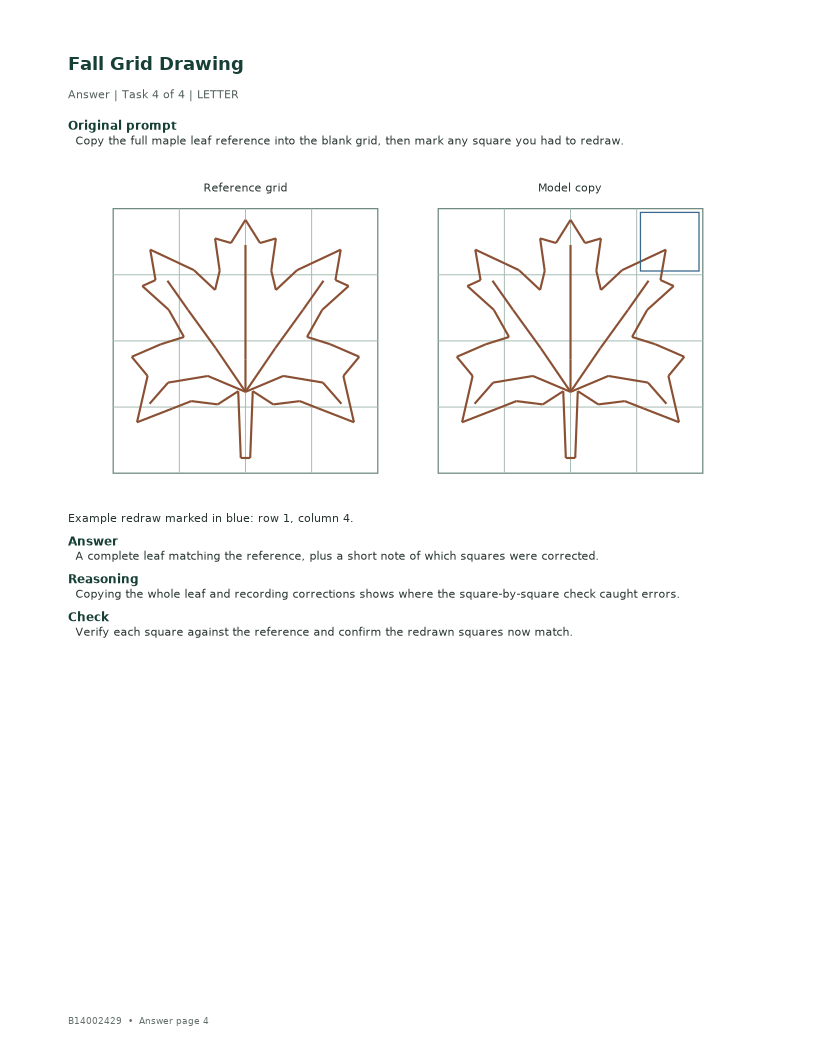
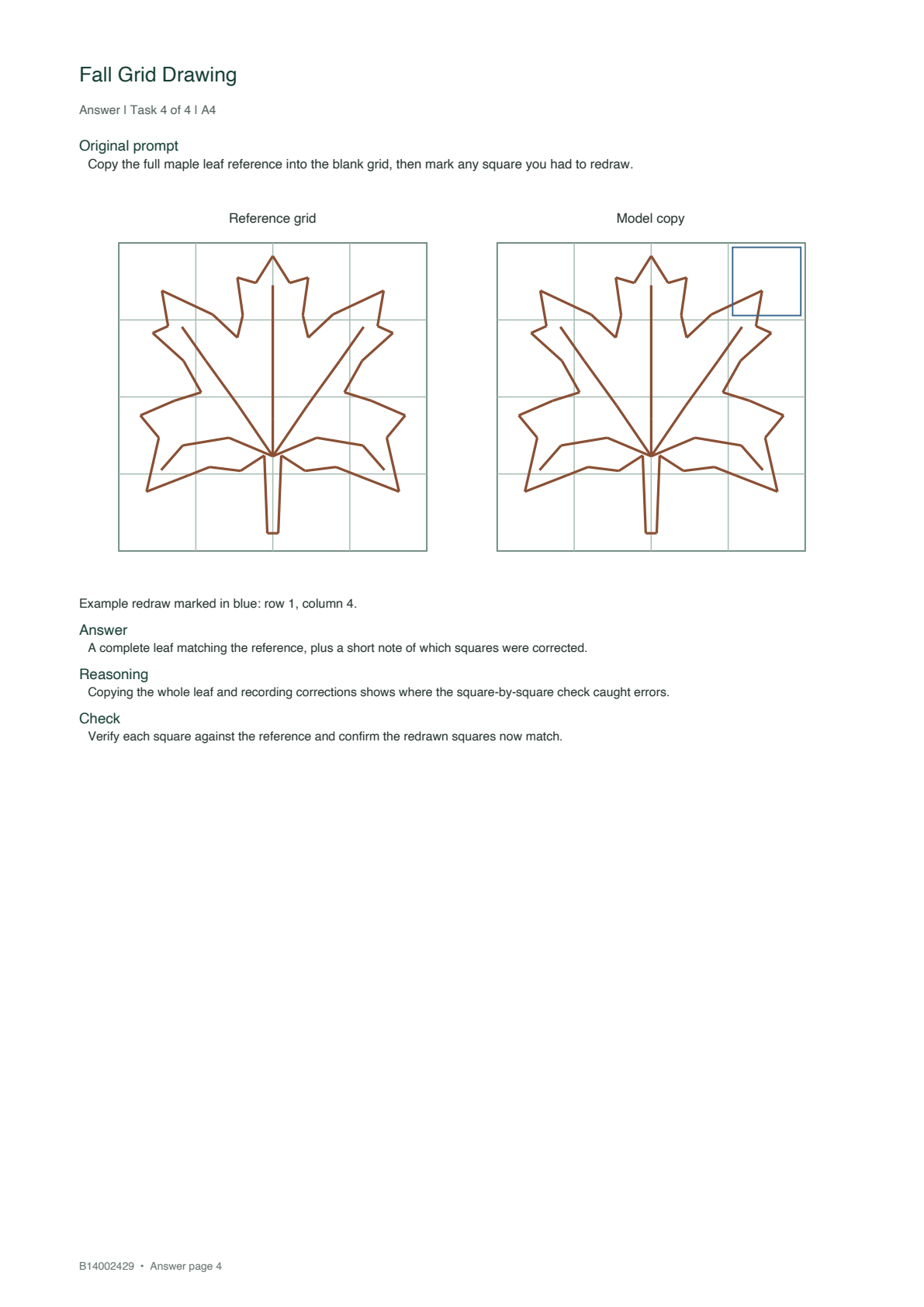
Task 4: Copy the full maple leaf reference into the blank grid, then mark any square you had to redraw. Answer: a complete leaf matching the reference, plus a short note of which squares were corrected. Check: verify each square against the reference and confirm the redrawn squares now match.
Download the complete resource pack
All individual SVG pages (20)
- A4 reference page 1
- A4 reference page 2
- A4 student page 1
- A4 student page 2
- A4 student page 3
- A4 student page 4
- A4 answer page 1
- A4 answer page 2
- A4 answer page 3
- A4 answer page 4
- LETTER reference page 1
- LETTER reference page 2
- LETTER student page 1
- LETTER student page 2
- LETTER student page 3
- LETTER student page 4
- LETTER answer page 1
- LETTER answer page 2
- LETTER answer page 3
- LETTER answer page 4
Print at 100% / actual size. Use the stated scale on any schematic diagram; physical cutting templates are identified separately. A4 and US Letter are separate files. Free access, no signup; CC BY 4.0.
How to use these pages
- What grid drawing is and why it works
- How to copy square by square
- Worked example
- Practice tasks
- More practice tasks
Worked example
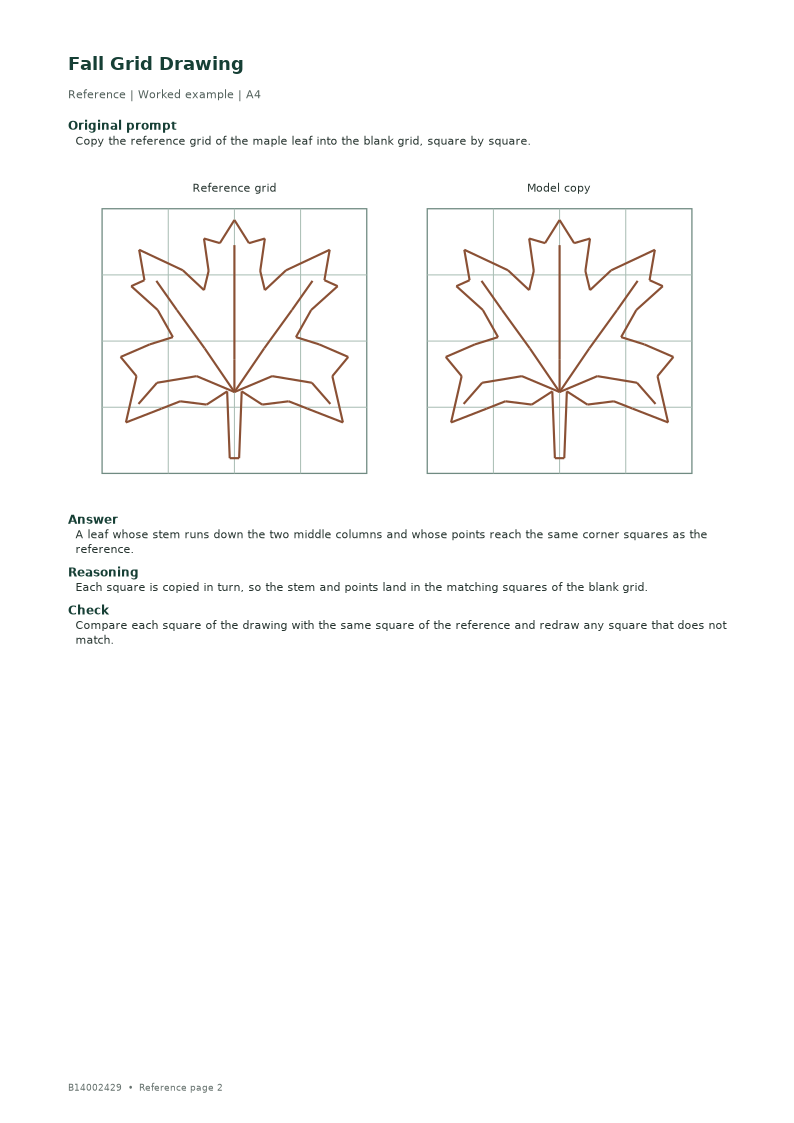
Example: Copy the reference grid of the maple leaf into the blank grid, square by square.
Answer: A leaf whose stem runs down the two middle columns and whose points reach the same corner squares as the reference.
Reasoning: Each square is copied in turn, so the stem and points land in the matching squares of the blank grid.
Check: Compare each square of the drawing with the same square of the reference and redraw any square that does not match.
Four practice tasks and complete answers
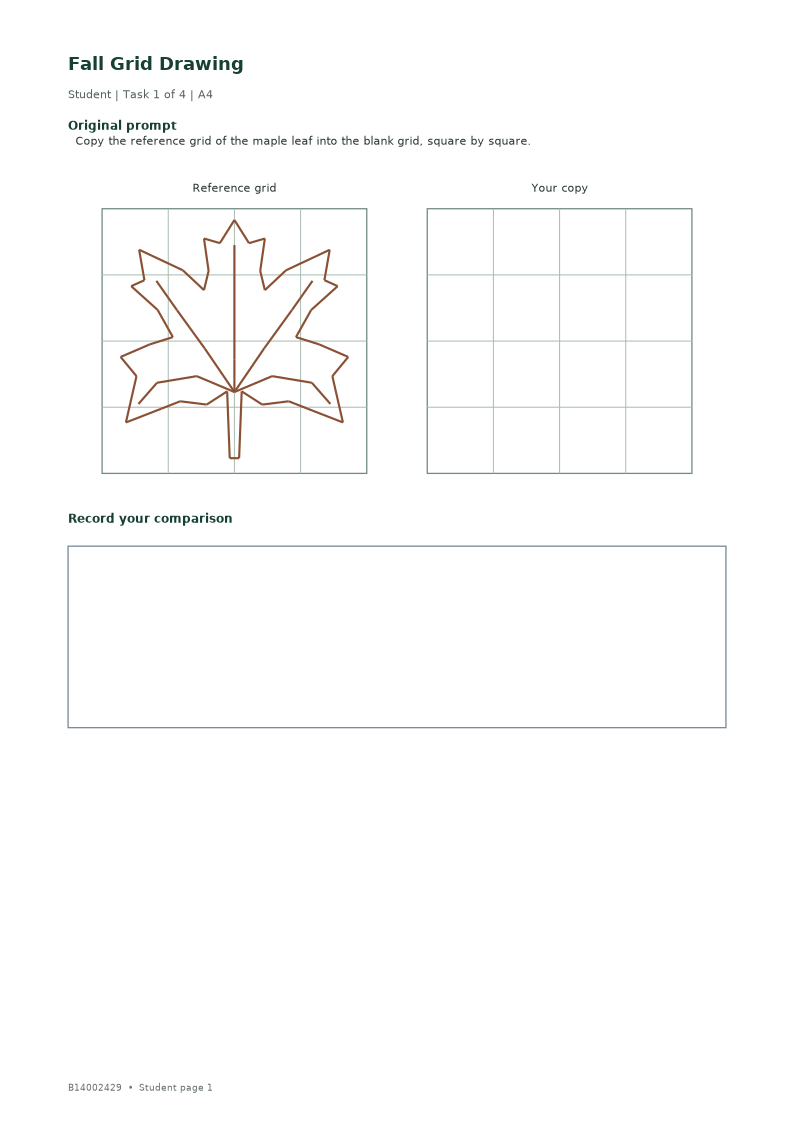
Task 1
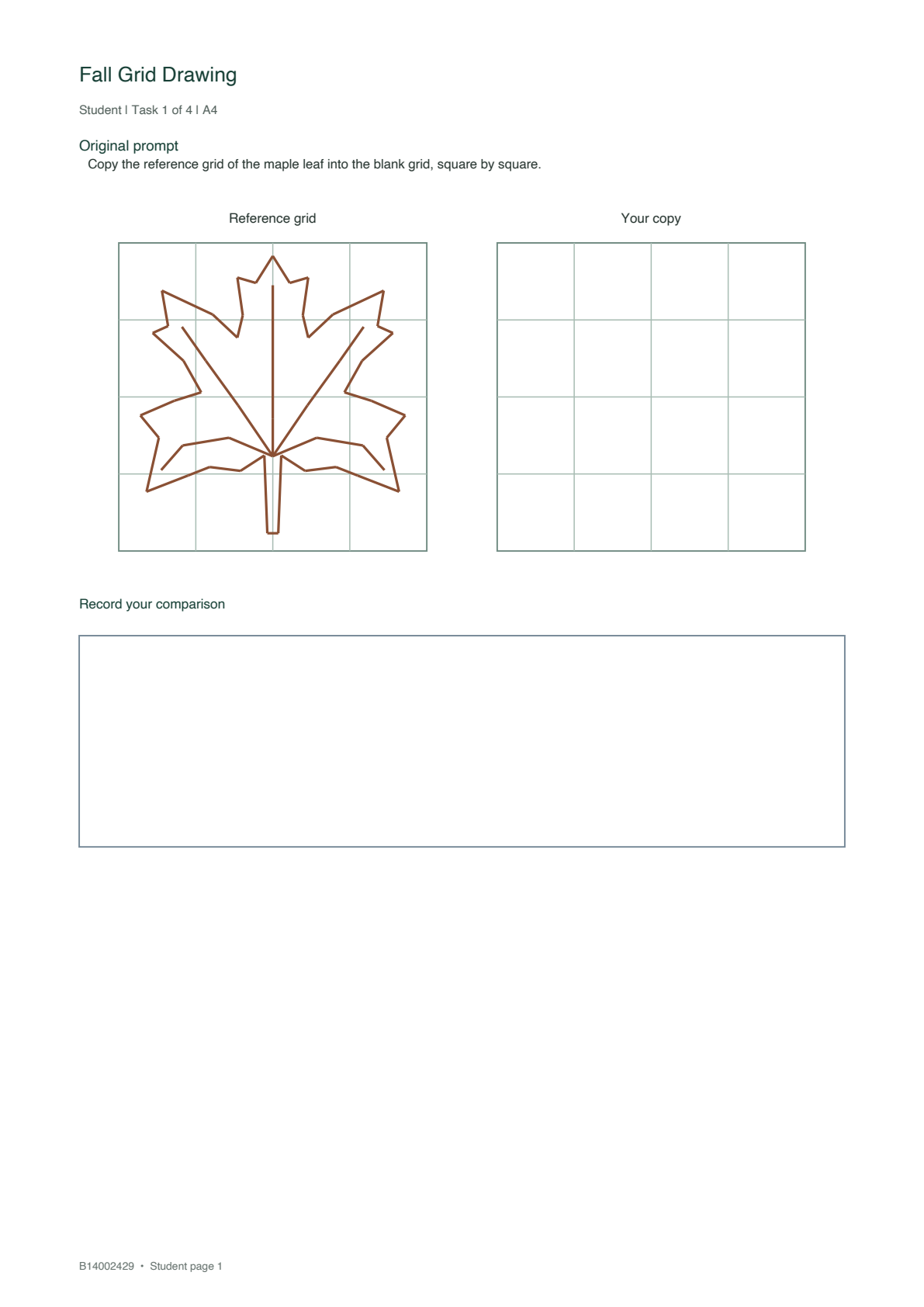
Copy the reference grid of the maple leaf into the blank grid, square by square.
Show answer 1
A leaf whose stem runs down the two middle columns and whose points reach the same corner squares as the reference.
Copying one square at a time places each part of the leaf in the matching square.
Check: Compare each square with the reference and correct any mismatch.
Task 2
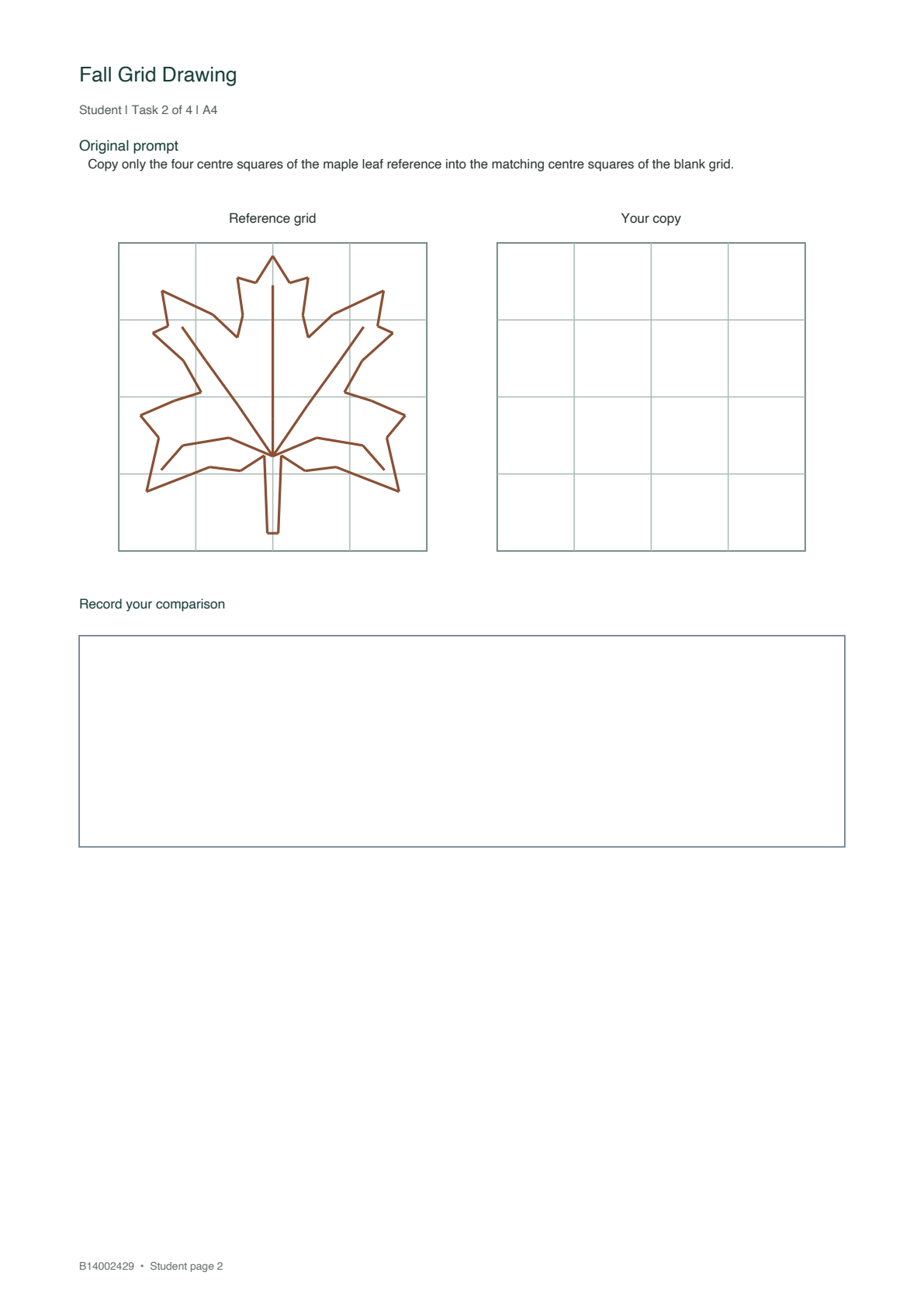
Copy only the four centre squares of the maple leaf reference into the matching centre squares of the blank grid.
Show answer 2
Copy the stem and leaf-body fragments inside rows 2–3 and columns 2–3. Leave all other squares blank, including those containing the outer tips.
Restricting the copy to the centre squares isolates the leaf body and stem from the outer points.
Check: Confirm each centre square matches the reference and that no outer-square content has leaked in.
Task 3
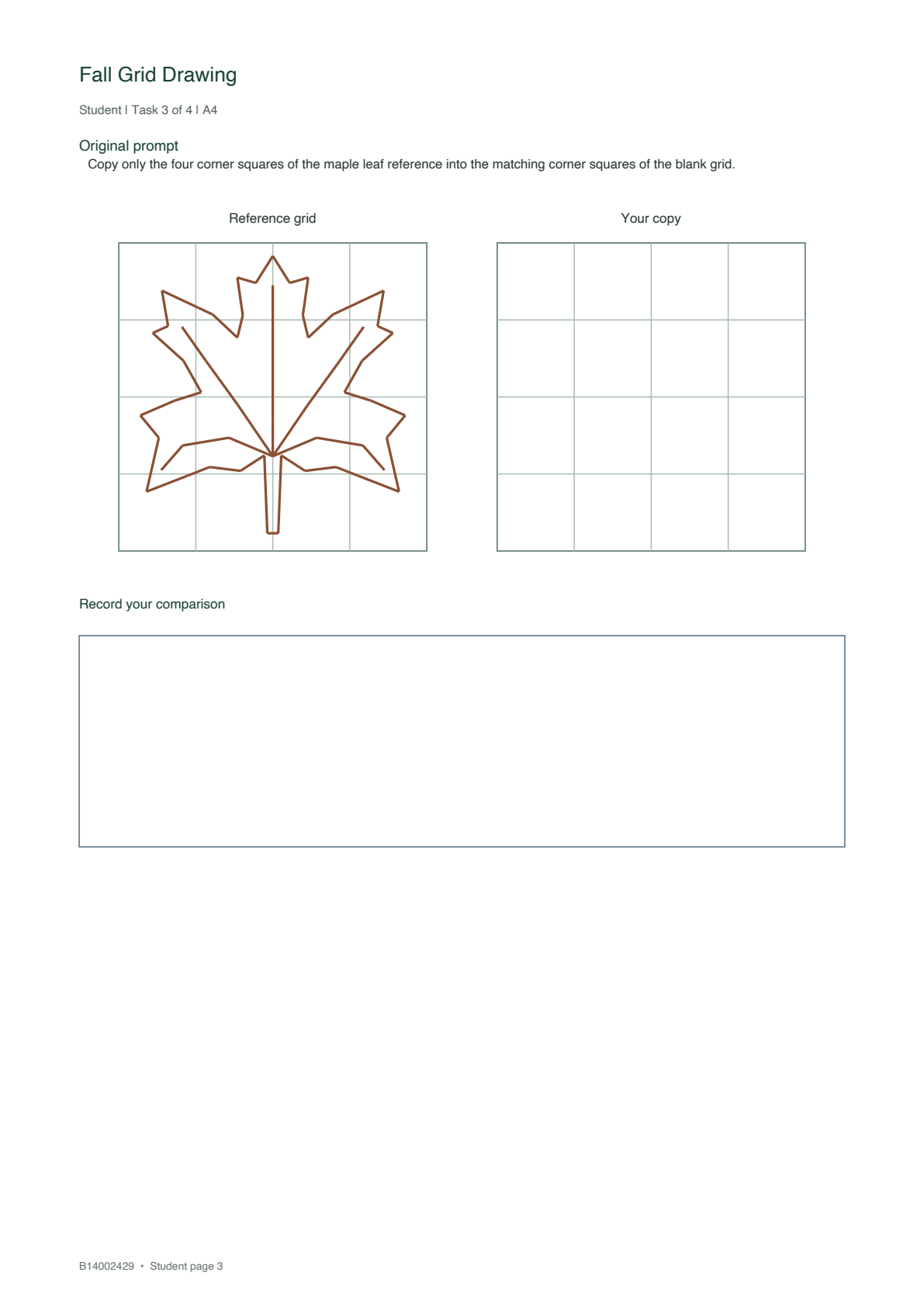
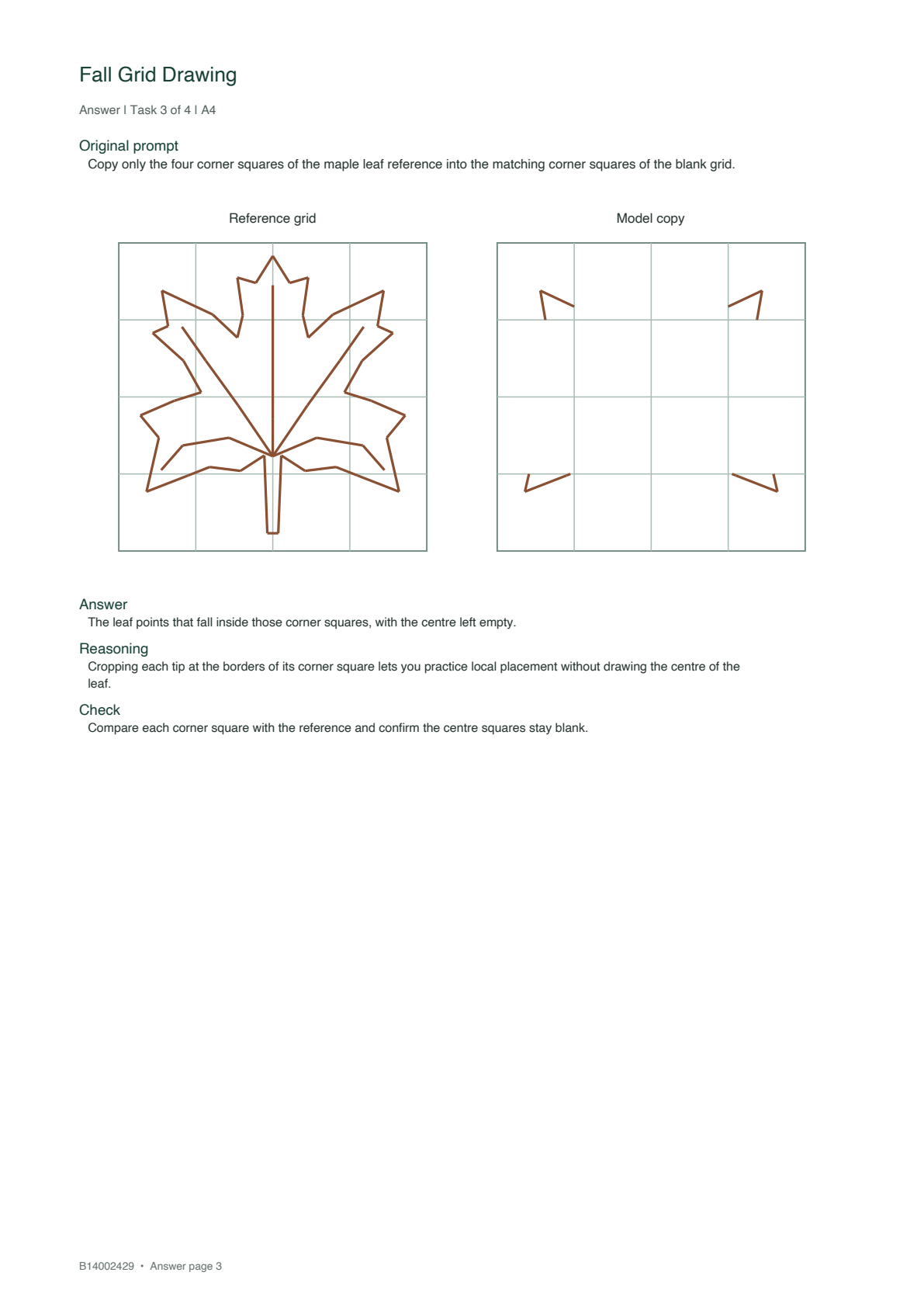
Copy only the four corner squares of the maple leaf reference into the matching corner squares of the blank grid.
Show answer 3
The leaf points that fall inside those corner squares, with the centre left empty.
Cropping each tip at the borders of its corner square lets you practice local placement without drawing the centre of the leaf.
Check: Compare each corner square with the reference and confirm the centre squares stay blank.
Task 4
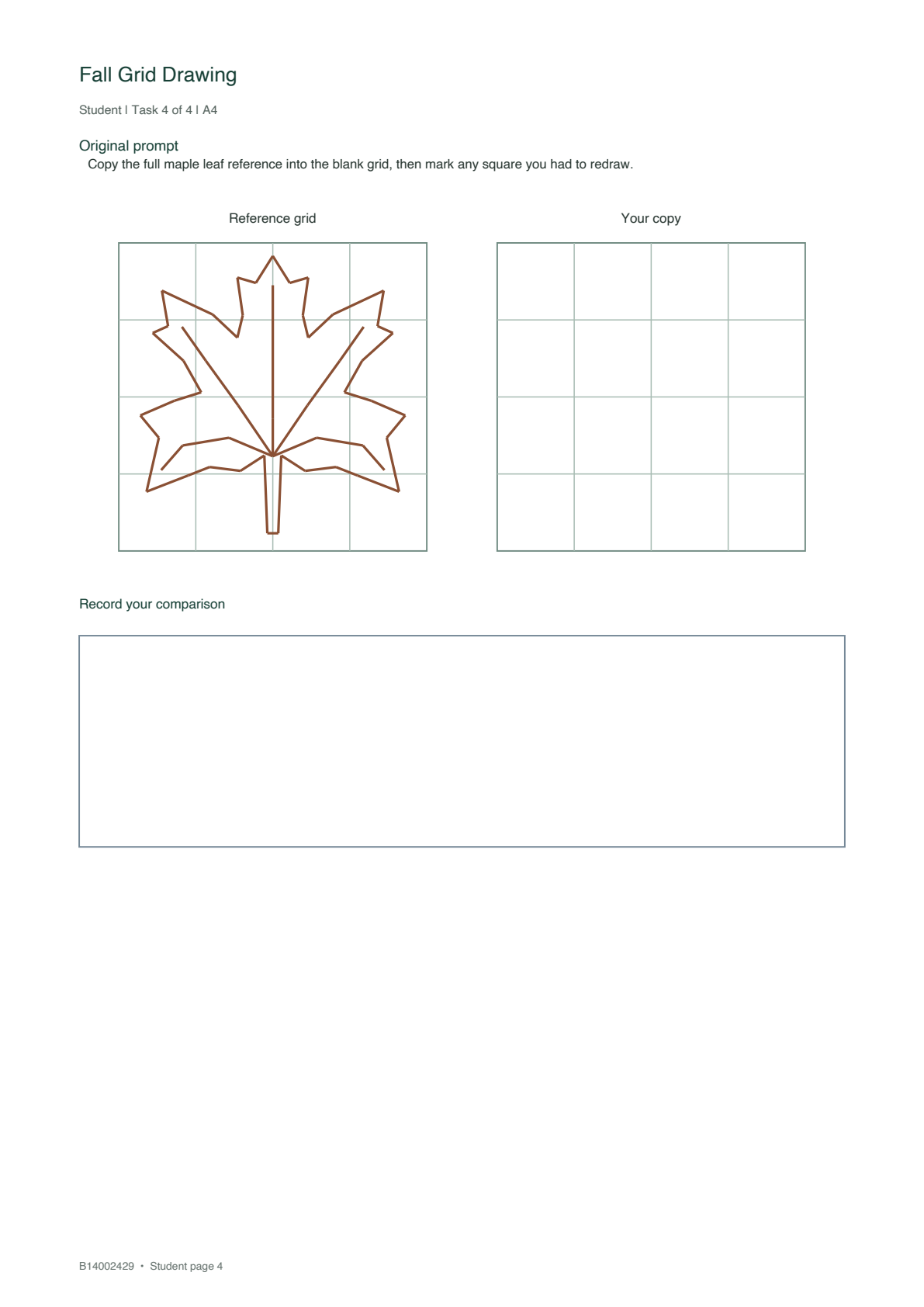
Copy the full maple leaf reference into the blank grid, then mark any square you had to redraw.
Show answer 4
A complete leaf matching the reference, plus a short note of which squares were corrected.
Copying the whole leaf and recording corrections shows where the square-by-square check caught errors.
Check: Verify each square against the reference and confirm the redrawn squares now match.
Useful checks
- Drawing a whole shape in one square instead of copying what is inside each square. Work one square at a time and draw only the part of the shape that falls inside that square.
- Ignoring the square edges and placing a line in the wrong part of a square. Use the square's edges to judge where each line starts and ends, then compare with the reference.
Questions about this resource
Do I need to draw every square in order?
No. Start with clear, simple squares, then fill the rest; the check is the same either way.
What if my drawing does not match the reference?
Compare square by square and redraw only the squares that do not match.