Free original lessons
Color Theory Drawing
Color theory drawing means choosing colors by their relationship on a color wheel and by their lightness (value), then applying those choices to a drawing. This pack teaches you to build a simple color wheel, make a value swatch strip, and use both to plan and check the colors in a drawing.
Letter & A4
PDF & SVG
What a color-theory drawing plate contains
A color-theory drawing plate has two reference parts and one applied part. The reference parts are a color wheel and a value swatch strip. The applied part is a drawing whose colors you choose and check using those references.
Building the color wheel
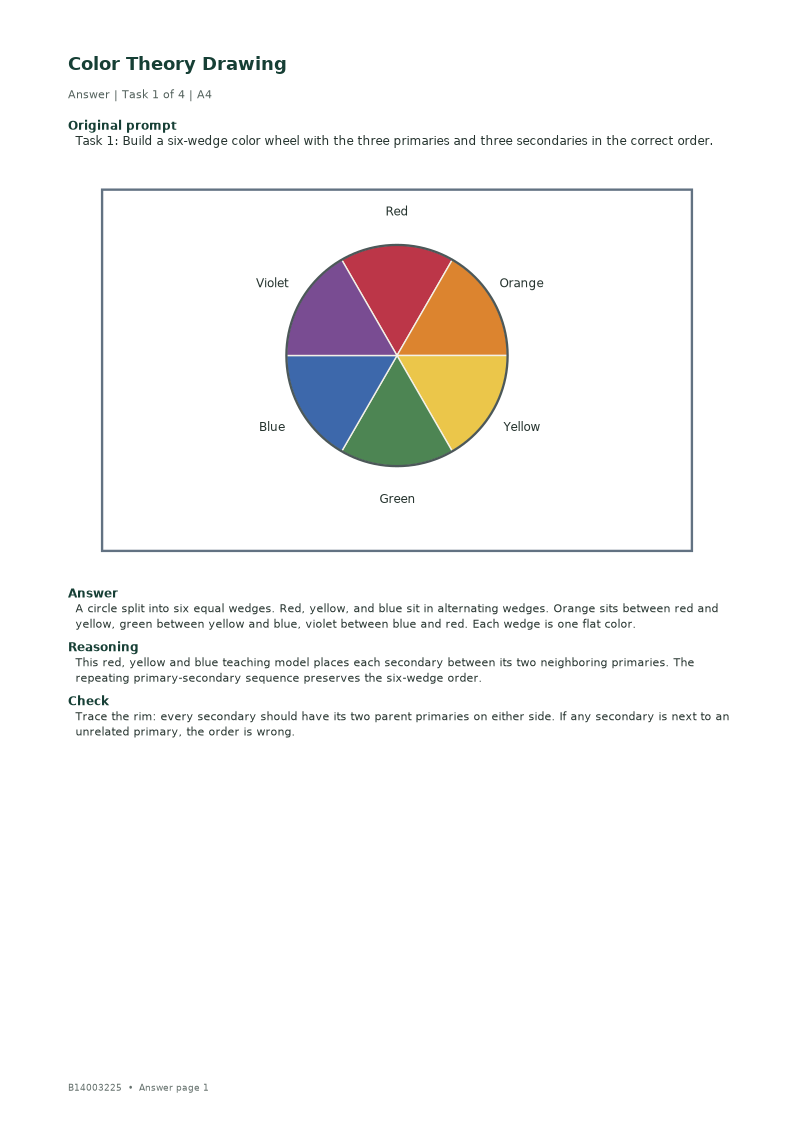
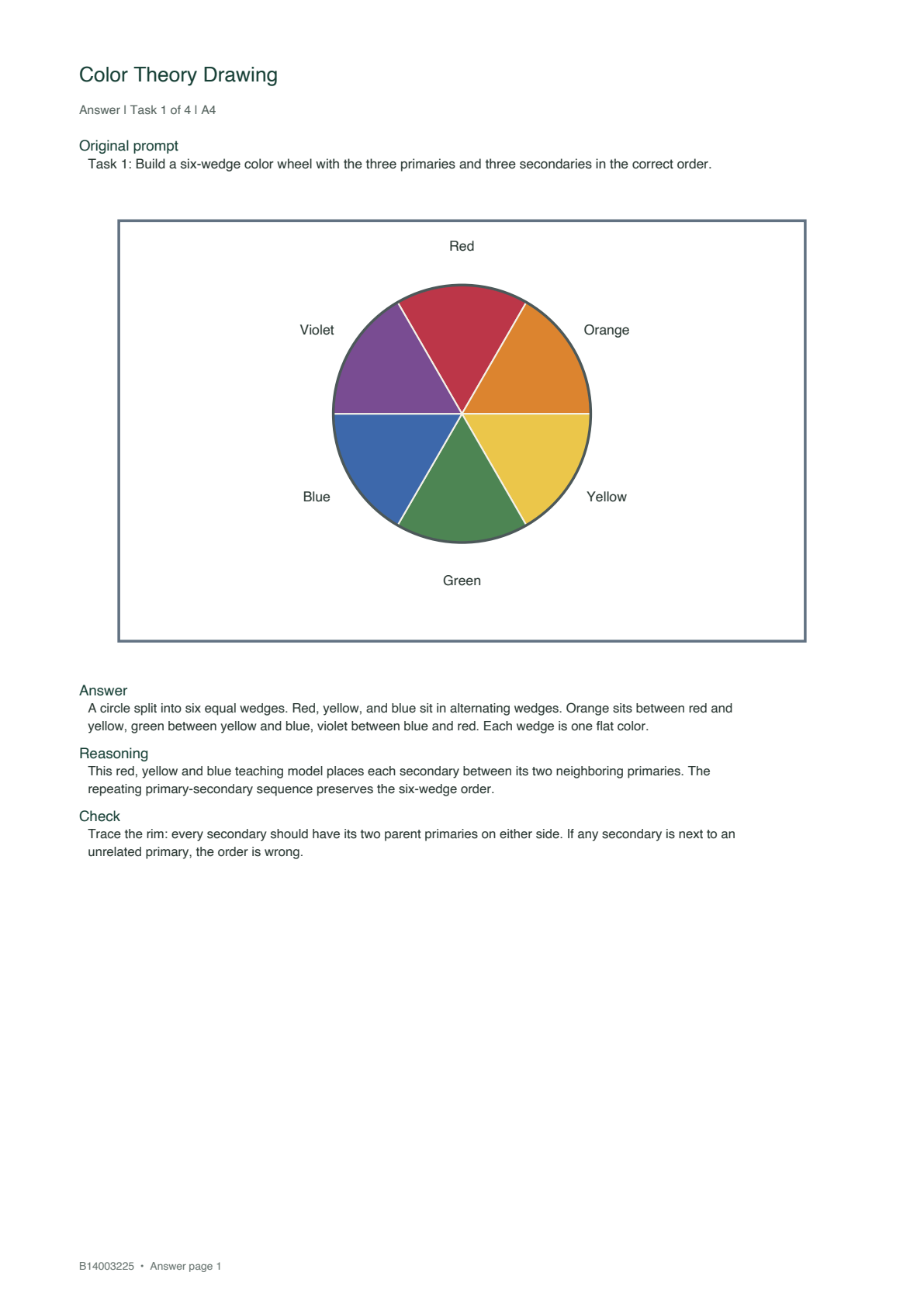
Use the traditional red, yellow and blue teaching wheel for this lesson. Split the circle into six equal wedges. Put red, yellow and blue in alternating positions. Put orange between red and yellow, green between yellow and blue, and violet between blue and red. Fill each wedge with a flat color.
Building the value swatch strip
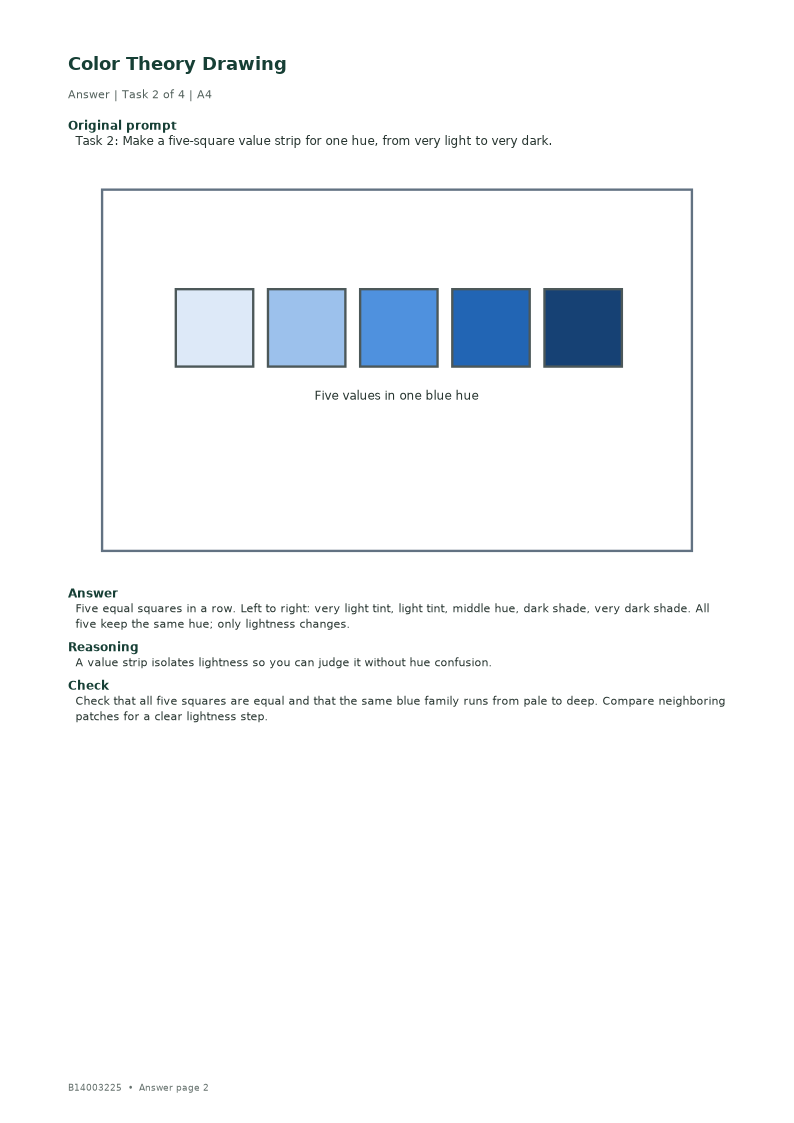
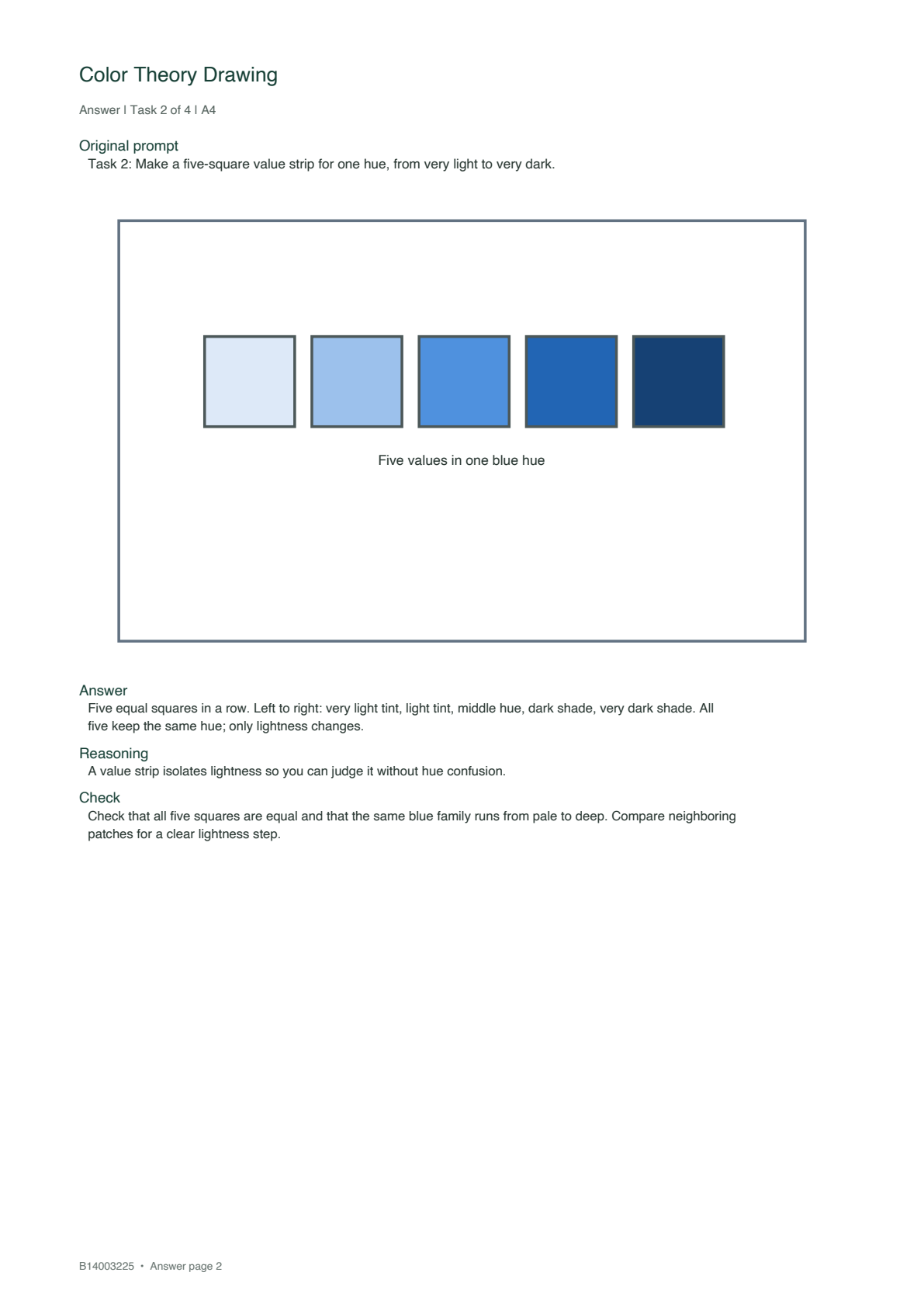
Draw a row of five equal squares. Fill them from lightest to darkest using one hue: a very light tint, a light tint, the middle hue, a dark shade, and a very dark shade. The strip shows how one color changes in lightness without changing its hue.
Applying the wheel and strip to a drawing
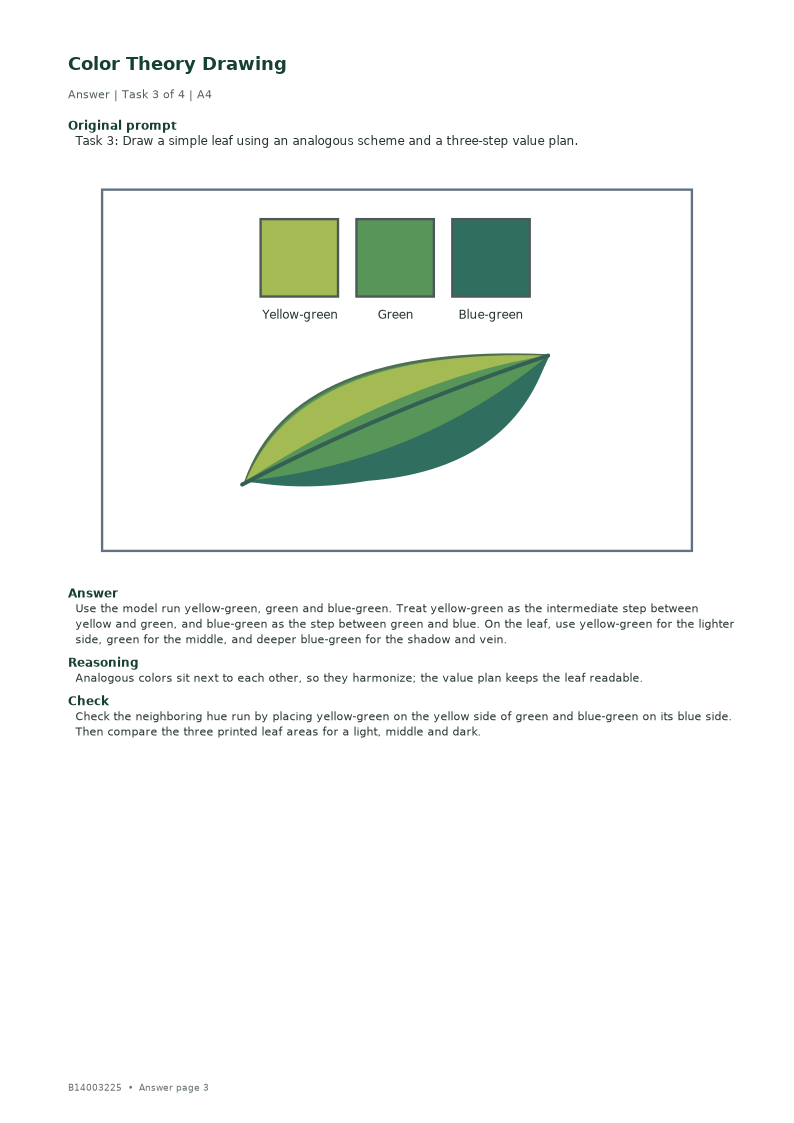
Use opposite wedges for a complementary pair and alternating wedges for a triad. For the green-family example, imagine an in-between step between yellow and green and another between green and blue. The neighboring run for the leaf is yellow-green, green, then blue-green. Compare lightness using your strip before applying the hues.
Download the complete resource pack
All individual SVG pages (18)
- A4 reference page 1
- A4 student page 1
- A4 student page 2
- A4 student page 3
- A4 student page 4
- A4 answer page 1
- A4 answer page 2
- A4 answer page 3
- A4 answer page 4
- LETTER reference page 1
- LETTER student page 1
- LETTER student page 2
- LETTER student page 3
- LETTER student page 4
- LETTER answer page 1
- LETTER answer page 2
- LETTER answer page 3
- LETTER answer page 4
Print at 100% / actual size. Use the stated scale on any schematic diagram; physical cutting templates are identified separately. A4 and US Letter are separate files. Free access, no signup; CC BY 4.0.
How to use these pages
- What a color-theory drawing plate contains
- Building the color wheel
- Building the value swatch strip
- Applying the wheel and strip to a drawing
Worked example
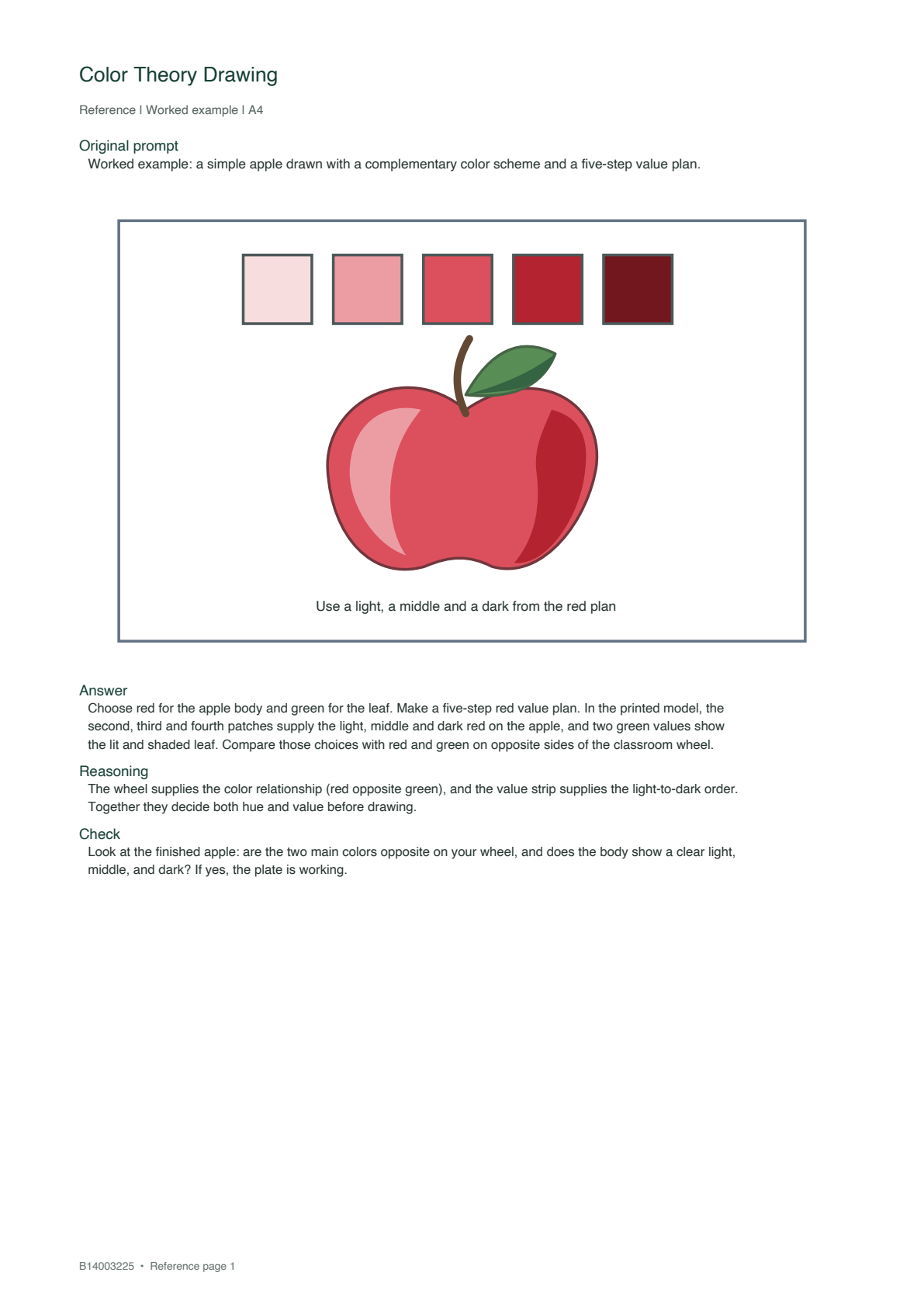
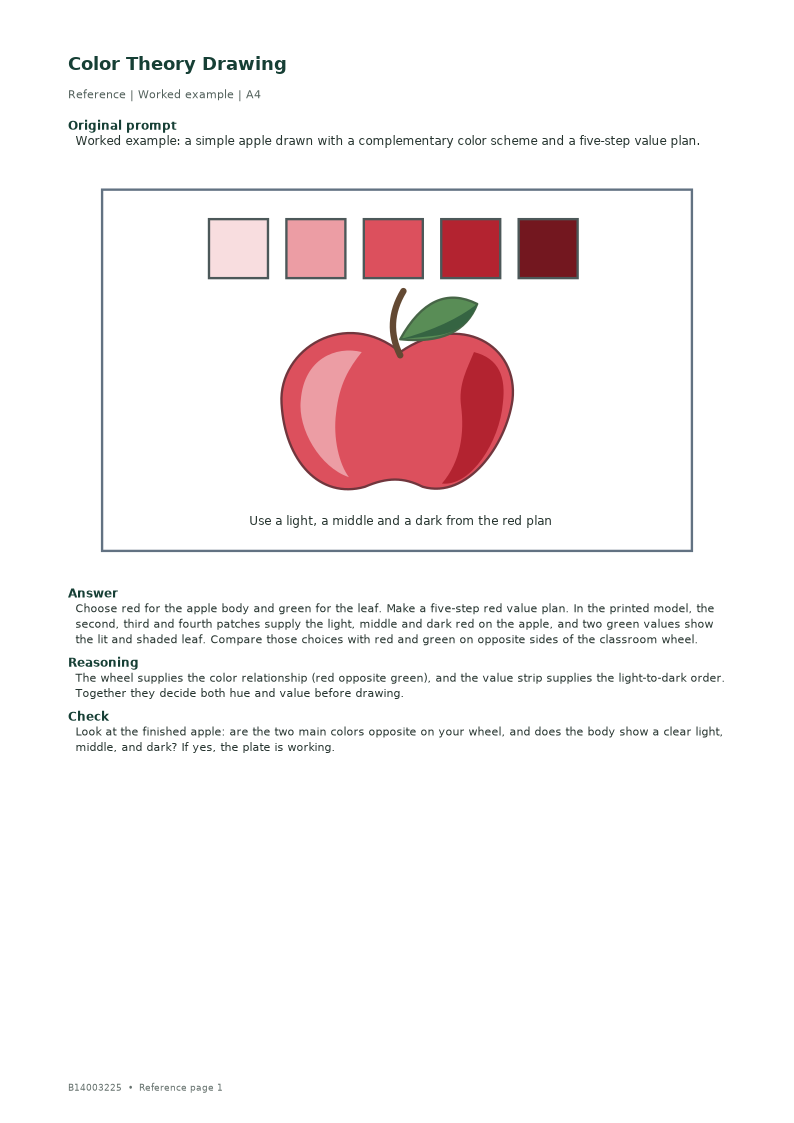
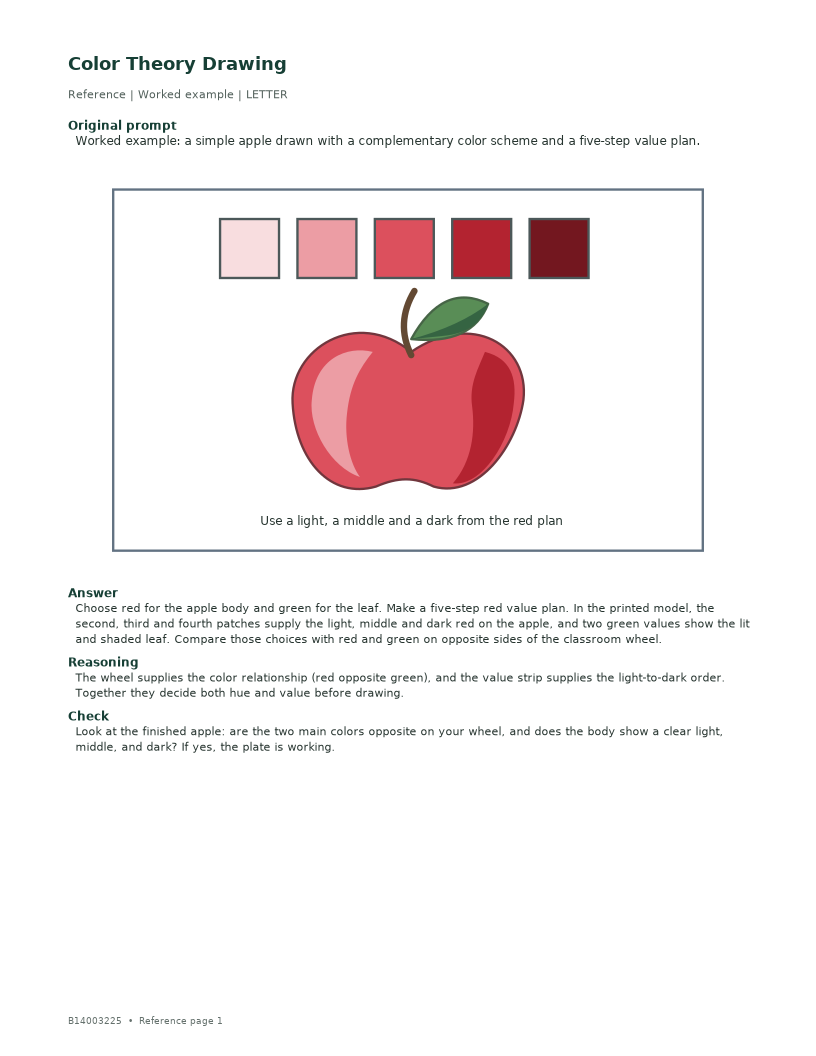
Example: Worked example: a simple apple drawn with a complementary color scheme and a five-step value plan.
Answer: Choose red for the apple body and green for the leaf. Make a five-step red value plan. In the printed model, the second, third and fourth patches supply the light, middle and dark red on the apple, and two green values show the lit and shaded leaf. Compare those choices with red and green on opposite sides of the classroom wheel.
Reasoning: The wheel supplies the color relationship (red opposite green), and the value strip supplies the light-to-dark order. Together they decide both hue and value before drawing.
Check: Look at the finished apple: are the two main colors opposite on your wheel, and does the body show a clear light, middle, and dark? If yes, the plate is working.
Four practice tasks and complete answers
Task 1
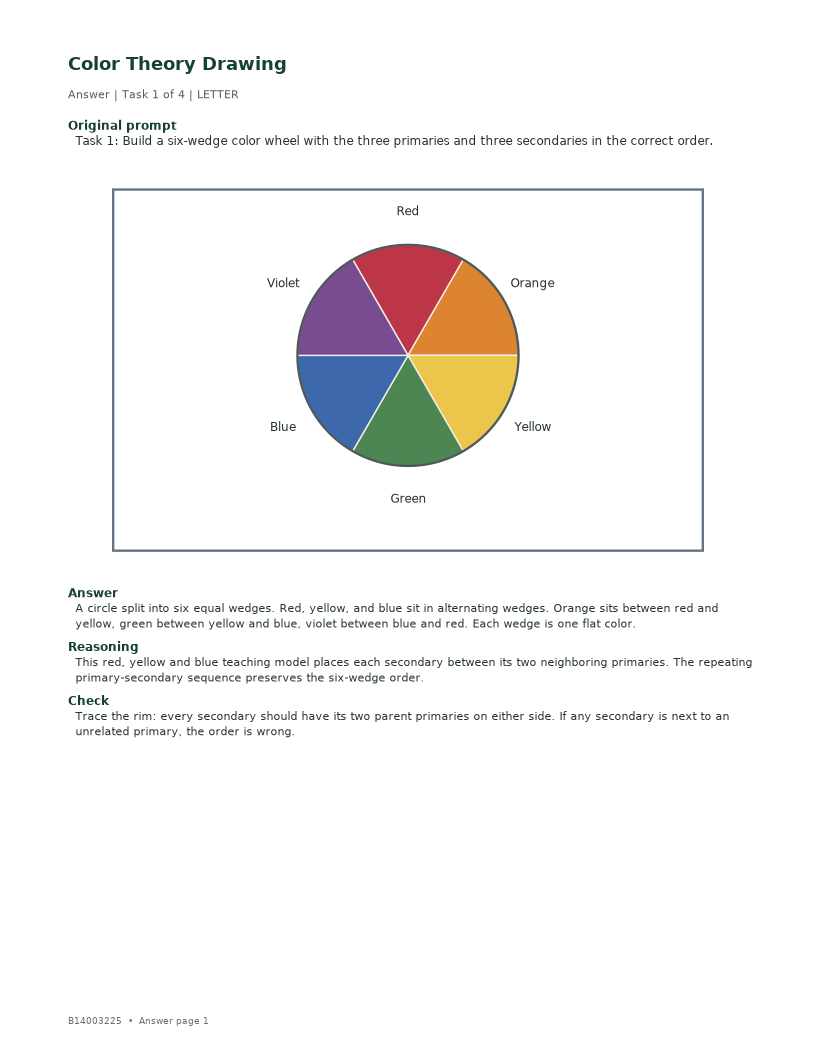
Task 1: Build a six-wedge color wheel with the three primaries and three secondaries in the correct order.
Show answer 1
A circle split into six equal wedges. Red, yellow, and blue sit in alternating wedges. Orange sits between red and yellow, green between yellow and blue, violet between blue and red. Each wedge is one flat color.
This red, yellow and blue teaching model places each secondary between its two neighboring primaries. The repeating primary-secondary sequence preserves the six-wedge order.
Check: Trace the rim: every secondary should have its two parent primaries on either side. If any secondary is next to an unrelated primary, the order is wrong.
Task 2
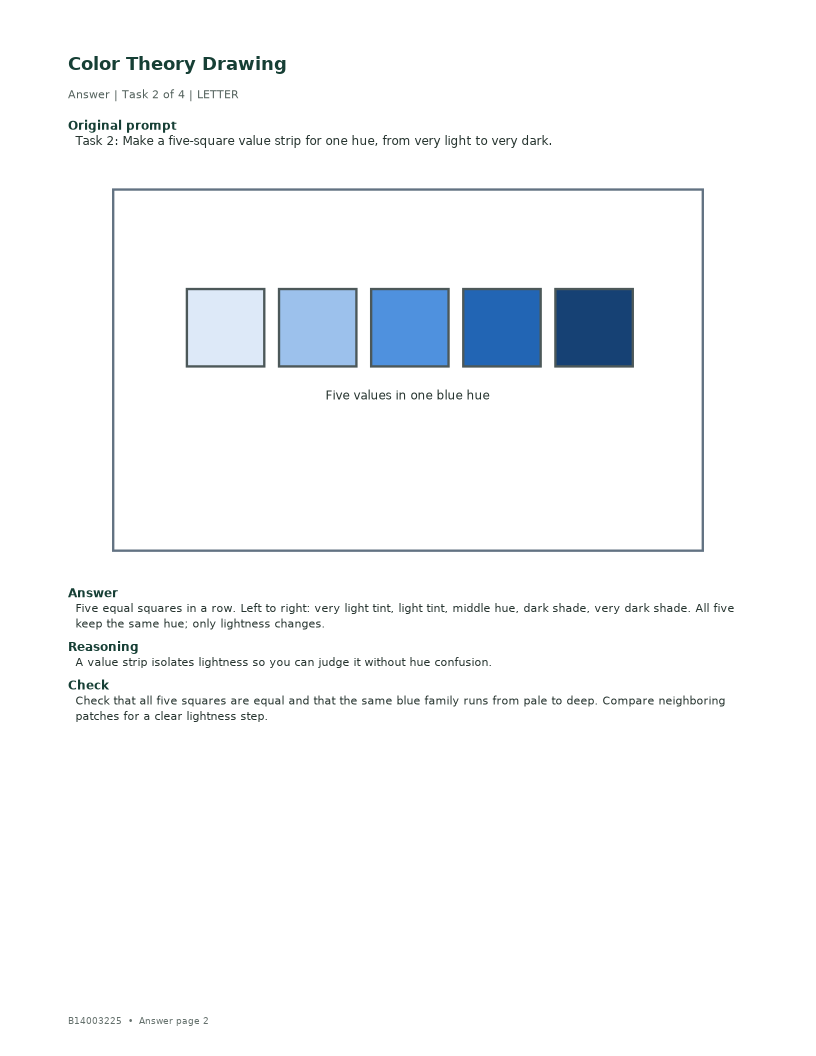
Task 2: Make a five-square value strip for one hue, from very light to very dark.
Show answer 2
Five equal squares in a row. Left to right: very light tint, light tint, middle hue, dark shade, very dark shade. All five keep the same hue; only lightness changes.
A value strip isolates lightness so you can judge it without hue confusion.
Check: Check that all five squares are equal and that the same blue family runs from pale to deep. Compare neighboring patches for a clear lightness step.
Task 3
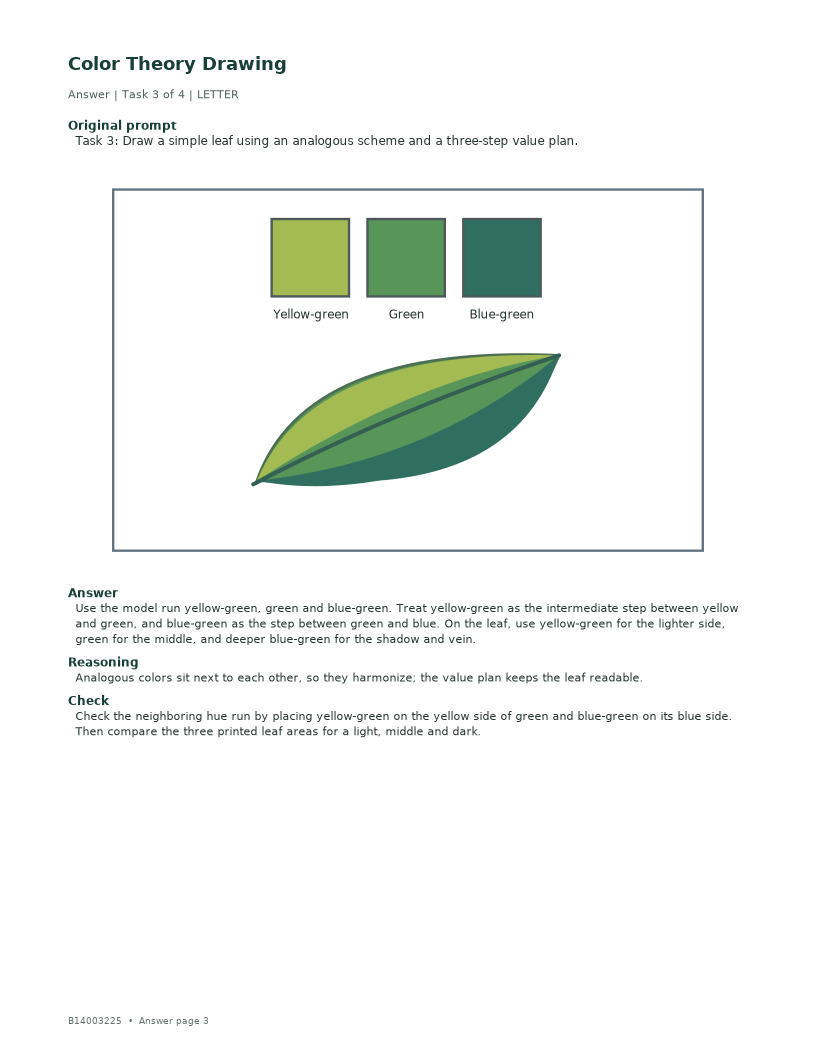
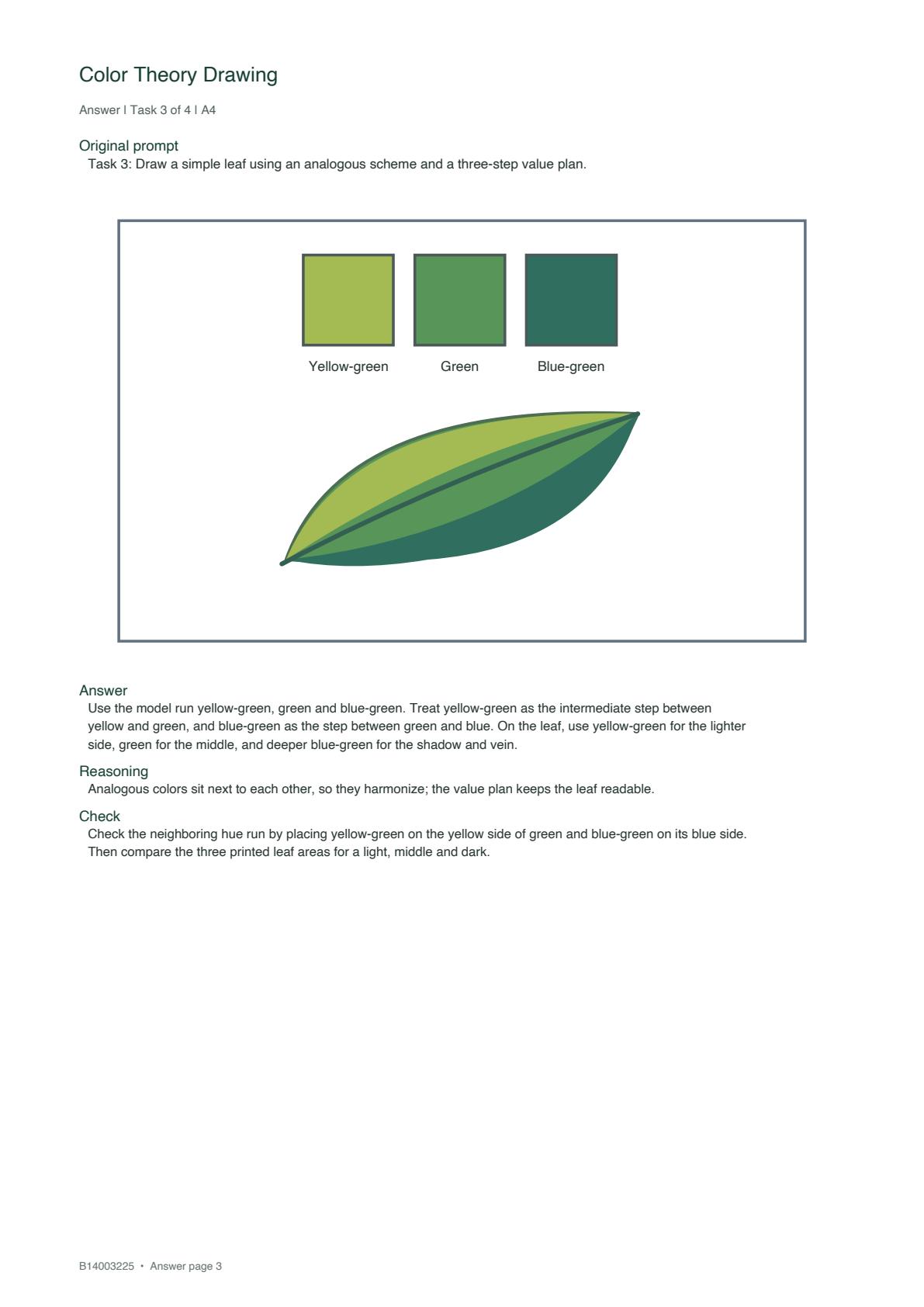
Task 3: Draw a simple leaf using an analogous scheme and a three-step value plan.
Show answer 3
Use the model run yellow-green, green and blue-green. Treat yellow-green as the intermediate step between yellow and green, and blue-green as the step between green and blue. On the leaf, use yellow-green for the lighter side, green for the middle, and deeper blue-green for the shadow and vein.
Analogous colors sit next to each other, so they harmonize; the value plan keeps the leaf readable.
Check: Check the neighboring hue run by placing yellow-green on the yellow side of green and blue-green on its blue side. Then compare the three printed leaf areas for a light, middle and dark.
Task 4
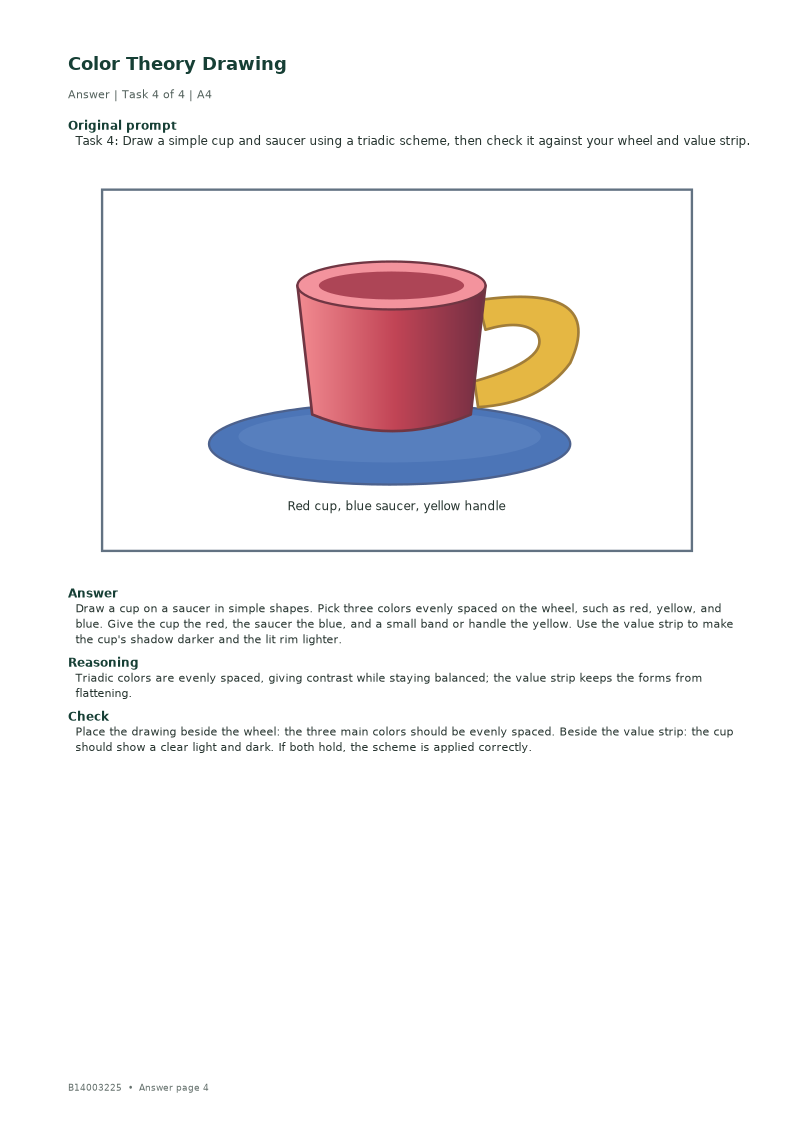
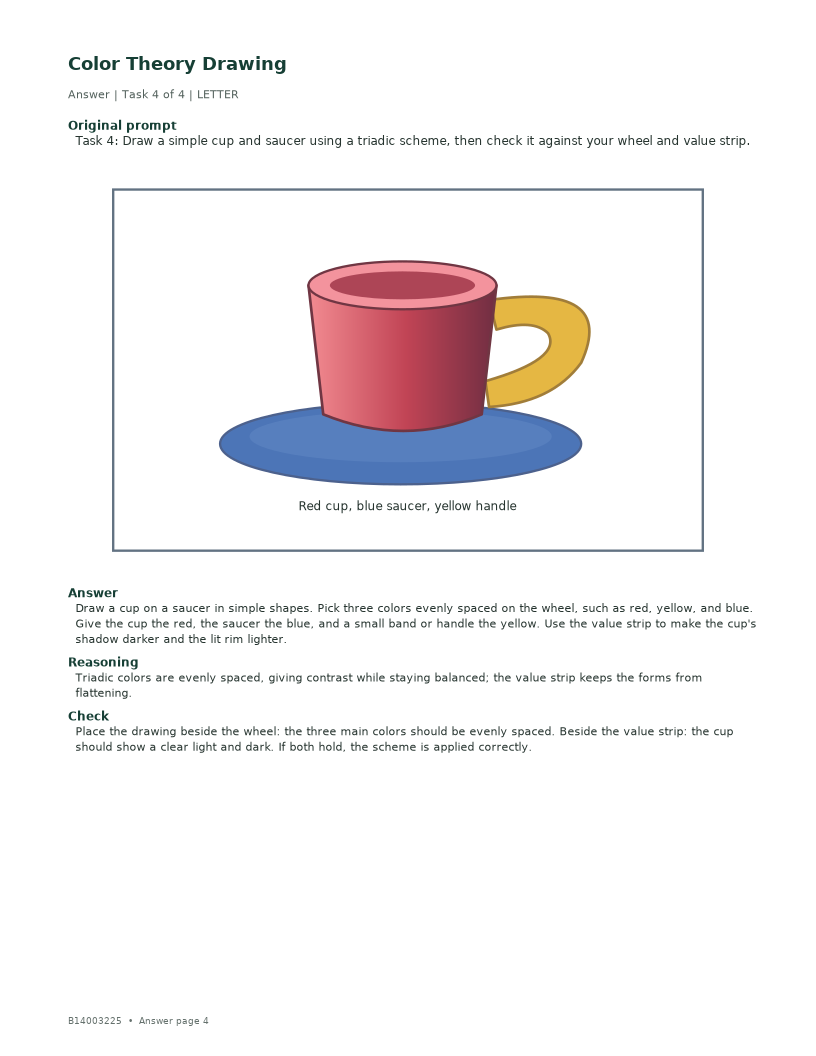
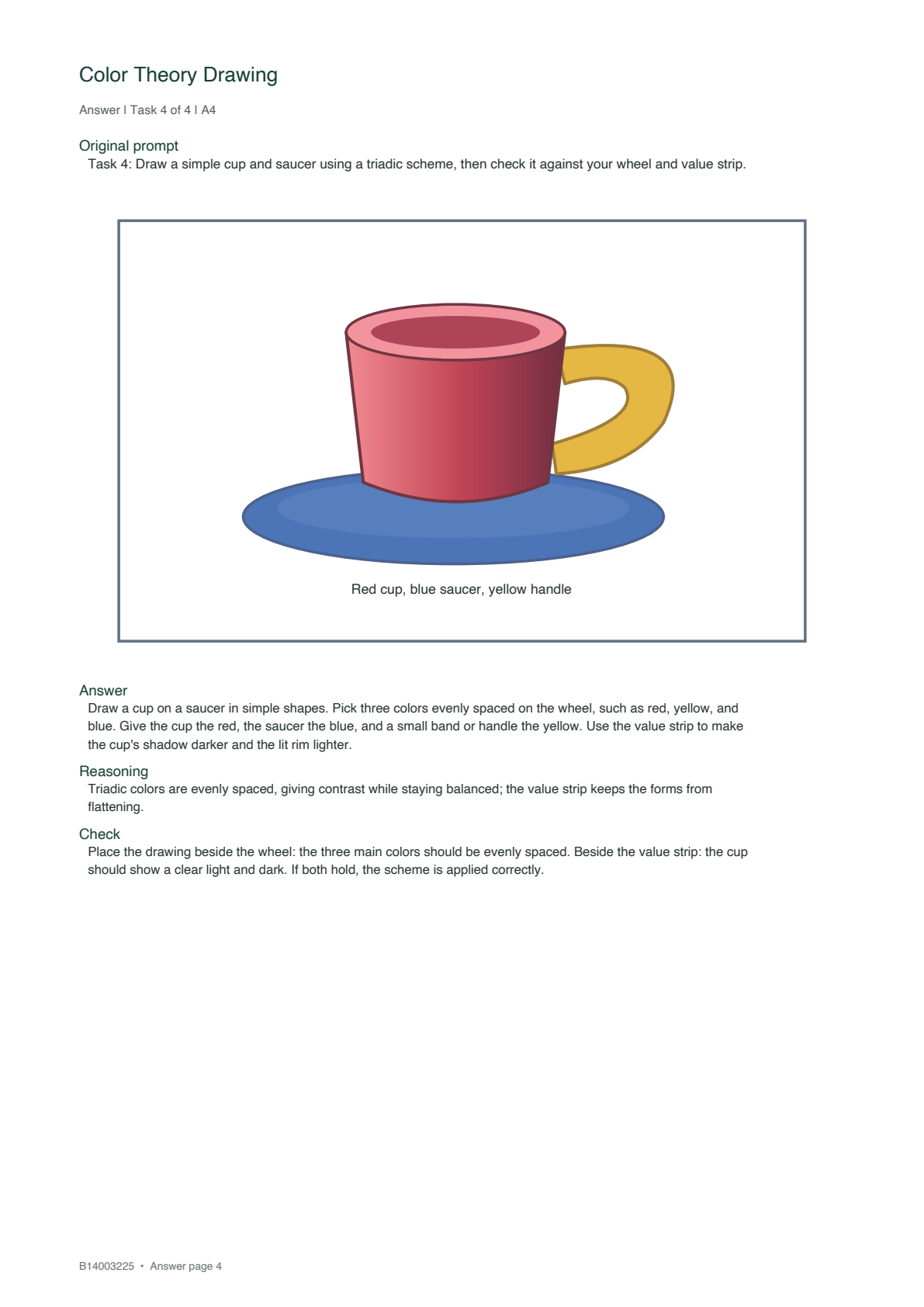
Task 4: Draw a simple cup and saucer using a triadic scheme, then check it against your wheel and value strip.
Show answer 4
Draw a cup on a saucer in simple shapes. Pick three colors evenly spaced on the wheel, such as red, yellow, and blue. Give the cup the red, the saucer the blue, and a small band or handle the yellow. Use the value strip to make the cup's shadow darker and the lit rim lighter.
Triadic colors are evenly spaced, giving contrast while staying balanced; the value strip keeps the forms from flattening.
Check: Place the drawing beside the wheel: the three main colors should be evenly spaced. Beside the value strip: the cup should show a clear light and dark. If both hold, the scheme is applied correctly.
Useful checks
- Putting a secondary next to an unrelated primary on the wheel. Check the six wedges. Each secondary sits between the primary pair listed for this teaching wheel.
- Changing hue partway along the value strip. Keep one hue and change only lightness from square to square.
- Choosing colors that look nice but ignoring value, so the drawing flattens. Plan light, middle, and dark areas with the value strip before blocking in color.
Questions about this resource
Do I need exact paint mixes?
No. This pack teaches color relationships and value order; any medium that lets you show distinct colors and light-to-dark steps works.
How many colors should a drawing use?
Use the scheme you chose: two for complementary, three neighbors for analogous, three evenly spaced for triadic. Keep it simple so the relationships stay clear.