Free original lessons
Contour Line Drawing of a TV: A Focused Outline Study
Learn to draw a TV in contour line by tracing its outline, bezel, stand, and buttons. Includes blind-contour and slow-contour practice with clear checks.
Free lesson
Four exercises
Worked answers
Object Drawing Lessons
Contour drawing captures an object's edges without shading or screen content. This lesson isolates the TV outline: the outer silhouette, the screen bezel, the stand, and any button edges. You will use two conventions: blind contour (eyes on the object, pencil moving without looking at the paper) and slow contour (looking mostly at the object, checking the paper only to place the next edge). The goal is accurate edge relationships, not a polished illustration. All measurements are hypothetical examples; measure your own TV and label any numbers you choose.
Practice materials: Printable downloads are not available for this lesson yet. Use the instructions and four exercises below.
Reference illustration
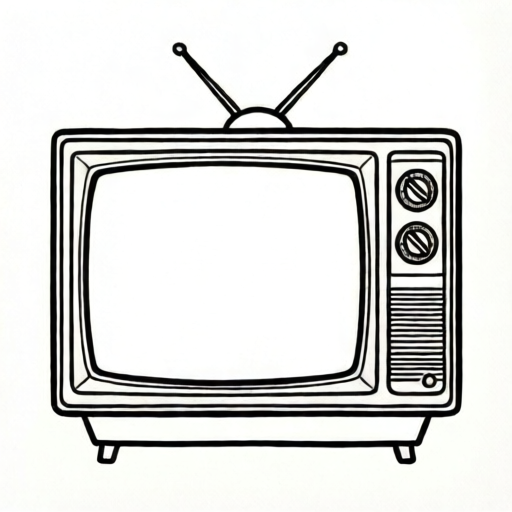
Use the stated measurements and conventions for each exercise.
Define the contour boundary
A contour line marks a change in direction or a visible edge. For a TV, the outer silhouette is the first contour: the top edge, side edges, bottom edge, and the stand's contact with the floor. The screen bezel is a second contour inside the silhouette. Button edges are short internal contours. Exclude screen content, perspective construction lines, and shading.
Work on plain paper with a pencil. Choose one viewing position and keep it fixed. If the TV is angled, draw the edges as they appear from that position, but do not build a perspective grid. The contour is a single-line study: avoid double lines unless an edge genuinely has thickness you choose to show.
- Place the TV so its full silhouette is visible and the stand is not hidden.
- Measure the overall width and height with a ruler; write these as hypothetical example values, such as 60 cm wide and 40 cm tall.
- Mark four light boundary points on the paper for the silhouette corners.
- Draw the outer silhouette as one continuous line, moving slowly along each edge.
Blind-contour box
Blind contour trains hand-eye coordination by removing visual feedback. Cover or ignore the paper while your pencil traces the TV's edges. Start at the top-left corner of the silhouette, move along the top edge, down the right side, across the bottom, and up the left side. Then trace the bezel without lifting the pencil if possible.
The drawing may look distorted; that is expected. The check is whether your pencil changed direction at the same moments your eye moved along the object. Keep the blind-contour box small, about the size of your hand, so the exercise stays manageable.
- Draw a rectangle on the paper and label it blind-contour box.
- Fix your eyes on the TV's top-left silhouette corner.
- Move the pencil slowly along the top edge while your eyes follow the same edge.
- Continue around the silhouette and then the bezel without looking at the paper.
- Stop after one full circuit; do not correct the line.
Slow-contour box
Slow contour allows brief glances at the paper to place the next edge. The pace is deliberate: move the pencil at the same speed your eye travels. Trace the screen bezel first, then the stand, then any button edges. Keep the line single and continuous where possible.
Use a simple convention for button edges: draw a short line segment for each visible button boundary, and do not invent buttons that are not visible from your position. If a button is a circle, draw one closed contour; if it is a rectangle, draw four connected segments. Label any chosen numerical values as hypothetical examples, such as a 2 cm button spacing.
- Draw a second rectangle and label it slow-contour box.
- Trace the bezel as one closed contour, checking the paper only between edges.
- Trace the stand's outer edges and its contact line with the floor.
- Add short contour segments for visible buttons.
- Compare the bezel's proportions to the silhouette using a ruler.
Check edge relationships
A contour study is checkable by edge relationships, not by realism. Measure the drawn silhouette's width and height and compare their ratio to the TV's measured ratio. For example, if the TV is 60 cm wide and 40 cm tall, the ratio is 1.5 to 1; the drawing should show a similar ratio within your chosen tolerance. Label this as a hypothetical example.
Check that the bezel sits inside the silhouette with consistent margins on left and right. Check that the stand's contact line is horizontal if the TV sits on a level floor. Check that button contours do not cross the bezel edge. These checks allow valid alternative line styles, such as slightly curved versus straight edges, as long as the relationships hold.
- Measure the drawn silhouette width and height; record the ratio.
- Compare to the measured TV ratio; note any difference.
- Check left and right bezel margins are visually equal.
- Check the stand contact line is level.
- Check button contours stay within the bezel area.
Worked example
A TV measures 60 cm wide and 40 cm tall. Draw a slow-contour silhouette and bezel, then check the width-to-height ratio. Use a hypothetical tolerance of plus or minus 0.1 in the ratio.
Worked answer
The measured ratio is 60 divided by 40, which equals 1.5. The drawn silhouette measures 18 cm wide and 12 cm tall, giving 18 divided by 12, which equals 1.5. The difference is 0, within the tolerance. The bezel margins are checked as equal on left and right, and the stand contact line is level. The contour is accepted.
Four practice exercises
Exercise 1
A TV silhouette is drawn 24 cm wide and 16 cm tall. The actual TV is 72 cm wide and 48 cm tall. Calculate both width-to-height ratios and state whether they match within a hypothetical tolerance of plus or minus 0.1.
Show answer and check
Drawn ratio: 24 divided by 16 equals 1.5. Actual ratio: 72 divided by 48 equals 1.5. The difference is 0, so they match within the tolerance.
Why: Divide width by height for each pair. Compare the two ratios by subtraction. A difference of 0 is inside plus or minus 0.1.
Check: Recompute both divisions and subtract the smaller ratio from the larger. Confirm the result is less than or equal to 0.1.
Exercise 2
In a blind-contour box, a student draws the top edge, right edge, bottom edge, and left edge but lifts the pencil three times. The circuit is complete. Using the rubric, state one improvement and one valid alternative that would still be accepted.
Show answer and check
Improvement: keep the pencil down for one full circuit to meet the blind-contour condition. Valid alternative: a slightly curved top edge is acceptable if the silhouette remains closed and the edge relationships hold.
Why: The rubric requires one full circuit without lifting the pencil. Line style is not fixed, so curved versus straight edges are valid alternatives as long as the contour is closed.
Check: Compare the drawing to the rubric items: pencil-lift condition and closed silhouette. Confirm the alternative does not break edge relationships.
Exercise 3
A slow-contour drawing shows a bezel with a 3 cm left margin and a 5 cm right margin on a 30 cm wide silhouette. The TV's actual bezel margins are equal. State the mistake and a fix using only contour lines.
Show answer and check
Mistake: the bezel is not centered inside the silhouette. Fix: redraw the bezel as a closed contour with equal left and right margins, using the silhouette edges as reference points.
Why: Equal margins are an edge relationship. The contour study checks relationships, not shading. Redrawing the bezel contour corrects the relationship without adding perspective lines.
Check: Measure both margins on the drawing. Confirm they are equal within your chosen tolerance, and confirm the bezel remains inside the silhouette.
Exercise 4
A TV has three visible buttons along the bottom bezel. In a slow-contour box, describe how to draw them using the button convention, and state one check that they are correctly placed.
Show answer and check
Draw one short contour segment for each visible button boundary, spaced along the bottom bezel. Check that no button contour crosses the bezel edge and that all three sit within the bezel area.
Why: The convention uses short segments for visible button edges and omits hidden buttons. Placement is checked by containment within the bezel contour.
Check: Trace each button segment and confirm it stays inside the bezel. Count the segments and compare to the number of visible buttons.
Common mistakes
- Drawing screen content or shading instead of contour edges. Limit the line to visible edges: silhouette, bezel, stand, and buttons. Leave the screen area empty.
- Lifting the pencil repeatedly during blind contour. Keep the pencil down for one full circuit; accept distortions rather than correcting.
- Inventing buttons or ports not visible from the chosen position. Draw only edges you can see; if a button is hidden, omit it.
- Using perspective construction lines to build the TV. Draw edges as they appear from one fixed position without a grid or vanishing points.
Self-check rubric
- Silhouette is drawn as a single continuous contour with no shading.
- Bezel is a closed contour inside the silhouette with consistent left and right margins.
- Stand edges and floor contact line are included and level.
- Visible button edges are drawn as short contour segments without inventing hidden buttons.
- Width-to-height ratio of the drawn silhouette is within the chosen tolerance of the measured TV ratio.
- Blind-contour box shows one full circuit without lifting the pencil or looking at the paper.
- Valid alternatives are accepted: curved or straight edges, different line weights, and omitted hidden features.
Questions and answers
Can I use a ruler for the contour lines?
Use a ruler only to measure proportions for checking. Draw the contour freehand so the line records your eye movement.
What if my TV is curved or has a different stand?
Trace the actual visible edges. The convention is edge-following, not a fixed TV shape; valid alternatives include curved bezels and different stand profiles.
How long should each contour box take?
Aim for slow, deliberate movement. A blind-contour circuit might take two to three minutes; a slow-contour bezel might take five minutes. These are hypothetical examples, not strict rules.
Do I need to label measurements on the drawing?
Label only the measurements you use for checking, and mark them as hypothetical examples if they are chosen rather than measured from your equipment.