Free original lessons
Draw a Beagle: Ear, Muzzle and Body Proportions
Learn a repeatable construction for a beagle drawing: oval body and head, long drooping ear, square muzzle, and proportion checks using simple units.
Free lesson
Four exercises
Worked answers
Object Drawing Lessons
This lesson teaches a construction plate for a beagle drawing, not a generic dog face. You will build the dog from an oval body and an oval head, then place the long drooping ear and the square muzzle using measured proportions. The convention is simple: one head-width is the distance from the top of the skull to the bottom of the chin, and all other lengths are described in head-widths. X-height is baseline to midline for any labels you write, and letter styles vary, so handwriting is judged for legibility, not a single style. Measure your own paper and pencil; any numerical values below are hypothetical examples, not standards. Work lightly at first, check proportions before adding detail, and keep the ear and muzzle as the defining features.
Practice materials: Printable downloads are not available for this lesson yet. Use the instructions and four exercises below.
Reference illustration
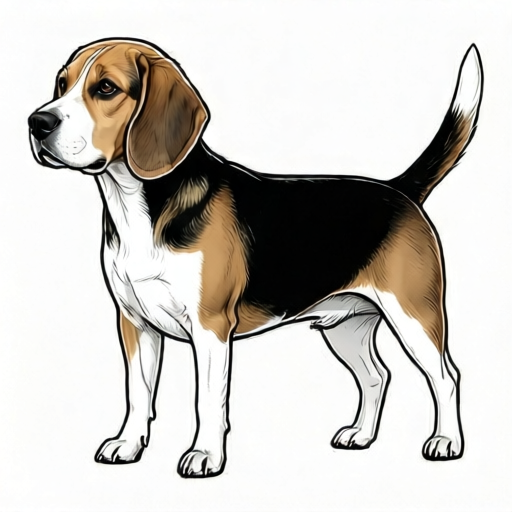
Use the stated measurements and conventions for each exercise.
Set the body and head ovals
Begin with a light oval for the body, wider than it is tall. A useful hypothetical example is a body oval about two head-widths long and one head-width tall. Place the head oval so it overlaps the front of the body slightly; the head is roughly one head-width tall and slightly narrower than the body height.
Keep the head oval upright, not tilted, so the muzzle and ear can be measured consistently. Mark the midline of the head oval vertically and the eye line horizontally at about the middle. These guide lines are construction aids, not final features.
- Draw a light body oval about two head-widths long and one head-width tall.
- Draw a head oval overlapping the front of the body by about one quarter of the head width.
- Mark a vertical midline and a horizontal eye line on the head oval.
- Check that the head oval is about one head-width tall before continuing.
Place the square muzzle
The beagle muzzle is blocky, not pointed. Draw a short rectangle or rounded square at the lower front of the head oval, centered on the midline. A hypothetical example is a muzzle about half a head-width wide and one third of a head-width long.
The top of the muzzle should sit near the eye line, and the nose sits at the front edge. Keep the muzzle level with the eye line so the face reads as a beagle rather than a generic dog.
- Draw a rounded square muzzle centered on the midline at the lower front of the head.
- Make the muzzle about half a head-width wide and one third of a head-width long.
- Place the nose at the front edge of the muzzle, level with the eye line.
- Check that the muzzle is wider than it is long.
Add the long drooping ear
The ear is the strongest beagle cue. Start at the top side of the head oval, just behind the eye line, and draw a long ear that hangs down past the bottom of the head oval. A hypothetical example is an ear length of about one and a quarter head-widths.
The ear should be broad at the top and taper slightly toward a rounded tip. Let it overlap the side of the head and the front of the body. Draw the near ear fully and the far ear as a smaller shape behind the head.
- Start the near ear at the top side of the head, behind the eye line.
- Draw a long ear hanging past the bottom of the head oval by about one quarter head-width.
- Broaden the top of the ear and round the tip.
- Add the far ear as a smaller shape behind the head oval.
Check proportions and finish
Before adding detail, compare the ear length, muzzle width, and body length to the head-width unit. The ear should be the longest single feature on the head, the muzzle should be short and square, and the body should be about twice as long as the head is tall.
Add eyes on the eye line, a slight stop between the eyes, and a tail at the back of the body. Keep lines light until the proportions pass the check, then darken the final outline.
- Measure the ear length against the head-width unit.
- Measure the muzzle width against half a head-width.
- Measure the body length against two head-widths.
- Add eyes, stop, and tail, then darken the final outline.
Worked example
A learner draws a head oval 4 cm tall. Using the hypothetical proportions in this lesson, state the body length, body height, muzzle width, muzzle length, and ear length in centimeters.
Worked answer
Head-width unit = 4 cm. Body length = 2 head-widths = 8 cm. Body height = 1 head-width = 4 cm. Muzzle width = 0.5 head-width = 2 cm. Muzzle length = 1/3 head-width ≈ 1.3 cm. Ear length = 1.25 head-widths = 5 cm.
Why: Each proportion is expressed as a multiple of the head-width unit, so multiply 4 cm by each multiplier. The muzzle length is one third of 4 cm, which is about 1.3 cm.
Check: Add the multipliers: body length 2, body height 1, muzzle width 0.5, muzzle length 0.33, ear length 1.25. Multiply each by 4 cm and confirm the results match the stated values.
Four practice exercises
Exercise 1
A learner draws a head oval 6 cm tall. Using the hypothetical proportions, calculate the body length, body height, muzzle width, and ear length in centimeters.
Show answer and check
Body length = 12 cm; body height = 6 cm; muzzle width = 3 cm; ear length = 7.5 cm.
Why: Head-width unit = 6 cm. Body length is 2 units = 12 cm. Body height is 1 unit = 6 cm. Muzzle width is 0.5 unit = 3 cm. Ear length is 1.25 units = 7.5 cm.
Check: Divide each result by 6 cm: 12/6 = 2, 6/6 = 1, 3/6 = 0.5, 7.5/6 = 1.25. The multipliers match the lesson proportions.
Exercise 2
A learner draws a body oval 10 cm long. Using the hypothetical proportions, calculate the head-width unit, head height, muzzle length, and ear length in centimeters.
Show answer and check
Head-width unit = 5 cm; head height = 5 cm; muzzle length ≈ 1.7 cm; ear length = 6.25 cm.
Why: Body length is 2 head-widths, so the unit is 10 cm ÷ 2 = 5 cm. Head height is 1 unit = 5 cm. Muzzle length is 1/3 unit ≈ 1.7 cm. Ear length is 1.25 units = 6.25 cm.
Check: Multiply the unit 5 cm by each multiplier: 2 × 5 = 10 cm body length, 1 × 5 = 5 cm head height, 0.33 × 5 ≈ 1.7 cm muzzle length, 1.25 × 5 = 6.25 cm ear length.
Exercise 3
A learner draws an ear 8 cm long. Using the hypothetical proportions, calculate the head-width unit, head height, body length, and muzzle width in centimeters.
Show answer and check
Head-width unit = 6.4 cm; head height = 6.4 cm; body length = 12.8 cm; muzzle width = 3.2 cm.
Why: Ear length is 1.25 head-widths, so the unit is 8 cm ÷ 1.25 = 6.4 cm. Head height is 1 unit = 6.4 cm. Body length is 2 units = 12.8 cm. Muzzle width is 0.5 unit = 3.2 cm.
Check: Multiply the unit 6.4 cm by each multiplier: 1.25 × 6.4 = 8 cm ear length, 1 × 6.4 = 6.4 cm head height, 2 × 6.4 = 12.8 cm body length, 0.5 × 6.4 = 3.2 cm muzzle width.
Exercise 4
A learner draws a muzzle 2 cm wide. Using the hypothetical proportions, calculate the head-width unit, head height, ear length, and body length in centimeters.
Show answer and check
Head-width unit = 4 cm; head height = 4 cm; ear length = 5 cm; body length = 8 cm.
Why: Muzzle width is 0.5 head-widths, so the unit is 2 cm ÷ 0.5 = 4 cm. Head height is 1 unit = 4 cm. Ear length is 1.25 units = 5 cm. Body length is 2 units = 8 cm.
Check: Multiply the unit 4 cm by each multiplier: 0.5 × 4 = 2 cm muzzle width, 1 × 4 = 4 cm head height, 1.25 × 4 = 5 cm ear length, 2 × 4 = 8 cm body length.
Common mistakes
- Drawing a pointed or long muzzle. Redraw the muzzle as a rounded square about half a head-width wide and one third of a head-width long.
- Making the ear too short or sticking out sideways. Start the ear behind the eye line and hang it past the bottom of the head oval by about one quarter head-width.
- Making the body too round or too short. Stretch the body oval to about two head-widths long and one head-width tall.
- Tilting the head oval so the muzzle and ear no longer align. Keep the head oval upright and re-mark the vertical midline and horizontal eye line.
Self-check rubric
- Body oval is about two head-widths long and one head-width tall.
- Head oval is about one head-width tall and overlaps the front of the body.
- Muzzle is a rounded square about half a head-width wide and one third of a head-width long.
- Near ear starts behind the eye line and hangs past the bottom of the head oval by about one quarter head-width.
- Far ear is drawn smaller behind the head oval.
- Eye line and midline are used consistently.
- Labels are legible at x-height baseline to midline; letter style may vary.
- Final outline is darkened only after proportion checks pass.
Questions and answers
How long should the beagle ear be?
Use the head-width unit. A hypothetical example is an ear about one and a quarter head-widths long, hanging past the bottom of the head oval.
Why is the muzzle drawn as a square?
A beagle muzzle is blocky. A rounded square about half a head-width wide and one third of a head-width long keeps it short and square.
Can I use different letter styles on the plate?
Yes. X-height is baseline to midline, and letter styles vary. Labels are judged for legibility, not a single handwriting style.
What if my paper is a different size?
Measure your own paper and pencil. The head-width unit scales to your paper; any numerical values here are hypothetical examples.