Free original lessons
Top-View Bird Beak Drawing: Bill Shape and Nostril Placement
Learn to draw a bird beak from above using a defined top-view convention, with bill-shape guides, nostril placement rules, and four self-contained practice tasks.
Free lesson
Four exercises
Worked answers
Object Drawing Lessons
Drawing a bird beak from above is a focused shape-and-placement exercise. You will establish a top-view convention, build the bill outline from a centerline and width guides, and place nostrils symmetrically using measured proportions. The goal is a clear, checkable top-view drawing, not species identification. All measurements are hypothetical examples; measure your own paper and tools. Work in pencil so you can adjust before committing to final lines.
Practice materials: Printable downloads are not available for this lesson yet. Use the instructions and four exercises below.
Reference illustration
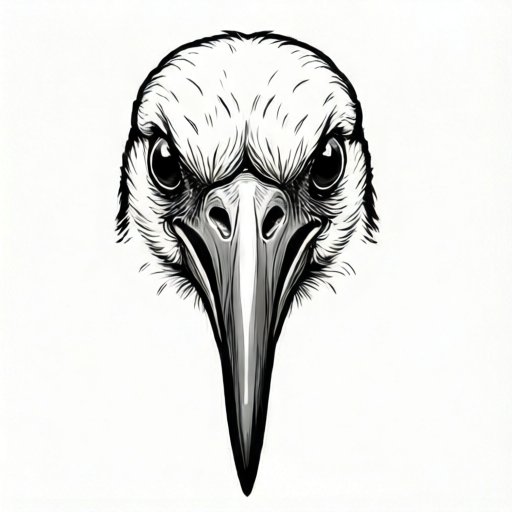
Use the stated measurements and conventions for each exercise.
Establishing the Top-View Convention
A top-view beak is drawn as if you are looking straight down at the bird's head. The bill projects forward from the face, and the two mandibles meet along a centerline. Because the upper mandible usually covers the lower from above, the visible outline is the upper bill's silhouette. Define your convention before drawing: the centerline runs vertically, the bill tip points toward the top of the page, and the base of the bill sits near the bottom. State this orientation in a corner note so the drawing is unambiguous.
Choose a scale that fits your paper. For example, a hypothetical bill length of 60 mm and a base width of 24 mm gives a length-to-width ratio of 2.5 to 1. These numbers are examples only; substitute measurements from your own reference or assigned exercise. Mark the centerline first, then measure the bill length along it and the base width across it. Keep units consistent throughout.
- Draw a vertical centerline and label the top as the bill tip direction.
- Mark the bill base point on the centerline and the bill tip point at the chosen length.
- Measure the base width across the centerline at the base point and mark both sides.
- Note your chosen length and width values beside the drawing for later checking.
Building the Bill Outline
The bill outline is built from the base width, the tip, and one or two width guides between them. A simple top-view bill can be drawn as a tapered shape: widest at the base, narrowing toward the tip. For a more controlled curve, place a midpoint guide at half the bill length and set its width to a chosen fraction of the base width. For example, a hypothetical midpoint width of 14 mm against a 24 mm base width gives a taper ratio of about 0.58. These values are illustrative; use the values given in your task.
Draw smooth side lines from the base corners through the midpoint guides to the tip. Keep the left and right sides mirror-symmetric about the centerline unless your convention explicitly allows asymmetry. Check symmetry by measuring the horizontal distance from the centerline to each side at the base, midpoint, and near the tip. Small differences are acceptable in freehand drawing, but the measured pattern should be consistent.
- Mark midpoint guides at half the bill length on both sides of the centerline.
- Set the midpoint width using your chosen taper fraction and mark both sides.
- Draw the left side line from base corner through midpoint guide to the tip.
- Draw the right side line as a mirror of the left and compare measured widths.
Placing Nostrils Symmetrically
Nostrils sit on the upper mandible, usually between the base and the midpoint of the bill. In top view they appear as two small marks placed symmetrically about the centerline. A practical placement rule is to put the nostril centers at a chosen fraction of the bill length from the base and a chosen fraction of the local half-width from the centerline. For example, a hypothetical placement at 30 percent of bill length from the base and 40 percent of the local half-width from the centerline is a clear, checkable convention. These percentages are examples, not standards.
Measure the local half-width at the nostril position using the side lines you drew. Mark the left nostril center and mirror it to the right. Keep nostril marks small and consistent in size. If your convention uses oval nostrils, orient them along the bill's long axis. Record the placement fractions beside the drawing so a checker can verify them.
- Measure the chosen fraction of bill length from the base along the centerline.
- Measure the local half-width at that position using the side lines.
- Mark the left nostril center at the chosen fraction of the local half-width.
- Mirror the right nostril center and record both placement fractions.
Checking and Finalizing the Drawing
Before finalizing, run three checks: length and width against your recorded values, symmetry of the side lines, and nostril placement against the recorded fractions. Use a ruler to measure the drawn bill length and base width and compare them with your chosen values. Measure the left and right half-widths at the base, midpoint, and nostril position. Measure the nostril distance from the base along the centerline and from the centerline to each nostril center.
If a measurement is off, adjust the guide marks rather than redrawing the whole bill. Darken the final outline only after the checks pass. Add a short note stating the convention: top view, tip direction, bill length, base width, taper fraction, and nostril placement fractions. This note makes the drawing self-documenting and allows valid alternative conventions to be checked fairly.
- Measure drawn length and base width and compare with recorded values.
- Measure left and right half-widths at base, midpoint, and nostril position.
- Measure nostril distance from base and from centerline on both sides.
- Adjust guides if needed, then darken the final outline and add the convention note.
Worked example
Draw a top-view beak with bill length 50 mm, base width 20 mm, midpoint width 12 mm, and nostril centers at 30 percent of bill length from the base and 40 percent of the local half-width from the centerline. Use millimeters throughout.
Worked answer
Centerline vertical, tip at top. Base point at 0 mm, tip at 50 mm. Base half-width 10 mm each side. Midpoint at 25 mm with half-width 6 mm each side. Side lines run from base corners through midpoint guides to the tip. Nostril position at 0.30 times 50 = 15 mm from the base. Local half-width at 15 mm is estimated from the side lines; using linear taper between base and midpoint, half-width is 10 minus (15/25) times 4 = 7.6 mm. Nostril offset is 0.40 times 7.6 = 3.04 mm each side of the centerline. Mark both nostril centers, check symmetry, and record all values.
Four practice exercises
Exercise 1
Draw a top-view beak with bill length 40 mm, base width 16 mm, and a straight taper to a point. Place nostril centers at 25 percent of bill length from the base and 50 percent of the local half-width from the centerline. Record all values.
Show answer and check
Centerline vertical, tip at top. Base half-width 8 mm each side. Straight side lines from base corners to the tip. Nostril position at 0.25 times 40 = 10 mm from base. Local half-width at 10 mm with straight taper is 8 minus (10/40) times 8 = 6 mm. Nostril offset is 0.50 times 6 = 3 mm each side. Mark both nostrils and record values.
Why: The straight taper gives a linear half-width from 8 mm at the base to 0 mm at the tip. At 10 mm from the base, the half-width is 6 mm. The nostril offset follows from the stated fraction of local half-width.
Check: Measure drawn length (40 mm), base width (16 mm), nostril distance from base (10 mm), and nostril offset from centerline (3 mm each side). Compare left and right offsets.
Exercise 2
Draw a top-view beak with bill length 60 mm, base width 24 mm, and a midpoint width of 14 mm at half the bill length. Place nostril centers at 30 percent of bill length from the base and 40 percent of the local half-width from the centerline. Record all values.
Show answer and check
Centerline vertical, tip at top. Base half-width 12 mm each side. Midpoint at 30 mm with half-width 7 mm each side. Side lines from base corners through midpoint guides to the tip. Nostril position at 0.30 times 60 = 18 mm from base. Local half-width at 18 mm using linear taper between base and midpoint is 12 minus (18/30) times 5 = 9 mm. Nostril offset is 0.40 times 9 = 3.6 mm each side. Mark both nostrils and record values.
Why: The taper between base and midpoint is linear: half-width drops from 12 mm to 7 mm over 30 mm. At 18 mm from the base, the half-width is 9 mm. The nostril offset uses the stated fraction of that local half-width.
Check: Measure drawn length (60 mm), base width (24 mm), midpoint width (14 mm), nostril distance from base (18 mm), and nostril offset (3.6 mm each side). Compare left and right offsets.
Exercise 3
Draw a top-view beak with bill length 45 mm, base width 18 mm, and a midpoint width of 10 mm at half the bill length. Place nostril centers at 20 percent of bill length from the base and 45 percent of the local half-width from the centerline. Record all values.
Show answer and check
Centerline vertical, tip at top. Base half-width 9 mm each side. Midpoint at 22.5 mm with half-width 5 mm each side. Side lines from base corners through midpoint guides to the tip. Nostril position at 0.20 times 45 = 9 mm from base. Local half-width at 9 mm using linear taper between base and midpoint is 9 minus (9/22.5) times 4 = 7.4 mm. Nostril offset is 0.45 times 7.4 = 3.33 mm each side. Mark both nostrils and record values.
Why: The taper between base and midpoint is linear: half-width drops from 9 mm to 5 mm over 22.5 mm. At 9 mm from the base, the half-width is 7.4 mm. The nostril offset uses the stated fraction of that local half-width.
Check: Measure drawn length (45 mm), base width (18 mm), midpoint width (10 mm), nostril distance from base (9 mm), and nostril offset (3.33 mm each side). Compare left and right offsets.
Exercise 4
Draw a top-view beak with bill length 55 mm, base width 22 mm, and a midpoint width of 13 mm at half the bill length. Place nostril centers at 35 percent of bill length from the base and 35 percent of the local half-width from the centerline. Record all values.
Show answer and check
Centerline vertical, tip at top. Base half-width 11 mm each side. Midpoint at 27.5 mm with half-width 6.5 mm each side. Side lines from base corners through midpoint guides to the tip. Nostril position at 0.35 times 55 = 19.25 mm from base. Local half-width at 19.25 mm using linear taper between base and midpoint is 11 minus (19.25/27.5) times 4.5 = 7.85 mm. Nostril offset is 0.35 times 7.85 = 2.7475 mm each side, rounded to 2.75 mm. Mark both nostrils and record values.
Why: The taper between base and midpoint is linear: half-width drops from 11 mm to 6.5 mm over 27.5 mm. At 19.25 mm from the base, the half-width is 7.85 mm. The nostril offset uses the stated fraction of that local half-width.
Check: Measure drawn length (55 mm), base width (22 mm), midpoint width (13 mm), nostril distance from base (19.25 mm), and nostril offset (2.75 mm each side). Compare left and right offsets.
Common mistakes
- Drawing the bill as a side view or three-quarter view instead of a true top view. State the top-view convention first, keep the centerline vertical, and check that both side lines are visible as mirror outlines.
- Placing nostrils by eye without measuring from the base or centerline. Use the recorded placement fractions and measure the local half-width at the nostril position before marking.
- Making the bill outline asymmetric without intending to. Measure left and right half-widths at the base, midpoint, and nostril position and adjust the guide marks.
- Mixing units or forgetting the chosen scale values. Write the bill length, base width, and all fractions beside the drawing and use one unit throughout.
Self-check rubric
- Top-view convention is stated and followed: centerline vertical, tip direction labeled.
- Bill length and base width match the recorded values within a stated tolerance.
- Side lines are smooth and mirror-symmetric within a stated tolerance at base, midpoint, and nostril position.
- Nostril centers are placed at the recorded fractions of bill length and local half-width, mirrored on both sides.
- All measurements and fractions are recorded beside the drawing with consistent units.
- Valid alternative conventions are accepted if stated, measured, and internally consistent.
Questions and answers
Do I need to identify the bird species?
No. This exercise covers top-view bill shape and nostril placement only; species identification is outside the task.
Can I use different length and width values?
Yes. The values in the examples are hypothetical. Choose your own values, record them, and keep units consistent.
How symmetric must the drawing be?
Use measured symmetry as your check. Small freehand differences are acceptable if the measured pattern is consistent and recorded.
Where should the nostrils go?
Use your chosen fractions of bill length from the base and of local half-width from the centerline, then mirror both sides.