Free original lessons
Draw a Cartoon Person Exercising While Listening to Music
Learn to draw a lively cartoon figure with headphones in an exercise pose using simple shapes, clear limb guides, and a checkable drawing rubric.
Free lesson
Four exercises
Worked answers
Object Drawing Lessons
This lesson teaches a repeatable method for drawing a cartoon person who is exercising while wearing headphones. You will build the figure from a head, torso, and jointed limbs, place the headphones clearly over the ears, and choose an exercise motion that reads instantly. The approach uses a defined convention: the head is a circle, the torso is a rounded rectangle, and limbs are two-segment lines with visible joints. Cartoon style is flexible, so proportions and line weight may vary as long as the pose and headphones remain recognizable. All measurements below are hypothetical examples for practice; measure your own paper and tools if you need exact sizes. The lesson includes a worked example, four self-contained practice tasks, a rubric, and a plan for future printable resources.
Practice materials: Printable downloads are not available for this lesson yet. Use the instructions and four exercises below.
Reference illustration
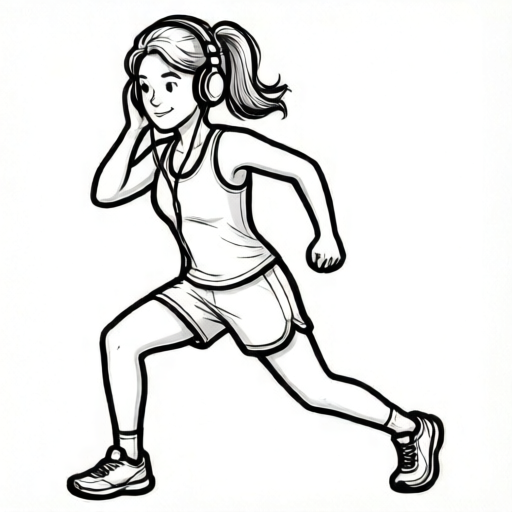
Use the stated measurements and conventions for each exercise.
Build the Figure from Simple Shapes
Start with a light construction drawing. Draw a circle for the head about 4 cm across on a typical sheet. Below it, draw a rounded rectangle for the torso about 5 cm tall and 3 cm wide, leaving a small gap for the neck. Mark a shoulder point at each top corner of the torso and a hip point at each bottom corner. These four points anchor the limbs.
Use two-segment limbs: an upper segment from shoulder to elbow, and a lower segment from elbow to hand. For legs, use hip to knee and knee to foot. Keep joint dots visible in the construction stage so you can check that elbows and knees bend in believable directions. Cartoon figures may have short or long limbs, but the joint sequence must stay clear.
- Draw the head circle and mark a vertical midline and a horizontal midline.
- Draw the torso rounded rectangle and connect it to the head with a short neck.
- Mark shoulder and hip points, then sketch two-segment arms and legs with joint dots.
- Choose an exercise motion and adjust the limb angles so the action is obvious.
- Add headphones as a band over the top of the head and two ear cups centered on the ear area.
- Erase construction lines lightly and darken the final outline.
Place the Headphones Clearly
Headphones must read as headphones, not as a hat or hair. Draw a curved band that follows the top of the head from one ear side to the other. Place each ear cup as a rounded rectangle or oval centered on the side of the head at the horizontal midline. The cups should overlap the head outline slightly so they sit on the ears rather than float beside them.
A small cable or a tiny control dot on one cup can reinforce the headphone idea, but keep it simple. Avoid covering the eyes or mouth, because the face helps show effort and rhythm. If the figure wears a ponytail or cap, draw the headphone band over or around it so the band remains visible.
- Draw the band as a smooth curve from left ear to right ear over the top of the head.
- Center each ear cup on the horizontal midline of the head.
- Overlap the cups slightly with the head outline.
- Add one simple detail such as a short cable or a small dot on one cup.
- Check that the band and cups do not hide the eyes or mouth.
Choose and Check the Exercise Motion
Pick one clear motion: jumping jack, running in place, or arm raise with a knee lift. For a jumping jack, arms angle up and out while legs angle down and out. For running in place, one knee lifts forward and the opposite arm swings forward. For an arm raise with a knee lift, both arms rise above shoulder height while one knee lifts.
Check the motion by covering the headphones with your hand. If the pose still reads as exercise, the motion is strong. Then uncover the headphones and check that they still read clearly. Both elements must survive this test. Keep the head, torso, and joint dots consistent so the figure does not look broken.
- Sketch the chosen motion with light lines.
- Cover the headphones and confirm the exercise pose is recognizable.
- Uncover the headphones and confirm the band and cups are recognizable.
- Adjust limb angles or headphone placement until both checks pass.
- Darken the final lines and add a simple ground line if needed.
Worked example
Draw a cartoon figure doing a jumping jack with headphones. Use a 4 cm head circle, a 5 cm by 3 cm torso, and two-segment limbs. Show the band over the head and cups on the ears.
Worked answer
A finished drawing shows a circle head with a curved band from ear to ear and two oval cups centered on the horizontal midline. The torso is a rounded rectangle. Both arms angle up and out from the shoulders, and both legs angle down and out from the hips. Joint dots at elbows and knees are visible in the construction stage. The pose reads as a jumping jack when the headphones are covered, and the headphones read clearly when the pose is covered.
Four practice exercises
Exercise 1
Draw a cartoon figure running in place with headphones. Use a 4 cm head circle and a 5 cm by 3 cm torso. One knee lifts forward and the opposite arm swings forward. Show the band and ear cups.
Show answer and check
A figure with a circle head, rounded rectangle torso, one knee lifted forward, opposite arm forward, and headphones with a band over the head and cups on the ears.
Why: Running in place needs one lifted knee and an opposite arm swing to read as motion. The headphones must stay centered on the ears so they do not look like a hat.
Check: Cover the headphones and confirm the running pose is clear. Uncover them and confirm the band and cups are clear. Check that elbow and knee joints bend in believable directions.
Exercise 2
Draw a cartoon figure doing an arm raise with a knee lift while wearing headphones. Both arms rise above shoulder height and one knee lifts. Use the same head and torso sizes as the worked example.
Show answer and check
A figure with both arms raised above shoulder height, one knee lifted, and headphones with a visible band and two ear cups centered on the ears.
Why: Raising both arms above shoulder height creates a strong exercise signal. A single knee lift adds motion without confusing the pose. The headphones remain the secondary focus.
Check: Cover the headphones and confirm the arm raise and knee lift are obvious. Uncover them and confirm the band crosses the top of the head and the cups sit on the ear area.
Exercise 3
Draw a cartoon figure doing a side stretch with headphones. One arm reaches overhead and the torso leans slightly to one side. Keep the head circle and torso rectangle clear.
Show answer and check
A figure leaning slightly to one side with one arm overhead, the other arm relaxed, and headphones with a band and cups on the ears.
Why: A side stretch uses a lean and an overhead arm to show exercise. The lean must not hide the headphone band, so the band is drawn over the top of the head.
Check: Check that the lean is visible and the overhead arm is above shoulder height. Confirm the band is not hidden by the arm or hair. Cover the headphones to test the stretch, then cover the stretch to test the headphones.
Exercise 4
Draw a cartoon figure marching with headphones. One knee lifts to about hip height and the opposite arm swings forward. Add a simple ground line.
Show answer and check
A figure with one knee lifted to about hip height, opposite arm forward, a ground line, and headphones with a band and cups on the ears.
Why: Marching reads clearly when one knee lifts and the opposite arm swings. A ground line anchors the figure and helps show that the lifted foot is off the ground.
Check: Confirm the lifted knee is near hip height and the opposite arm is forward. Check that the ground line touches the standing foot only. Cover the headphones to test the march, then uncover them to test the band and cups.
Common mistakes
- Drawing ear cups beside the head instead of on the ears. Center each cup on the horizontal midline and overlap it slightly with the head outline.
- Making the exercise pose ambiguous by bending joints in impossible directions. Keep elbow and knee joint dots visible during construction and check that each joint bends in a believable direction.
- Letting the headphone band disappear into the hair or hat. Draw the band as a separate curve over the top of the head and keep it visible against the hair shape.
- Using inconsistent limb lengths that make the figure look broken. Compare upper and lower segments on both sides and adjust so the figure looks balanced, even if cartoon proportions are exaggerated.
Self-check rubric
- Head is a recognizable circle or oval with a clear horizontal midline.
- Torso is a rounded rectangle connected to the head by a short neck.
- Arms and legs use two segments with visible joint dots in construction.
- Headphone band crosses the top of the head from ear side to ear side.
- Ear cups are centered on the ear area and overlap the head outline slightly.
- Exercise motion is recognizable when the headphones are covered.
- Headphones are recognizable when the exercise pose is covered.
- Final outline is clean and construction lines are lightly erased.
- Cartoon style may vary in proportions and line weight; valid alternatives are accepted if the checks above pass.
Questions and answers
Do I need to draw a realistic person?
No. The lesson uses a cartoon convention with a circle head, rounded rectangle torso, and two-segment limbs. Realistic figures are outside this task.
Can the headphones be over-ear or on-ear style?
Yes. Any clear headphone shape works if the band crosses the top of the head and the cups sit on the ear area.
How large should the drawing be?
The 4 cm head and 5 cm torso are hypothetical examples. Measure your own paper and choose sizes that fit comfortably.
What if my figure has a ponytail?
Draw the headphone band over or around the ponytail so the band remains visible. The ear cups still center on the ear area.